Add GIZMOCHINA as Preferred Source on Google
As an Amazon Associate, Gizmochina earns from qualifying purchases. Links on this page may earn us a commission at no extra cost to you.
The Vivo X500 Pro has a 6,510mAh battery, while the iPhone 18 Pro has a market-dependent 4,056mAh or 4,288mAh battery. Both phones have displays that are close in size, use 2nm chips, and launched just a couple of weeks apart, but they take very different routes when it comes to hardware.
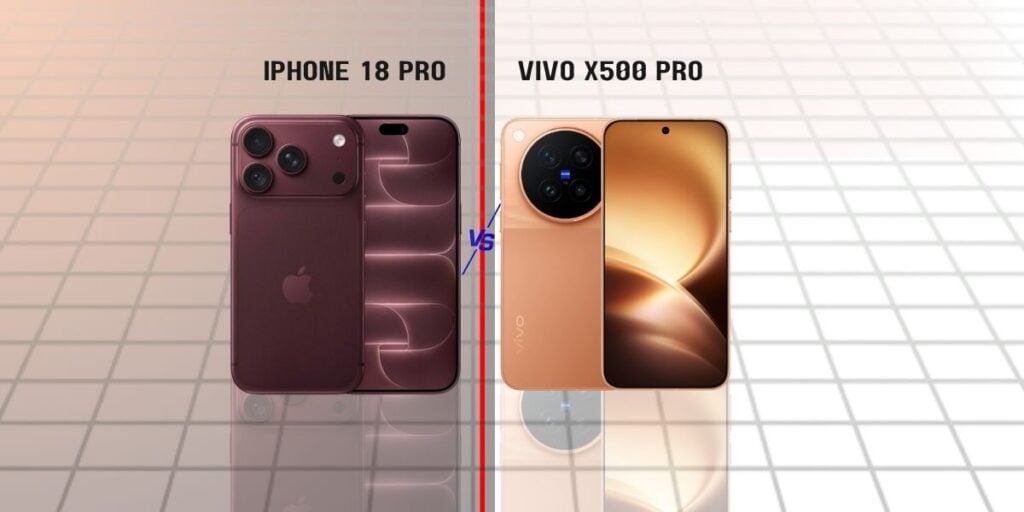
The Vivo X500 Pro is also thinner and lighter. It weighs 197g and measures 8.12mm thick, compared with 211g and 8.8mm for the iPhone 18 Pro. Here we will look at the main features of both phones. Both companies also sell larger models, the iPhone 18 Pro Max and Vivo X500 Pro Max, which we have covered in a separate piece.
1. Design and build
The iPhone 18 Pro uses a glass body with an aluminum frame and Ceramic Shield 2 on the front. It keeps the Dynamic Island, Camera Control, and Action button. The phone comes in Burgundy, Glacier, Silver, and Black.
The Vivo X500 Pro has an aviation aluminum frame with rounded edges. Its pancake-style camera module has a knurled texture, while the glass back has a matte finish. Vivo says the matte finish is used on the Echoes of the Earth, Sunny Day, and Sunset colors. Those versions are 8.12mm thick, while the Night Photography model is 7.95mm. Color options include black, gray, white, and orange.
Both phones have water resistance. Vivo lists IP68 and IP69 protection, while the iPhone 18 Pro has an IP68 rating for immersion of up to 6 meters. Vivo also notes that the X500 Pro is not a professional waterproof phone and that liquid damage is not covered by its warranty.
Magnetic accessories work with both phones, but the setup is different. The Vivo X500 Pro supports magnetic accessories but does not have built-in magnets, so a magnetic case is needed. Apple offers MagSafe accessories for the iPhone 18 Pro.
The Vivo X500 Pro uses an ultrasonic fingerprint sensor under the display, while the iPhone 18 Pro uses Face ID.
2. Display
The Vivo X500 Pro has a 6.36-inch BOE Q11 LTPO 8T display with a 1Hz to 144Hz refresh range and 459ppi. Vivo claims up to 4,500 nits of peak brightness, 100% P3 coverage, and a minimum brightness of 1 nit. It also includes several eye-comfort and outdoor visibility features.
The iPhone 18 Pro has a slightly smaller 6.3-inch LTPO Super Retina XDR OLED display with a 120Hz refresh rate and 1206 x 2622 resolution. It reaches 3,000 nits at peak brightness, with 1,600 nits in high-brightness mode and 1,000 nits typical brightness. The panel also supports HDR10, Dolby Vision, and an anti-reflective coating.
3. Main camera
The iPhone 18 Pro has a 48MP main camera with a variable ƒ/1.5-4.0 aperture and a 24mm focal length. Apple uses a second-generation sensor-shift stabilization system, and the camera can adjust its aperture depending on the scene. The phone also supports Apple’s newer camera controls and Photographic Styles.
The Vivo X500 Pro has a 50MP main camera built around what Vivo calls the Blueprint X-Drive 900 sensor. Vivo claims 17EV of dynamic range in Log mode and CIPA 7.0 stabilization on both the main and telephoto cameras. Zeiss T* coating is used to reduce reflections, ghosting, and stray light, while Vivo’s V3+ and VS1 chips handle image processing.
The two phones are also different in terms of manual controls. Apple’s Camera app adds controls for things such as aperture, shutter speed, white balance, and a histogram. The Vivo uses a Zeiss-branded camera app with different style and color options, along with several cinematic video modes.
4. Zoom, ultrawide and front cameras
The iPhone 18 Pro has three 48MP rear cameras. The telephoto camera uses a 100mm focal length with 4x optical zoom, while the ultrawide camera has a 13mm focal length and a 120-degree field of view. The phone also has an 18MP front camera with autofocus and support for Apple’s Center Stage features.
The Vivo X500 Pro has a 64MP periscope telephoto camera at 85mm, along with a 50MP ultrawide and a 50MP front camera. Vivo also sells a Zeiss G2 teleconverter separately. With the accessory attached, the company says it can achieve a 200mm equivalent focal length for its super telephoto modes.
5. Video
The iPhone 18 Pro supports 4K video at up to 120fps, Dolby Vision HDR, ProRes and ProRes RAW, along with Apple Log 2. It can also record spatial video and audio.
The Vivo X500 Pro supports 4K 240fps slow motion, 4K 120fps video tracking, 8K native Live and 4K native Cinematic Live. It also has several motion-based shooting modes and AI One-Click Highlights for automatically editing clips.
Both phones therefore offer plenty of video tools, although Apple’s support for ProRes RAW and Apple Log 2 gives it a more established set of options for users who want to work with footage after recording.
The iPhone 18 Pro also uses Apple Intelligence for several editing features. Spatial Reframing lets you change the composition after taking a photo, Extend expands the frame and Clean Up removes unwanted objects. Another feature called smart focus tracking can also keep a subject in focus when it moves out of and back into the frame.
Vivo’s software includes AI One-Click Highlights and an AI-assisted travel guide. Vivo says the guide is available through its Blue Heart assistant with a free trial, followed by a paid monthly plan.
6. Performance and cooling
The iPhone 18 Pro runs on Apple’s A20 Pro, a 2nm chip with a six-core CPU and seven-core GPU. Apple has also increased the size of the vapor chamber compared with the previous generation and says the phone can deliver up to 40% better sustained performance than the iPhone 17 Pro.
The Vivo X500 Pro uses the Dimensity 9600 Pro, also built on a 2nm process. It was the first phone announced with the chip. The processor has two C2-Ultra cores at up to 4.55GHz and six C2 Pro cores, with a Mali-G2-Ultra-NX GPU.
The iPhone 18 Pro comes with 12GB of RAM across its 256GB, 512GB, 1TB and 2TB storage options. The Vivo X500 Pro is available with up to 12GB of RAM and 1TB of storage, although its retail configuration uses LPDDR5X Ultra RAM and UFS 4.1 storage.
There is no like-for-like benchmark comparing both phones yet, so the performance comparison is still mostly based on their chips and manufacturer claims.
7. Software and AI
The iPhone 18 Pro ships with iOS 27 and Apple’s new Siri AI features. Siri AI is currently in beta, initially supports English, and is not available in the EU at launch. It can work with personal information, perform actions inside supported apps, and answer general questions using online references.
iOS 27 also adds features such as Call Context, Image Playground, message and mail suggestions, Safari tab groups, and Shortcuts that can be created from a text description.
The Vivo X500 Pro runs OriginOS 7 based on Android 17 and comes with five major OS updates. Its Atomic Workbench can keep up to five apps open in the foreground and lets you move images and text between them. Other additions include liquid motion effects, interruptible animations, and Minor Mode.
8. Battery and charging
The Vivo X500 Pro has a 6,510mAh battery with a rated capacity of 6,305mAh. It supports 90W wired charging and 40W wireless charging. The full wireless speed requires Vivo’s compatible wireless charger and accessories.
The iPhone 18 Pro has a 4,056mAh battery in the Nano-SIM version and a 4,288mAh battery in the eSIM-only version, although the latter capacity is not officially confirmed. It supports wired charging to 50% in 15 minutes and 25W MagSafe or Qi2 wireless charging, with the China model limited to 15W wireless charging.
On paper, the Vivo has a much larger battery and considerably faster wireless charging. Apple’s advantage is a more compact battery capacity paired with the company’s own hardware and software optimization.
9. Connectivity and extras
Both phones support 5G, Wi-Fi 7, and Bluetooth 6. The iPhone 18 Pro also supports USB-C 3.2 Gen 2 with DisplayPort, NFC, UWB, and satellite features such as Emergency SOS and Messages via satellite.
Vivo lists several connectivity features for the X500 Pro, including eSIM support and a Global Virtual SIM service with coverage in more than 120 countries. Some of these features are tied to China, so their availability on global versions will need to be checked.
The Vivo also supports Bluetooth and digital USB-C headphones but not analog USB-C headphones. A 3.5mm headset therefore requires a separate DAC adapter.
10. Price, availability and deals
The iPhone 18 Pro starts at $1,199 for 256GB, which is $100 more than the iPhone 17 Pro. Storage goes up to 2TB, giving buyers four storage options. In the US, Apple offers financing through Apple Card Monthly Installments and a lease option through Apple Upgrade. Trade-in credits and carrier promotions can also lower the price.
The Vivo X500 Pro starts at 6,499 yuan (about $1,044) for the 12GB + 256GB version in China, where it went on sale on September 29. Vivo has not announced international pricing yet. The global launch is scheduled for October 28, so the price outside China may be different from the current conversion.
For daily updates, please visit our News Section.
Stay ahead in tech! Join our Telegram community and sign up for our daily newsletter of top stories!