Advertisement

Add GIZMOCHINA as Preferred Source on Google

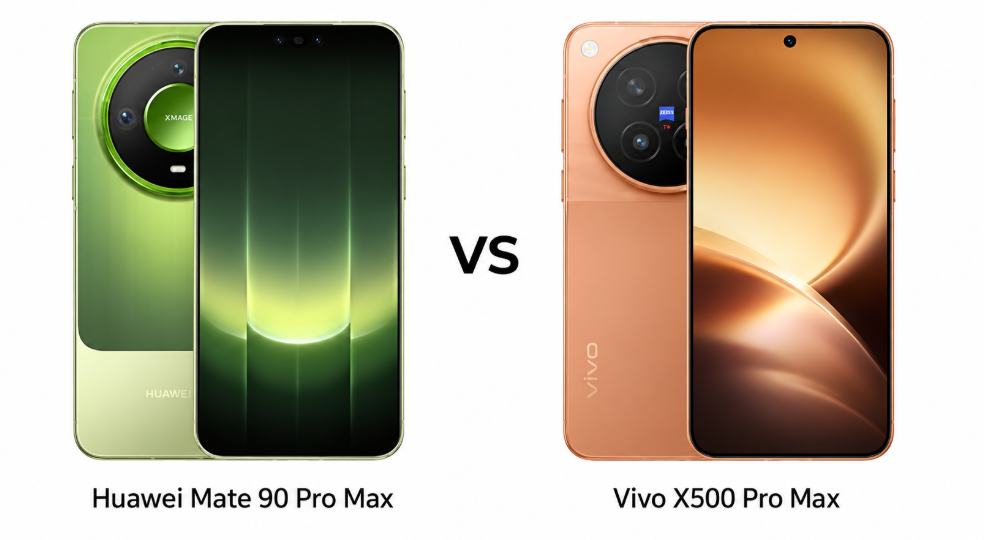
Huawei Mate 90 Pro Max and Vivo X500 Pro Max target users who want a premium smartphone experience, but their priorities differ. Huawei focuses on display technology, versatile connectivity, and fast charging, while Vivo combines powerful hardware, advanced camera capabilities, and a large battery. The choice comes down to whether Huawei’s premium features justify its higher price or Vivo delivers the more complete flagship package.
Major Features:

CategoryHuawei Mate 90 Pro MaxVivo X500 Pro MaxWinner
BuildKunlun Glass 3, aluminum frame, glass-fiber reinforced plastic backGlass front, aluminum frame, glass or glass-fiber reinforced plastic backHuawei — stronger screen protection
Water ResistanceIP68/IP69, immersion up to 6m for 30 minutesIP68/IP69, immersion up to 1.5m for 30 minutesHuawei — greater immersion resistance
Display6.9-inch dual-layer LTPO OLED, 120Hz6.85-inch LTPO AMOLED, 144HzVivo — higher refresh rate
Resolution1320 × 2848 pixels1440 × 3168 pixelsVivo — sharper display
Peak Brightness12,000 nits (isolated spot during video playback)4,400 nitsHuawei — higher claimed peak brightness
Operating SystemHarmonyOS 7.0Android 17, OriginOS 7Vivo — broader Android ecosystem
ChipsetKirin 9050 or Kirin 9050 ProMediaTek Dimensity 9600 Pro (2nm)Vivo — newer 2nm platform
RAM12GB, 16GB12GB, 16GBTie — comparable memory options
Storage512GB, 1TB256GB, 512GB, 1TBVivo — more storage configurations
Main Camera50MP, variable aperture, OIS50MP, f/1.6, OISHuawei — variable-aperture flexibility
Telephoto Camera200MP, 4x optical zoom, OIS200MP, 3.5x optical zoom, OISHuawei — longer optical zoom
Ultrawide Camera40MP, 120°50MP, 119°, autofocusVivo — higher resolution and autofocus
Rear VideoUp to 4K, HDR VividUp to 8K at 30fps, advanced Log recordingVivo — more advanced video options
Selfie Camera13MP ultrawide, autofocus, TOF 3D sensor50MP wide, autofocusVivo — higher-resolution selfie camera
Selfie VideoUp to 4K4K at up to 60fpsVivo — higher frame-rate option
Battery6,800mAh8,000mAh silicon-carbonVivo — larger capacity
Wired Charging100W90WHuawei — faster wired charging
Wireless Charging50W40WHuawei — faster wireless charging
Reverse ChargingReverse wireless and 18W reverse wiredReverse wireless and reverse wiredHuawei — specified reverse wired speed
ConnectivityWi-Fi 7, Bluetooth 6.0, USB-C 3.1, DisplayPort 1.2Wi-Fi 7, Bluetooth 5.4/6.0, USB-C 3.2Huawei — DisplayPort support
Software SupportNot specifiedUp to five major OS updatesVivo — defined update commitment
Price / ValuePriced around $1,400 / ₹1,36,000Priced around $1,000 / ₹1,00,000Vivo — lower price with competitive flagship features
Overall WinnerPremium display, protection, and chargingBattery, video, performance platform, and valueVivo — more balanced flagship package
Disclaimer: Specs are based on available data. Actual performance may vary. Verify details from official sources before buying.

1. Design and Display

Build and Feel

The Huawei Mate 90 Pro Max combines Kunlun Glass 3, an aluminum frame, and a glass-fiber reinforced plastic back, creating a premium design with enhanced protection. Its IP68/IP69 rating also provides strong resistance against dust and water. The Vivo X500 Pro Max offers a glass front, aluminum frame, and either a glass or glass-fiber reinforced plastic back, depending on the version. Both phones feel appropriate for the flagship category, but Huawei has an advantage in screen protection and underwater resistance. Vivo’s understated construction remains appealing for buyers who prefer a conventional premium Android design.

Display Quality

Huawei features a 6.9-inch dual-layer LTPO OLED panel with a 120Hz refresh rate, HDR Vivid support, and an exceptionally high claimed peak brightness. Vivo counters with a 6.85-inch LTPO AMOLED display offering a sharper 1440p-class resolution, a faster 144Hz refresh rate, Dolby Vision, and HDR10+. Its higher pixel density should deliver slightly crisper text and finer details. Vivo’s refresh rate also provides a marginally smoother experience in supported games and scrolling, while Huawei’s display technology emphasizes brightness and visual comfort.

Verdict

Vivo wins on resolution, refresh rate, and HDR versatility, while Huawei leads in screen protection and claimed peak brightness. Vivo is the better-balanced display choice.

2. Specifications Including Battery

Performance

The Huawei Mate 90 Pro Max runs HarmonyOS 7.0 with either the Kirin 9050 or Kirin 9050 Pro chipset. Its actual performance will depend on the configuration, particularly for demanding games and intensive multitasking. The Vivo X500 Pro Max uses the 2nm MediaTek Dimensity 9600 Pro, paired with Android 17 and OriginOS 7. Its modern platform, UFS 4.1 storage, and support for up to five major Android upgrades make it an attractive choice for users prioritizing sustained performance and software longevity. Vivo is the more compelling option for buyers who want a familiar Android ecosystem, although real-world benchmark and thermal testing would be needed to establish its performance advantage conclusively.

Battery and Charging

Huawei packs a 6,800mAh battery with 100W wired charging, 50W wireless charging, and reverse wired and wireless charging. Vivo goes further with an 8,000mAh silicon-carbon battery, supported by 90W wired and 40W wireless charging. The larger capacity gives Vivo a promising advantage for long days of gaming, navigation, photography, and streaming. Huawei, however, offers faster charging on paper and greater wireless charging output. Both support reverse charging, adding flexibility when powering accessories. Vivo looks better suited to users who prioritize endurance, while Huawei appeals to those who want to replenish their battery quickly.

Verdict

Vivo takes the performance and endurance advantage with its newer 2nm platform, larger battery, and longer software support commitment. Huawei counters with faster wired and wireless charging.

3. Camera

Main and Secondary Lenses

Both smartphones feature triple rear-camera systems built around a 50MP main sensor and a 200MP periscope telephoto camera. Huawei combines variable aperture on its primary camera with 4x optical zoom, potentially offering greater flexibility across lighting conditions and portrait distances. Vivo uses a fixed-aperture main camera and 3.5x optical zoom, complemented by a 50MP autofocus ultrawide lens. Its Zeiss optics, T* coating, and advanced video recording options strengthen its appeal to photography enthusiasts. Huawei’s larger telephoto sensor specification and longer optical reach look promising, but Vivo’s imaging system offers a more extensive professional video toolkit, including high-resolution recording and Log formats.

Selfie Camera

Huawei includes a 13MP ultrawide front camera with autofocus and a TOF 3D sensor for depth sensing and biometric functions. It supports 4K video recording, making it suitable for video calls and content creation. Vivo steps up with a 50MP autofocus selfie camera and 4K recording at up to 60fps. The higher resolution should provide greater flexibility for cropping and capturing detailed self-portraits, while autofocus helps maintain clarity at different distances. Huawei’s 3D sensing hardware remains useful for facial recognition, but Vivo’s front camera is the stronger option for creators who regularly record themselves.

Verdict

Vivo wins overall for selfie versatility and advanced video tools. Huawei remains competitive with its variable-aperture main camera and longer optical zoom, making the rear-camera contest closer.

4. Pricing

The Huawei Mate 90 Pro Max is priced around $1,400 (₹1,36,000), positioning it firmly in the ultra-premium flagship segment. The Vivo X500 Pro Max is priced around $1,000 (₹1,00,000), making it considerably more accessible despite offering competitive flagship hardware. The difference is approximately $400 (₹36,000), which is substantial for buyers comparing phones with similarly ambitious camera systems and premium displays. Huawei’s higher price may appeal to users who specifically value its display technology, charging capabilities, and advanced protection. Vivo’s pricing makes it easier to justify a flagship upgrade without paying the additional premium.

Is the price justified?

Huawei’s price is more difficult to justify because Vivo delivers a larger battery, a higher-resolution display, a 50MP selfie camera, and extensive video features for considerably less. Huawei still offers meaningful advantages in charging speed, display brightness, and optical zoom reach. However, these strengths may not outweigh the savings for most buyers. Vivo provides a more attractive combination of everyday practicality and high-end hardware, making it the stronger value proposition.

Verdict

Vivo wins decisively on value for money, delivering a more balanced flagship experience at a lower price. Huawei is worth considering if its specialized display and charging features are priorities.

Disclaimer:
Prices are approximate and may vary based on country, region, launch timing, and applicable taxes. Always check whether the listed price is for a China unit or a global/international variant when purchasing.

5. Conclusion

The Huawei Mate 90 Pro Max distinguishes itself with its dual-layer LTPO OLED display, variable-aperture main camera, 4x optical zoom, 100W wired charging, and 50W wireless charging. Its Kunlun Glass 3 protection and IP68/IP69 rating also make it appealing to users who value durability. The Vivo X500 Pro Max counters with a 2nm chipset, an 8,000mAh silicon-carbon battery, a 144Hz high-resolution display, Zeiss-enhanced optics, and extensive professional video capabilities. Android 17 and its stated support for five major OS upgrades add further long-term appeal. These differences make the decision less about which phone has the most impressive individual feature and more about which combination best suits everyday use. Huawei has several specialized advantages, but Vivo offers fewer obvious compromises for a broader range of users.

Verdict

The Vivo X500 Pro Max is the overall winner. Its combination of performance-focused hardware, larger battery, versatile cameras, longer software support, and lower price makes it the more practical flagship for most buyers. Huawei remains a strong alternative for users who prioritize advanced display technology, faster charging, and enhanced water resistance.

Disclaimer: Prices, specifications, and availability may vary by region and retailer. Recommendations in this article are based on editorial opinion, feature-based value, and market positioning at the time of writing. Readers are advised to do their own research before making a purchase.

Read More:

Comments