
Add GIZMOCHINA on Google:
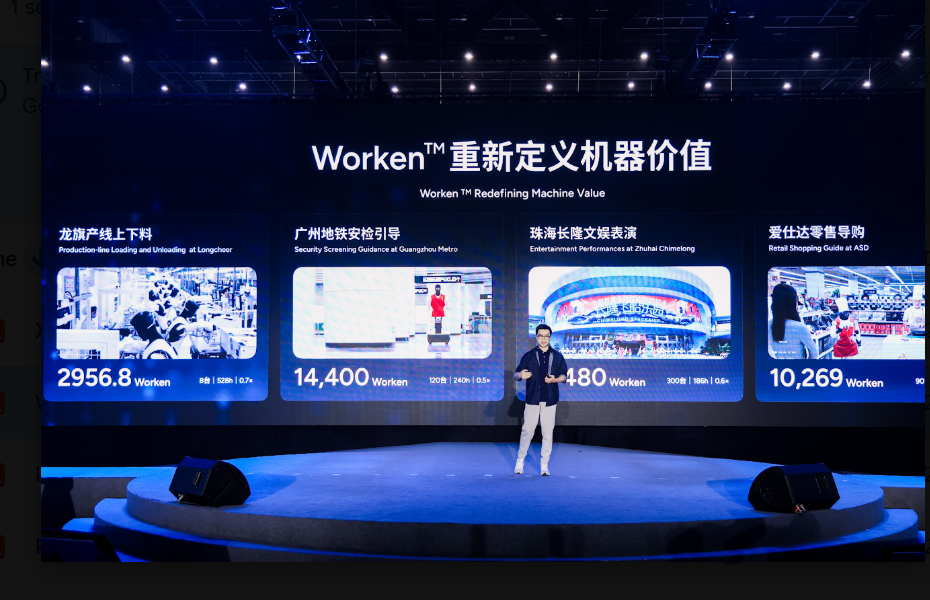
AGIBOT has introduced Worken, a new framework designed to measure how much useful work robots actually complete in real-world environments. The framework aims to provide a different way of evaluating progress in the robotics industry. Instead of focusing on how many robots are manufactured or deployed, Worken looks at their actual productivity, autonomous working time, and the quality of their output.
What Is AGIBOT’s Worken Framework?
The name Worken combines the words Work and Token. The proposed framework focuses on measuring Effective Intelligent Work Hours, giving businesses a way to understand how effectively Physical AI systems perform assigned tasks.
AGIBOT believes that counting deployed robots alone does not provide a complete picture of their usefulness. For example, two factories may operate the same number of robots but achieve very different production results. Robots that work independently for longer periods and consistently complete tasks with minimal human assistance deliver greater productivity.
The same idea can also apply to logistics and service robots. Simply moving around a warehouse or interacting with customers is not enough. These machines must successfully complete their assigned tasks.
How Does Worken Calculate Robot Productivity?
AGIBOT’s proposed formula combines three factors: the number of active robots, their autonomous working hours and their output efficiency ratio.
The first factor counts robots that are actively performing useful tasks rather than machines that have only been manufactured, delivered or installed. The second measures how long robots work independently, excluding waiting periods and continuous human control. The third evaluates completed work against an agreed productivity benchmark.
For example, a manufacturing facility with 10 active robots, six autonomous working hours per robot and an output efficiency ratio of 0.8 would generate 48 Worken.
This approach aims to distinguish between machines that remain powered on and those that consistently deliver acceptable results.
Potential Applications in Manufacturing and Other Industries
Manufacturing could be one of the first areas where Worken becomes useful because production tasks often have clearly defined targets. Businesses could use the framework to monitor robotic productivity, compare similar operations and identify where machines lose productive working time.
It could also help companies evaluate software updates by checking whether robots complete more tasks independently or require less human intervention.
AGIBOT’s existing industrial applications, including material-handling operations at Longcheer, provide potential real-world environments for exploring the framework.
The concept could eventually extend to service robots, where productivity might be measured through completed guidance tasks, customer assistance and successful visitor interactions.
Worken Is Still an Evolving Framework
AGIBOT describes Worken as a developing measurement framework rather than an established universal standard. Its practical usefulness will depend on reliable operational data, clearly defined tasks and suitable performance benchmarks.
It is also not intended to replace other important measures such as safety, reliability, operating costs and output quality. Furthermore, Worken does not represent a universal monetary value for robotic labour.
If developed successfully, the framework could help businesses make better decisions about robotic investments and understand how software and AI improvements increase productivity over time.
Ultimately, AGIBOT’s approach highlights a broader shift in robotics: measuring progress not just by how many robots enter the workplace, but by how much useful work they actually deliver.
Read More:
- AGIBOT Wins 46 Medals at World Humanoid Robot Games, Takes 18 Gold
- Humanoid Robots Are Scaling Fast, And AGIBOT from China Is Leading the Charge
- Chinese Robot Company AGIBOT Took 39% of the Global Humanoid Market in 2025



Comments