
Add GIZMOCHINA on Google:
As an Amazon Associate, Gizmochina earns from qualifying purchases. Links on this page may earn us a commission at no extra cost to you.
Huawei Pura 90 Plus takes the familiar Pura 90 formula and pushes it towards a more premium camera experience, with upgraded optics, improved display protection and faster wireless charging. However, the standard Pura 90 has a few surprises of its own, particularly when it comes to selfie photography and battery capacity. So, what exactly does the Plus model add, and are those upgrades worth the extra price?
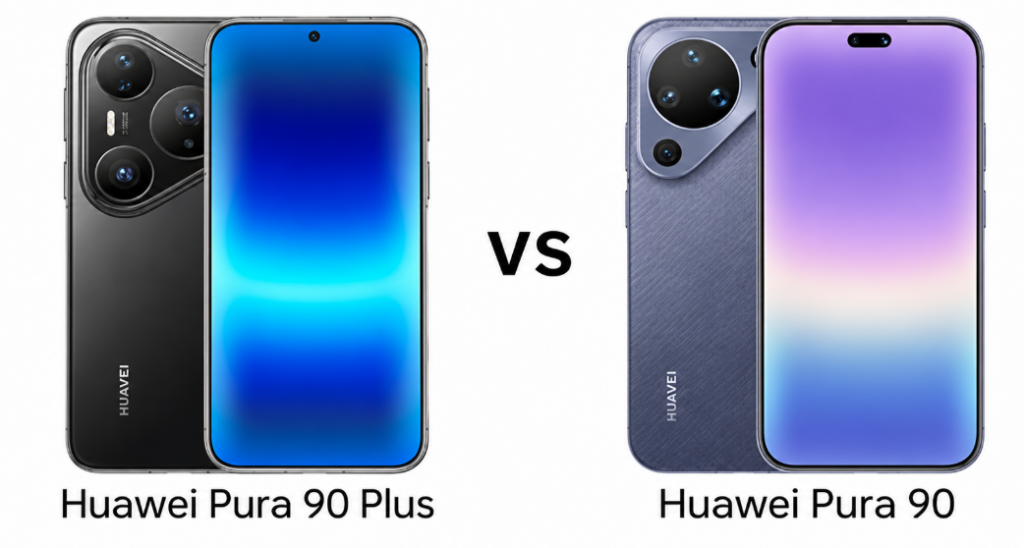
1. Major Features:
| Category | Huawei Pura 90 Plus | Huawei Pura 90 | Upgrades |
|---|---|---|---|
| Dimensions | 163.1 x 76.1 x 8.3 mm | 163.1 x 78.1 x 7 mm | No major upgrade; different body proportions |
| Weight | 220 g | 210 g | No upgrade |
| Build | Kunlun Glass 2, aluminum frame, aluminosilicate glass back | Kunlun Glass, aluminum frame | Kunlun Glass 2 and upgraded back protection |
| Water Resistance | IP68/IP69 | IP68/IP69 | No upgrade |
| Display Type | LTPO OLED, 1B colours, 120Hz | LTPO OLED, 1B colours, 120Hz | No upgrade |
| Display Size | 6.8 inches | 6.8 inches | No upgrade |
| Resolution | 1276 x 2848 pixels | 1320 x 2856 pixels | No upgrade; lower resolution |
| PWM Dimming | 1440Hz PWM | PWM | Specified 1440Hz PWM dimming |
| Screen Protection | Kunlun Glass 2 | Kunlun Glass | Upgraded screen protection |
| Operating System | HarmonyOS 7 | HarmonyOS 6.1 | Upgraded operating system |
| Chipset | Kirin 9025 | Kirin 9010s | Newer chipset |
| RAM | 12GB | 12GB / 16GB | No upgrade; loses 16GB option |
| Storage | 256GB / 512GB / 1TB | 256GB / 512GB | Adds a 1TB storage option |
| Main Camera | 50MP, 1-inch sensor, variable f/1.6-f/4.0 aperture, OIS | 50MP, f/1.8, OIS | 1-inch sensor and variable aperture |
| Periscope Telephoto | 48MP, 4x optical zoom, OIS | 50MP, 3.7x optical zoom, OIS | Increased optical zoom from 3.7x to 4x |
| Ultrawide Camera | 40MP, f/2.2 | 12.5MP, f/2.2 | Upgraded from 12.5MP to 40MP |
| Rear Camera Features | Laser AF, colour spectrum sensor, LED flash, HDR | Laser AF, colour spectrum sensor, LED flash, HDR | No upgrade |
| Rear Video | 4K, 1080p, HDR Vivid, gyro-EIS, OIS | 4K, 1080p, 480fps interpolated slow motion, HDR Vivid, gyro-EIS, OIS | No upgrade; loses specified 480fps interpolated recording |
| Selfie Camera | 13MP, autofocus | 50MP, autofocus | No upgrade; lower resolution |
| Selfie Video | 4K, 1080p | 4K, 1080p, 1080p@120fps | No upgrade; loses specified 120fps recording |
| Speakers | Stereo speakers | Stereo speakers | No upgrade |
| Wi-Fi | Wi-Fi 7 | Wi-Fi 7 | No upgrade |
| Bluetooth | 6.0 | 6.0 | No upgrade |
| NFC | Yes | Yes | No upgrade |
| Infrared | Yes | Yes | No upgrade |
| USB | USB Type-C 3.2, DisplayPort 1.2, OTG | USB Type-C | Upgraded USB connectivity with DisplayPort 1.2 |
| Fingerprint Sensor | Side-mounted | Side-mounted | No upgrade |
| Battery | 5700mAh | 6500mAh | No upgrade; 800mAh smaller battery |
| Wired Charging | 100W | 100W | No upgrade |
| Wireless Charging | 80W | 50W | Upgraded from 50W to 80W |
| Reverse Wired Charging | 18W | 5W | Upgraded from 5W to 18W |
| Reverse Wireless Charging | Yes | Yes | No upgrade |
| Price | $730 / ₹73,500 | $680 / ₹64,000 | Approximately $50 / ₹9,500 higher |
2. Design and Display
Build and Feel
The Huawei Pura 90 Plus upgrades its construction with Kunlun Glass 2 on the front and an aluminosilicate glass back, giving it a more premium protection package than the standard Pura 90. Both phones retain an aluminum frame, dual Nano-SIM support and IP68/IP69 water and dust resistance. However, the Plus model’s enhanced glass protection is a meaningful refinement for long-term durability.
The standard Pura 90 keeps things simpler with regular Kunlun Glass protection on the front and a glass-and-aluminum construction. Neither phone compromises on water resistance, so everyday protection remains comparable. The Plus feels like the more premium package, particularly for buyers who prioritise tougher screen protection and a more refined build.
Display Quality
Both smartphones feature 6.8-inch LTPO OLED displays with 1 billion colours and 120Hz refresh rates. However, the standard Pura 90 actually offers the higher resolution at 1320 x 2856 pixels, compared to 1276 x 2848 pixels on the Pura 90 Plus. Both deliver approximately 463ppi, meaning everyday sharpness should be remarkably similar.
The Plus model features 1440Hz PWM dimming, while the standard model lists PWM and HDR Vivid support. The standard Pura 90 also has a slightly higher screen-to-body ratio. Consequently, the Plus is not a straightforward display upgrade. Its main advantage is the PWM frequency, while the standard model retains a small resolution advantage.
Verdict
The Pura 90 Plus upgrades front glass protection and offers 1440Hz PWM dimming, but the standard Pura 90 retains higher resolution and HDR Vivid support. Neither delivers a decisive display upgrade.
3. Specifications Including Battery
Performance
The Huawei Pura 90 Plus upgrades the chipset from the Kirin 9010s to the Kirin 9025 and moves from HarmonyOS 6.1 to HarmonyOS 7. This gives the Plus model a newer hardware and software foundation. However, actual performance improvements will depend on optimisation and real-world testing rather than chipset naming alone.
Memory configurations are also different. The Plus offers 256GB, 512GB and 1TB storage options, all paired with 12GB RAM. The standard Pura 90 offers 256GB and 512GB with 12GB RAM, alongside a 512GB option with 16GB RAM. Therefore, the Plus adds a higher 1TB storage tier, but the standard model offers more RAM in its top configuration.
Battery and Charging
Interestingly, the standard Pura 90 actually packs the larger battery at 6500mAh, compared to 5700mAh on the Pura 90 Plus. Both support 100W wired charging, although the standard model charges to full in 45 minutes. This makes the base model surprisingly competitive for buyers prioritising battery capacity.
The Plus model counters with 80W wireless charging instead of 50W, alongside 18W reverse wired charging and reverse wireless charging. The standard model supports reverse wireless charging and 5W reverse wired charging. Therefore, the Plus upgrades wireless charging considerably, but sacrifices 800mAh of battery capacity.
Verdict
The Pura 90 Plus brings a newer chipset, newer software, 1TB storage and faster wireless charging. However, the standard Pura 90 retains a larger battery and a 16GB RAM option.
4. Camera
Main and Secondary Lenses
The Huawei Pura 90 Plus makes its biggest camera upgrade with a 50MP main sensor featuring a 1-inch sensor size, variable f/1.6-f/4.0 aperture and OIS. The standard Pura 90 uses a 50MP main camera with an f/1.8 aperture. The Plus also upgrades the telephoto experience with a 48MP periscope camera offering 4x optical zoom, compared to the standard model’s 50MP periscope camera with 3.7x optical zoom.
Ultrawide photography also receives a substantial upgrade. The Plus features a 40MP ultrawide camera, while the standard model uses a 12.5MP sensor. Both retain laser autofocus, a colour spectrum sensor, LED flash and HDR support. The Plus clearly focuses on improved main-camera hardware, longer optical reach and more detailed ultrawide photography, making its rear camera system the more substantial upgrade.
Selfie Camera
The standard Huawei Pura 90 surprisingly takes the lead in selfie photography with a 50MP front camera featuring autofocus, HDR and panorama support. It also supports 4K recording, 1080p video, 1080p at 120fps and HDR Vivid. This makes the base model particularly appealing for creators who frequently record themselves or capture detailed selfies.
The Pura 90 Plus moves to a 13MP front camera with autofocus and HDR support. It retains 4K and 1080p video recording but loses the standard model’s higher-resolution sensor, panorama and 120fps selfie recording. This is an unexpected downgrade for a Plus model, especially considering the stronger rear camera hardware. Selfie-focused buyers may actually prefer the standard version.
Verdict
The Pura 90 Plus delivers major rear-camera upgrades through its 1-inch main sensor, 4x periscope zoom and 40MP ultrawide. However, the standard Pura 90 wins on selfie specifications.
5. Pricing
The Huawei Pura 90 Plus is priced around $730 / ₹73,500, while the standard Huawei Pura 90 is priced around $680 / ₹64,000. This puts the Plus model approximately $50 or ₹9,500 above the standard version. The difference is relatively modest in dollar terms, but the Indian pricing gap is more noticeable. Both smartphones target the premium segment, although their feature priorities differ considerably.
For the additional price, the Plus brings a newer chipset, a larger main camera sensor, improved telephoto zoom, a higher-resolution ultrawide camera, Kunlun Glass 2 and faster wireless charging. However, buyers also lose battery capacity and some important selfie-camera features. The standard model remains a compelling alternative, particularly for users who value battery endurance and front-camera versatility.
Is the price justified?
The Plus model’s additional cost is reasonably justified by its upgraded rear-camera system, newer chipset and faster wireless charging. However, the standard Pura 90 offers better value for buyers who want a larger battery, higher-resolution selfies and a 16GB RAM option. The upgrade makes more sense for photography enthusiasts than general users.
Verdict
The Pura 90 offers better overall value, while the Pura 90 Plus justifies its premium through meaningful rear-camera and hardware upgrades. The choice depends on which features matter most.
6. Conclusion
The Huawei Pura 90 Plus stands out with its 1-inch main camera sensor, variable aperture, 4x optical zoom, 40MP ultrawide camera, 1440Hz PWM dimming and 80W wireless charging. It also introduces the Kirin 9025 chipset, HarmonyOS 7 and a 1TB storage option. Meanwhile, the standard Pura 90 counters with a 6500mAh battery, 50MP selfie camera, 16GB RAM configuration and higher display resolution. These differences make the two phones surprisingly distinct despite sharing the same 6.8-inch display size and premium positioning.
Verdict
Overall winner: Huawei Pura 90 Plus. Its 1-inch main sensor, upgraded rear cameras, newer chipset, and faster wireless charging make it the more substantial hardware upgrade. However, the standard Pura 90 remains the smarter value purchase for battery life and selfies.
Read More:
- Huawei Enjoy 100 Pro vs 100 Pro Max: Is the Upgrade Worth It?
- Sony vs Samsung: Which Clip-On Earbuds Are Worth Your Money?
- RedMagic 12 Pro vs Honor Win 2: Which Flagship Gaming Phone Is Worth Buying?
FREE NEWSLETTER
Get Gizmochina Daily
Every morning: the phone and gadget news that matters, with our take. 4 minutes.


Comments