
Add GIZMOCHINA on Google:
Huawei Enjoy 100 Pro and Enjoy 100 Pro Max share the same family identity, but they take different approaches to the smartphone experience. While both feature OLED displays, 120Hz refresh rates and the Kirin 8020-series platform, the Pro Max brings several meaningful upgrades, particularly in battery capacity, display resolution, and durability. Interestingly, the standard Pro also retains a few advantages, especially for selfie enthusiasts. The comparison comes down to whether the Max upgrades justify its higher asking price or whether the Pro already delivers the more balanced experience.
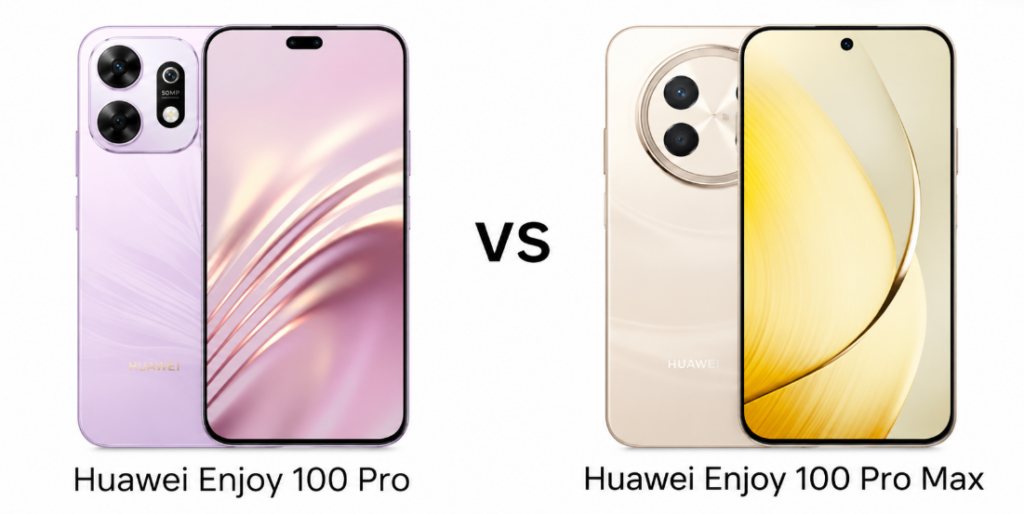
1. Major Upgrades:
| Category | Huawei Enjoy 100 Pro | Huawei Enjoy 100 Pro Max | Upgrades |
|---|---|---|---|
| Dimensions | 161.4 x 74.8 x 7.9 mm | 163.3 x 78 x 8 mm | Larger overall build |
| Weight | 192 g | 228 g | — |
| Build | Glass front, aluminium back, plastic frame | Glass front, aluminium back, plastic frame | No change |
| Water Resistance | IP64 | IP65 | Better water resistance |
| Drop Resistance | Not specified | Up to 1.8m | Added drop protection |
| Display Type | OLED, 1B colours | OLED, 1B colours | No change |
| Display Size | 6.7 inches | 6.84 inches | 0.14-inch larger display |
| Refresh Rate | 120Hz | 120Hz | No change |
| Resolution | 1080 x 2412 pixels | 1272 x 2756 pixels | Higher resolution |
| Pixel Density | ~394 ppi | ~444 ppi | Sharper display |
| Brightness | 1300 nits (HBM) | 8000 nits (peak, isolated spot) | Higher advertised peak brightness |
| Screen Protection | Aluminosilicate glass (2x tougher) | Aluminosilicate glass | No specified upgrade |
| Operating System | HarmonyOS 7.0 | HarmonyOS 7.0 | No change |
| Chipset | Kirin 8020A | Kirin 8020A / Kirin 8020 | Possible chipset variant |
| RAM | 6GB | 8GB | 2GB more RAM |
| Storage | 128GB / 256GB / 512GB | 128GB / 256GB / 512GB | No change |
| Card Slot | No | No | No change |
| Rear Camera | 50MP, f/1.8, PDAF | 50MP, f/1.8, PDAF | No change |
| Rear Camera Features | LED flash, HDR, panorama | LED flash, HDR, panorama | No change |
| Rear Video | 4K, 1080p@120fps | 4K, 1080p, gyro-EIS | Adds gyro-EIS; Pro retains 120fps |
| Front Camera | 32MP, f/2.2 | 8MP, f/2.0 | Lower-resolution selfie camera |
| Front Video | 4K, 1080p | 4K, 1080p, gyro-EIS | Adds gyro-EIS |
| Loudspeaker | Yes | Yes, stereo speakers | Stereo speakers added |
| 3.5mm Jack | No | No | No change |
| Wi-Fi | Wi-Fi 7, dual-band | Wi-Fi 7, dual-band | No change |
| Bluetooth | 6.0 | 6.0 | No change |
| Positioning | GPS, GLONASS, GALILEO, BDS, QZSS | GPS, GLONASS, GALILEO, BDS, QZSS, NavIC | Adds NavIC |
| NFC | Yes | Yes | No change |
| Infrared Port | Yes | Yes | No change |
| USB | USB Type-C 2.0, OTG | USB Type-C 2.0, OTG | No change |
| Fingerprint Sensor | Side-mounted | Side-mounted | No change |
| Additional Sensors | Accelerometer, compass | Accelerometer, gyro, compass | Adds gyroscope |
| Satellite Messaging | — | BDS satellite messaging (China only) | Adds satellite messaging |
| Battery | 6100mAh | 8800mAh | 2700mAh larger battery |
| Wired Charging | 40W | 40W | No change |
| Reverse Wired Charging | 5W | 5W | No change |
| Price | $250 / ₹25,000 | $280 / ₹28,000 | $30 / ₹3,000 higher |
2. Design and Display
Build and Feel
Both smartphones feature glass fronts, aluminium rear panels and plastic frames, giving them a similar premium design direction. However, the Enjoy 100 Pro Max offers better durability with an IP65 rating compared to the Pro’s IP64 certification. It also carries a claimed 1.8m drop resistance, making it the more reassuring choice for buyers concerned about everyday accidents. The standard Pro, meanwhile, keeps things simpler with splash resistance.
The Pro Max also gets a more substantial build, while both devices retain dual Nano-SIM support. Neither phone includes a headphone jack, so wireless audio or USB-C accessories remain the practical options. The Max’s improved protection makes it a more confidence-inspiring option for rougher everyday use, although the standard Pro still offers respectable protection for typical handling.
Display Quality
The Enjoy 100 Pro features a 6.7-inch OLED panel with Full HD+ resolution, a 120Hz refresh rate and 1300 nits of HBM brightness. The Pro Max upgrades to a larger 6.84-inch OLED display with a sharper 1272 x 2756 resolution and approximately 444ppi pixel density. Both support 1 billion colours and 120Hz refresh rates.
Huawei features 8000-nit peak brightness for the Pro Max, measured at an isolated spot during video playback. This should not be confused with sustained full-screen brightness. The Pro additionally lists 2160Hz PWM dimming.
Verdict
The Pro Max delivers a larger, sharper display and stronger durability. However, the Pro’s PWM dimming advantage makes it worth considering for buyers sensitive to screen flicker.
3. Specifications Including Battery
Performance
Both smartphones run HarmonyOS 7.0 and use the Kirin 8020A platform, although the Pro Max is also listed with a possible Kirin 8020 variant. The standard Pro comes with 6GB RAM, while the Max upgrades to 8GB RAM across its storage configurations. Both offer 128GB, 256GB and 512GB storage options, without microSD expansion.
This gives the Pro Max an advantage in memory capacity, particularly for users who multitask frequently or keep several applications running. However, the shared chipset family means the Max should not automatically be considered a major processing-performance upgrade. Both also offer Wi-Fi 7, Bluetooth 6.0, NFC, infrared and USB-C 2.0 connectivity, keeping their everyday feature sets closely matched.
Battery and Charging
Battery capacity is one of the biggest differences between these smartphones. The Enjoy 100 Pro packs a 6100mAh silicon-carbon battery, while the Pro Max takes a substantial step up with an 8800mAh unit. Both support 40W wired charging and 5W reverse wired charging, so charging speeds remain identical despite the larger battery.
The additional 2700mAh capacity gives the Pro Max considerably more potential endurance, making it particularly appealing to heavy users, travellers and people who prefer fewer charging interruptions. However, its larger battery will naturally require more charging time at the same rated charging speed.
Verdict
The Pro Max is the clear endurance upgrade, while the shared chipset family and charging speeds keep performance and charging differences relatively limited.
4. Camera
Main and Secondary Lenses
Both smartphones feature a 50MP f/1.8 primary camera with PDAF, LED flash, HDR and panorama support. This means the core photography hardware remains consistent across the lineup rather than receiving a significant sensor upgrade on the Max. Both also support 4K video recording, making their primary camera specifications closely matched.
The difference appears in video capabilities. The standard Pro supports 1080p recording at up to 120fps, while the Pro Max lists gyro-EIS for more stable footage. This makes the Max potentially more appealing to users who regularly record handheld videos. However, the Pro’s higher slow-motion recording frame rate gives it a specific advantage for capturing faster action.
Selfie Camera
Interestingly, the standard Enjoy 100 Pro has the stronger selfie camera on paper. It features a 32MP f/2.2 front camera with HDR, panorama and 4K video recording. The Pro Max switches to an 8MP f/2.0 sensor, which is a substantial reduction in resolution despite being the more expensive model.
The Max does retain 4K and 1080p video recording with gyro-EIS, potentially helping with front-camera video stability. However, buyers who prioritise detailed selfies, video calls and front-camera photography may find the standard Pro more appealing. The Max’s front-camera stabilisation is a useful addition, but it does not compensate for its lower-resolution sensor in every situation.
Verdict
The rear cameras are closely matched, but the standard Pro has a clear selfie-resolution advantage. The Pro Max makes more sense for users prioritising stabilised video.
5. Pricing
The Huawei Enjoy 100 Pro is priced around $250 / ₹25,000, while the Enjoy 100 Pro Max is priced around $280 / ₹28,000. This puts the Max at a $30 / ₹3,000 premium, representing approximately a 12% increase over the standard model. Both retain the same 40W charging, 50MP primary camera and storage options, making the additional cost primarily about the additional upgrades.
Verdict
The Pro Max offers more hardware for the additional cost, but the standard Pro delivers better value for buyers who prioritise selfies and everyday essentials.
6. Conclusion
The Huawei Enjoy 100 Pro and Pro Max cater to slightly different priorities despite sharing much of their hardware foundation. The Pro Max stands out with its 8800mAh battery, 8GB RAM, higher-resolution OLED display, IP65 protection, 1.8m drop resistance and gyro-EIS video stabilisation. Its BDS satellite messaging support, exclusive to China, is another notable addition.
The standard Pro, however, has its own advantages. Its 32MP selfie camera is considerably higher in resolution than the Max’s 8MP front sensor, while its 2160Hz PWM dimming adds another distinction. Both offer a 50MP primary camera, 40W wired charging, 5W reverse wired charging and the same broad connectivity features. Ultimately, the choice depends on whether battery endurance and durability matter more than selfie photography and saving money.
Verdict
Overall winner: Huawei Enjoy 100 Pro Max. Its significantly larger battery, sharper display, additional RAM and improved durability make the premium worthwhile. The standard Pro remains the smarter alternative for selfie-focused buyers.
Read More:
- Sony vs Samsung: Which Clip-On Earbuds Are Worth Your Money?
- RedMagic 12 Pro vs Honor Win 2: Which Flagship Gaming Phone Is Worth Buying?
- Huawei Band 11 vs Xiaomi Smart Band 11: Which Smart Band Should You Buy?
FREE NEWSLETTER
Get Gizmochina Daily
Every morning: the phone and gadget news that matters, with our take. 4 minutes.




Comments