
Add GIZMOCHINA on Google:
As an Amazon Associate, Gizmochina earns from qualifying purchases. Links on this page may earn us a commission at no extra cost to you.
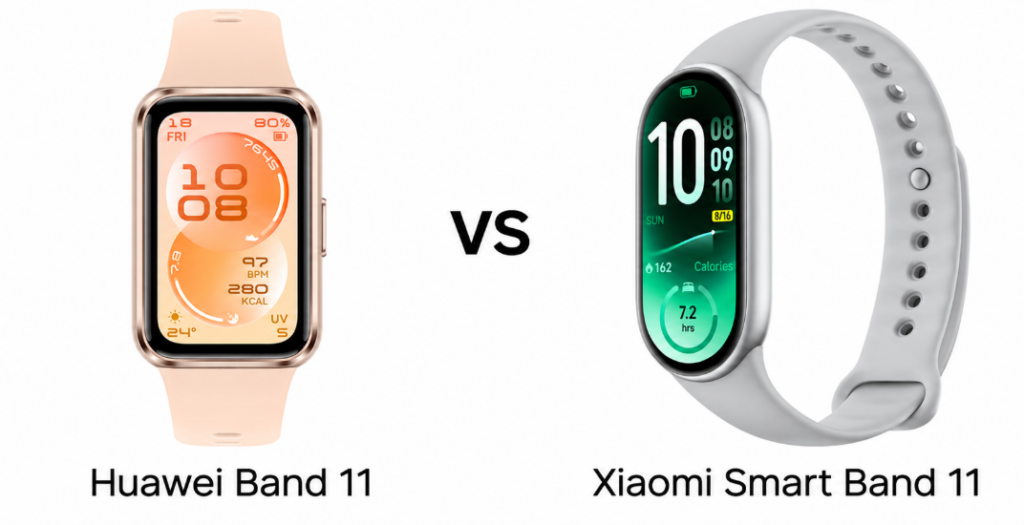
Huawei Band 11 and Xiaomi Smart Band 11 are affordable fitness trackers designed for users who want everyday health monitoring, activity tracking and smart features without investing in a full-fledged smartwatch. Both offer AMOLED displays, 5ATM water resistance, heart rate monitoring and blood oxygen tracking. However, they differ in display size, connectivity, battery specifications and additional health features. With prices starting at approximately $43, the two bands are closely matched in affordability. Here’s how they compare across their key features and which one offers better value.
Main Features:
| Category | Huawei Band 11 | Xiaomi Smart Band 11 | Winner |
|---|---|---|---|
| Design | Aluminium alloy / polymer | Aluminium alloy | Xiaomi – Lighter body |
| Weight | 16–17g | 15.58g | Xiaomi – Slightly lighter |
| Water Resistance | 5ATM | 5ATM | Tie – Equal rating |
| Display | 1.62-inch AMOLED | 1.72-inch AMOLED | Xiaomi – Larger display |
| Resolution | 286 × 482 pixels | 212 × 520 pixels | Huawei – Higher pixel density |
| Peak Brightness | Not specified | 1,500 nits | Xiaomi – Higher specified brightness |
| Heart Rate Monitoring | Yes | Yes | Tie – Both supported |
| SpO₂ Monitoring | Yes | Yes | Tie – Both supported |
| Sleep Tracking | TruSleep | Yes | Huawei – Named tracking technology |
| Stress Monitoring | Yes | Not specified | Huawei – Additional wellness feature |
| Emotion Tracking | Yes | Not specified | Huawei – Additional tracking feature |
| Motion Sensors | 9-axis IMU | Accelerometer, gyroscope, compass | Tie – Different configurations |
| Bluetooth | 6.0 | 5.4 | Huawei – Newer version |
| Battery Capacity | Not specified | 233mAh | Xiaomi – Capacity specified |
| Battery Life | Up to 14 days | Not specified | Huawei – Longer documented endurance |
| Charging | Magnetic | Magnetic | Tie – Same charging method |
| Charging Time | Not specified | Approximately 90 minutes | Xiaomi – Charging time specified |
| Android Compatibility | Android 9.0+ | Android 8.0+ | Xiaomi – Older Android support |
| iOS Compatibility | iOS 13.0+ | iOS 14.0+ | Huawei – Older iOS support |
| Price | $45 / ₹4,000 | $43 / ₹3,600 | Xiaomi – More affordable |
Design and Build
The Huawei Band 11 features an aluminium alloy or durable polymer case, depending on the variant, paired with a fluoroelastomer strap. It weighs approximately 16g to 17g without the strap, making it a lightweight option for continuous wear. The Xiaomi Smart Band 11 also uses an aluminium alloy frame but weighs slightly less at 15.58g without the strap. It supports TPU and nylon strap options, giving users more flexibility in styling and comfort.
Both fitness trackers offer 5ATM water resistance, making them suitable for swimming and everyday water exposure. Huawei has a slightly more compact design, while Xiaomi offers multiple colour choices and strap options.
Winner: Xiaomi – Lighter construction and more strap choices.
Display
The Xiaomi Smart Band 11 has a larger 1.72-inch AMOLED display with a resolution of 212 × 520 pixels and peak brightness of 1,500 nits. Its automatic brightness adjustment also helps improve visibility across different lighting conditions. The Huawei Band 11 features a smaller 1.62-inch AMOLED panel with a sharper 286 × 482 resolution and a pixel density of 347 PPI.
Although Xiaomi offers more screen space and higher specified peak brightness, Huawei provides greater pixel density, which can benefit text clarity and interface details. Both use touchscreen displays, making everyday navigation straightforward.
Winner: Xiaomi – Larger display and higher peak brightness for outdoor visibility.
Health Tracking
Both bands provide essential health monitoring through optical heart rate sensors and blood oxygen tracking. They also include sleep monitoring, making them useful for users interested in understanding their daily health patterns. Huawei uses its TruSleep technology and additionally supports stress and emotion tracking, offering a broader set of explicitly listed wellness features.
Xiaomi includes an optical heart rate sensor, pulse oximeter and ambient light sensor, alongside its sleep-tracking capabilities. However, its specifications do not explicitly list emotion tracking or stress monitoring. Huawei therefore has an advantage in the range of documented wellness features, although neither band should replace medical monitoring equipment.
Winner: Huawei – Additional stress and emotion tracking features.
Fitness and Sports Tracking
Both fitness bands include motion-sensing hardware to support activity and movement tracking. Huawei uses a 9-axis IMU sensor, which combines motion-sensing capabilities into a single sensor system. Xiaomi lists an accelerometer, gyroscope and electronic compass, providing several dedicated sensors for movement and orientation tracking.
These components support the underlying activity-monitoring experience, although the specifications do not confirm the exact number of workout modes or advanced training metrics available on either device. Xiaomi’s electronic compass is an additional hardware feature, while Huawei’s integrated 9-axis sensor offers a consolidated motion-sensing solution.
Winner: Tie – Both offer capable motion-sensing hardware, with different sensor configurations.
Battery Life and Charging
Huawei provides clearer battery endurance figures, claiming up to 14 days of maximum usage, eight days under typical usage and approximately three days with Always-On Display enabled. These figures give buyers a better understanding of what to expect under different usage conditions.
Xiaomi equips the Smart Band 11 with a 233mAh lithium-polymer battery and claims an approximately 90-minute charging time. However, an official battery-life figure has not been provided in the available specification sheet, making a direct endurance comparison difficult.
Both devices support magnetic charging, offering a convenient way to recharge without traditional charging ports.
Winner: Huawei – Clearly specified battery endurance of up to 14 days.
Connectivity and Compatibility
The Huawei Band 11 supports Bluetooth 6.0 with BR/BLE protocols, while the Xiaomi Smart Band 11 uses Bluetooth 5.4. Huawei therefore has the advantage in Bluetooth version, although the practical difference in everyday fitness-band connectivity cannot be established from these specifications alone.
Compatibility is another area where both devices offer broad smartphone support. Huawei works with Android 9.0 or later and iOS 13.0 or later. Xiaomi supports Android 8.0 and above and iOS 14.0 and above. Both require their respective companion applications, with Huawei using its supported Huawei Health ecosystem and Xiaomi relying on Mi Fitness.
Winner: Huawei – Newer Bluetooth version and broader iOS compatibility.
Everyday Features and Usability
Both bands are designed around touchscreen interaction, with AMOLED displays providing a clear interface for everyday use. Huawei includes a physical side button, giving users an additional way to interact with the device. Its ambient light sensor also supports automatic adjustment of display brightness.
Xiaomi includes a linear haptic motor, which can provide more refined vibration feedback during interactions and notifications. It also features an ambient light sensor for automatic brightness adjustment. These additions make both devices practical for everyday use, although their overall smart features cannot be fully compared without confirmed details about notification handling, call support and other software capabilities.
Winner: Tie – Huawei offers a physical button, while Xiaomi includes a linear haptic motor.
Pricing and Value for Money
The Huawei Band 11 is priced around $45 (₹4,000), while the Xiaomi Smart Band 11 costs approximately $43 (₹3,600). The difference is relatively small, placing both fitness trackers in a similar affordable category.
Huawei justifies its slightly higher price with additional stress and emotion tracking, a newer Bluetooth version and clearly specified battery endurance. Xiaomi, meanwhile, offers a larger and brighter display, a lighter body and additional strap options. Its lower price also makes it appealing to buyers who prioritise screen quality and everyday fitness tracking over additional wellness features.
Winner: Xiaomi – Lower price, larger display and flexible strap options.
Which One Should You Buy?
The Huawei Band 11 is a better choice for users who prioritise health monitoring, battery endurance and additional wellness features. Its stress and emotion tracking capabilities, combined with clearly stated battery-life figures, make it an appealing option for users who want a more comprehensive daily health companion.
The Xiaomi Smart Band 11 is better suited to users who prefer a larger, brighter display, a lighter design and more customisation through different strap options. It also costs slightly less, making it attractive for budget-conscious buyers.
Both offer essential fitness-band functionality, so the decision largely depends on whether health features or display quality matter more.
Final Verdict
The Huawei Band 11 and Xiaomi Smart Band 11 offer competitive packages at nearly identical prices, but each has a different strength. Huawei stands out with its additional wellness tracking features, Bluetooth 6.0 connectivity and clearly specified battery endurance. Xiaomi counters with a larger AMOLED display, higher peak brightness, lighter construction and a more affordable price.
Neither fitness band is an outright winner across every category. Huawei is the more appealing option for users focused on health monitoring and battery endurance, while Xiaomi makes more sense for those who value display quality, comfort and customisation. Ultimately, both are capable affordable fitness trackers, with the better choice depending on individual priorities.
FAQs:
1. Which is better, Huawei Band 11 or Xiaomi Smart Band 11?
Huawei offers more wellness features and documented battery life, while Xiaomi provides a larger display and lower price.
2. Does Huawei Band 11 have better health tracking?
Huawei additionally supports stress and emotion tracking alongside heart rate, SpO₂ and sleep monitoring.
3. Which fitness band has a better display?
Xiaomi Smart Band 11 has a larger 1.72-inch AMOLED display with 1,500-nit peak brightness.
4. How long does Huawei Band 11 battery last?
Huawei claims up to 14 days maximum, eight days typical usage and three days with Always-On Display.
5. Is Xiaomi Smart Band 11 worth buying?
Yes. It offers a larger AMOLED display, lightweight construction and 5ATM water resistance at a lower price.
Disclaimer: Prices, specifications, and availability may vary by region and retailer. Recommendations in this article are based on editorial opinion, feature-based value, and market positioning at the time of writing. Readers are advised to do their own research before making a purchase.
Read More:
- OnePlus Ace 7 Pro vs Realme GT 8 Pro: Which Snapdragon 8 Elite Gen 5 Flagship Is Better?
- RedMagic 12 Pro+ vs iQOO 16: Same Chip, Different Flagship Experience
- Vivo X500 Pro vs iPhone 17 Pro: Can Vivo Beat Apple’s Flagship?
FREE NEWSLETTER
Get Gizmochina Daily
Every morning: the phone and gadget news that matters, with our take. 4 minutes.



Comments