
Add GIZMOCHINA on Google:
As an Amazon Associate, Gizmochina earns from qualifying purchases. Links on this page may earn us a commission at no extra cost to you.
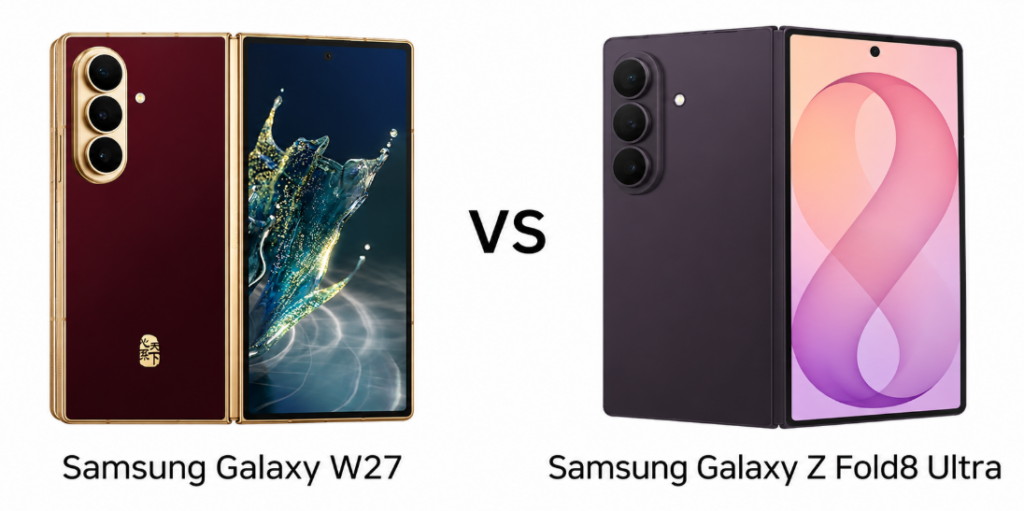
Samsung’s Galaxy W27 and Galaxy Z Fold8 Ultra present an unusual comparison. Rather than two competing foldables with substantially different hardware, they represent two regional interpretations of Samsung’s premium foldable flagship. The W27 targets China’s luxury smartphone market, while the Z Fold8 Ultra serves international buyers. Despite their shared hardware, a few exclusive features and regional differences make this comparison interesting.
Did You Know? The Samsung Galaxy W27 belongs to Samsung’s China-exclusive W Series, developed in partnership with China Telecom under the Heart to the World brand. Unlike the globally marketed Galaxy Z Fold series, the W lineup targets China’s premium luxury smartphone segment, bringing exclusive designs, premium packaging and China-specific features such as Tiantong satellite communication. The W27 is therefore more than a regional rename of the Galaxy Z Fold8 Ultra; it represents Samsung’s luxury-focused approach to the Chinese market.
1. Major Features:
| Category | Samsung Galaxy W27 | Galaxy Z Fold8 Ultra | Winner |
|---|---|---|---|
| Market Availability | China exclusive | Global markets | Z Fold8 Ultra – Wider availability |
| Launch Date | October 29, 2026 | August 6, 2026 | — |
| Design | Premium dual-tone design with gold accents | Conventional flagship design | W27 – More exclusive styling |
| Frame | Advanced Armor Aluminum | Advanced Armor Aluminum | Tie |
| Cover Protection | Gorilla Glass Ceramic 3 | Gorilla Glass Ceramic 3 | Tie |
| Water & Dust Resistance | IP48 | IP48 | Tie |
| Main Display | 8-inch Dynamic AMOLED 2X | 8-inch Dynamic LTPO AMOLED 2X | Z Fold8 Ultra – LTPO technology |
| Display Resolution | 2504 × 2256 pixels | 2504 × 2256 pixels | Tie |
| Cover Display | 6.5-inch Dynamic AMOLED 2X | 6.5-inch Dynamic LTPO AMOLED 2X | Z Fold8 Ultra – LTPO technology |
| Refresh Rate | 120Hz adaptive | 120Hz adaptive | Tie |
| Peak Brightness | 3,000 nits | 3,000 nits | Tie |
| Processor | Snapdragon 8 Elite Gen 5 for Galaxy | Snapdragon 8 Elite Gen 5 for Galaxy | Tie |
| GPU | Adreno 840 | Adreno 840 | Tie |
| RAM | 16GB LPDDR5X | 12GB / 16GB | W27 – 16GB standard |
| Storage | 512GB / 1TB | 256GB / 512GB / 1TB | Z Fold8 Ultra – More choices |
| Main Camera | 200MP, OIS | 200MP, OIS | Tie |
| Ultra-Wide Camera | 50MP | 50MP | Tie |
| Telephoto Camera | 10MP, OIS, 3x optical zoom | 10MP, OIS, 3x optical zoom | Tie |
| Digital Zoom | Up to 30x | Up to 30x | Tie |
| Inner Selfie Camera | 10MP | 10MP | Tie |
| Cover Selfie Camera | 10MP | 10MP | Tie |
| Battery | 5,000mAh | 5,000mAh | Tie |
| Wired Charging | 45W | 45W | Tie |
| Wireless Charging | 20W | 20W | Tie |
| Reverse Wireless Charging | Supported | 4.5W | Tie |
| Satellite Communication | Tiantong satellite communication | Not listed | W27 – Satellite connectivity |
| Operating System | Android 17 | Android 17 | Tie |
| User Interface | One UI 9 | One UI 9 | Tie |
| Software Updates | Not specified | Up to 7 major Android updates | Z Fold8 Ultra – Confirmed update policy |
| Wi-Fi | Wi-Fi 7 | Wi-Fi 7 | Tie |
| Bluetooth | 6.0 | 6.0 | Tie |
| NFC | Yes | Yes | Tie |
| UWB | Yes | Yes | Tie |
| USB | USB Type-C | USB Type-C 3.2 | Z Fold8 Ultra – Faster USB standard |
| SIM | Dual SIM | Nano-SIM + eSIM + eSIM (up to 2 active) | Z Fold8 Ultra – eSIM support |
| Fingerprint Sensor | Side-mounted | Side-mounted | Tie |
| Price (Base Variant) | ¥18,999 (approx. $2,830) | Approx. $2,100 | Z Fold8 Ultra – Lower starting price |
2. Design and Display
Build and Feel
The Galaxy W27 stands out with a more extravagant design, featuring gold-coloured accents, a textured frame and two distinctive finishes: Jixia Hong and Jihu Blue. Its premium appearance reflects Samsung’s China-exclusive Heart to the World series, giving it a more luxurious identity than the conventional flagship styling of the Z Fold8 Ultra.
The Z Fold8 Ultra takes a comparatively understated approach, prioritising a familiar flagship aesthetic. Both phones feature Advanced Armor Aluminum construction, IP48 protection and Gorilla Glass Ceramic 3 cover protection. The W27 looks more exclusive, but the Z Fold8 Ultra’s traditional styling makes it the more universally appealing option.
Display Quality
There is practically no reason to choose one over the other for display quality. Both feature an 8-inch Dynamic AMOLED 2X main display with a 120Hz adaptive refresh rate, 3,000-nit peak brightness and HDR10+ support. Their 6.5-inch cover displays also share 120Hz refresh rates and the same resolution.
The Z Fold8 Ultra additionally features LTPO AMOLED technology and an anti-reflective coating in its main display specifications. Both deliver an excellent experience for multitasking, gaming and watching content, although the Ultra has a slight advantage on paper in display technology.
Verdict
The W27 wins on visual exclusivity, while the Z Fold8 Ultra offers a more understated flagship aesthetic. Display performance is virtually identical, making design the primary reason to prefer either model.
3. Specifications Including Battery
Performance
Both foldables use Qualcomm’s Snapdragon 8 Elite Gen 5 for Galaxy processor and Adreno 840 GPU, making their underlying performance practically identical. However, the W27 simplifies the buying decision with 16GB RAM as standard and 512GB or 1TB storage configurations.
The Z Fold8 Ultra offers greater flexibility, starting with 12GB RAM and 256GB storage, while higher configurations provide up to 16GB RAM and 1TB storage. Both run Android 17 with One UI 9, and the global model offers up to seven major Android upgrades. Neither has a meaningful processing advantage, although the W27’s higher starting memory configuration is appealing.
Battery and Charging
Battery performance is another area where Samsung maintains parity. Both smartphones pack a 5,000mAh battery with 45W wired charging and 20W wireless charging. Reverse wireless charging is also available, allowing users to power compatible accessories.
Neither device offers a substantial battery advantage, and their charging capabilities should deliver a similar everyday experience. The Z Fold8 Ultra supports Qi2.2 wireless charging, while the W27 also brings 20W wireless charging. Battery capacity and charging speeds are not meaningful reasons to choose the more expensive model.
Verdict
Performance and battery life are essentially tied. The W27 gets an advantage in its minimum RAM configuration, but the Z Fold8 Ultra offers more affordable entry-level configurations without sacrificing processing power.
4. Camera
Main and Secondary Lenses
Samsung equips both foldables with the same triple-camera arrangement: a 200MP primary sensor with OIS, a 50MP ultra-wide camera and a 10MP telephoto camera with OIS and 3x optical zoom. This gives both devices comparable photographic versatility, from detailed everyday shots to wider landscapes and zoom photography.
Video capabilities are similarly impressive, with support for 8K recording at 30fps and 4K recording at up to 120fps. The identical camera hardware means buyers should not expect the W27 to deliver a significant improvement in image quality. Both are well-equipped flagship camera systems, with no meaningful hardware advantage for either model.
Selfie Camera
The front camera hardware is also unchanged. Both smartphones feature a 10MP inner display camera and a separate 10MP cover camera, providing flexibility for video calls, selfies and content creation.
The cover camera is particularly useful for taking selfies with the rear display preview, while the inner camera accommodates video calls when the device is unfolded. Since the camera specifications are identical, choosing the W27 does not bring an additional photography advantage. The Z Fold8 Ultra remains equally capable for everyday selfies and video communication.
Verdict
Neither smartphone wins the camera battle. Their identical 200MP main, 50MP ultra-wide and 10MP telephoto setups deliver essentially the same photographic capabilities, making camera performance irrelevant to the buying decision.
5. Pricing
The Samsung Galaxy W27 starts at ¥18,999 (priced around $2,830) for its 16GB/512GB configuration, while the 16GB/1TB model costs ¥21,999 (priced around $3,275). The Z Fold8 Ultra has a significantly broader lineup, with its entry-level US pricing starting around $2,100. Higher configurations cost more, with the 16GB/1TB version positioned closer to the W27’s premium pricing. This makes the W27 considerably more expensive at the entry level, despite sharing almost all its core hardware with the global model.
Is the price justified?
The W27’s premium pricing reflects its exclusive positioning, distinctive gold-accented design, satellite communication and higher minimum memory configuration. Samsung also bundles premium accessories, including a Kevlar magnetic case and a 45W charger in China. However, these extras do not fundamentally change the smartphone experience.
The Z Fold8 Ultra offers nearly identical hardware at a lower entry price, with broader regional availability and more flexible configurations. For most buyers, paying extra for the W27 is difficult to justify when its biggest advantages are cosmetic and region-specific.
Verdict
The Galaxy Z Fold8 Ultra is the clear value-for-money winner. The W27 is a luxury alternative, but its premium price is difficult to justify through hardware differences alone.
6. Conclusion
The Galaxy W27’s biggest differentiator is its Tiantong satellite communication, supporting satellite calls and messages when conventional mobile networks are unavailable. It also brings exclusive China-market styling, a premium gold-accented finish, 16GB RAM as standard, and a more elaborate retail package.
The Z Fold8 Ultra counters with wider international availability, more storage and memory configurations, and a more practical buying experience outside China. Importantly, the W27’s satellite functionality is tied to China’s Tiantong network and relevant carrier services, so it should not be considered a universal advantage for international buyers.
Verdict
The Samsung Galaxy Z Fold8 Ultra is the better purchase for most consumers, offering virtually identical flagship hardware, broader availability and better value. The W27 makes sense primarily for buyers who specifically want its exclusive design, China-market positioning and satellite communication features. Ultimately, it is a more luxurious regional alternative rather than a hardware upgrade.
Disclaimer: Prices, specifications, and availability may vary by region and retailer. Recommendations in this article are based on editorial opinion, feature-based value, and market positioning at the time of writing. Readers are advised to do their own research before making a purchase.
Read More:
- OnePlus Turbo 6V vs Nord 5: Is a 9000mAh Battery Better Than Flagship Performance?
- RedMagic 12 Pro+ vs OnePlus Ace 7 Pro: Which Flagship Gaming Phone Is Better?
- REDMAGIC 12 Pro+ China vs REDMAGIC 12 Pro Global: What’s Different?
FREE NEWSLETTER
Get Gizmochina Daily
Every morning: the phone and gadget news that matters, with our take. 4 minutes.


Comments