
OnePlus Turbo 6V and Turbo 6 share much of the same foundation, including a massive battery, fast charging and a similar camera setup. However, the standard Turbo 6 introduces several meaningful upgrades that could influence buying decisions. The real question is whether its performance, display and connectivity improvements justify the additional cost, or whether the Turbo 6V delivers everything most users need.
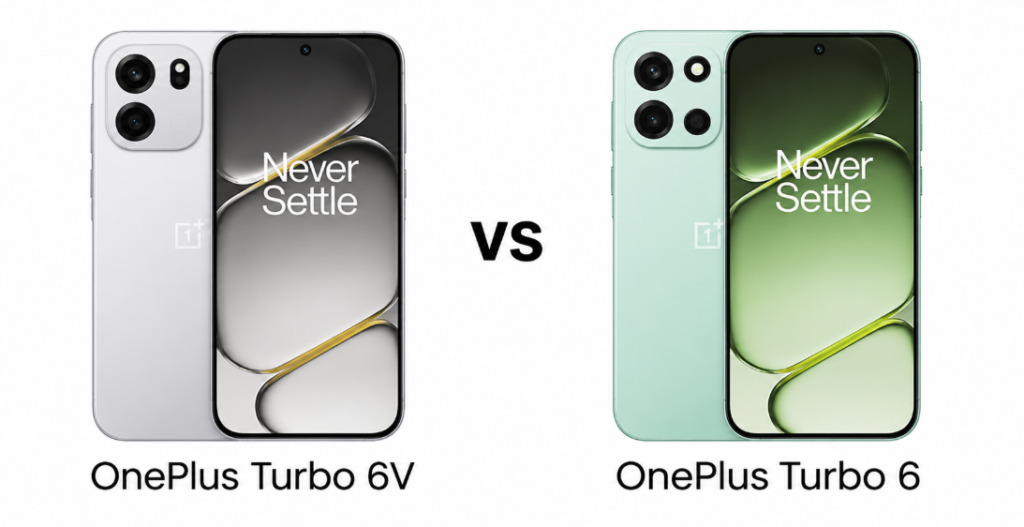
1. Major Features:
| Category | OnePlus Turbo 6V | OnePlus Turbo 6 | Winner & Reason |
|---|---|---|---|
| Design & Build | |||
| Dimensions | 162.5 x 77.5 x 8.5 mm | 162.5 x 77.5 x 8.5 mm | Tie |
| Weight | 215g | 217g | OnePlus Turbo 6V – Lighter |
| Protection | IP68/IP69K | IP68/IP69K | Tie |
| Display | |||
| Display Type | AMOLED, 1B colors | AMOLED, 1B colors | Tie |
| Display Size | 6.78 inches | 6.78 inches | Tie |
| Resolution | 1272 x 2772 pixels | 1272 x 2772 pixels | Tie |
| Refresh Rate | 144Hz | 165Hz | OnePlus Turbo 6 – Higher refresh rate |
| PWM Dimming | 3840Hz | 3840Hz | Tie |
| HDR Support | Not specified | HDR Vivid, HDR image support | OnePlus Turbo 6 – HDR support |
| Peak Brightness | 1800 nits | 1800 nits | Tie |
| Performance | |||
| Operating System | Android 16, ColorOS 16 | Android 16, ColorOS 16 | Tie |
| Chipset | Snapdragon 7s Gen 4 (4nm) | Snapdragon 8s Gen 4 (4nm) | OnePlus Turbo 6 – More powerful chipset |
| CPU | 2.7GHz octa-core | 3.21GHz octa-core | OnePlus Turbo 6 – Faster CPU |
| GPU | Adreno 810 | Adreno 825 | OnePlus Turbo 6 – More powerful GPU |
| Memory | |||
| RAM Options | 8GB / 12GB | 12GB / 16GB | OnePlus Turbo 6 – Higher RAM options |
| Storage Options | 256GB / 512GB | 256GB / 512GB | Tie |
| Storage Type | UFS 3.1 | UFS 4.1 | OnePlus Turbo 6 – Faster storage |
| Card Slot | No | No | Tie |
| Rear Camera | |||
| Main Camera | 50MP, f/1.9, PDAF, OIS | 50MP, f/1.9, PDAF, OIS | Tie |
| Auxiliary Lens | Color spectrum sensor | Color spectrum sensor | Tie |
| Video Recording | 4K@30/60fps, 1080p@30/60/120fps | 4K@30/60fps, 1080p@30/60/240fps | OnePlus Turbo 6 – Higher slow-motion frame rate |
| Front Camera | |||
| Selfie Camera | 16MP, f/2.4 | 16MP, f/2.4 | Tie |
| Selfie Video | 1080p@30fps | 1080p@30fps | Tie |
| Audio | |||
| Loudspeaker | Stereo speakers | Stereo speakers | Tie |
| 3.5mm Jack | No | No | Tie |
| Connectivity | |||
| Wi-Fi | Wi-Fi 6 | Wi-Fi 7 | OnePlus Turbo 6 – Newer Wi-Fi standard |
| Bluetooth | 5.4 | 5.4 | Tie |
| NFC | Yes | Yes | Tie |
| Infrared Port | Yes | Yes | Tie |
| USB | USB Type-C 2.0 | USB Type-C 2.0 | Tie |
| Battery | |||
| Battery Capacity | 9000mAh | 9000mAh | Tie |
| Charging | 80W wired | 80W wired | Tie |
| Reverse Charging | 27W wired | 27W wired | Tie |
| Approximate Price | $300 / ₹25,000 | $350 / ₹27,000 | OnePlus Turbo 6V – More affordable |
2. Design and Display
Build and Feel
The OnePlus Turbo 6V and Turbo 6 follow an almost identical design approach, with matching dimensions, IP68/IP69K protection and dual-SIM support. Both offer a durable construction designed to handle demanding everyday use. The Turbo 6V weighs slightly less at 215g compared with 217g for the standard model, but the difference is unlikely to influence purchasing decisions significantly.
Display Quality
Both smartphones feature a 6.78-inch AMOLED display with a 1.5K resolution, 3840Hz PWM dimming and up to 1800 nits peak brightness. The standard Turbo 6, however, upgrades the refresh rate from 144Hz to 165Hz and adds HDR Vivid support and HDR image compatibility. This makes the Turbo 6 more appealing for gaming and supported HDR content, although the Turbo 6V already delivers a smooth viewing experience.
Verdict
The Turbo 6 takes the display advantage with its higher refresh rate and HDR support. However, the Turbo 6V remains an excellent choice for users who do not need those additional visual upgrades.
3. Specifications Including Battery
Performance
The biggest difference between these smartphones is their processing hardware. The Turbo 6V uses the Snapdragon 7s Gen 4, while the Turbo 6 upgrades to the considerably more powerful Snapdragon 8s Gen 4. The standard model also gets the Adreno 825 GPU instead of the Adreno 810, making it better suited to demanding games, multitasking and sustained performance workloads. Storage is another important upgrade, with UFS 4.1 replacing UFS 3.1 on the Turbo 6. Both run Android 16 with ColorOS 16, but the standard model offers a more capable hardware foundation for demanding users.
Battery and Charging
Battery capacity is identical, with both smartphones packing a massive 9,000mAh silicon-carbon battery. Charging is also unchanged, featuring 80W wired charging and 27W reverse wired charging, alongside UFCS and additional charging protocol support. Neither model sacrifices battery endurance or charging convenience, making the Turbo 6V particularly attractive for buyers who prioritise battery life over processing power.
Verdict
The Turbo 6 is the clear performance upgrade, particularly for gaming and faster storage. However, identical battery hardware means the Turbo 6V delivers essentially the same endurance and charging experience.
4. Camera
Main and Secondary Lenses
Camera hardware remains largely unchanged between the two smartphones. Both feature a 50MP primary camera with an f/1.9 aperture, PDAF and optical image stabilisation, accompanied by a colour spectrum sensor. They also support 4K video recording at up to 60fps, with gyro-EIS and OIS. The Turbo 6 adds no major camera hardware advantage, although it supports 1080p recording at 240fps compared with 120fps on the Turbo 6V. This gives the standard model an advantage for slow-motion footage, but everyday photography capabilities should remain broadly similar.
Selfie Camera
Both smartphones feature an identical 16MP front-facing camera with an f/2.4 aperture and support for HDR and panorama photography. Video recording is also unchanged, with 1080p recording at 30fps and gyro-EIS. Neither phone offers a meaningful selfie camera upgrade, so buyers should not consider the standard Turbo 6 for its front camera capabilities alone.
Verdict
Camera hardware is effectively a tie. The Turbo 6 offers a higher slow-motion recording option, but the Turbo 6V provides almost the same photography and everyday video experience.
5. Pricing
The OnePlus Turbo 6V is priced around $300 / ₹25,000, while the standard OnePlus Turbo 6 is priced around $350 / ₹27,000. This creates a noticeable difference in positioning, with the Turbo 6V targeting budget-conscious buyers and the Turbo 6 sitting slightly higher in the lineup. The standard model costs more but brings meaningful improvements to processing power, storage speed and display technology.
Is the price justified?
The additional price of the Turbo 6 is reasonably justified for buyers who want stronger gaming performance, UFS 4.1 storage and a 165Hz HDR-capable display. However, spending less on the Turbo 6V makes more sense for everyday users because the battery, charging, camera hardware and overall design remain largely unchanged. The Turbo 6V offers better value for money, while the Turbo 6 offers more performance per upgrade.
Verdict
The Turbo 6V wins on affordability and overall value, but the Turbo 6 justifies its premium for users who will actually benefit from its hardware upgrades.
6. Conclusion
The OnePlus Turbo 6 and Turbo 6V are differentiated more by their internal hardware than their overall experience. The Turbo 6 stands out with its Snapdragon 8s Gen 4 chipset, Adreno 825 GPU, UFS 4.1 storage, 165Hz display and HDR Vivid support. Meanwhile, the Turbo 6V retains the same 9,000mAh battery, 80W charging, 27W reverse wired charging, IP68/IP69K protection and nearly identical camera hardware at a lower price.
Essentially, the Turbo 6 is designed for users who want flagship-class performance from this series, whereas the Turbo 6V focuses on delivering the core experience without unnecessary spending.
Verdict
The OnePlus Turbo 6 is the overall winner thanks to its substantially stronger processor, faster storage and better display. However, the Turbo 6V remains the smarter budget purchase for everyday users who value battery life and affordability over performance upgrades.
Read More:
- Huawei Pura 90 Plus vs iPhone 17 Pro: Huawei Wins on Hardware, But Is Apple Still Better?
- RedMagic 12 Pro+ vs Xiaomi 18 Pro: Which Flagship Is Worth Buying?
- OnePlus 16 vs OnePlus Ace 7 Pro: Which OnePlus Flagship Should You Buy?
FREE DAILY NEWSLETTER
Joel Explains
What matters in phones and gadgets, before it reaches you. From Gizmochina’s editor-in-chief, every morning.
Join 1,500+ readers. One email a day, unsubscribe in one click.




Comments