
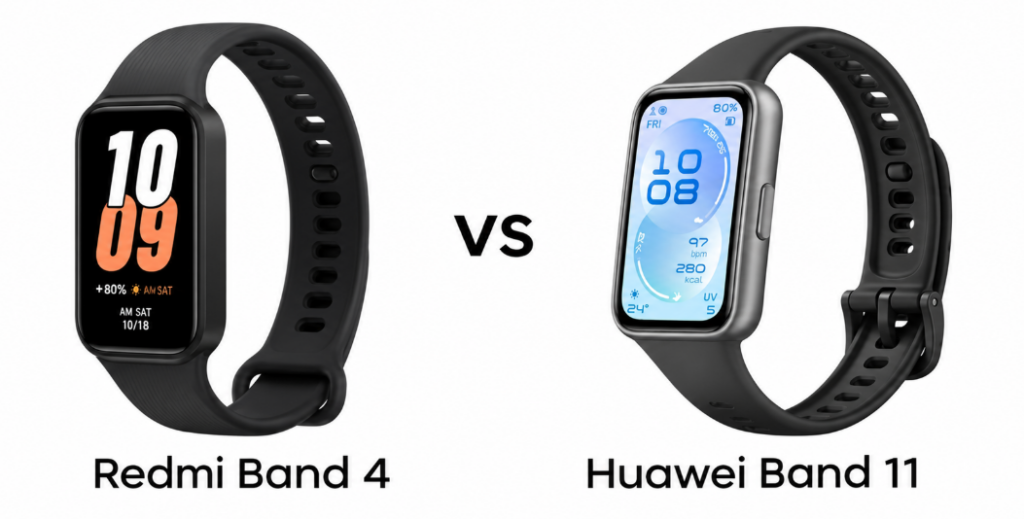
Redmi Band 4 and Huawei Band 11 are affordable fitness bands designed for users who want health monitoring, activity tracking and everyday convenience without investing in a full-fledged smartwatch. Redmi focuses on battery endurance and affordability, offering up to 21 days of battery life at approximately $25. Huawei takes a more feature-rich approach with a larger AMOLED display, advanced sleep tracking, around 100 workout modes and additional smart features. However, the Huawei Band 11 costs approximately $45, making the price difference worth considering. So, which fitness band offers the better overall experience?
1. Major Features:
| Category | Redmi Band 4 | Huawei Band 11 | Winner |
|---|---|---|---|
| Frame Design | Metal-textured Unibody | Aluminium Alloy / Polymer | Huawei – Material options |
| Display Size | 1.47-inch | 1.62-inch | Huawei – Larger display |
| Refresh Rate | 60Hz | 60Hz | Tie – Same refresh rate |
| Maximum Battery Life | Up to 21 days | Up to 14 days | Redmi – Longer battery life |
| Typical Battery Life | Approximately 8 days | Up to 8 days | Tie – Similar battery endurance |
| Heart Rate Monitoring | Supported | Supported | Tie – Both support monitoring |
| Blood Oxygen Monitoring | Supported | Continuous and manual | Huawei – More monitoring options |
| Stress Monitoring | All-day | Emotion/Stress Assistant Tracker | Huawei – Additional wellness features |
| Sleep Tracking | Supported | TruSleep | Huawei – Advanced sleep tracking |
| Women’s Health Tracking | Supported | Menstrual cycle tracking | Tie – Both support cycle tracking |
| Sports Modes | 50 | Around 100 | Huawei – More workout modes |
| Water Resistance | 5ATM | 5ATM | Tie – Same water resistance |
| Notifications | Supported | Calls and messages | Tie – Both support notifications |
| Price | $25 / ₹2,400 | $45 / ₹4,000 | Redmi – More affordable |
2. Design & Build
The Redmi Band 4 features a metal-textured unibody design, 2.5D curved glass and a vertically textured strap, giving it a refined appearance. Huawei Band 11 offers aluminium alloy and durable polymer variants, weighing approximately 17g and 16g respectively without the strap. Its slim 8.99mm profile also makes it comfortable for extended wear, including overnight sleep tracking.
Huawei additionally offers multiple colour options and fluoroelastomer straps, allowing users to choose between different finishes. While Redmi has an attractive textured design, Huawei provides more clearly defined material choices and a lightweight construction.
Winner: Huawei – Lightweight construction, slimmer profile and multiple material options.
3. Display
The display is one of Huawei Band 11’s biggest advantages. Redmi Band 4 features a 1.47-inch display with a 60Hz refresh rate and 2.5D curved glass. Huawei Band 11 offers a larger 1.62-inch AMOLED display with a 286 × 482 resolution and 347 PPI.
Huawei also delivers up to 1,500 nits of peak brightness, improving visibility in bright outdoor conditions. Its AMOLED panel offers rich colours and deep blacks, while Always-On Display allows users to check information without waking the screen. Both provide a 60Hz refresh rate, but Huawei offers a considerably more advanced viewing experience.
Winner: Huawei – Larger AMOLED display, 1,500-nit brightness and Always-On Display.
4. Battery Life & Charging
Battery endurance is where Redmi Band 4 fights back. It offers up to 21 days of battery life, compared with Huawei Band 11’s maximum of 14 days. Redmi also has an approximately eight-day battery life figure with regular monitoring.
Huawei provides more detailed battery estimates, including up to eight days under typical usage and three days with Always-On Display enabled. It uses magnetic charging and requires a 5V/1A charger. Redmi’s charging details are not included in the available specifications.
Although actual endurance depends on usage and enabled tracking features, Redmi’s higher maximum rating makes it attractive for users who prefer less frequent charging.
Winner: Redmi – Longer maximum battery endurance of up to 21 days.
5. Health & Wellness Tracking
Both bands support heart rate monitoring, blood oxygen tracking, stress monitoring and sleep tracking. Redmi Band 4 additionally includes women’s health tracking and all-day stress monitoring, covering essential wellness needs.
Huawei Band 11 expands the experience with TruSleep, detailed sleep insights and multidimensional emotional wellbeing monitoring. It also supports continuous SpO₂ monitoring and an Emotion/Stress Assistant Tracker. Its optical heart rate sensor provides continuous heart rate monitoring, while the Huawei Health app offers additional health insights.
These additions make Huawei particularly appealing to users interested in understanding sleep patterns, emotional wellbeing and daily health trends.
Winner: Huawei – More comprehensive sleep analysis and emotional wellbeing features.
6. Sports & Fitness Tracking
Redmi Band 4 supports 50 sports modes, covering a useful range of everyday physical activities. Huawei Band 11 goes further with approximately 100 workout modes, including yoga, strength training and rope skipping.
Huawei also features activity rings, running courses and a 9-axis IMU combining an accelerometer, gyroscope and magnetometer. Its fitness platform provides workout records, training load, recovery information, VO₂ max estimates and Running Ability Index.
This makes Huawei more appealing to users who regularly switch between different exercise routines or want additional information about their training. Redmi remains sufficient for users who primarily need basic activity tracking.
Winner: Huawei – Around 100 workout modes and more advanced fitness insights.
7. GPS & Outdoor Tracking
Neither band offers confirmed independent GPS positioning in the specifications being compared. However, Huawei Band 11 supports outdoor cycling route tracking through a compatible smartphone with GNSS, allowing users to record their routes without requiring a separate GPS receiver inside the band.
This functionality depends on smartphone compatibility and the Huawei Health app. Redmi Band 4’s specifications do not confirm built-in GPS or connected route tracking.
For users who regularly walk, run or cycle outdoors, Huawei provides a more clearly documented route-tracking experience, although carrying a compatible smartphone is necessary.
Winner: Huawei – Offers confirmed phone-assisted outdoor cycling route tracking.
8. Smart Features & Connectivity
Redmi Band 4 supports notifications, alarms, watch faces and WeChat and Alipay QR payments, although NFC is not supported. Huawei Band 11 offers Bluetooth 6.0 connectivity, notifications for calls and messages, calendar reminders and remote camera shutter functionality.
Huawei also supports more than 100 watch faces, personalised widgets, Always-On Display, timers, a stopwatch, a calculator, compass, weather information and phone-finding functionality. Users can also decline incoming calls and respond with preset messages on compatible smartphones.
Compatibility with Android 9.0 and later and iOS 13.0 and later further strengthens Huawei’s everyday usability. Redmi remains attractive for users who specifically value its QR payment options, but Huawei offers a broader collection of smart features.
Winner: Huawei – More everyday utilities, Bluetooth 6.0 and extensive personalisation.
9. Water Resistance & Everyday Use
Both Redmi Band 4 and Huawei Band 11 offer 5ATM water resistance, making them suitable for swimming and everyday exposure to water.
Huawei specifies that its rating supports shallow-water activities, including swimming pools and coastal swimming, but excludes diving, hot showers and high-pressure water activities. These limitations are important because 5ATM does not mean unrestricted underwater use.
Redmi offers the same nominal resistance rating, making the two bands comparable in this category. For users who want a fitness tracker for swimming, exercise and everyday wear, both provide suitable water protection within their rated limits.
Winner: Tie – Both feature 5ATM water resistance.
10. Which One Should You Buy?
At approximately $25 or ₹2,400, Redmi Band 4 is the better choice for budget-conscious users who prioritise battery life, basic health monitoring and essential fitness tracking. Its 21-day maximum battery rating is particularly attractive.
Huawei Band 11 costs approximately $45 or ₹4,000, but justifies the additional expense through its larger AMOLED display, 1,500-nit brightness, approximately 100 workout modes and more advanced wellness capabilities.
It also offers a wider range of smart features and phone-assisted route tracking. Users who want more than basic fitness monitoring will find Huawei’s additional capabilities worthwhile.
For buyers who can comfortably spend the extra $20, Huawei Band 11 is the stronger overall choice. Redmi Band 4 remains a practical alternative for users who value battery endurance and affordability above everything else.
Overall comparison: Huawei Band 11 wins in display quality, health and fitness capabilities, connectivity and smart features. Redmi Band 4 takes the lead in maximum battery endurance and price, making it the better budget option.
Disclaimer: Prices, specifications, and availability may vary by region and retailer. Recommendations in this article are based on editorial opinion, feature-based value, and market positioning at the time of writing. Readers are advised to do their own research before making a purchase.
FREE DAILY NEWSLETTER
Joel Explains
What matters in phones and gadgets, before it reaches you. From Gizmochina’s editor-in-chief, every morning.
Join 1,500+ readers. One email a day, unsubscribe in one click.


Comments