
As an Amazon Associate, Gizmochina earns from qualifying purchases. Links on this page may earn us a commission at no extra cost to you.
The Tensor G6 is Google’s latest and most powerful smartphone chipset that debuted with the Pixel 11 series. It introduces some serious upgrades, such as ARM’s latest C1-Ultra and C1-Pro cores running at higher speeds, a significantly upgraded Tensor Processing Unit (TPU), and advanced imaging pipelines. Still, those weren’t enough to beat the much more powerful Snapdragon 8 Elite Gen 6.
In our testing, the Tensor G6 lagged behind the Snapdragon 8 Elite Gen 5 significantly in terms of performance. So, we’ve now decided to put it against a step-down Qualcomm chipset, the Snapdragon 8 Gen 5, to see if the last-gen Snapdragon chip can still deliver better performance than the latest Tensor chip.
Let’s take a quick look at the spec sheet before we jump to the benchmark numbers.
| Tensor G6 | Snapdragon 8 Gen 5 | |
|---|---|---|
| Announced | August 2026 | November 2025 |
| Process node | 3 nm (TSMC) | 3 nm (TSMC) |
| CPU | 1x 4.11 GHz (C1-Ultra) 4x 3.38 GHz (C1-Pro) 2x 2.65 GHz (C1-Pro) | 2× 3.8 GHz (Oryon Gen 3 – Prime) 6× 3.32 GHz (Oryon Gen 3 – Performance) |
| GPU | PowerVR CXTP-48-1536 | Adreno 829 Ray tracing support Snapdragon Elite Gaming features |
| NPU | 5th-gen Tensor Processing Unit (TPU) | Qualcomm Hexagon NPU Agentic AI support |
| Memory | LPDDR5x Up to 4.2 GHz | LPDDR5x Up to 4.8 GHz |
| Storage | UFS 4.0, UFS 4.1 | UFS 4.0, UFS 4.1 |
| Camera | Up to 200 MP single camera 4K portrait video support Up to 8K video recording at 30 fps Up to 4K video recording at 120 fps 120x Pro Zoom support Real-time semantic segmentation | Qualcomm Spectra triple AI ISP (20-bit) Up to 320 MP single camera Up to 108 MP single camera with zero shutter lag at 30fps Up to 48 MP triple cameras with zero shutter lag at 30fps Up to 4K video recording at 120 fps Real-time semantic segmentation |
| Connectivity | MediaTek M90 5G modem Download speed: 12 Gbps (peak) Wi-Fi 7 Bluetooth 6.0 | Snapdragon X80 5G modem Download speed: 10 Gbps (peak) Upload speed: 3.5 Gbps (peak) Wi-Fi 7 (peak speed: 5.8 Gbps) Bluetooth 6.0 |
Tensor G6 vs Snapdragon 8 Gen 5: Benchmark score
Note: The benchmark tests were carried out using the Pixel 11 Pro XL (powered by the Tensor G6) and the OnePlus 15R (powered by the Snapdragon 8 Gen 5).
Geekbench performance (v6)
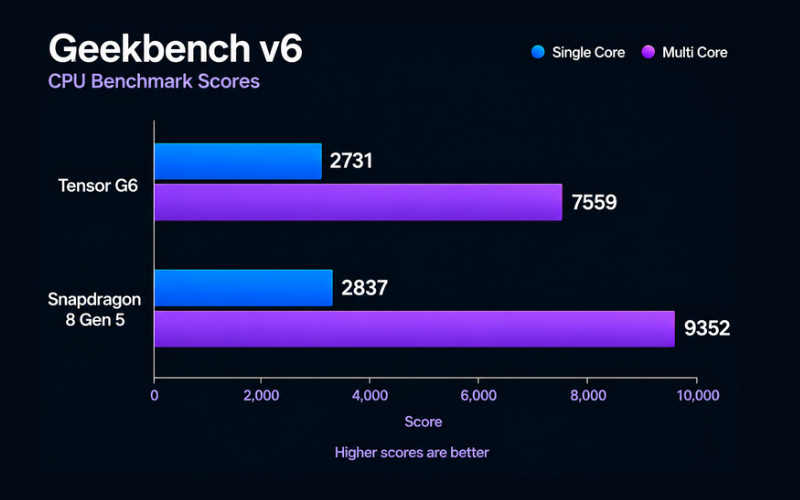
The Tensor G6 almost matches the Snapdragon 8 Gen 5 in single-core performance. The Snapdragon chip is still ahead with about 4% higher score. However, the gap widens to a staggering 23% in the multi-core test.
| Tensor G6 | Snapdragon 8 Gen 5 | |
|---|---|---|
| Single core | 2,731 | 2,837 |
| Multi core | 7,559 | 9,352 |
Geekbench 6 results suggest the two chips will deliver similar performance in everyday tasks. However, Snapdragon 8 Gen 5-powered devices will deliver much better performance during high CPU workloads like video editing, rendering, streaming, and heavy multitasking.
AnTuTu performance (v11)
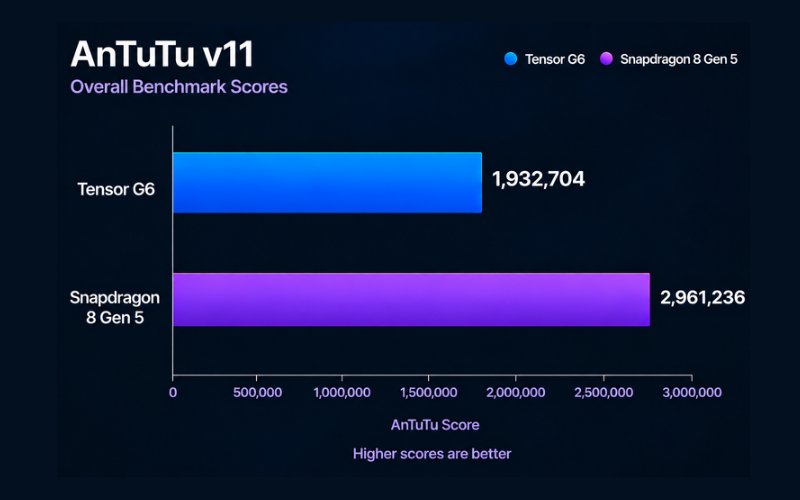
On the AnTuTu benchmark (v11), the Tensor G6 stays below the 2 million mark, but the Snapdragon 8 Gen 5 almost touches 3 million. That’s a solid 53% gain for the Snapdragon chip.
| Tensor G6 | Snapdragon 8 Gen 5 | |
|---|---|---|
| AnTuTu score | 1,932,704 | 2,961,236 |
| CPU | 819,662 | 914,878 |
| GPU | 450,458 | 974,402 |
| Memory | 290,635 | 382,729 |
| UX | 371,949 | 689,228 |
The breakdown of the AnTuTu score shows the Snapdragon 8 Gen 5 gets 11% higher CPU score and a massive 116% higher GPU score. Qualcomm’s chips have always been absolutely dominant with GPU performance over Tensor chips, and nothing changes with the newest Tensor G6.
The memory and user experience (UX) performance results also go into Snapdragon’s favor, achieving 31% and 85% higher scores, respectively.
3DMark performance
Wild Life Extreme Stress Test
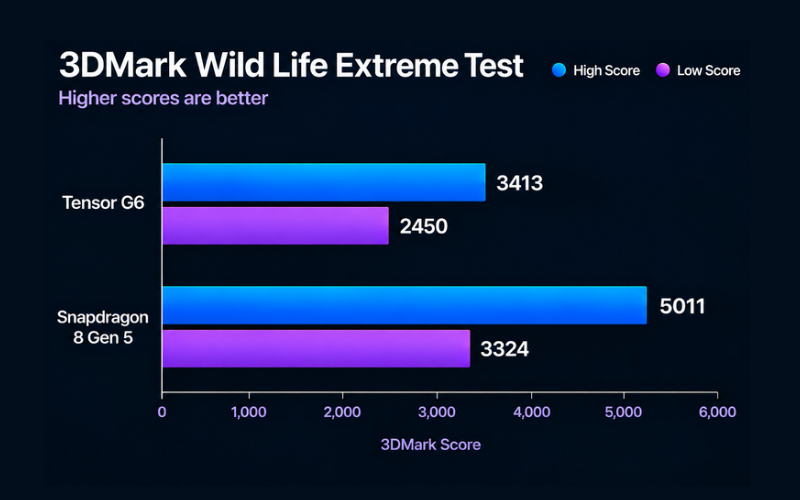
We also ran the chips through the popular gaming benchmark, 3DMark Wild Life Extreme Stress Test, to better understand how they perform during extensive gaming sessions.
| Tensor G6 | Snapdragon 8 Gen 5 | |
|---|---|---|
| High score | 3,413 | 5,011 |
| Low score | 2,450 | 3,324 |
| Stability | 71.7% | 66.3% |
The Snapdragon 8 Gen 5 delivers solid numbers, again. The high score is 46% better and the low score is 35% better than the Tensor G6.
If you take a close look at the scores, the low score of the Snapdragon 8 Gen 5 is actually much closer to the high score of the Tensor G6. That itself shows how superior the Snapdragon 8 Gen 5 is.
Performance-wise, the Snapdragon 8 Gen 5 is much better than the Tensor G6. But there are other factors as well, such as camera capabilities, connectivity, and NPU capabilities, you need to consider before making a conclusion.
Tensor G6 vs Snapdragon 8 Gen 5: Key differences that matter
Tensor G6 has a higher peak CPU speed, but less capable CPU setup
Unlike most smartphone chipsets, the Tensor G6 has a 7-core CPU, featuring ARM’s C1-series cores. The Snapdragon 8 Gen 5, on the other hand, uses an 8-core CPU setup, with all cores designed by Qualcomm itself.
The Snapdragon chip features a ‘2+6’ CPU cluster, which is optimized towards performance compared to the Tensor G6 with ‘1+4+2’ configuration, which aims to offer a balanced performance and power efficiency, even though it has a higher peak frequency of 4.11 GHz (vs. 3.8 GHz).
Tensor G6 is a big NO for gamers, but the Snapdragon 8 Gen 5 shines
For gaming and graphics rendering-related tasks, the Tensor G6 is equipped with a PowerVR CXTP-48–1536 GPU, which isn’t well optimized for high-end gaming. Casual gaming sessions should be fine though.
This is where the Snapdragon 8 Gen 5 shines. It features a powerful Adreno 829 GPU with deeper gaming optimizations and Snapdragon Elite Gaming features to deliver an excellent gaming experience, even during long sessions. Game developers also put some extra effort optimizing popular titles primarily for Qualcomm Adreno GPUs.
Tensor G6 has a tighter NPU integration
Google has put more focus on delivering a far better on-device AI experience. The new 5th-gen Tensor Processing Unit (TPU) delivers 50% more compute power and twice the memory bandwidth over the Tensor G5.
The TPU enables Google to offer features such as Instant Night Sight , 4K Portrait Video, Magic Capture, 120x Pro Zoom, Proactive Assistance, and Live Media Translate on Pixel devices without relying on cloud servers.
Qualcomm, on the other hand, takes a different approach with NPUs integrated into their Snapdragon chips. Their chips feature developer-friendly AI engines designed for flexible third-party models and always-on sensing. The Snapdragon 8 Gen 5 features a Qualcomm Hexagon NPU with agentic AI support.
Snapdragon 8 Gen 5 prioritizes raw bandwidth, while Tensor G6 focuses on strong ISP-TPU integration
The Snapdragon 8 Gen 5 packs a Spectra Triple 20-bit AI-ISP, built to handle massive data streams simultaneously across multiple high-resolution sensors. It supports up to 320MP camera sensor and 8K video recording at 60 fps.
The Tensor G6 supports a lower peak resolution of 200MP, but prioritizes a tighter ISP integration with TPU to offer up to 4.5x faster Night Shots capture and 120x Pro Zoom support. The chip has a dedicated hardware accelerator directly into the ISP that unlocks 4K Portrait Video on Pixel phones without overheating or dropping frames. The 8K video recording, though, is limited to 30 fps.
Best smartphones with these chipsets
Tensor G6
Snapdragon 8 Gen 5
FREE DAILY NEWSLETTER
Joel Explains
What matters in phones and gadgets, before it reaches you. From Gizmochina’s editor-in-chief, every morning.
Join 1,500+ readers. One email a day, unsubscribe in one click.

Comments