
Add GIZMOCHINA as Preferred Source on Google
The Tensor G6 has been released with the new Pixel 11 series, and it brings serious upgrades over last year’s Tensor G5. The new chip utilizes ARM’s latest C1-Ultra and C1-Pro cores running at higher speeds, a significantly upgraded Tensor Processing Unit (TPU), and advanced imaging pipelines that enable next-gen camera features.
Qualcomm’s Snapdragon chips, on the other hand, have long been dominating the battle against Tensor chips by maintaining a huge performance gap. So, whenever a new Tensor chip arrives, it’s exciting to test it against the latest high-end Snapdragon chip to find out if Google has narrowed the gap.
TL;DR
– Raw Power vs. Intelligence: Snapdragon 8 Elite Gen 5 dominates in raw CPU/GPU benchmarks and heavy gaming performance, while Tensor G6 focuses on deep on-device AI integration and computational photography.
– The Better Pick: Choose Snapdragon for maximum horsepower and sustained performance, but go with Tensor if you prioritize smarter Pixel software features powered by custom silicon.
For a broader view of how this chip stacks up against the rest of Qualcomm’s lineup, see our roundup of best Snapdragon chipsets in 2026.
Let’s get straight to the spec sheet, and then to benchmark comparison to find out how the Tensor G6 and Snapdragon 8 Elite Gen 5 stack up against each other.
Tensor G6 vs Snapdragon 8 Elite Gen 5: Spec sheet
| Tensor G6 | Snapdragon 8 Elite Gen 5 | |
|---|---|---|
| Announced | August 2026 | September 2025 |
| Process node | 3nm (TSMC) | 3nm (TSMC) |
| CPU | 1 x 4.11 GHz (C1-Ultra) 4 x 3.38 GHz (C1-Pro) 2 x 2.65 GHz (C1-Pro) | 2 x 4.61 GHz (Oryon Gen 3 Prime) 6 x 3.63 GHz (Oryon Gen 3 Performance) |
| GPU | PowerVR CXTP-48-1536 | Adreno 840 Ray tracing support Snapdragon Elite Gaming features |
| NPU | 5th-gen Tensor Processing Unit (TPU) | Qualcomm Hexagon NPU |
| Memory | LPDDR5X | LPDDR5X up to 5.3 GHz |
| Storage | UFS 4.0, UFS 4.1 | UFS 4.0, UFS 4.1 |
| Camera | up to 200MP single camera 4K portrait video support up to 8K video recording at 30fps up to 4K video recording at 120fps 120x Pro Zoom support real-time semantic segmentation | Qualcomm Spectra Triple ISP (20-bit) up to 320MP single camera up to 8K video recording at 60fps up to 4K video recording at 120fps real-time semantic segmentation (limitless) Advanced Professional Video (APV) codec |
| Connectivity | MediaTek M90 5G modem up to 12 Gbps download speed Wi-Fi 7 Bluetooth 6.0 | Snapdragon X85 5G modem up to 12.5Gbps download speed up to 3.7Gbps upload speed Wi-Fi 7 (peak speed: 5.8Gbps) Bluetooth 6.0 |
Tensor G6 vs Snapdragon 8 Elite Gen 5: Benchmark scores
Note: The benchmark tests were performed on the Google Pixel 11 Pro XL (powered by the Tensor G6) and the Samsung Galaxy S26 Ultra (powered by the Snapdragon 8 Elite Gen 5).
Geekbench score (v6)
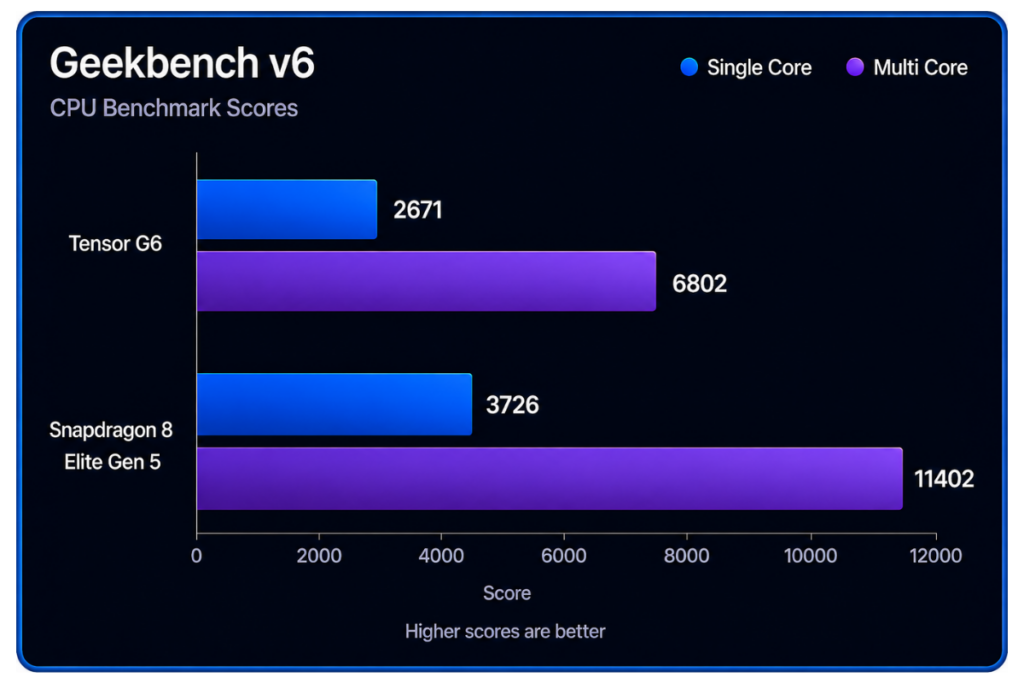
The Galaxy S26 Ultra, powered by the Snapdragon 8 Elite Gen 5, heavily outperforms the Tensor G6-powered Pixel 11 Pro XL. The single-core performance is up by 39%, while the multi-core performance increase jumps to 67%.
| Tensor G6 | Snapdragon 8 Elite Gen 5 | |
| Single core | 2671 | 3726 |
| Multi core | 6802 | 11402 |
Geekbench shows the latest Snapdragon chip continues to dominate Tensor chips in CPU performance.
But what other GPU and other performance metrics? We’ve put them to the test on AnTuTu and 3DMark to find out.
AnTuTu score (v11)
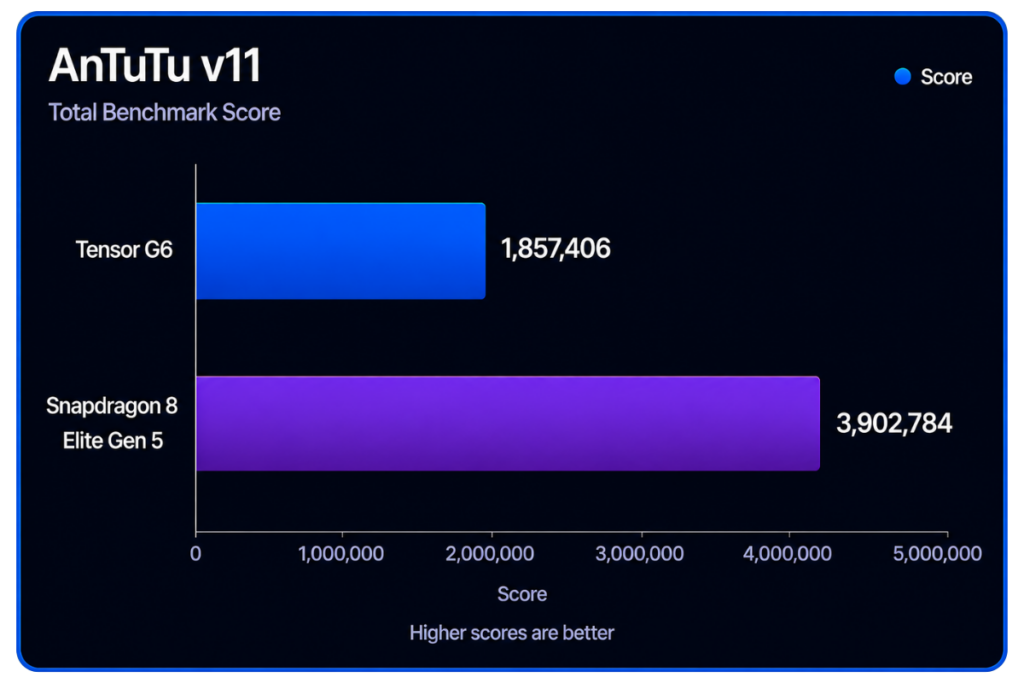
The Snapdragon 8 Elite Gen 5 also dominates the AnTuTu benchmark. It scores about 3.9 million in total, while the Tensor G6 struggles at 1.8 million. That’s a solid 110% boost for the Snapdragon chip.
The breakdown of the AnTuTu score gives a rather clearer picture.
| Tensor G6 | Snapdragon 8 Elite Gen 5 | |
| AnTuTu score | 1,857,406 | 3,902,784 |
| CPU | 787,728 | 1,165,473 |
| GPU | 432,908 | 1,572,568 |
| Memory | 279,312 | 411,987 |
| UX | 357,458 | 752,756 |
The Snapdragon 8 Elite Gen 5 pulls ahead across all AnTuTu tests. The CPU score is up by 48%, while the GPU score is up by a massive 263%. That itself is enough to know which is for gamers. Still, we ran the 3DMark gaming-specific test for better clarity. (check the score below)
The memory and user experience tests during the AnTuTu test also favor the Snapdragon 8 Elite Gen 5 over Tensor G6.
3DMark score
Wild Life Extreme Stress Test
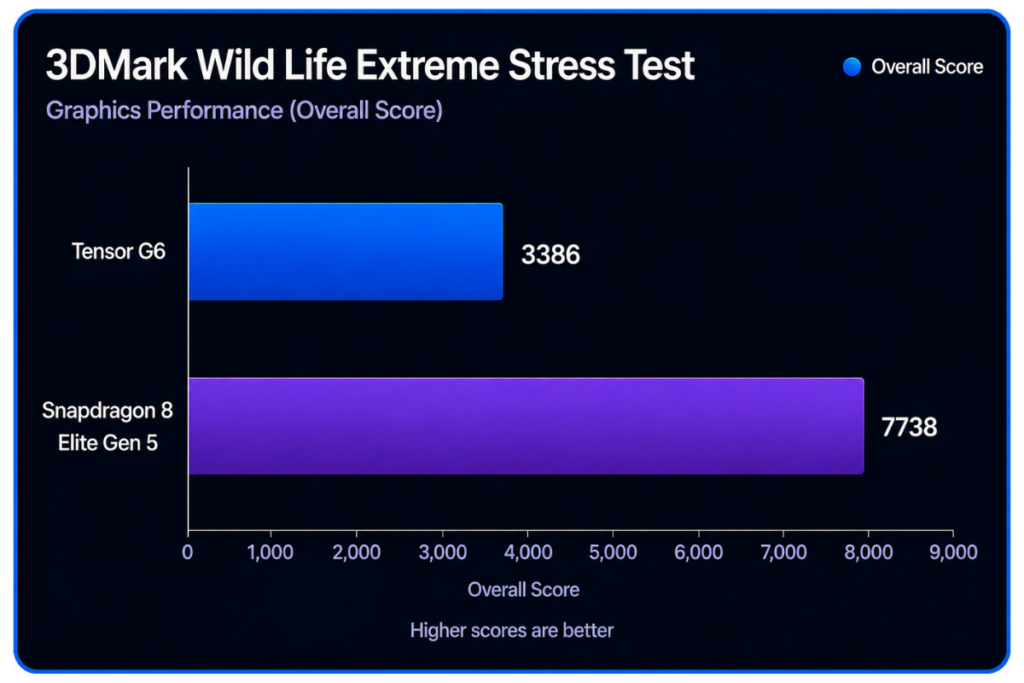
The 3DMark Wild Life Extreme Stress test measures how well a device maintains its graphical performance and manages heat over an extensive period of demanding 3D sequences.
When tested, the Tensor G6-powered Pixel 11 Pro XL gets an overall score of 3386 with an average of 20.31 fps. The Galaxy S26 Ultra, powered by Snapdragon 8 Elite Gen 5, pulls off 7738 in average score with an average fps of 46.34.
Not only does the Snapdragon 8 Elite Gen 5 achieve over a 128% higher score, but it also maintains an average fps more than twice that of the Tensor G6.
| Tensor G6 | Snapdragon 8 Elite Gen 5 | |
| Overall score | 3386 | 7738 |
| Average FPS | 20.31 | 46.34 |
The Snapdragon 8 Elite Gen 5 absolutely shines compared to the Tensor G6 across every benchmark we ran them through, and Google’s fine with it. Tensor chips aren’t designed to compete on synthetic benchmarks, but there’s something unique about these chips.
Tensor G6 lags much behind its competitors on benchmarks, and Google’s fine with it
Google has explicitly stated that its Tensor chips are not designed to win benchmark battles against high-end chips from Apple, Qualcomm, and MediaTek. Instead, they focus on delivering helpful experiences and excellent on-device AI capabilities.
Unlike Apple or Qualcomm, which focus on maximizing single-core and multi-core clock speeds, Google’s design goal is heterogeneous computing. This means Tensor chips are designed so that different subsystems (CPU, GPU, ISP, and TPU) work together to execute specific tasks efficiently, rather than just making the CPU as fast as possible.
The defining feature of Tensor chips is the TPU (Tensor Processing Unit). All of us are aware of Pixel’s software magic, and at its core is a powerful TPU that can run complex AI models locally on-device. It powers features like Live Translate, Magic Eraser, Real Tone processing, and other on-device generative AI smarts.
Tensor G6 vs Snapdragon 8 Elite Gen 5: Which one is right for you?
If you prioritize raw power and top-tier sustained gaming performance, the Snapdragon 8 Elite Gen 5 remains the undisputed powerhouse. However, if you value personal AI assistants and intuitive features like Magic Eraser, real-time Live Translate, and Google’s computational photography magic, the Tensor G6 delivers a much more intelligent, tailored smartphone experience.
Choose Snapdragon for excellent gaming performance, but pick Tensor if you want software magic powered by purpose-built silicon.
Best Google Tensor G6 phones:
- Google Pixel 11
- Google Pixel 11 Pro
- Google Pixel 11 Pro XL
- Google Pixel 11 Pro Fold
Best Snapdragon 8 Elite Gen 5 phones:
- Samsung Galaxy S26 Ultra
- Oppo Find X9 Ultra
- Vivo X300 Ultra
- Xiaomi 17 Ultra
- iQOO 15 Ultra




Comments