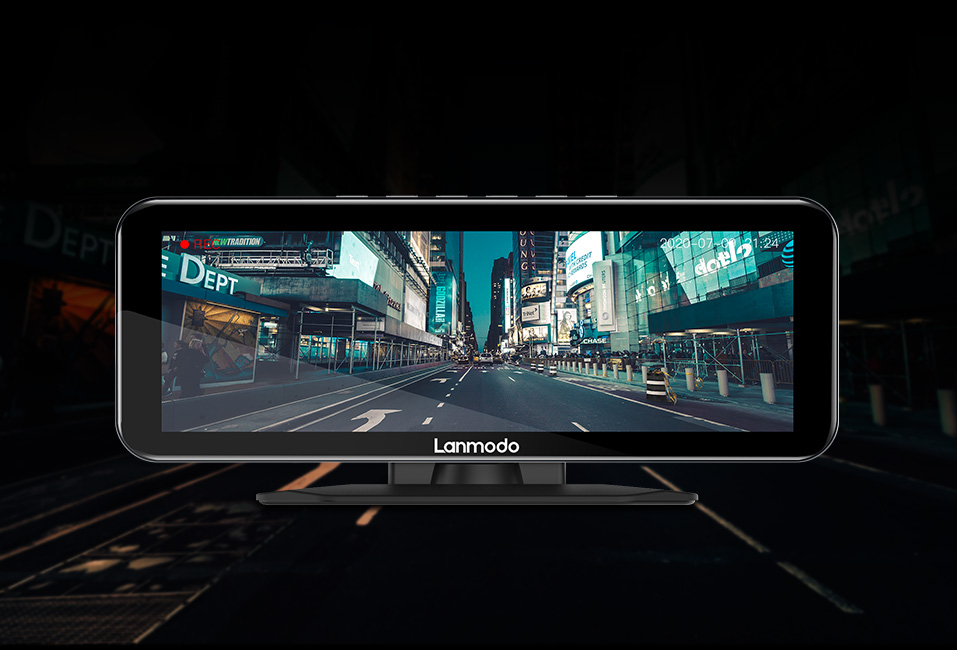
Lanmodo is well-known for its car accessories across the globe. The company recently launched the Vast Pro night vision system to facilitate the car drivers while driving in the night. It even houses a dash camera to record videos and captures your whole travel. The night vision system can be yours for $199 after its official launch if you become a golden member at $10 now.
There are several other perks of becoming a golden member. It can save you $420 as the actual retail price of the night vision system will be $619. It will be available on priority to the golden members once it arrives on the IndieGoGo crowdfunding website. Moreover, the $10 is refundable if you don’t purchase Lanmodo products.
Lanmodo Vast Pro night vision system assist the car drivers through the darkness. It can be easily installed with minimal apparatus. The night vision system features a driving recorder, parking mode, and shows full colors using low-light imaging. The high-resolution front and rear camera capture the road view at 1080p high resolution.
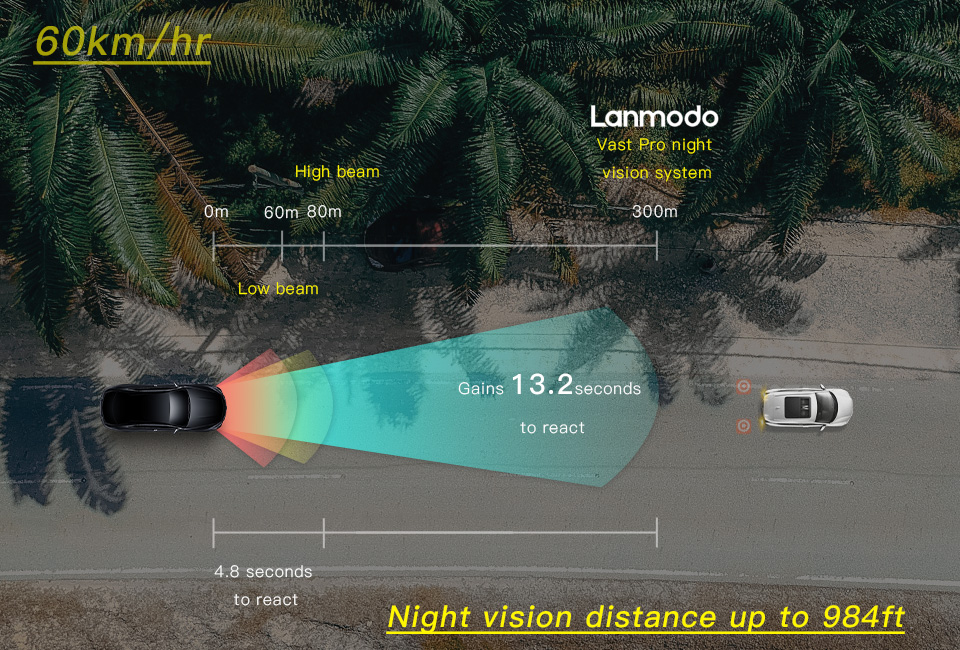
The camera at a 45-degree angle presents a broader view that is beyond our naked eyes. It can easily capture up to a distance of 984ft which is much farther than the normal headlights. Such a vast reach enables us to avoid accidents as it provides more reaction time.
Moreover, it records the whole travel which is quite useful in case you met with some accident. It can record until 128GB storage is not full at the resolution of 1080p. The parking sensor on the rear and front protects to avoid any obstruction.
You can get such a useful device for the price of $199 if you become a golden member now.
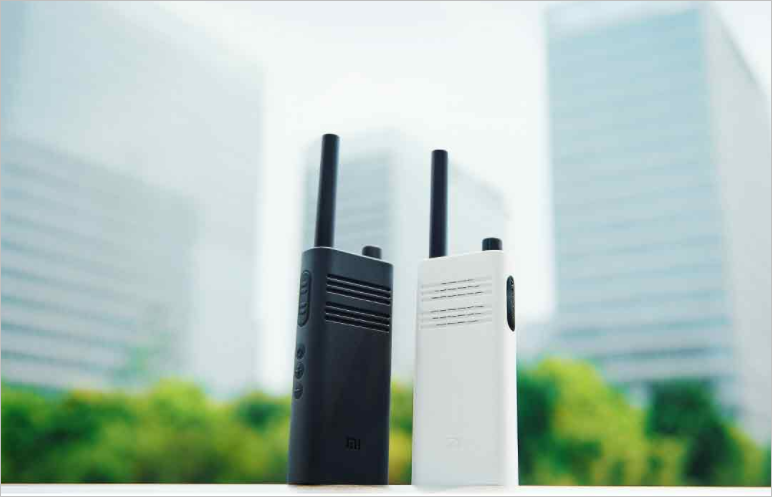
Xiaomi has launched a cheaper version of the three-generation Mi Walkie Talkie. This model is dubbed Mi Walkie Talkie Lite and carries a price tag of 129 yuan ($18). The lite version is a trimmed-down version of the Mi Walkie Talkie which was first launched in 2017. Since then, Xiaomi also launched the Mi Walkie Talkie 1s and Mi Walkie Talkie 2 in 2018 and 2019 respectively.
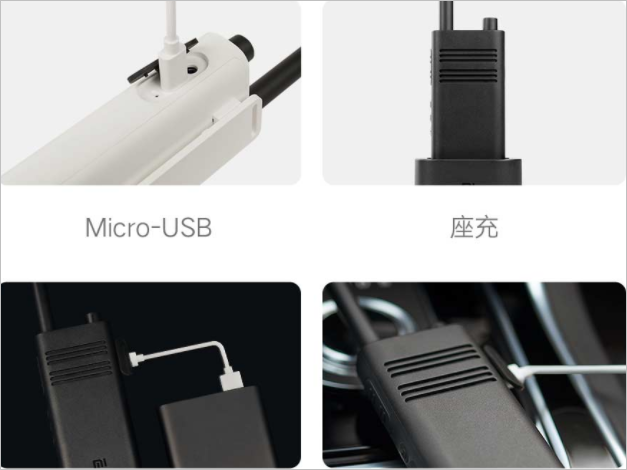
The Mi Walkie Talkie Lite has a transmission power of 3W, a range of 1-5 kilometres in an open environment and 1-3 kilometres in an urban environment. There is a 2000mAh battery with a standby time of up to 5 days. The battery also supports continuous use for 10 hours. This is against the 6 kilometres range and 13 days of long standby of the MIJIA Walkie Talkie 2.
The entire device weighs only 163 grams and adopts a hard and scratch-resistant spark design. It is portable and easy to use and also comes with a quick-release back clip. The 40mm large-diameter loudspeaker has a 23% larger field sound radiation area than the 36mm traditional walkie-talkie. The speech sound is more penetrating, and it can ensure a good call effect in a noisy environment.
The Walkie-Talkie Lite can be paired with the MIJIA app in order to select a frequency, backup frequency information, and turn on button-free calls, saying goodbye to traditional cumbersome operations.
After the walkie-talkie enters the pairing mode, the 16 frequency channels of the walkie-talkie can be copied to other walkie-talkies in the nearby receiving state at the same time , realizing one-to-many frequency allocation.
The Mi Walkie Talkie Lite is presently available in China via Xiaomi Youpin.
Xiaomi is known for offering value for money smartphones since its inception. It was one of the few OEMs responsible for the 4G smartphone revolution in India. Due to which, it is now leading the market for years. Now, the company is aiming to make a name for itself in Europe following the same principle. To begin its aggressive push to the region, it has officially announced to launch a sub-€300 5G smartphone this month.
Xiaomi has been operating its business in Europe for a few years now. It has been slowly growing its market share in these countries for the past few quarters. With Huawei’s decline, the company is trying to push hard as possible with growing competition from OPPO and realme.
Though Xioami’s Redmi brand offers a number of affordable 5G handsets in China, they are yet to make their way to international markets. Instead of bringing them, the company announced to launch a Mi 10 series device powered by Qualcomm Snapdragon 700 series chipset.
Currently, the only mid-range 5G phone that Xiaomi sells in Europe is Mi 10 Lite priced at €350. It features the popular Snapdragon 765G SoC, which is found in almost all the budget 5G devices sold globally.
The only other Snapdragon 700 series chip to offer 5G is Snapdragon 768G. Hence, the upcoming mysterious below €300 price tag Xiaomi 5G handset to be either power by one of these chipsets or by something else, which Qualcomm will announce a few days ahead of the phone’s official launch.
Anyway, as this smartphone is expected in September itself, we can expect the company to soon begin teasing it in the coming days.
The era in which even pathogens are turning smart, the all-new AOSO Smart Robotic Cleaner should be of your choice to keep your place neat and tidy. Now up for pre-sale at a decent price tag of $229.99, the smart cleaner has a bunch of smart features and capabilities up its sleeve.
As per the creator, the Smart Robotic Cleaner features Advanced Visual SLAMwhich empowers your smart life. The AOSO cleaner also offers auto navigation and mapping, 166° wide-angle camera, app-based remote control, and other smart features.
Apart from all the robotic hi-fi features, the cleaner is powerful enough with up to 2000 Pa suction which can be operated in three suction modes. For better control over the cleaning process, the cleaner provides four cleaning modes.
The cleaner operates on a quite decent 3,200mAH rechargeable battery which is rated to last for an impressive 110 minutes of maneuver. An LED display is present on which you can have a quick look at the remaining battery level and other important functions such as the current mode of operation etc.
As of the build, the AOSO Smart Cleaner weighs in at just 3.5Kg. Design-wise, it’s so compact and looks pleasing on the eyes. It has an anti-collision and anti-drop sensor, so you can have peace of mind while the robot is on its spree of cleaning your premises.
Here is a quick glance at the USPs of the smart cleaner.
Advanced Visual SLAM Technology with 166° wide-angle Camera;
App support for automation and remote control.
Up to 2000 Pa suction, three suction modes.
Ultra Strong Battery Capacity 3,200mAh claimed to last for 110 minutes.
Four Cleaning Modes: Auto mode, Spot mode, Edge mode, and Scheduled mode
As mentioned, the Robotic Smart Cleaner is up for pre-sale with a discounted price of $229.9 and the early bird sale ends on 15th September 2020. The shipment, as provided on the sale page, is scheduled to begin from 17th September 2020. So, if you tend to get one of them for your house or professional premises, then do it now. Note that, post the pre-sale the contraption will bear a price tag of $300. If interested, you may place your order from Tiktech right now.
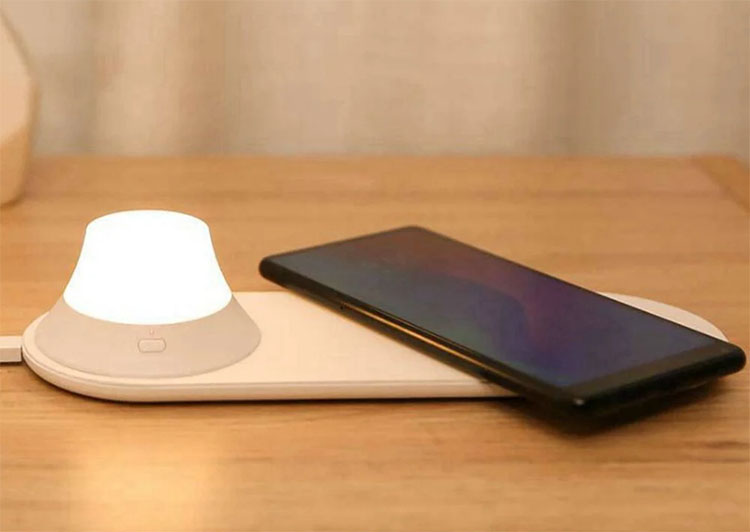
Yeelight is offering a Wireless Charger for iPhone at a discount price of $26.24 using a coupon code. It offers several advanced features that make it worth purchase if you’re looking for a wireless charger for iPhone and other compatible smartphones. The wireless charger uses premium material like ABS and PC. It usually retails for $34.99 but under the ongoing sale, you can grab it at a 25% discount.
Apart from the wireless charging mechanism, the product also offers charging night warm light for eye protection. It houses a 500 mAh polymer lithium battery for standalone charging and powering the light. It inputs a supply of 5V 2A / 9V 2A with an output supply of 5V 5W Max/ 9V 10W Max.
The useful yet beautifully crafted wireless charger offers a night light on one side and wireless fast charging on the other side. It houses features like overvoltage protection and even detects unsupported devices. The users can even remove the magnetic night light easily.
Yeelight Wireless Charger supports multiple devices for fast charging apart from the iPhones.
In order to grab the Yeelight Wireless Charger, you can order it using the coupon code Yeelight25 from the Newchic store. The discount will reflect after applying the coupon code.
Xiaomi’s flagships have always been popular for its incredible cost to performance ratio. However, if you are familiar with Xiaomi’s strategy, you should also know that the company usually cuts down some features to save costs.
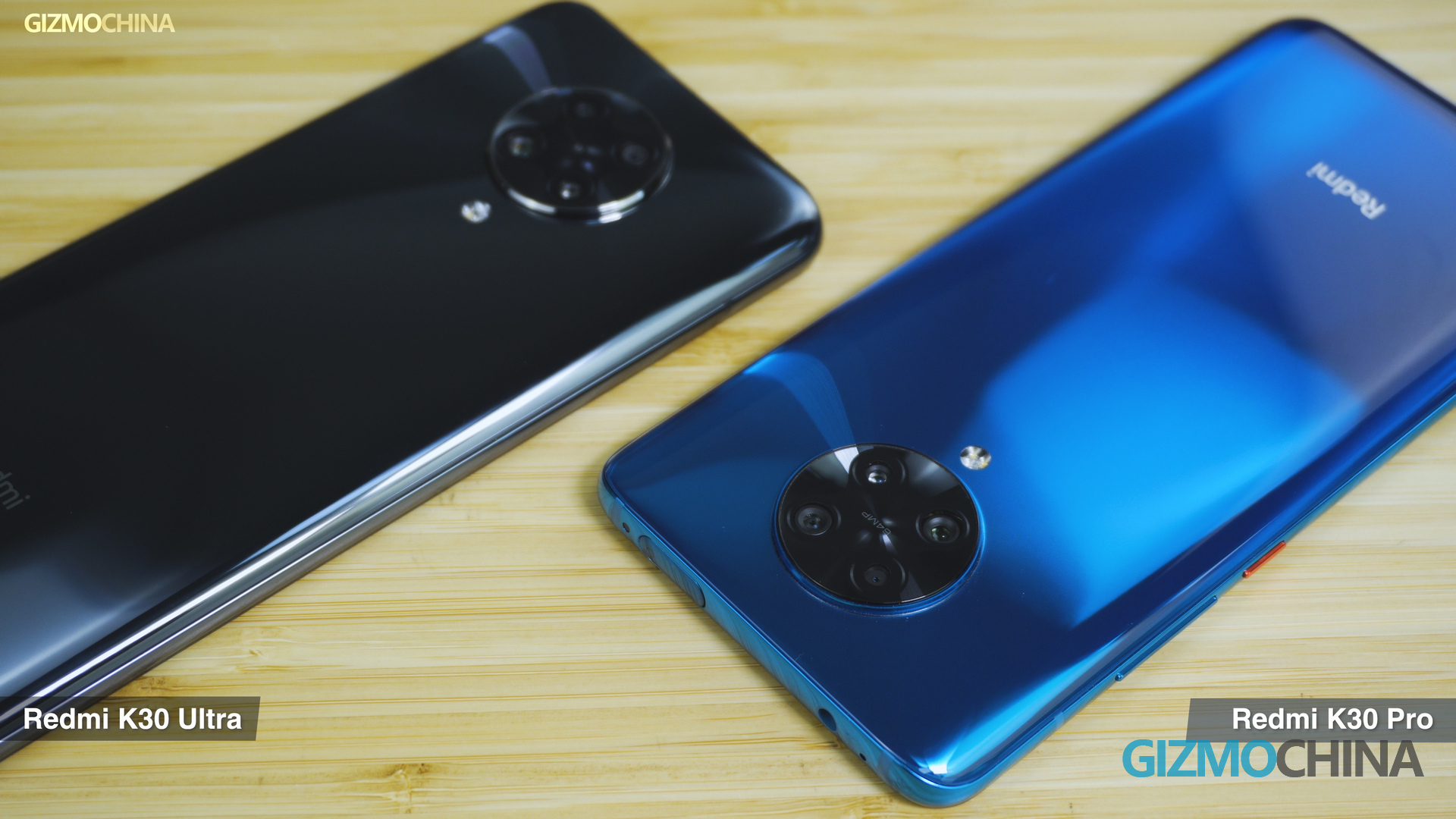
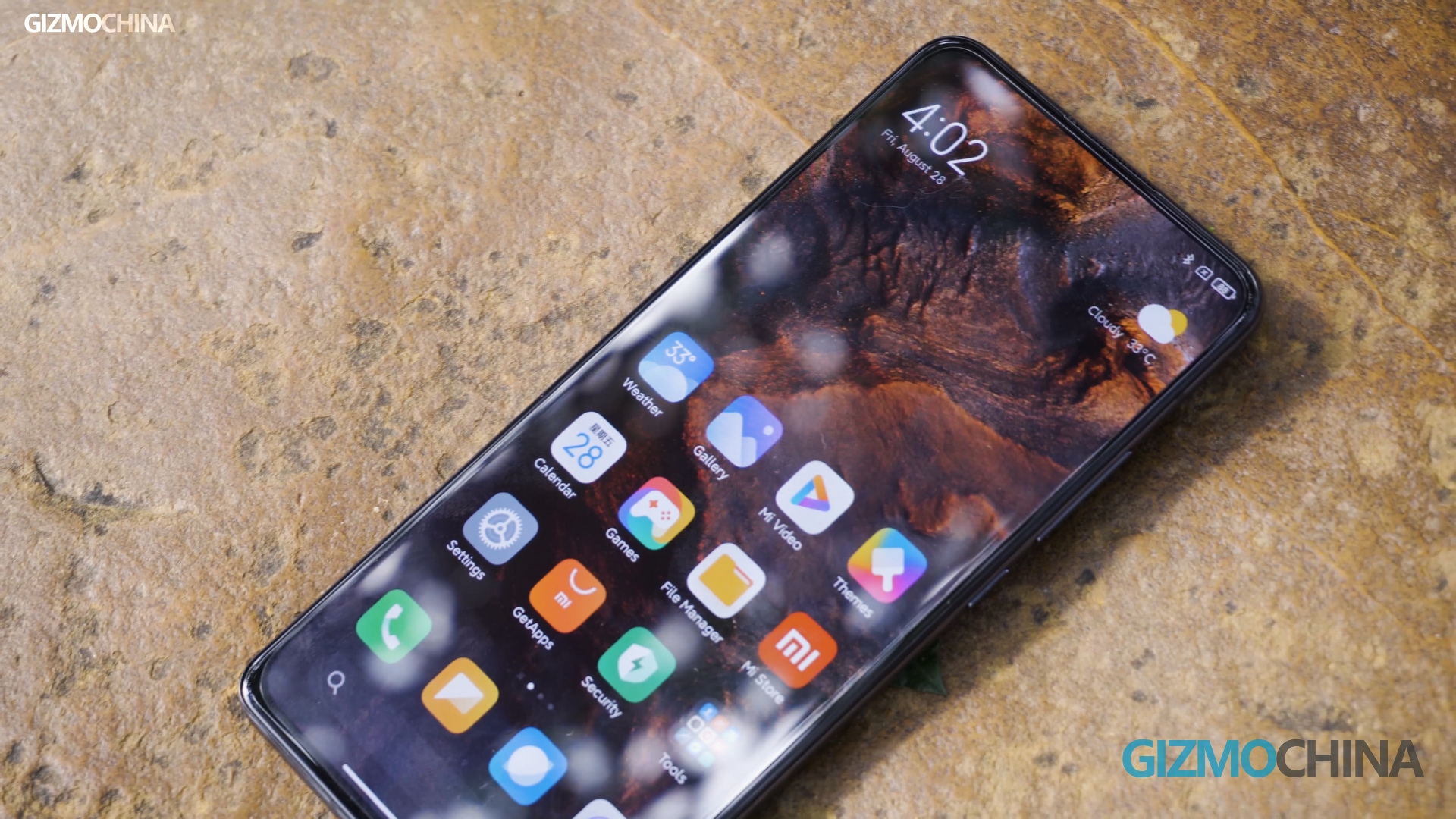
Take the Redmi K30 Pro for example. The phone skipped the most popular feature of 2020 — a high refresh-rate display. But now, they have fixed this drawback on the new Redmi K30 Ultra with a 120Hz refresh-rate display.
However, as I mentioned above, in order to keep the price to acceptable levels, the Redmi K30 Ultra comes with the MTK Dimensity 1000 Plus instead of the Qualcomm Snapdragon 865. So when you get a high refresh rate display, you have to settle for a MediaTek chip. But is it a kind of balance between performance and pricing? Or overall, is the Ultra a less powerful model with a better price as compared to the K30 Pro?
Let’s check that out in this Redmi K30 Ultra review.
Redmi K30 Ultra Review: Display 120Hz
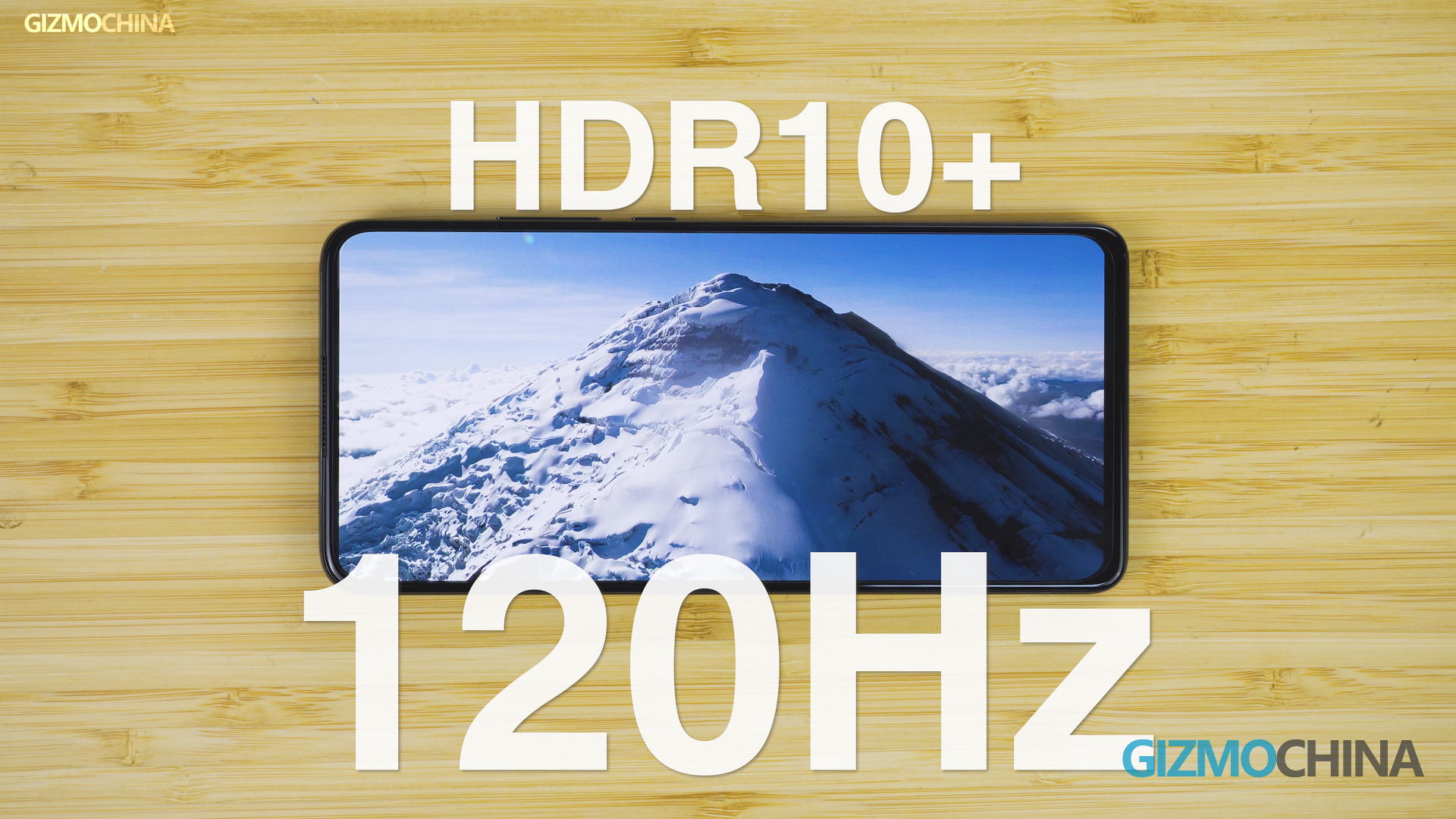
Let’s start with its upgraded display first. Actually, besides the 120Hz refresh rate, there is almost nothing different from the K30 Pro’s display. It also supports HDR10+ and P3 color gamut. Partial peak brightness is also 1200nit.
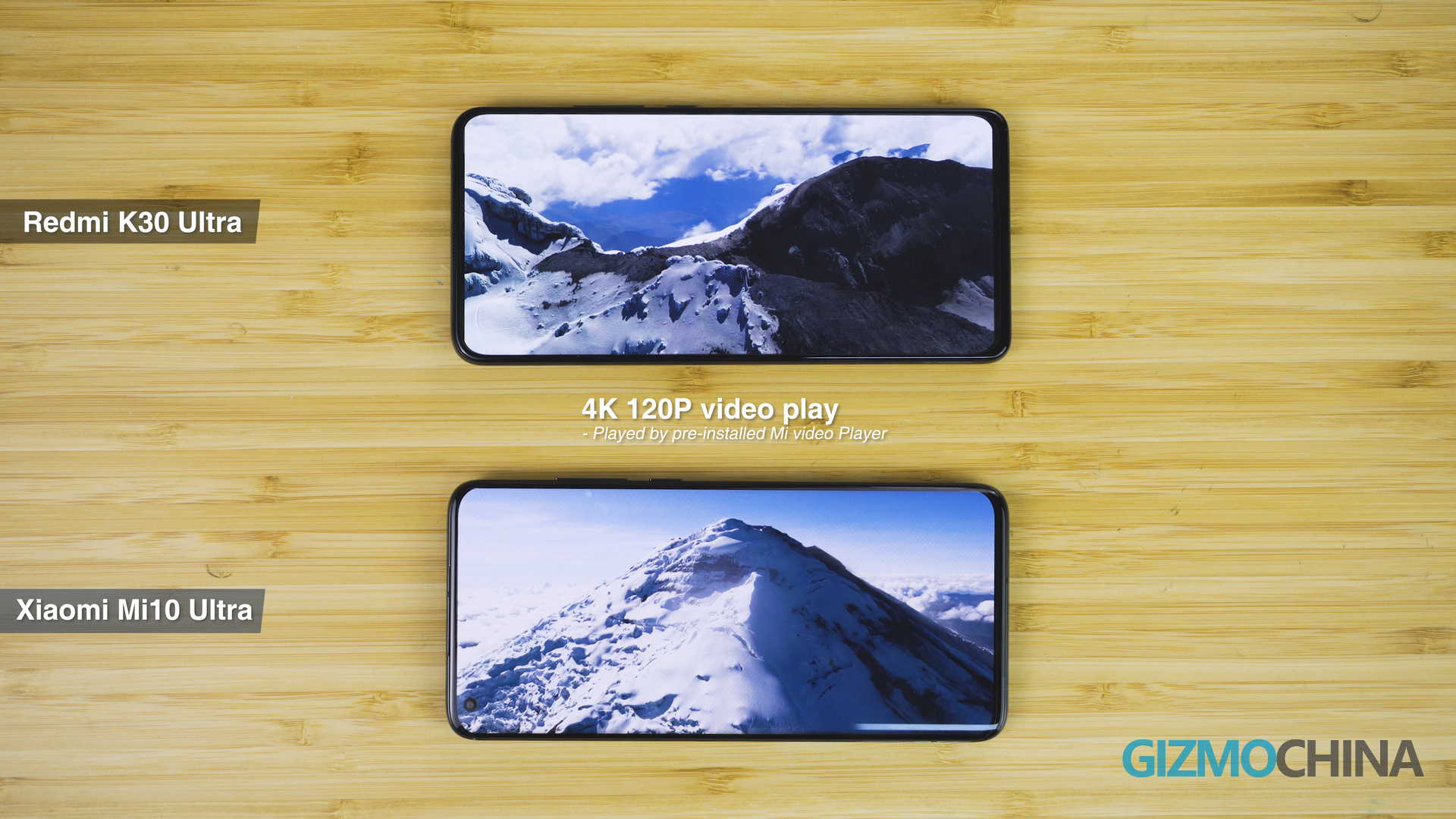
What’s strange is that when we tried playing a 4K HDR video in full screen, the K30 Ultra’s playback was not as smooth as the Mi 10 Ultra (see the video review above) which was a bit disappointing.
While the phone boasts a 120Hz display, it looks like it needs a bit of optimization to ensure that the chipset is able to deliver a super smooth playback. It’s also worth adding that the phone overheated a little when playing back 4K video and you may even face unusual power consumption sometimes.
1 of 2
Redmi K30 Pro Ultra vs mi 10 ultra
Redmi K30 Pro Ultra vs mi 10 ultra
Redmi K30 Pro Ultra vs mi 10 ultra
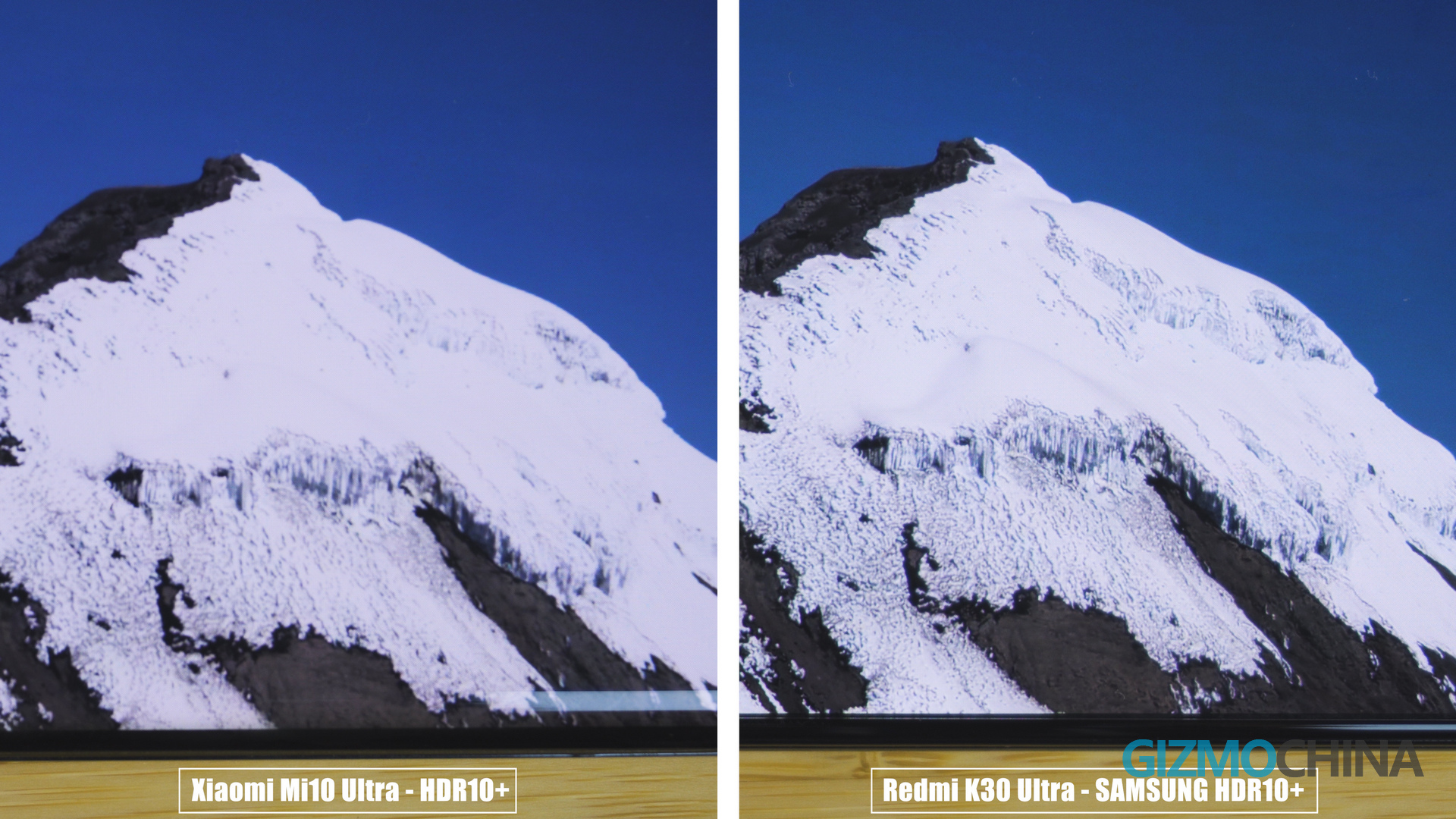
However, the K30 Ultra’s SAMSUNG display surprisingly has better image sharpness and better details during 4k video playback. So while it was not as smooth as the Mi 10 Ultra when it comes to 4K video playback, the quality turned out to be slightly better. As for HDR, they were both doing a good job, the color presentation and dynamic range is very close to each other.
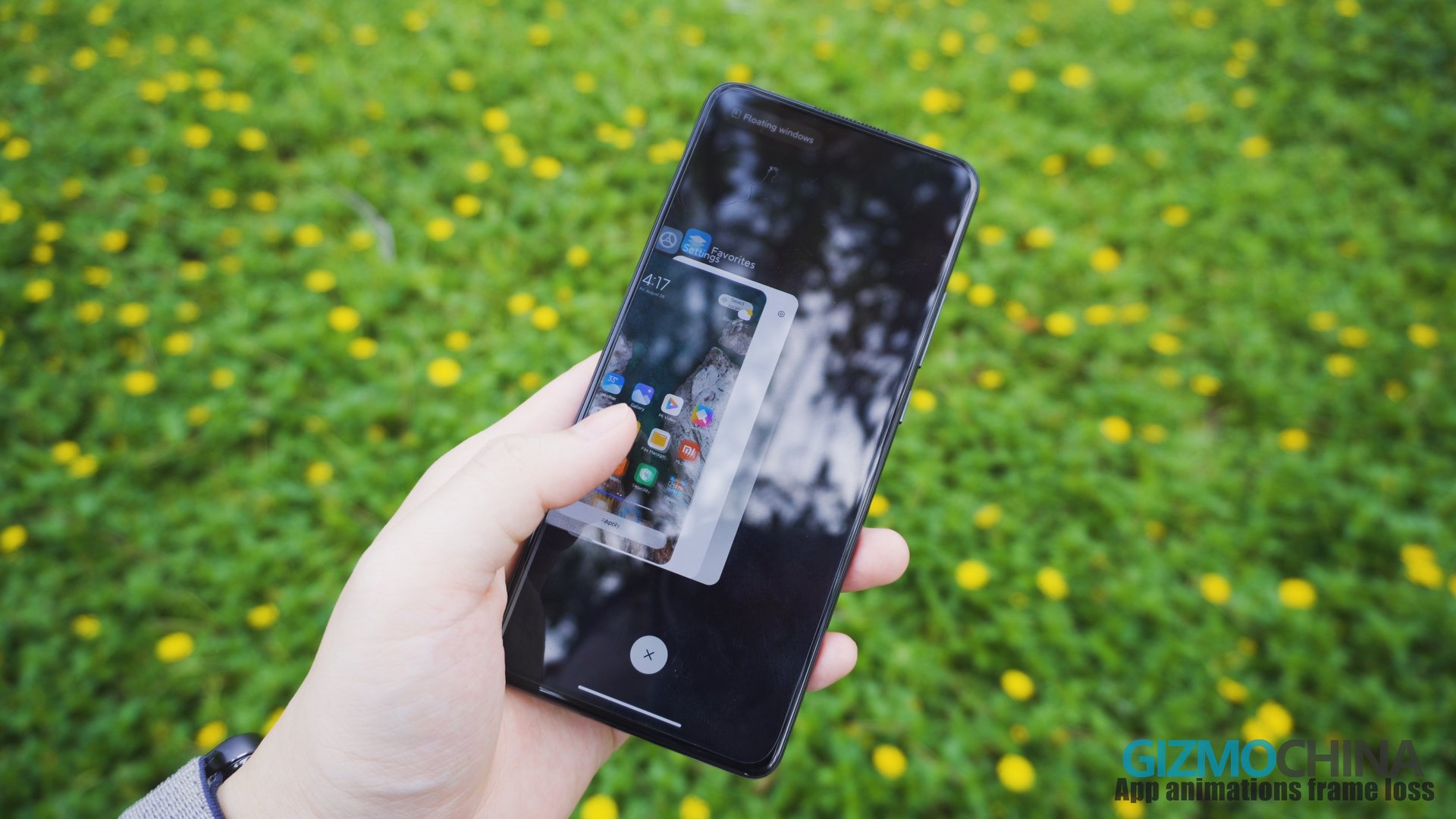
Another detail that feels strange is frame loss. On the K30 Ultra’s 120Hz display, the app dynamic animation is not as smooth as what we expected. Although the animations would respond quickly to user actions, there’s still some lag with obvious frame loss. As we retried it a number of times, the frame-loss problem eventually disappeared for certain apps that ran in the background. Notably, at the system level and for system apps, the 120Hz display with a 240Hz sampling rate still provided quick reactions and led to a relatively smooth experience.
Redmi K30 Ultra Review: Performance
As for the new chipset, the MTK Dimensity 1000 Plus, we didn’t feel the chip provided the best performance. Although theoretically, it’s not as powerful as the Snapdragon 865, the 1000 Plus is still an excellent option for gaming.
But when you compare it with the K30 Ultra, you can easily see the difference in its gaming performance. We personally think it’s a matter of Xiaomi’s software optimization rather than the ability of Dimensity 1000 Plus. As Xiaomi’s first model running the 1000 Plus, the K30 Ultra wasn’t very efficient. We feel the overall heat control and battery management need improvement.
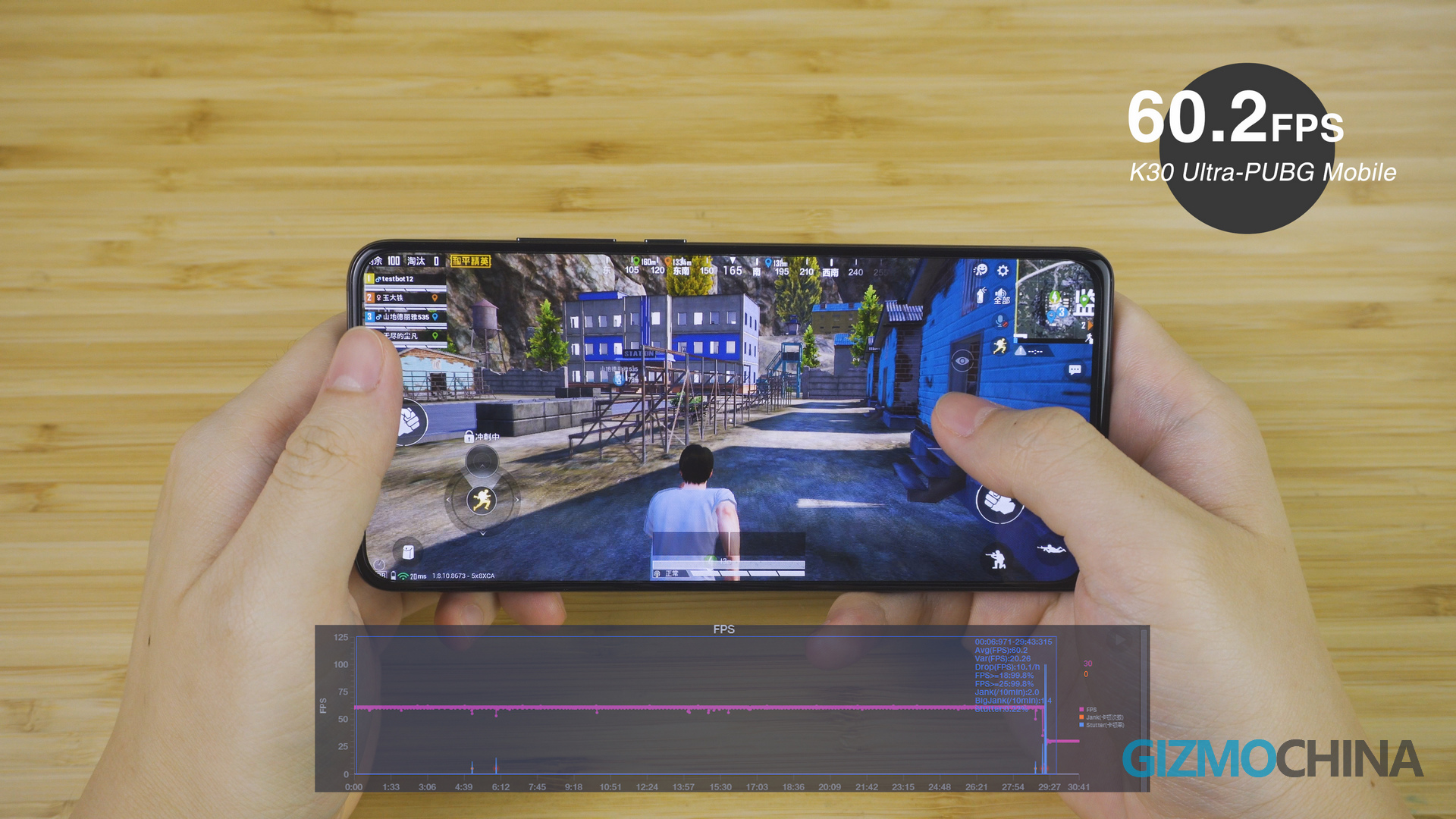
Also due to poor optimization, the K30 Ultra still applied a framerate limit of 60fps in almost all the games. So right now, you’re not able to fully enjoy the gaming performance brought about by the upgraded display.
The good news is that Xiaomi has promised to fix the problem of framerate limitation and optimize the chipset performance in the incoming updates for the K30 Ultra. But no certain date was informed.
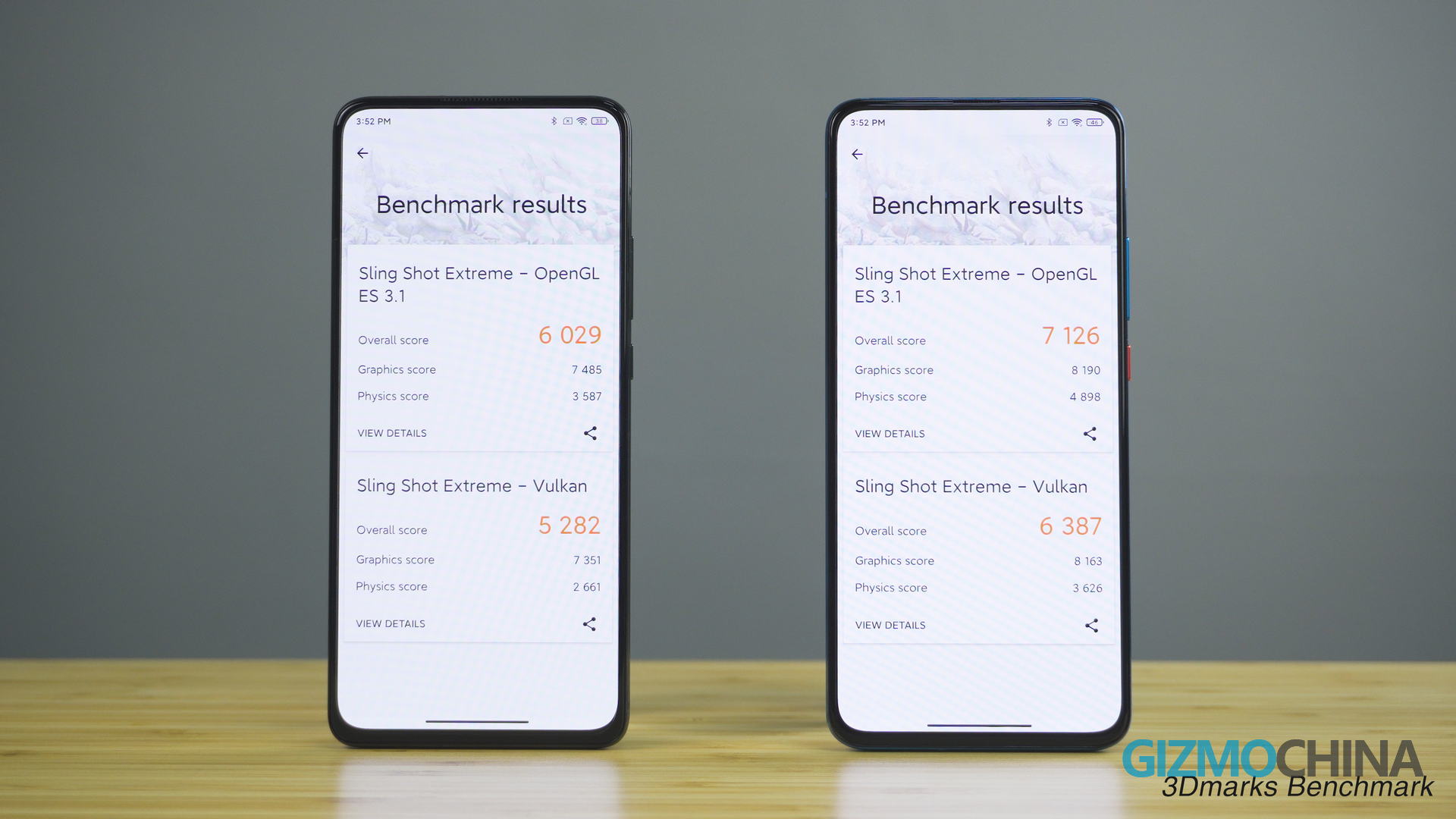
Anyway, let’s see how it performed in benchmarks. In 3Dmark, the Ultra was able to activate the excellent performance of the Dimensity 1000 Plus. The result is pretty close to what we got on the K30 Pro. The Ultra was equipped with the LPDDR4X Flash memory and UFS2.1 storage, while the K30 Pro features the latest generation of memory and storage. So technically the K30 Pro could have a better performance on data and system speeds.
As for geekbench 5, it’s pretty strange that the Ultra was not able to run the whole test and give us the result.
Although we think it doesn’t make sense to do gaming tests on a model that’s not optimized for gaming at this point, we still had to show you its performance at least in a couple of games. This way you’ll get an idea of why we repeatedly say that the phone needs better optimization.
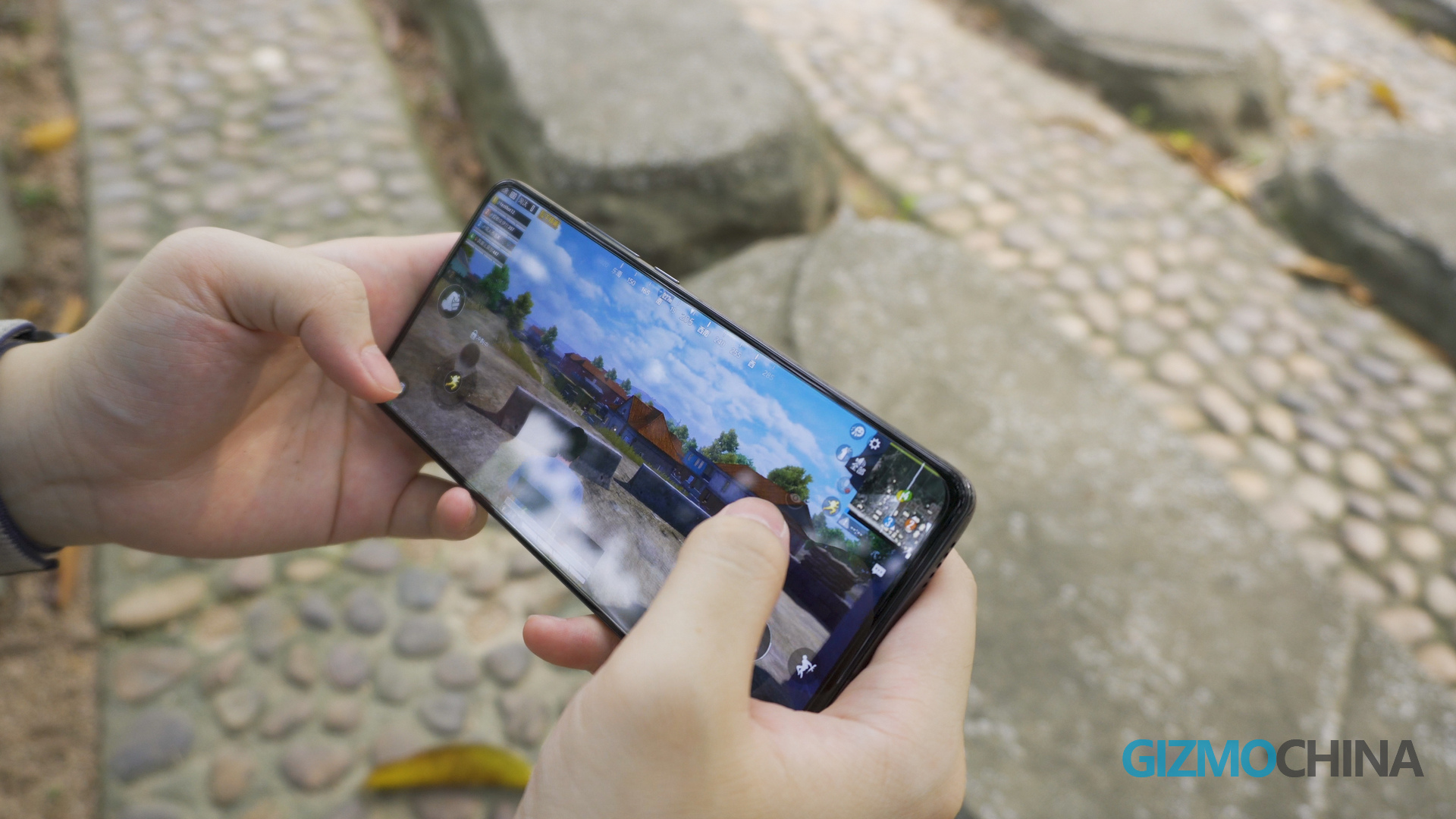
In PUBG Mobile with the highest graphic settings, although we turned on the 120fps mode, the phone could only run the game at 60.21fps on an average.
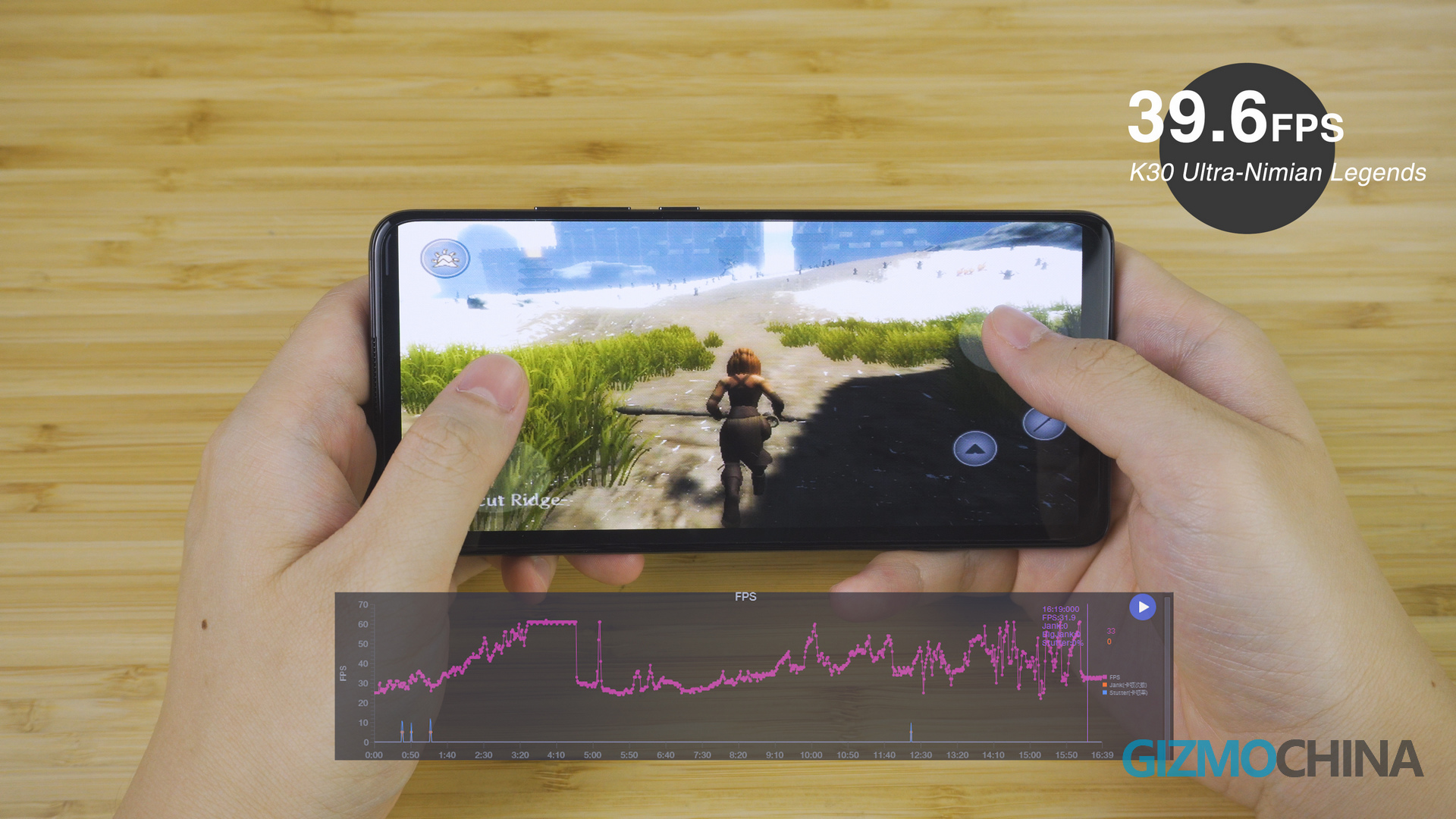
For the stress test with Nimian Legends, the model could run the game at 39.6fps on an average. If you remember, the iQOO Z1, another phone running Dimensity 1000+ but with an even higher 144Hz display, fared much better when it came to gaming. So we don’t think chipset was the big constraint here.
Nimian Legends
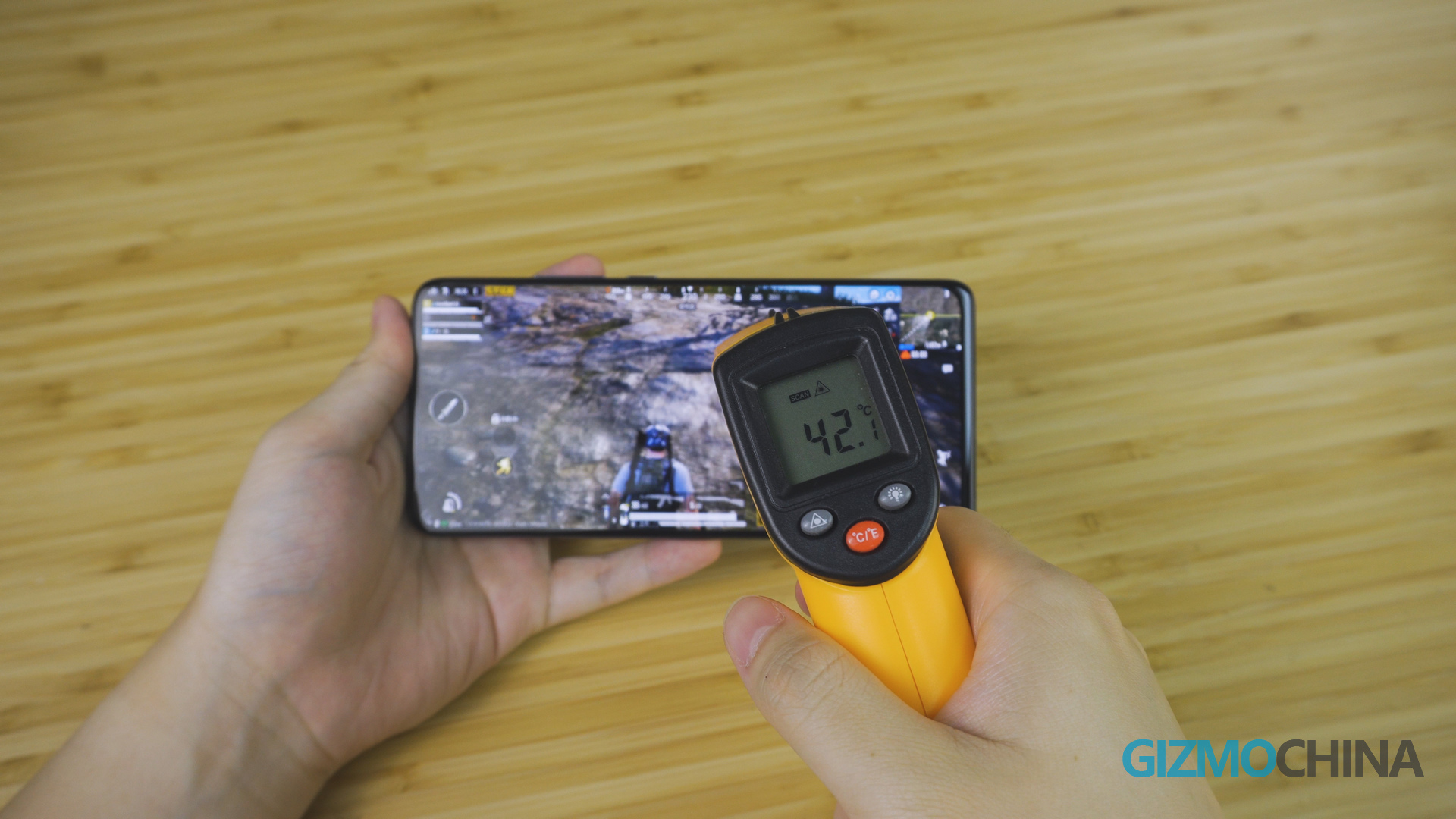
During the gaming test, the model heated up easily, even when we ran it under 60fps mode.
Unexpectedly, the most surprising part of the K30 Ultra is the performance of its camera.
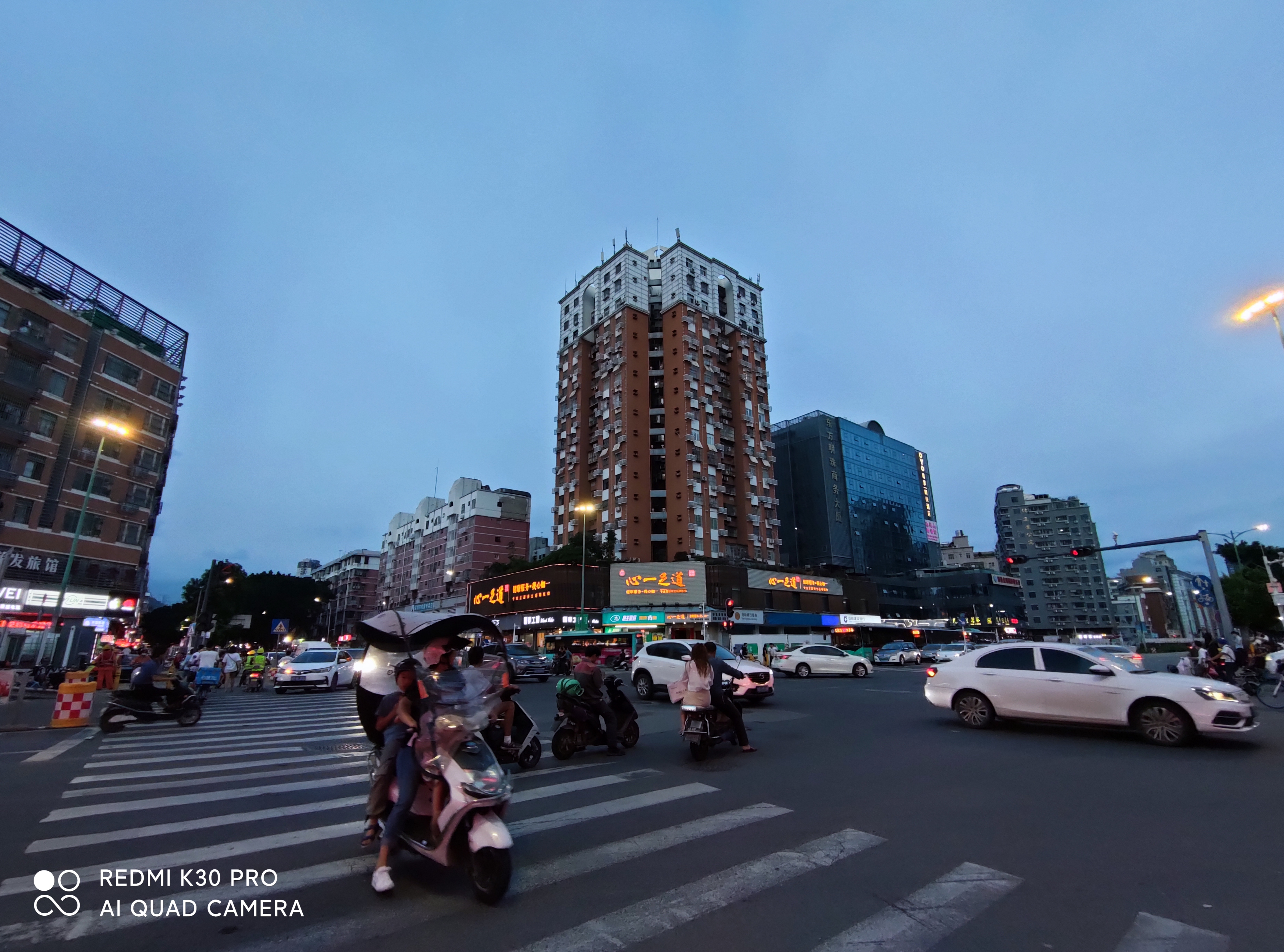
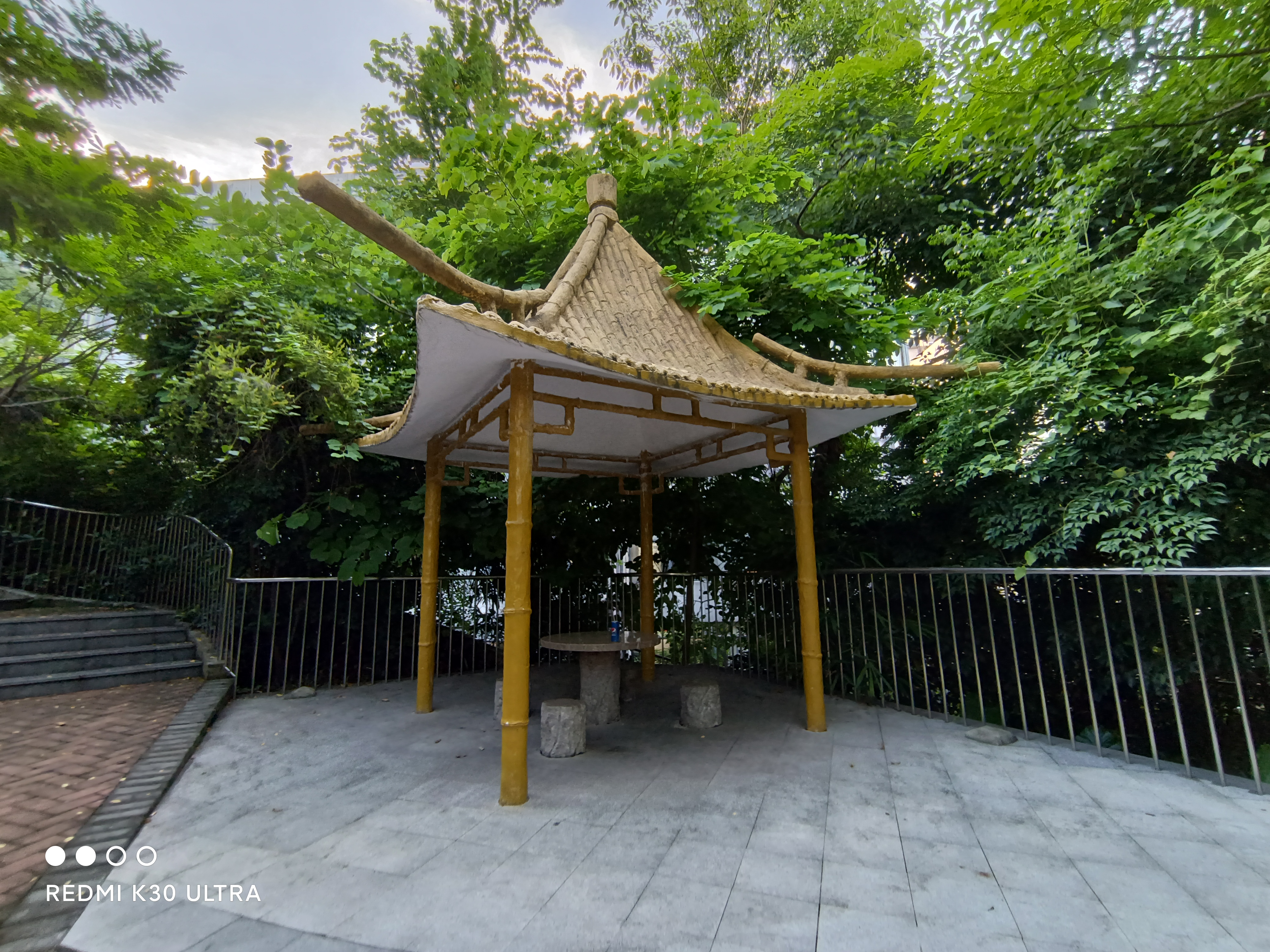
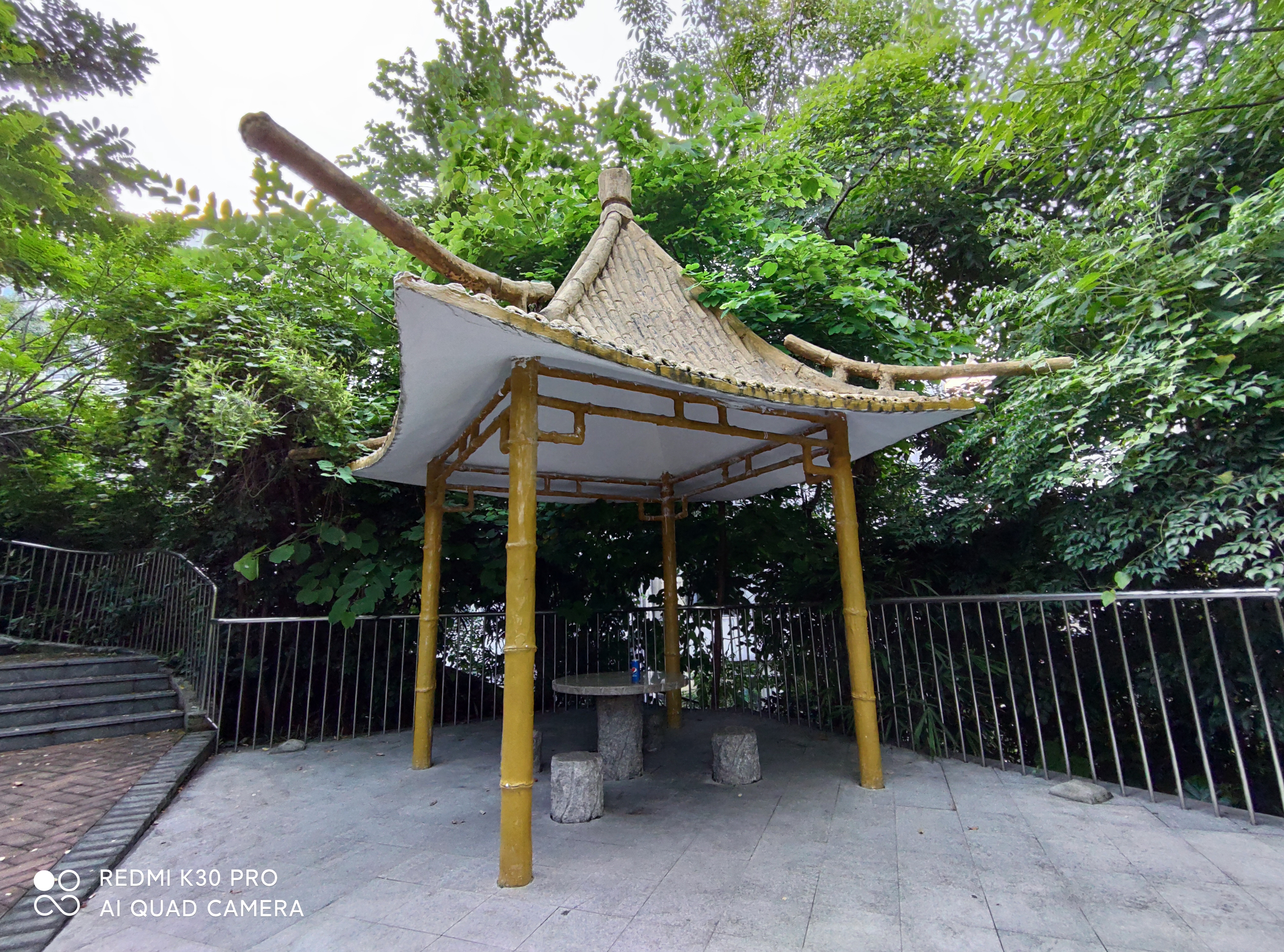
The 64MP main camera sports a Sony IMX682 sensor. From its samples, we could see that the main camera was able to give more accurate exposure, while the K30 Pro sometimes might overexpose and lose detail over extreme brightness. Especially when we turned on HDR and AI colors, the Ultra’s main camera was able to deliver an excellent dynamic range to cover details of both bright and dark areas.
1 of 4
For example, in this photo, the Ultra was able to handle the bright sky pretty well, while the K30 Pro just lost the details of the sky. In addition, the Ultra’s samples presented relatively correct white balance under most scenarios, while the K30 Pro’s white balance was usually cooler and didn’t meet the real scenarios needs.
1 of 6
Both K30 models are equipped with a 13MP wide-angle camera. But the Ultra’s field of view is a bit narrower, but the aperture is larger. Under auto-HDR mode, their performance is similar to what they have on their main cameras. The Ultra’s wide-angle samples surprisingly have much wider dynamic range than the Pro’s. And it also remained a better white balance detection. Meanwhile, thanks to the larger aperture, it seems that under the low-light conditions with the same shot parameters, the Ultra also had better performance with good brightness than what we got on the K30 Pro. But it also got the same problems of most wide-angle cameras, which is the poor detail and unstable noise control for corners. The central image is always much better than the corners. In comparison, another one of Ultra’s advantages is its ability to remove the fringing around edges.
1 of 8
And the 50mm equivalent lens is for macro use. It’s another highlight for the new camera combination. Compared to the macro camera on the Pro, the Ultra has a faster focus speed and a bit closer focus. And the Ultra’s macro could produce much more delightful colors. But the macro camera only features a small sensor with 5MP resolution, so it’s not really practical for low-light uses.
Both of them only feature electronic image stabilization but lack OIS anti-shaking solution, so they both required the object to stay still.
1 of 8
Normal Mode Camera Sample
Night Mode
Normal Mode Camera Sample
Night Mode
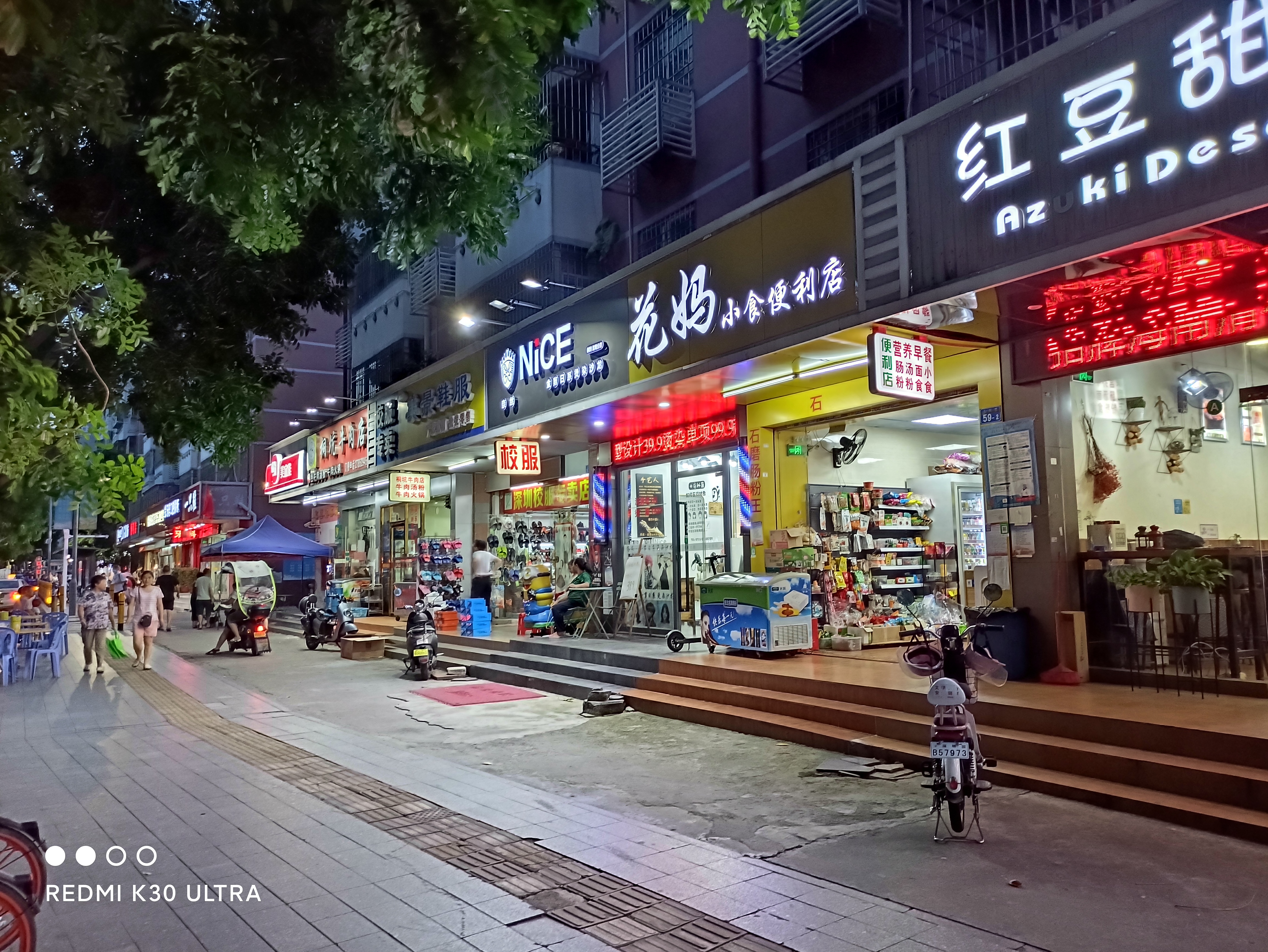
About its night performance, actually, it was hard to pick a winner. The night mode looks very close to what we got under the HDR mode. And from shot parameters, we also guess that it may not apply an exclusive night solution for night uses. The ISO and shutter were not so different from what used for the normal mode. The samples shot under Ultra’s night mode didn’t really improve over the noise control and image detail. It seems that Xiaomi still needs a lot of work to fix the night mode.
1 of 3
As for its portrait camera, the edge detection and distance detection were not as good as what we saw on the Mi 10 Ultra. Especially with complicated background, the aperture adjustment didn’t work so well.
Another improvement of the Ultra is the dual-speakers for stereo sounds. Compared to the single speaker on the Pro, the audio improvement is quite impressive but not as good as the symmetrical speakers on Mi 10.
Although the Ultra and Pro use the same charging solution for their 4500mAh batteries, the full-charge test showed that the Ultra’s charging efficiency still got slightly improved. The Ultra took around 66mins to complete the full charge, while the charging time for the Pro was a bit longer, it eventually finished the test in around 74 mins.
Redmi K30 Ultra Review: Verdict
So overall, the K30 Ultra brings a number of upgrades as compared to the K30 Pro. It is definitely one of the best options in its price range. However, as a 10th-anniversary product, its improvement over the daily experience is not as significant as we expected. It feels like an unfinished product that has the potential to provide better user experience in areas such as the optimization of the 120Hz display and the new chipset. On the other hand, the camera performance is surprisingly more impressive when compared to the K30 Pro.
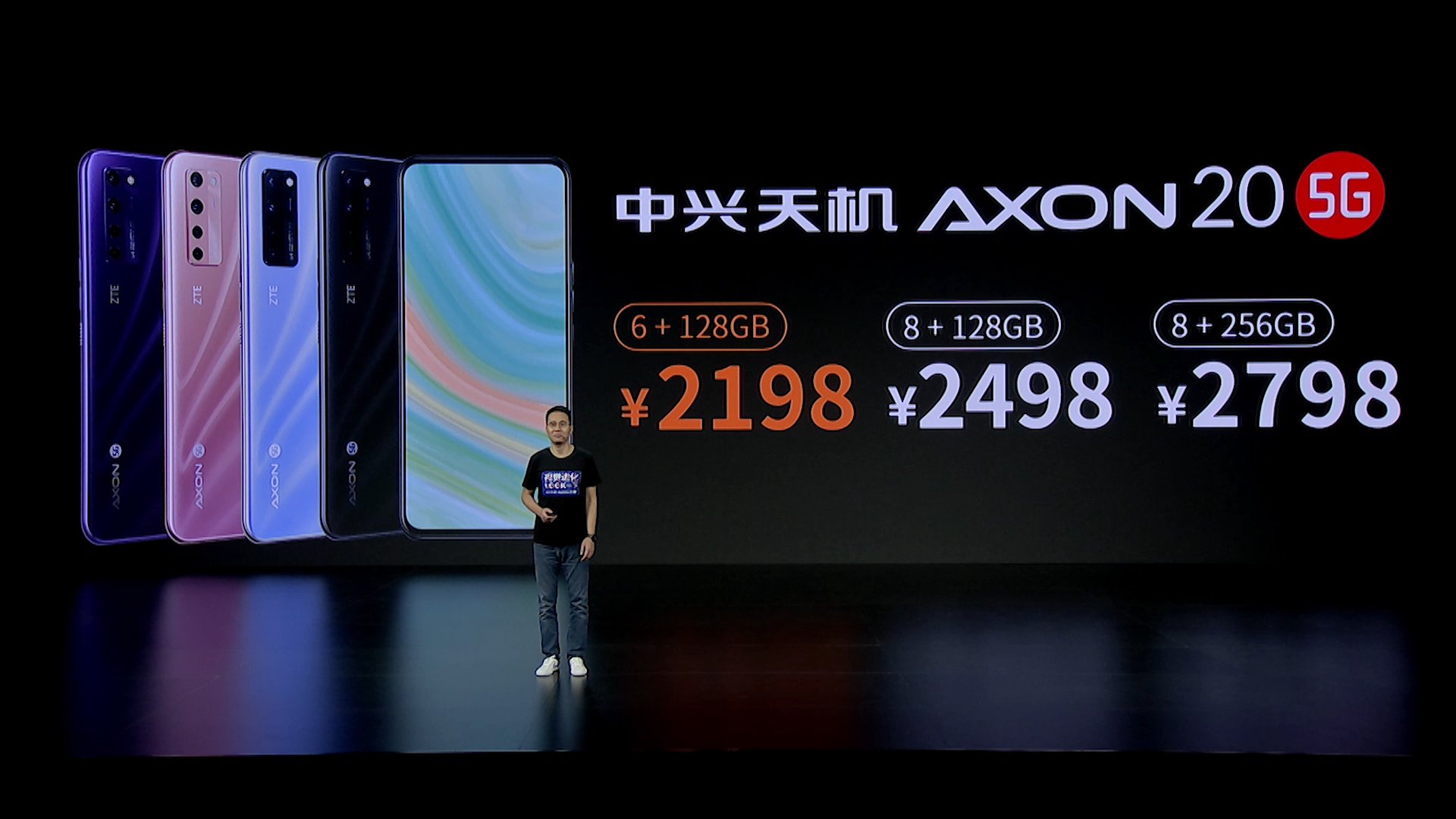
ZTE revealed a couple of weeks back that it will launch a smartphone equipped with an under-display fingerprint sensor. Later on, details emerged that the phone will adopt the moniker Axon 20 5G and we also saw some of the details and renders via leaks and teasers. True to its word, the company has gone official with the Axon 20 5G. The smartphone comes as the world’s first under-display camera phone.
Axon 20 5G: Specs & Features
The Axon 20 5G’s main selling point is definitely the under-display camera which it packs and that has a high influence on the display design. The Axon 20 5G packs a 6.92-inch OLED screen that covers 100% of the DCI-P3 color gamut and supports 10-bit color depth. The display also supports a 90Hz high refresh rate, 240Hz touch sampling rate, and provides a true, unobstructed full-screen view. The display has an FHD+ resolution of 2460×1080 pixels.
ZTE says it was able to achieve the under-screen camera design by deploying five core technologies, including special materials, dual-control chips, unique driver circuits, a special pixel matrix, and an in-house selfie algorithm. With these technologies, ZTE was able to overcome numerous technical challenges during research and development.
The company also uses a high-transparency material for the display that balances the performance of the display and the front camera. The material includes new organic and inorganic films, thereby improving the light input of the display area to the front camera.
Moreover, a built-in independent dual-control chip and integrated driver circuits have been employed to enable the color synchronization between the front camera and the conventional display. In addition, a unique driver circuit layout design and precision miniaturization components have been used to avoid interference, and restrain the impact on the front camera. ZTE also created a special matrix that can optimize pixels and improve display consistency, thereby creating a more natural transition. The technology sounds similar to Xiaomi’s own under-display camera solution.
Furthermore, ZTE’s front-camera selfie algorithm has optimized the performance of the camera under several lighting conditions. It also supports automatic dynamic range adjustment, hence the great improvement of the photo clarity and the image contrast.
Apart from the under-screen camera, the Axon 20 5G also features an ultra-thin design with a thickness of 7.98 mm. The entire smartphone weighs 198 grams, making it relatively light (this can be subjective) and thin to hold. You also get an under-screen speaker and under-screen fingerprint scanner onboard the device.
The Qualcomm Snapdragon 765G chipset fires up the Axon 20 5G. The mid-range SoC has become quite popular with many Chinese smartphone brands with models such as the Mi 10 Lite 5G, Redmi K30i 5G, OPPO Reno 4/4 Pro, OnePlus Nord, Nubia Red Magic 5G Lite, and several others utilizing the chipset. The processor is a 7nm octa-core chipset with a Kryo 475 Prime core (Cortex-A76) clocked at 2.4GHz, a Kryo 475 Gold core (Cortex-A76) clocked at 2.2GHz and six Kryo 475 Silver cores (Cortex-A55) clocked at 1.8GHz.
The processor is paired with 6GB RAM and there is also an 8GB RAM version. The phone comes in 128GB and 256GB storage options.
The rear panel of the Axon 20 5G is made of high-hardness 3D curved glass with a ten-layer structure stack design. The panel is coated using vacuum optical coating thus forming a nano-level streamer illusion texture. The back houses a Quad camera setup stacked at the upper left corner. The sensors include a 64MP Ultra-high pixel main camera. There is also an 8MP 120-degree ultra-wide-angle camera, a 2MP depth of field lens, and a 2MP macro lens.
Further, the ZTE Axon 20 5G is equipped with as many as 12 antennas, 3-4 more antennas than those of other suppliers. It adopts a 360-degree surround integrated design. The 12 antennas are intelligently arranged around the mobile phone, and each has its own functions. The phone comes with dual-band 5G. When the mobile network environment becomes weak and the network speed of a 5G card is too slow, ZTE Axon 20’s unique network detection algorithm can intelligently identify and automatically switch wireless data services to the second 5G SIM instantly, realizing 5G dual-card seamless switch to ensure smooth networking.
Keeping the lights on is a 4220mAh battery which charges via a USB-C port. The phone supports Qualcomm Quick Charge 4+ and supports 30W fast-charging.
Pricing & Availability
As for the pricing, ZTE Axon 20 5G 6GB + 128GB variant starts at 2198 yuan ($322). The 8GB+128GB version is priced at 2498 yuan (~$366) while the 8GB + 256GB option goes for 2798 yuan (~$410). The phone is presently on pre-order and will go on sale on September 10 in China.
OnePlus is revamping its product lineup by offering mid-range and budget smartphones. Pete Lau, the co-founder and CEO of the brand revealed it first in May. Then, in July, the company launched OnePlus Nord as its first mid-range smartphone in years. Followed by that, leaks started pouring out information about OnePlus’s other budget handsets. Now, today, codenames of some of these handsets emerge.
Just yesterday, we had our first look at OnePlus 8T with a flat display and slimmer bezels. Now, today, codenames of four OnePlus smartphones leak on Twitter, courtesy of tech influencer Mukul Sharma (@stufflistings).
He shared a picture of a code snippet, which revealed the following codenames associated with what seems to be their marketing name.
billie2 – OnePlus Billie 2
billie2t – OnePlus Billie 2T
billie8 – OnePlus Billie 8
billie8t – OnePlus Billie 8T
This is not the first time we are hearing about the codename “billie”. These devices leaked in a rendered video earlier in August. Max J, the person behind that leak did confirm that there will be multiple phones. The above-listed devices could be the ones he mentioned.
Also, according to him, they are also known as “Aurora” and they can launch under the “Nord” branding. Hence, it is not sure if these handsets will be indeed called OnePlus Billie.
One of these devices could come powered by either Snapdragon 662 or Snapdragon 665. Whereas, another model from the list above could be a mid-range 5G smartphone powered by Snapdragon 690 like the Oneplus Nord but with a more affordable price tag.
Additionally, OnePlus will be also launching a phone codenamed “clover”, which could be the brand’s cheapest smartphone with feature like Snapdragon 460, 720p display, 6,000mAh battery, 4GB + 64GB storage configuration, microSD card slot, fingerprint sensor, 3.5mm headphone jack, 13MP + 2MP dual-camera setup, 18W fast charging, and around $200 price tag.
That said, most of the upcoming OnePlus budget and mid-range smartphones will probably debut first in India as hinted by the CEO back in May.
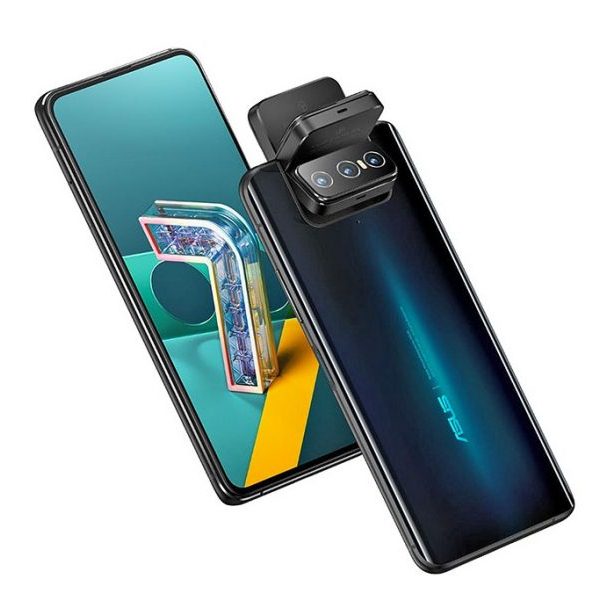
The Zenfone 7 series was announced last week in Taiwan. ASUS has now launched the new phones in Europe.
The Zenfone 7 and Zenfone 7 Pro keep the flip camera design of the Zenfone 6 but come with triple rear cameras. They also sport AMOLED displays with high refresh rates. However, they cost a lot more than their predecessor which was considered a flagship.
The Zenfone 7 has a price tag of €699 and will be available in a single variant with 8GB of RAM and 128GB of storage. In Taiwan, this model is priced at NT$23,990 (~€682). The Zenfone 7 Pro is going to sell for €799 and it will come with 8GB of RAM and 256GB of storage.
The two phones have a 6.67-inch FHD+ AMOLED display with HDR10+ and Gorilla Glass 6 protection. They also have support for storage expansion and have stereo speakers, side-mounted fingerprint scanners, and 5000mAh batteries with support for 30W HyperCharge fast charging. The two phones run Android 10 out of the box.
With respect to their differences, the Pro model has a Snapdragon 865+ processor under the hood. It has the same 64MP main camera + 8MP telephoto camera + 12MP ultrawide angle setup as the standard version but its telephoto camera has OIS which is not available on that of the Snapdragon 865-powered standard version.
There is no info on when the phone will be available for purchase and if it will be launched in India and North America.
HONOR has been teasing its first-ever gaming laptops for a few weeks now. Apart from official teasers by the brand as well as its executives, the notebooks have also leaked multiple times. Now, according to a tipster, they will launch on September 16 alongside two smartwatches.
The HONOR gaming laptops will be marketed under its HUNTER series of gaming products. Currently, the brand only sells a router under this series. But we can expect the portfolio to grow in the coming months.
The company is yet to announce the launch date for these notebooks. But according to 长安数码君 (Changan Digital King) on Weibo, they will be officially unveiled on September 16. As per him, at the same event, the brand will also debut two smartphones, one of which resembles the HUAWEI Watch Fit.
Talking about features, HONOR HUNTER gaming laptops have been confirmed by the brand to feature Intel chipsets. A leak even revealed its design to be inspired by supercars. Lao Ming (aka Glory Bear), the brand’s VP also teased it to feature RGB lightings a few days back.
Last week, the same executive also shared a teaser video, which showcased the design of the HUNTER gaming laptop. The video also confirmed one of the variants to be powered by Intel Core i7. Also, it revealed them to feature an RGB-backlit keyboard with a special key engraved with the HUNTER logo.
According to a leak, this notebook will be marketed as HUNTER V700 and will be available in at least two variants with model numbers – FRD-WFD9 / FRD-WDG9. That said, we will know more about these products in the coming days as their launch is nearing.
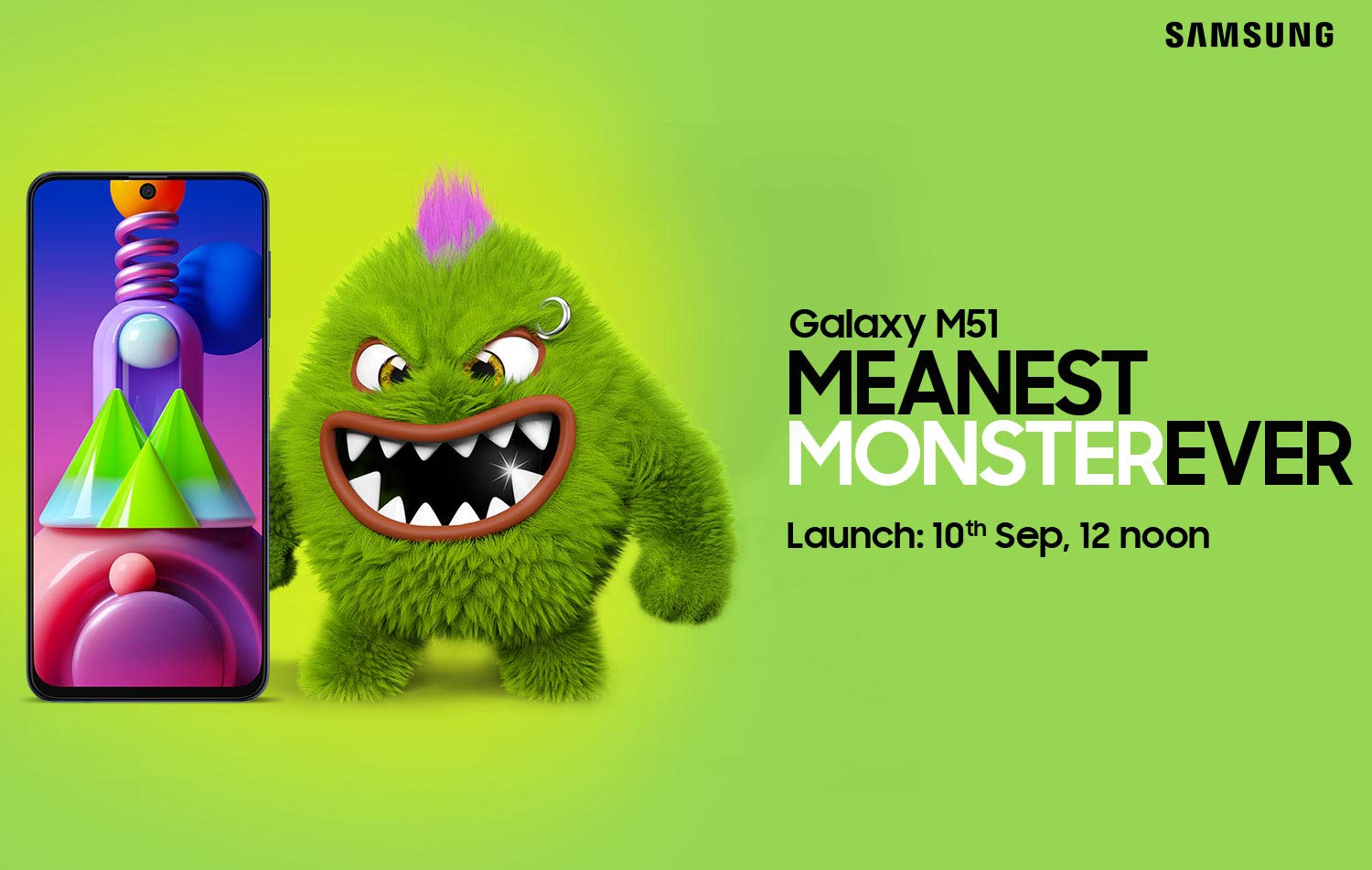
After months of leaks, the Samsung Galaxy M51 smartphone went official quietly yesterday. The device debuted in Germany with a price tag of 360 euros (~$431; ~Rs 31,500). The South Korean company has been teasing its launch in India for the past week. Today, the Galaxy M51’s landing page on Amazon India got updated with its launch date and new teasers. It is now confirmed that the Galaxy M51 will break cover in India on Sept. 10.
The Galaxy M51 launch event for India will kick off at 12 PM (local time) on Sept. 10. The updated Amazon listing has no information on its specs. However, the specs are no secret since the device has already launched in Germany.
The Galaxy M51 has a Full HD+ resolution supporting display of 6.7 inches. The aspect ratio offered by the S-AMOLED panel is 20:9. The Snapdragon 730 chipset is present under the hood of the Galaxy M51 along with 6 GB of RAM.
The One UI 2.0 based Android 10 OS comes preinstalled on the Galaxy M51. It has an internal storage of 128 GB and there is a microSD card slot for more storage. The phone is fitted with a side-facing fingerprint sensor.
Samsung Galaxy M51
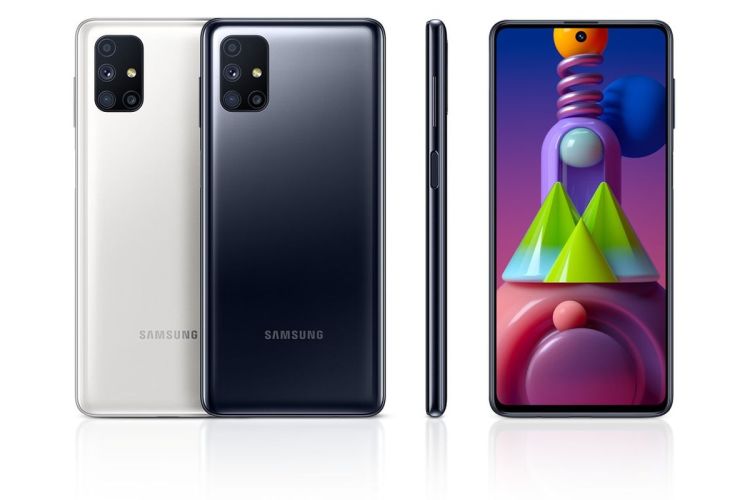
The Galaxy M51 houses a behemoth battery of 7,000mAh. It supports 25W fast charging through USB-C. The front side of the Galaxy M51 has a 32-megapixel selfie camera. The rectangle-shaped camera module positioned on the backside of the Galaxy M51 has a 64-megapixel main camera with f/1.8 aperture, a 12-megapixel ultrawide sensor, a 5-megapixel macro shooter, and a 5-megapixel lens for depth effects.
The pricing of the Samsung Galaxy M51 for India is under wraps. The Galaxy M31s that debuted in July carried a price tag of Rs. 21,499 (~$294) for its topmost variant. Probably, the country could be receiving the Galaxy M51 with a price tag of around Rs. 25,000 (~$342). The phone is likely to be available in India in Black and White color options.
Lenovo-owned Motorola has today launched a new smartphone — Motorola One 5G. The device is a U.S. version of the Moto G 5G Plus that was unveiled last month.
The smartphone features a 6.7-inch Full HD+ LCD display with 2520 x 1080 pixels screen resolution, 21:9 aspect ratio, HDR10, and 90Hz refresh rate. There’s also a layer of Gorilla Glass 5 to protect the screen from minor scratches.
Under the hood, the handset is powered by the Qualcomm Snapdragon 765 SoC, manufactured using a 7nm EUV process, coupled with Adreno 620 GPU. It packs 4GB LPDDR4x RAM and 128GB UFS 2.1 internal storage.
In the camera department, the phone features a quad-camera setup that consists of a 48MP primary sensor with f/1.7 aperture, an 8MP ultra-wide-angle lens with f/2.2 aperture, a 5MP macro lens with f/2.2 aperture, and a 2MP depth sensor with f/2.2 aperture.
On the front side, the device has a 16MP primary snapper with f/2.0 aperture and an 8 MP secondary sensor with f/2.2 aperture for taking selfies and video calling. The smartphone also comes with a side-mounted fingerprint sensor.
As for the connectivity options, the device supports 5G SA/NSA, Dual 4G VoLTE, Wi-Fi 6 802.11 ac (2.4GHz + 5GHz), Bluetooth 5.1, GPS (L1+L5), GLONASS, Galileo, NFC, and a USB Type-C port. It runs Android 10 out-of-the-box and is powered by a 5,000mAh battery with 20W TurboPower fast charging.
The Motorola One 5G comes in Oxford Blue color and will be priced under $500 when it goes on sale on AT&T but the exact date is not yet known. The 5G Ultra Wideband version will be available from Verizon in early October.
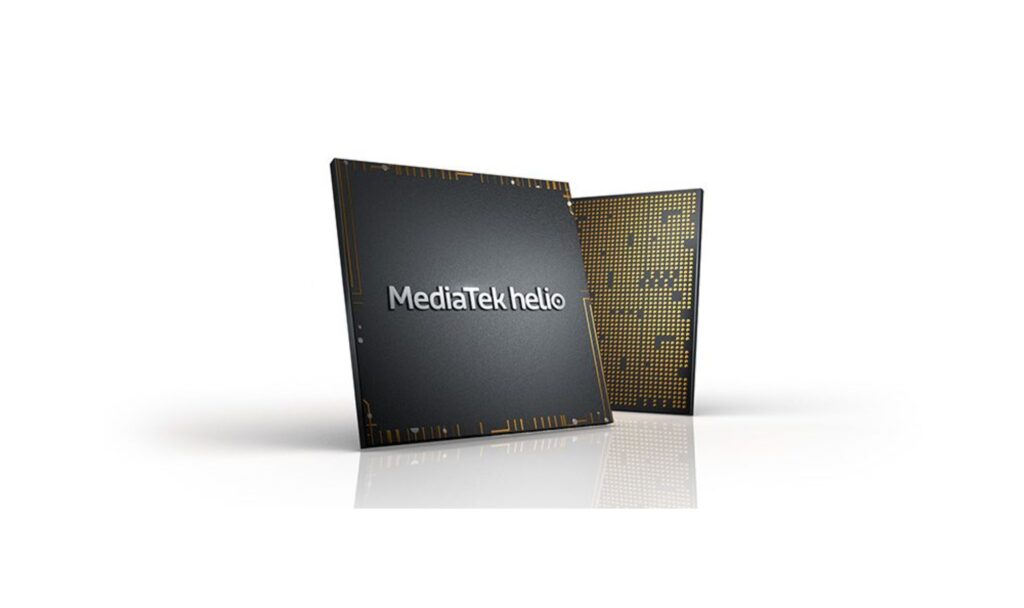
MediaTek has been raining entry-level and mid-range chipsets since the beginning of this year. Adding to its ever-growing portfolio, the Taiwanese chipmaker announces helio G95 SoC as its newest offering. The firm markets this as its most powerful 4G silicon for smartphones. It will compete against Qualcomm Snapdragon 732G, which just went official yesterday.
The helio G95 is similar to its predecessor helio G90T is every way. The only difference is that the ARM Mali G76 3EEMC4 GPU present in the former is clocked at 900Mhz instead of 800MHz in the latter. Hence, it should theoretically offer slightly better gaming performance.
Apart from the above-mentioned dissimilarity, the new helio G95 is basically an helio G90T inside out. That means it is manufactured using the same 12nm process technology by TSMC (Taiwan Semiconductor Manufacturing Company)
It includes an octa-core CPU consisting of 2 x Cortex-A76 cores clocked at 2.05GHz and 6 x Cortex-A55 cores clocked at 2GHz. Further, in the memory department, it can support up to 2 x LPDDR4x RAM clocked up to 2133MHz and 10GB in size. For storage, it can either paired with eMMC 5.1 or UFS 2.1.
Talking about cameras, it can support up to 64MP multi-camera setup and is capable of recording videos in up to 4K resolution at 30fps. As for the display, it can support panels of up to 2520 x 1080 resolution (FHD+) and 90Hz refresh rate.
On the connectivity front, the modem present in it supports 4G, VoLTE, ViLTE, VoWifi, and it also includes support for WiFi 5, Bluetooth 5.0, GNSS(Beidou, Galileo, Glonass, GPS) as well as FM Radio.
Additionally, the chip also comes with MediaTek HyperEngine gaming technology, which the company claims to offer better connectivity by using WiFi and LTE data connection at the same, in addition to better resource management and improved graphics.
That said, the newly launched MediaTek helio G95 will debut on realme 7, which will be unveiled on September 3 in India. Similarly, POCO X3 NFC which will go official next week on September 7 as the world’s first smartphone with its competitor Qualcomm Snapdragon 732G.
The United States has put several restrictions and sanctions on the Chinese giant Huawei, effectively banning the company from doing business with any of the American companies or the companies using American technologies.
While Huawei has been severely impacted because of these sanctions, American companies are also worried about potential losses. However, it seems that the deeds of the U.S. will benefit another emerging global superpower.
As per the SCMP report, Huawei founder Ren Zhengfei has said that the company has increased its investment in Russia after the United States put Huawei on the Entity List last year. He added that along with increased Russian investment, it expanded the Russian scientist team, and increased the salary of Russian scientists.
The company has become the leading smartphone brand globally, dethroning Samsung. However, it will be impossible for the company to keep the lead position given the recent setbacks. The new restrictions have made it impossible for Huawei to manufacturer its own Kirin chipsets and procure chipsets from the likes of Qualcomm.
However, US-based chip suppliers, including Qualcomm, have been trying to get approval to resume sales to Huawei. On the other hand, Taiwanese chip designer MediaTek has applied for a license to continue doing business with Huawei.
But, the company can still source U.S. chips for the cloud computing business, and thus, the company has now shifted its focus towards this. Huawei’s cloud computing sells computing power and storage solutions to companies, along with access to artificial intelligence.
As per the reports, Huawei is putting the cloud computing business in line with the smartphones and telecom equipment business. On top of that, it is said that the Chinese government will increasingly support the company through public cloud contracts.
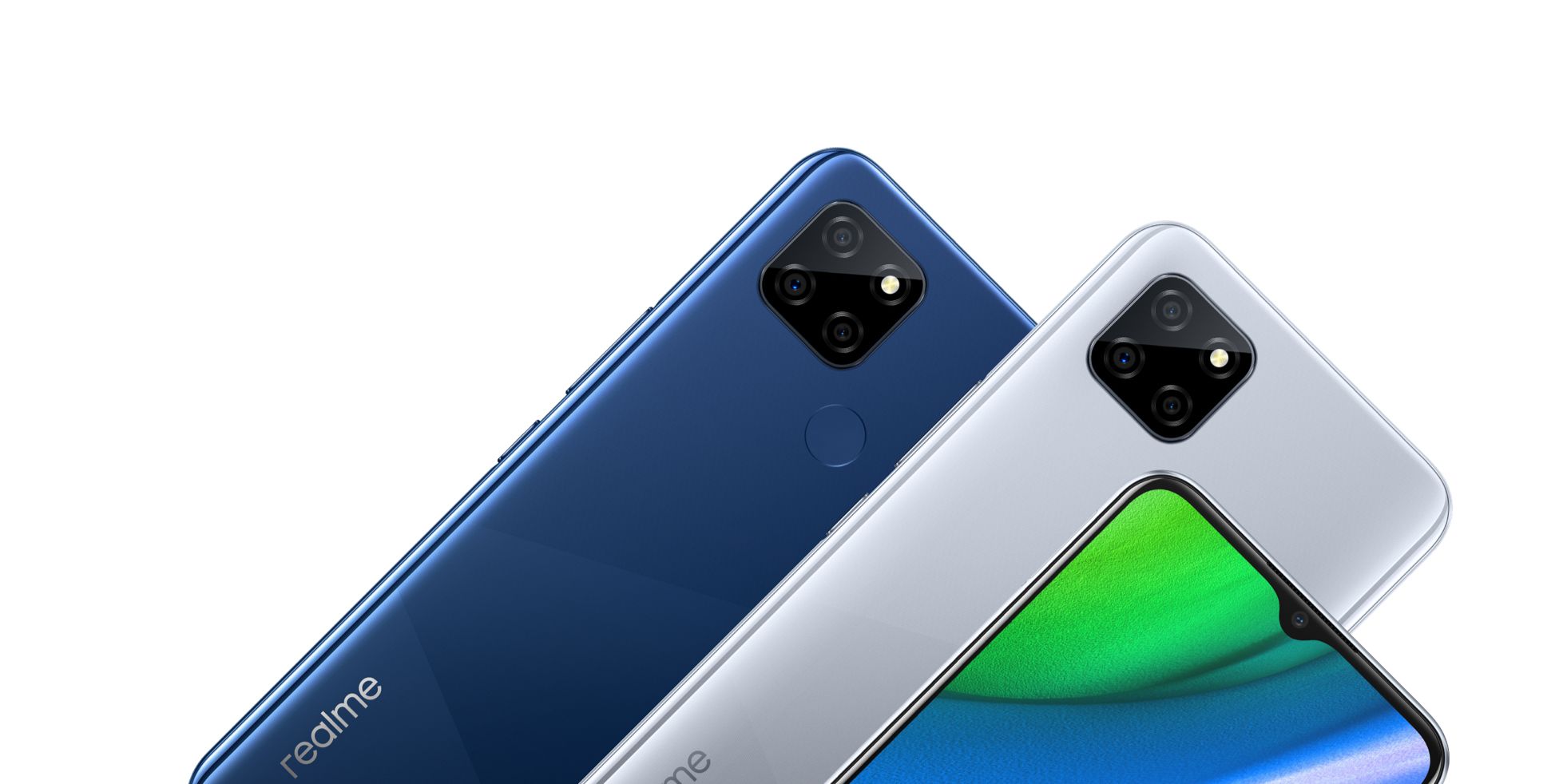
The Realme V3 has also gone official in China alongside the Realme X7 and Realme X7 Pro smartphones. The Realme V3 that is driven by the Dimensity 720 is the cheapest 5G smartphone for China. With a staring price of 999 Yuan (~$146), the Realme V3 offers features like a large-sized display, a huge battery with fast capabilities, and triple rear cameras.
Realme V3 5G specifications and features
The polycarbonate bodied Realme V3 5G has 164.4 x 76 x 8.6mm dimensions. The device weighs 189.5 grams. The Realme V3 5G has a mini-drop notch enabled display of 6.5 inches. The IPS LCD panel supports an HD+ resolution of 720 x 1600 pixels and a 20:9 aspect ratio. The handset offers a screen space of 88.7 percent.
The 2.0GHz Dimensity 720 chipset and up to 8 GB of LPDDR4x RAM powers the Realme V3 5. The smartphone has up to 128 GB of UFS 2.1 storage and it also features a microSD card slot for additional storage. The 5,000mAh battery of the smartphone can be fast-charged using an 18W charger.
The Realme V3 5G has a front camera of 8-megapixel that comes with features like portrait blur, time-lapse photography, panorama, face recognition, HDR, and 30fps 1080p video recording. Its rear side of the phone has a square-shaped camera module that comprises a 13-megapixel main camera with f/2.2 aperture, a 2-megapixel macro lens with a 4cm focal length, and a 2-megapixel depth sensor. The rear cameras offer features like super night scene, professional mode, panorama, AI scene recognition, 120fps 720p slow-motion video shooting, and 60fps 1080p video recording.
The Realme V3 5G has a rear-facing fingerprint scanner. The usual connectivity features like dual SIM support, 5G, Wi-Fi 802.11ac, Bluetooth 5.0, GPS, USB-C, and a 3.5mm audio jack. Lastly, the phone comes preinstalled with Realme UI based Android 10 OS.
Realme V3 5G pricing and availability
The Realme V3 has arrived in China in three variants such as:
6 GB RAM + 64 GB storage – 999 Yuan (~$146)
6 GB RAM + 128 GB storage – 1,399 Yuan (~$205)
8 GB RAM + 128 GB storage – 1,599 Yuan (~$237)
Color options – Sea Blue and Moonlight White
The Realme V3 5G is now available for pre-orders in China and its first sale will be conducted on Sept. 9. There is no word on the international availability of the Realme V3 5G.
The Realme X7 series of premium mid-range phones from Realme has gone official in China. The Realme X7 is the first phone to be fueled by the Dimensity 800U chipset. On the other side, the Dimensity 1000+ powered Realme X7 Pro has arrived to rival the Redmi K30 Ultra that features the same chipset. The Realme X7 series offers users with 120Hz refresh rate display and 65W fast charging technology. Both phones are also equipped with 64-megapixel quad rear cameras.
Realme X7 5G and Realme X7 Pro 5G specifications
The Realme X7 has 160.9 x 74.4 x 8.1mm dimensions and it weighs 175 grams. The handset is fitted with a 6.4-inch AMOLED display that supports 1080 x 2400 pixels, 20:9 aspect ratio, and 180Hz touch sampling rate. It offers a 90.8 percent screen-to-body ratio and comes with Gorilla Glass protection.
On the other side, the Realme X7 Pro measures 160.8 x 75.1 x 8.5mm and it weighs 184 grams. The phone features a 6.55-inch S-AMOLED display that offers FHD+ resolution, 20:9 aspect ratio, 120Hz refresh rate, 240Hz touch sampling rate, and 100 percent DCI-P3 color gamut. The Realme X7 Pro offers 91.6 percent screen space. Both phones have flat displays with a punch-hole design, and they are also equipped with in-display fingerprint scanners.
The Dimensity 800U fuels the Realme X7 5G, while the Pro model gets Dimensity 1000+. These phones are equipped with up to 8 GB of LPDDR4x RAM and up to 256 GB of UFS 2.1 storage. These phones are preinstalled with Realme UI based Android 10 OS.
The Realme X7 series have 32-megapixel front-facing cameras with 80-degree FOV and f/2.45 aperture. The front camera offers features such as portrait mode, HDR, face recognition, super night scene mode, 120fps 1080p slow-motion video shooting, and 30fps 1080p video recording.
The Realme X7’s rear-facing quad-camera system has a 64-megapixel main camera with f/1.8 aperture, a 119-degree 8-megapixel ultrawide snapper, a 2-megapixel B&W lens, and a 2-megapixel macro shooter. On the other side, the Realme X7 Pro 5G’s quad-camera setup comprises of a Sony IMX686 64-megapixel primary shooter, a 119-degree 8-megapixel ultrawide snapper, a 2-megapixel portrait sensor, and a 2-megapixel macro lens. Both phones offer photography features like super night scene mode, professional mode, background blur, HDR, super macro, superwide angle, AI scene recognition, UIS and UIS Max video super anti-shake, 120fps 1080p video recording, and 30fps 4K video shooting.
The Realme X7 has a 4,300mAh battery, whereas the Realme X7 Pro has a larger 4,500mAh battery. Both devices come with support for 65W SuperDart charging technology. The Realme X7 series can charge completely in just 35 minutes, claims the company. They are equipped with usual connectivity features such as dual SIM slot, 5G, Bluetooth 5.1, Wi-Fi 802.11ac, GPS, and USB-C. The Realme X7 has a single super liner speaker, whereas the Pro model is equipped with stereo speakers. The Pro model also supports dual-frequency GPS and NFC.
Realme X7 and Realme X7 Pro pricing and availability
Here are the pricing and availability of the different variants of the Realme X7 series
Realme X7
6 GB RAM + 128 GB storage – 1,799 Yuan (~$264)
8 GB RAM + 128 GB storage – 2,399 Yuan (~$352
)Color editions – Haiyu Blue, C color (gradient), and Fantasy White
Realme X7 Pro
6 GB RAM + 128 GB storage – 2,199 Yuan (~$323)
8 GB RAM + 128 GB storage – 2,499 Yuan (~$364)
8 GB RAM + 256 GB storage – 3,199 Yuan (~$469)
Color editions – Xingyu Black, C color (gradient), and Fantasy White
The pre-orders of the Realme X7 series have started in China. The first sales of the Realme X7 and Realme X7 Pro will be carried out on Sept. 7 in the home market. The company did not share any information on the international availability of the Realme X7 series.
Ming-Chi Kuo has been a reliable analyst when it comes to Apple but he has now shared his opinion about Huawei, which is currently the world’s leading smartphone brand, overtaking Samsung in Q2 2020.
He claims that the Chinese giant Huawei could exit the smartphone market if the conditions for the company worsens. The sanctions put on the company by the United States has been severely affecting the company’s business.
It all started in May last year when the U.S. President Donald Trump signed an executive order putting Huawei on “Entity List”, effectively banning the Chinese giant from using American technologies.
This led to Huawei getting banned from using Google’s Android operating system on its Huawei as well as Honor-branded devices. Recently, the U.S. government tightened restrictions on Huawei as well as its subsidiaries.
With the new restrictions, Huawei has been banned from using American companies or technologies for semiconductors. This means that the company can’t manufacture its own Kirin-branded chipsets with the help of American companies or the companies that use American technologies.
TSMC, the contact manufacturer of Huawei for the HiSilicon Kirin chipsets, stopped taking new orders from the company. Given that Qualcomm is based in the United States, it is also out of the question. MediaTek has already applied for a special license to do business with Huawei, but it’s unlikely to get it.
According to Kuo (via MyFixGuide), even if Huawei somehow manages to source components, the competitiveness and market share of the company is bound to suffer. He adds that in the best-case scenario, its market share declines, and in the worst-case scenarios, the company exits the smartphone market.
It is being reported that if the restrictions are not eased, then Huawei could be losing around 30 percent of the market share. With Huawei’s future on the line, companies like Apple, OPPO, Vivo, and Xiaomi are in a beneficial position in the local market.
LiDAR technology, which stands for “light detection and ranging” is now making its way to consumer electronics devices, although the technology was primarily being used in the automotive industry.
Apple started using the LiDAR technology on this year’s iPad Pro with the ToF sensor and now a report from DigiTimes claims that the same will be included in some of the upcoming iPhone 12 models as well.
LiDAR can measure distances by illuminating the target with laser light and by measuring the reflection with a sensor. The data can then be used to make accurate 3D representations of an object or environment, significantly improving AR experiences.
Although the DigiTimes report does not claim that the iPhone 12 will come with the LiDAR scanner, there have been a few reports claiming that the upcoming iPhone 12 Pro smartphone could feature it.
The Pro models of the upcoming iPhone are expected to have this scanner while the less expensive models with 5.4-inch as well as the 6.1-inch display will not have support for the LiDAR scanner as it is being regarded as a premium feature.
Samsung, which teased its next-generation foldable smartphone named Galaxy Z Fold 2 last month along with the flagship Note20 series, has now added a new production base in Brazil for the Galaxy Z Fold 2.
However, it is being reported that the majority of the units will still be produced in the company’s factory in Gumi, South Korea. Additionally, about 20 percent of the units could be produced at the Samsung factory in Vietnam.
In an effort to diversify its production, Samsung is now adding Brazil to the mix, where it will start production of the device from next year. But the report adds that only a few thousand units will be manufactured in Brazil.
Overall, the South Korean giant is planning to manufacture around 700,000 to 800,000 units of the new foldable device by the end of this year. However, the numbers could get changed based on demand.
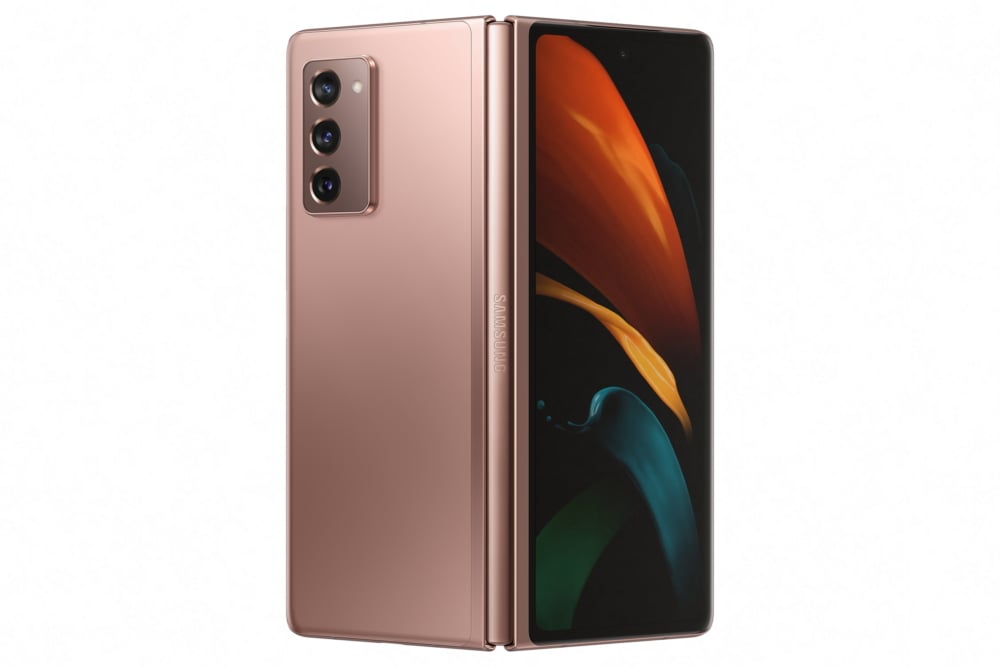
Samsung is now all set to launch the Galaxy Z Fold 2 smartphone featuring a 7.6-inch Quad HD+ Dynamic AMOLED display with 1768 x 2208 pixels screen resolution and a 6.23-inch Super AMOLED HD+ display with 816 x 2260 pixels when folded.
The device will reportedly be powered by the Qualcomm Snapdragon 865 Plus SoC, along with 12GB of RAM and 512GB of internal storage. It will be running the Android 10 operating system out-of-the-box along with One UI on top.
The Samsung Galaxy Z Fold 2 is priced at 1,799 Pounds (~$2,387), a bit lower than the original price of the first Galaxy Fold, which started at 1,900 Pounds (~$2,522). The device is currently listed for pre-orders, with shipping starting from 17th September 2020.
Oukitel C21 has received an overwhelming response from the buyers since its launch a couple of weeks ago via AliExpress. Many Oukitel fans and the users were excited about the new smartphone due to its affordability and value-for-money aspect. It is available for the exciting price of $89.99 packing an Helio P60 chipset, a 6.4-inch HD+ display, and a 20MP AI camera. However, the actual price of the smartphone is $119.99, but due to the introductory limited-time discount, users can grab it at a much lower price.
The interested users can head over to the Oukitel official store and can enjoy a hefty discount via the Oukitel C21 until September 6.
Oukitel C21 arrives with a lot more consisting of a 6.4-inch LTPS Full HD+ punch-hole display with narrow bezels and a 93% screen-to-body ratio. The display is effective and efficient in providing a wider viewing experience.
The smartphone is coupled with a 12nm based Helio P60 chipset featuring an octa-core processor and a powerful GPU for smooth graphics.
In the camera department, Ouktiel C21 offers a 20-megapixel selfie camera for quality selfies and video calling. Being a budget smartphone, Oukitel manages to provide the best gaming experience.
Different Bands Variants
In order to bring exquisite experience while using the smartphone, the company has launched two different bands print for the European region, and North + South American region. The users can choose the respective variant while checking out.
It is available in three different colors of Ocean Blue, Neon Purple and Midnight Black. It is available for a mere $89.99 via the Oukitel’s official AliExpress store. You will get a free silicon case and pre-pasted screen protector along with the package. The sale will start from September 1st and ends on September 6th.
We use cookies on our website to give you the most relevant experience by remembering your preferences and repeat visits. By clicking “Accept”, you consent to the use of ALL the cookies.
This website uses cookies to improve your experience while you navigate through the website. Out of these, the cookies that are categorized as necessary are stored on your browser as they are essential for the working of basic functionalities of the website. We also use third-party cookies that help us analyze and understand how you use this website. These cookies will be stored in your browser only with your consent. You also have the option to opt-out of these cookies. But opting out of some of these cookies may affect your browsing experience.
Necessary cookies are absolutely essential for the website to function properly. This category only includes cookies that ensures basic functionalities and security features of the website. These cookies do not store any personal information.
Any cookies that may not be particularly necessary for the website to function and is used specifically to collect user personal data via analytics, ads, other embedded contents are termed as non-necessary cookies. It is mandatory to procure user consent prior to running these cookies on your website.