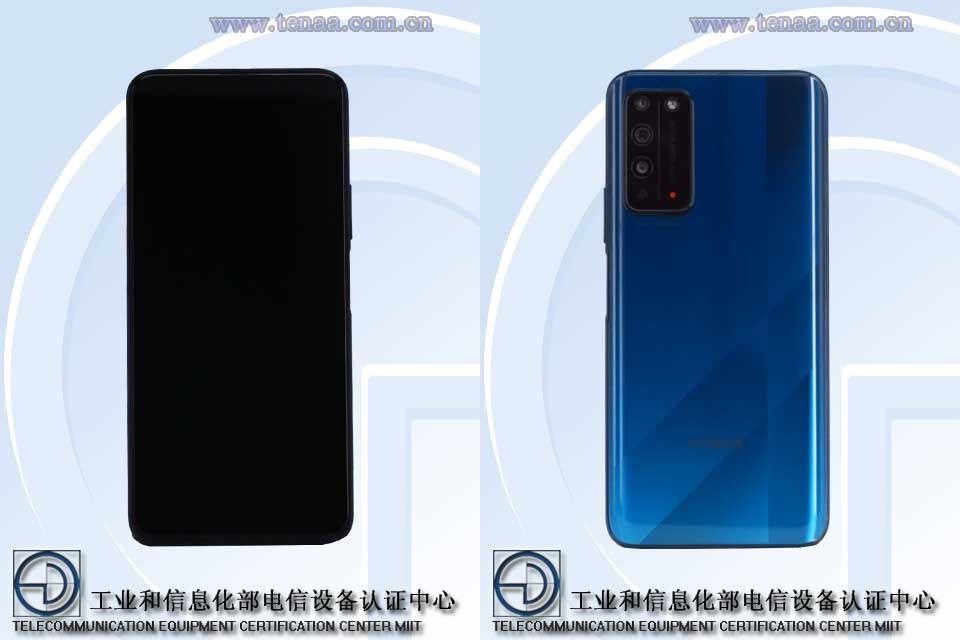
Last month, Honor revealed that its upcoming X-series will be breaking cover as Honor X10, and not as Honor 10X as many expected. It is speculated that the company decided to modify the name because it does not consumers to confuse between its X series phone with the upcoming rival phone named Redmi 10X 4. One major difference between the two phone is that Redmi 10X is a 4G phone and the Honor X10 is a 5G-ready device. The specifications of the Honor X10 appeared on TENAA last month, but the company did not reveal its launch date. Today, the Huawei sub-brand took to Weibo to reveal that the Honor X10 will be announced on May 20.
As it can be seen, the poster released by the company reveals the launch date and has no details on its key features. The TENAA listing of the Honor X10 revealed that it has a 6.63-inch IPS LCD display. Like the predecessor Honor 9X, the X10 will have a notch-less screen and a pop-up selfie shooter.
The Kirin 820 5G chipset is expected to be present under the hood of the Honor X10. The phone houses a 4,200mAh battery that supports 22.5W fast charging through USB-C.
The handset has a pop-up selfie snapper of 16-megapixel. The rear-side of the device has a rectangle-shaped camera module that houses three lenses such as a 40-megapixel primary lens, an 8-megapixel secondary lens and a 2-megapixel sensor. It is said to be equipped with a Sony IMX600y custom sensor as the main lens.
The Honor X10 has 163.7 x 76.5 x 8.8mm dimensions and it weighs 203 grams. The Honor 30S has a starting price of 2,399 Yuan (~$338) in China. It is speculated that the Honor X10 will be Honor’s cheapest 5G phone. It is likely to be priced around 2,000 Yuan (~$282).
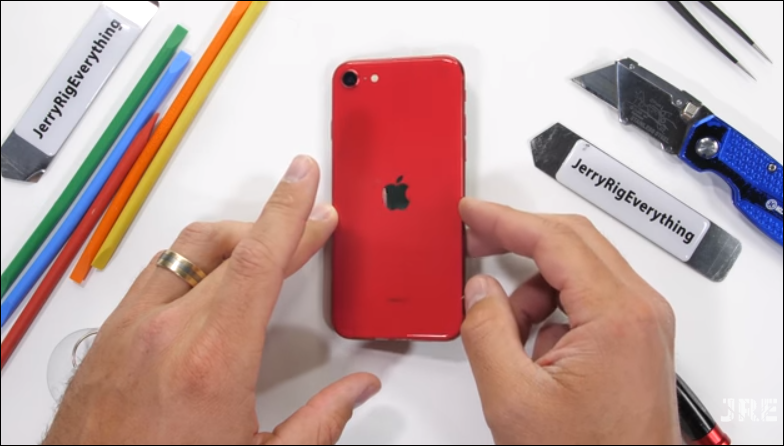
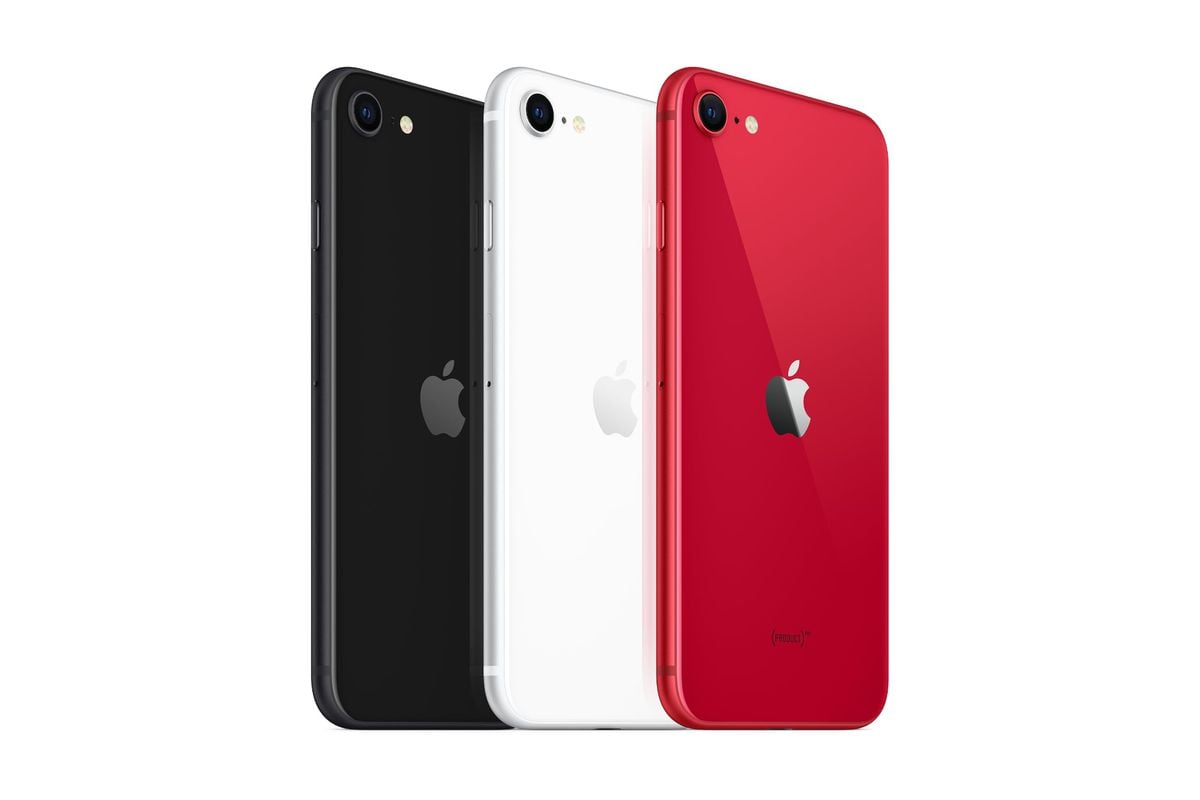
The iPhone SE (2020) released in April still continues to dominate discussions as a result of the cheap pricing and impressive specs lineup. No one seems to bother about the device using an old design with an extraordinary amount of bezels at the top and bottom end of the display. That is because you get a smartphone running on Apple’s latest flagship A13 Bionic chipset on an iPhone 8 body for $399. The iPhone SE is cheap but how easy it is to repair the smartphone? Zack Nelson of the YouTube channel JerryRigEverything has the answer.
One of the impressive features onboard the mobile phone apart from the A13 chipset is the Haptic touch mechanism. The teardown seems to focus more on this Taptic engine and that could be because it is one feature not on the iPhone 8. Haptic Touch uses the Taptic Engine and provides haptic feedback when the screen is pressed on one of Apple’s new iPhones. A Haptic Touch is a “touch and hold” gesture, and it can be used across the iOS 13 operating system.
The phone is pretty easy to open up as there are just a few screws. Since the device has an IP67 rating and can withstand 1-meter of water for 30 minutes, there is a rubber seal around the display to keep water from getting in from the screen.
The teardown gives us yet another look at the A13 motherboard as well as other components such as the wireless charging, cameras, 1812mAh battery, Taptic engine. The rear glass panel is discovered to be held in place with a permanent adhesive making it difficult to replace. It costs more than half the price of the phone to replace the back panel.
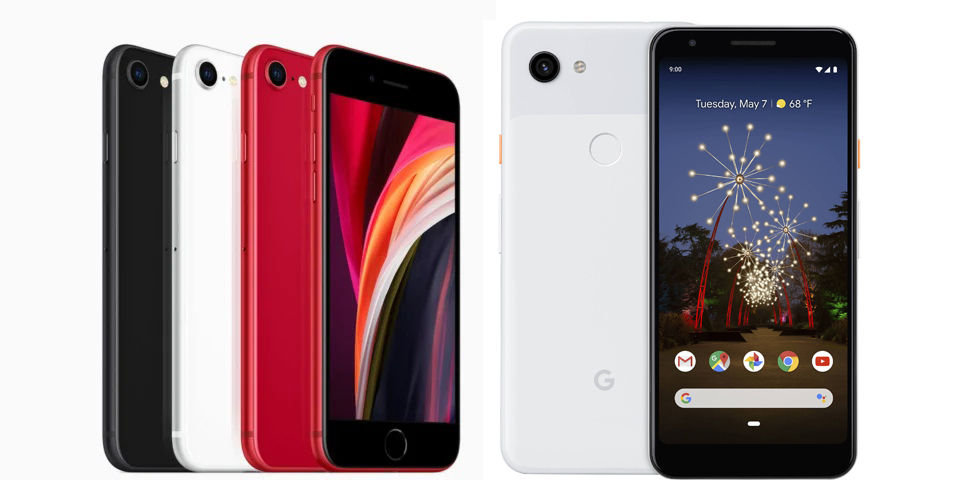
Google and Apple releasing affordable smartphones: a very rare event. But this year we have both choices. The affordable smartphone released by Google is the Pixel 3a, while the one by Apple is the iPhone SE 2020. For those who want a stock Android experience and the fastest updates at a modest price, as well as developers who want to save some money, there is no better option than Pixel 3a. On the other hand, iPhone SE 2020 is for all those people who want to enter Apple’s ecosystem and desire a device with the best performance without the need for a high budget. Further, both are compact devices. For all these reasons and more, we decided to make a specs comparison between the new iPhone SE and Google Pixel 3a.
Apple iPhone SE 2020 vs Google Pixel 3a
Apple iPhone SE 2020
Google Pixel 3a
DIMENSIONS AND WEIGHT
138.4 x 67.3 x 7.3 mm,
148 grams
151.3 x 70.1 x 8.2 mm,
147 grams
DISPLAY
4.7 inches, 750 x 1334p (Retina HD), Retina IPS LCD
Single 12.2 MP f/1.8
Single 8 MP f/2.0 front camera
BATTERY
1821 mAh, fast charging 18W, wireless charging Qi
3000 mAh, Fast Charging 18W
ADDITIONAL FEATURES
IP67 water resistant, eSIM
/
Design
As mentioned above, both iPhone SE and Google Pixel 3a are compact phones. But iPhone SE 2020 is the most compact one. It is the last-generation flagship with the smallest display and body available in the market. Both the devices come with pretty outdated aesthetics, including thick bezels around the screen. You get narrower bezels with the Pixel 3a, but it has a full plastic body. The iPhone SE 2020 has thicker bezels but it comes with more premium materials, including a glass back and an aluminum frame. Further, unlike the Pixel 3a, it is water resistant with the IP67 certification. Note that the iPhone SE has almost the same design as the iPhone 8 released in 2017.
Display
Google Pixel 3a sports an OLED display providing more vivid colors, while iPhone SE 2020 comes with an IPS panel delivering high color accuracy and the True Tone technology. With a 4.7-inch diagonal, iPhone SE 2020 has a very small panel, so it is not for everyone. It is extremely compact, but not the most suitable device for productivity users. Google Pixel 3a sports a bigger 5.6-inch display with an 18:9 aspect ratio (iPhone SE 2020 has a 16:9 aspect ratio).
Specs & Software
When it comes to the hardware department, there is no challenge: iPhone SE 2020 is superior thanks to its Apple A13 Bionic chipset. Despite its affordable price, the iPhone SE 2020 is one of the most performing smartphones out there since it boasts the same chipset as the iPhone 11 lineup and the excellently-optimized iOS operating system. Google Pixel 3a still provides pretty nice performances, but with its Snapdragon 670 SoC, it is just a mid-ranger. Both the devices come with an operating system that will get updates for several years. The iPhone SE ships with iOS 13, while Pixel 3a has Android 9 Pie, already updated to Android 10.
Camera
Both iPhone SE and Pixel 3a are great camera phones and they should be very close in most of the scenarios. However, they come with just one single sensor on the rear side, so they can not shoot ultrawide photos and they do not come with a telephoto sensor for optical zoom. Both support OIS and 4K video recording, but only iPhone SE can record videos in 4K at 60 fps. The iPhone SE is better at videos, while in terms of photo quality the two handsets should be more or less at the same level.
The weakest point of these handsets is the battery life. They are compact, but they also come with a below-average battery. The Google Pixel 3a has a battery with a 3000 mAh capacity, while iPhone SE provides just 1821 mAh. Unfortunately, the iPhone SE is a bit disappointing compared to all the other handsets launched in 2020. The Pixel 3a is definitely better, but not amazing as well. Note that the iPhone SE charges faster due to its smaller capacity and, unlike the Pixel 3a, it supports Qi wireless charging.
Price
In this period, you can find the Google Pixel 3a for less than €350/$300 globally, while the iPhone SE 2020 starts from €499/$399 in its base variant with 64 GB of internal storage. Each of these handsets has its pros and cons. Google Pixel 3a has no chance to reach the level of performance of the iPhone SE, but it has a better battery and a camera providing a similar quality. But at the end of the day, if we exclude the battery, iPhone SE is a superior device. On the other hand, Google Pixel 3a has a higher value for money, as well as a wider display which would let a lot of people go for it. Which one would you prefer?
Apple iPhone SE 2020 vs Google Pixel 3a: PRO and CONS
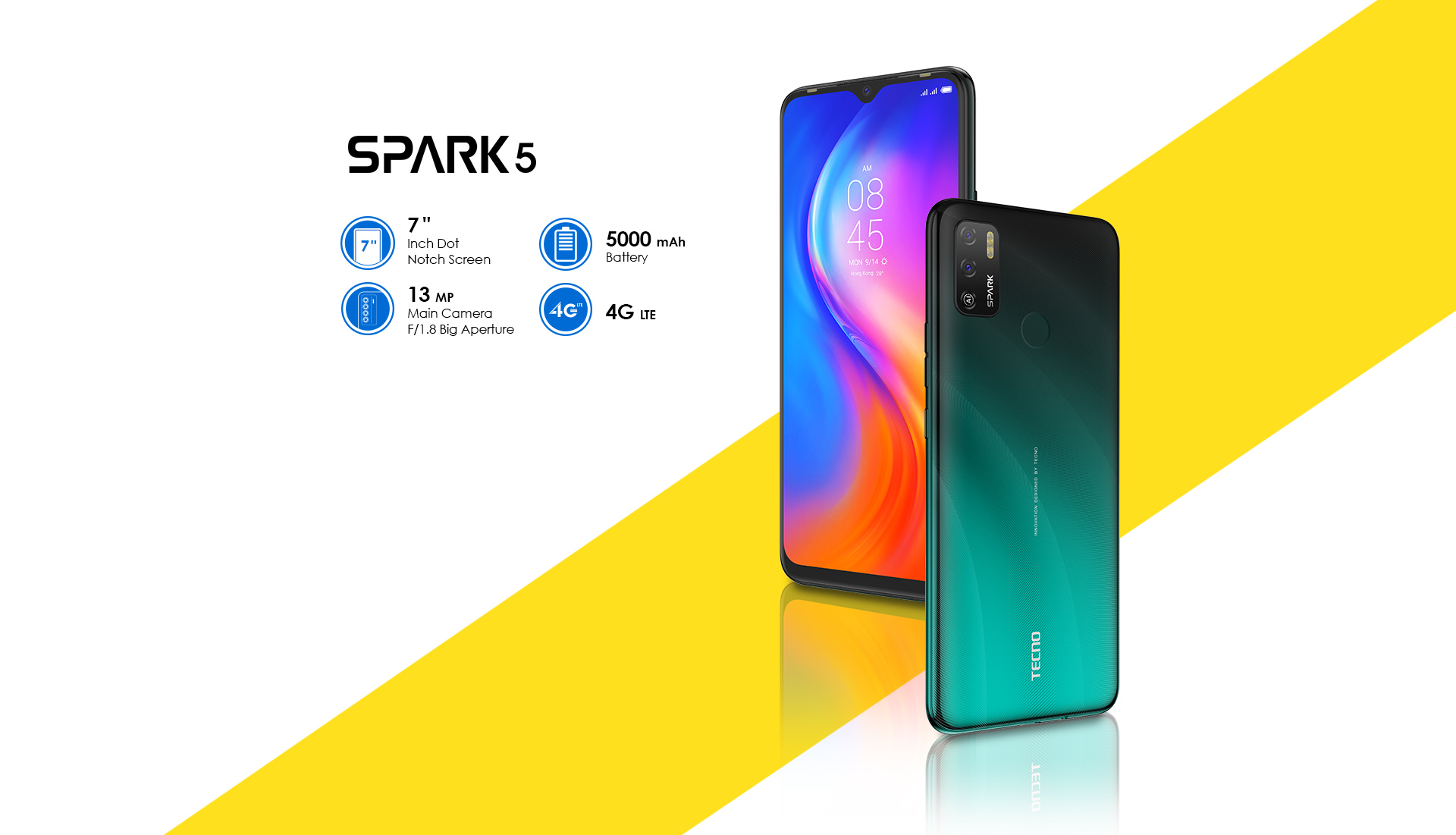
Yesterday, Transsion Holdings subsidiary Tecno launched the Spark 5 smartphone in Ghana. Apparently, the company equally took the wraps off the Spark 5 Air for the same market. Both smartphones are entry-level models that the company is expected to launch for other markets soon.
The Tecno Spark 5 Air features a humongous 7-inch HD+ waterdrop notch display with 88% screen to body ratio and 480 nits brightness. It is powered by an unknown 2GHz Octa-Core processor paired with 2GB of RAM and 32GB of internal storage. The phone adopts a gradient back panel which looks like it is made from plastic. There is a rear-mounted fingerprint sensor.
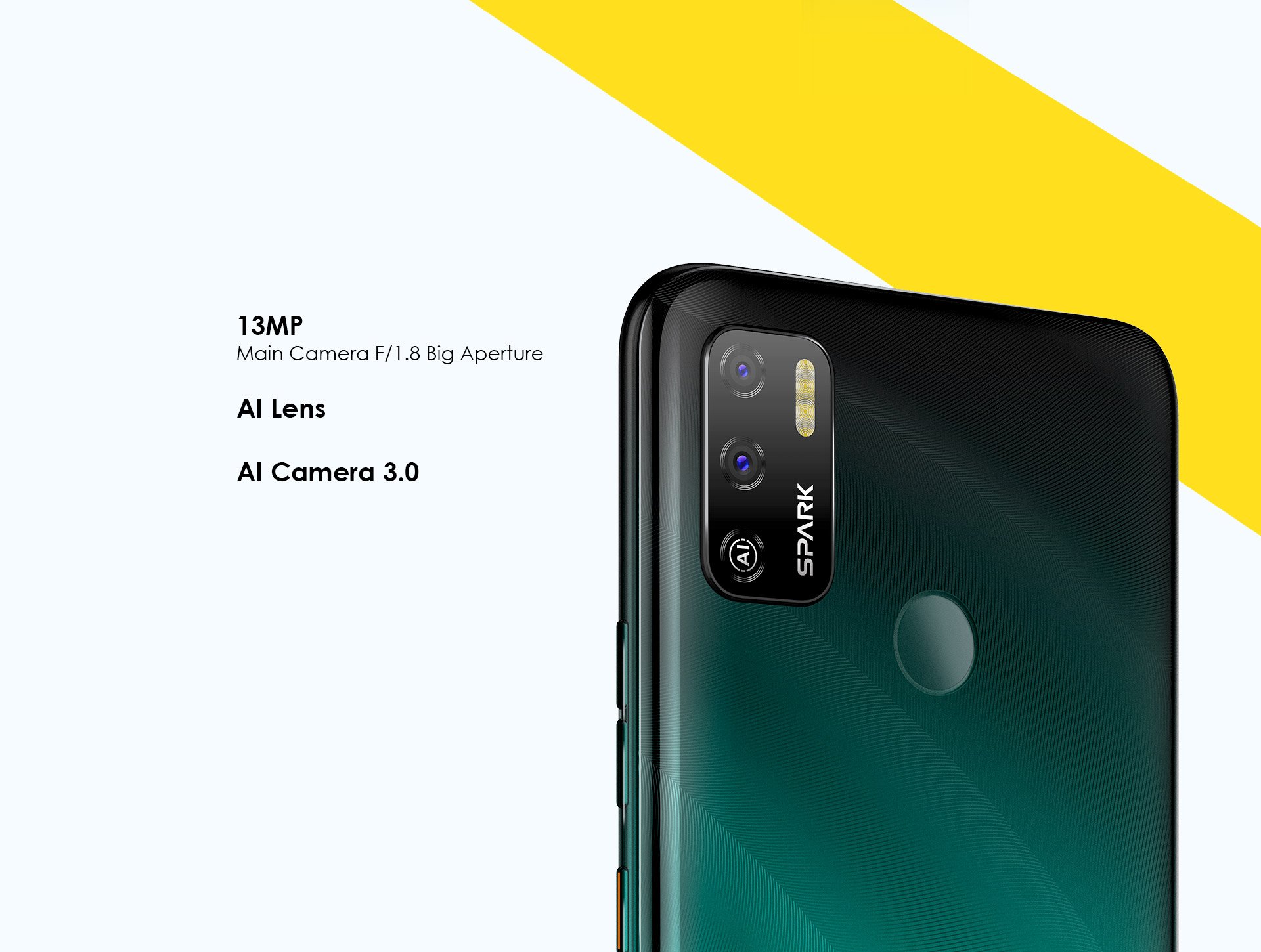
For photography, the Spark 5 Air packs a dual-camera setup which is listed as a 13MP f/1.8 + “AI lens” along with dual-LED flash. The waterdrop notch holds an 8MP camera setup for selfies. The camera comes with features such as AI Beauty Mode, Portrait Mode, in-build localized AR Stickers and Wide Selfie Mode.
Providing the interface is the Android 10-based HiOS 6.1 while the phone gets its light from a massive 5000mAh battery that should deliver an extended usage period. Other features include dual SIM, dual 4G VoLTE, Wi-Fi 802.11 b/g/n, Bluetooth, and GPS.
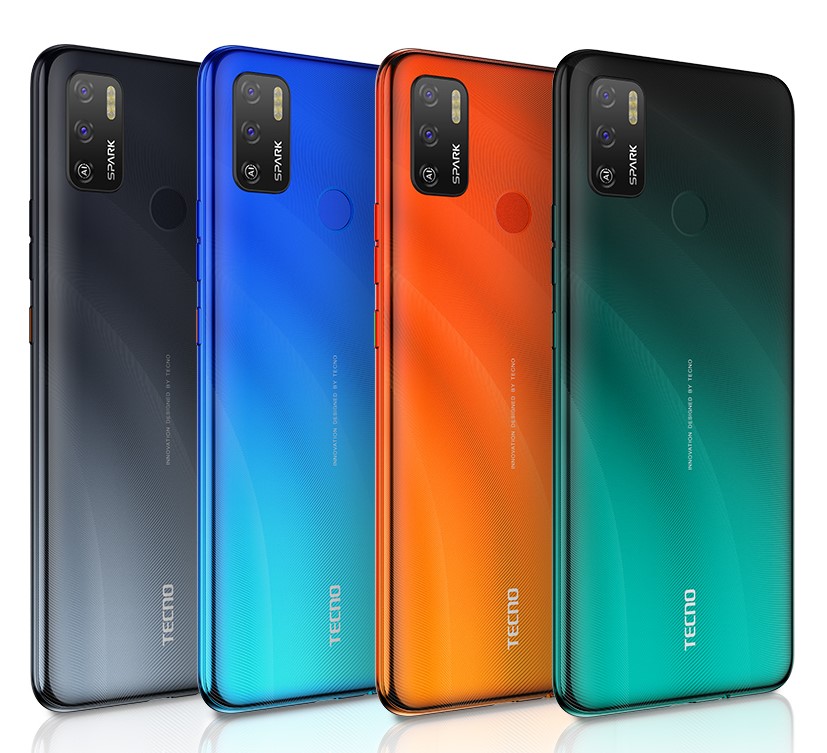
The Spark 5 Air will be available in Ice Jadeite, Spark Orange, Vacation Blue, and Misty Grey color options. The retail price is yet to be announced.
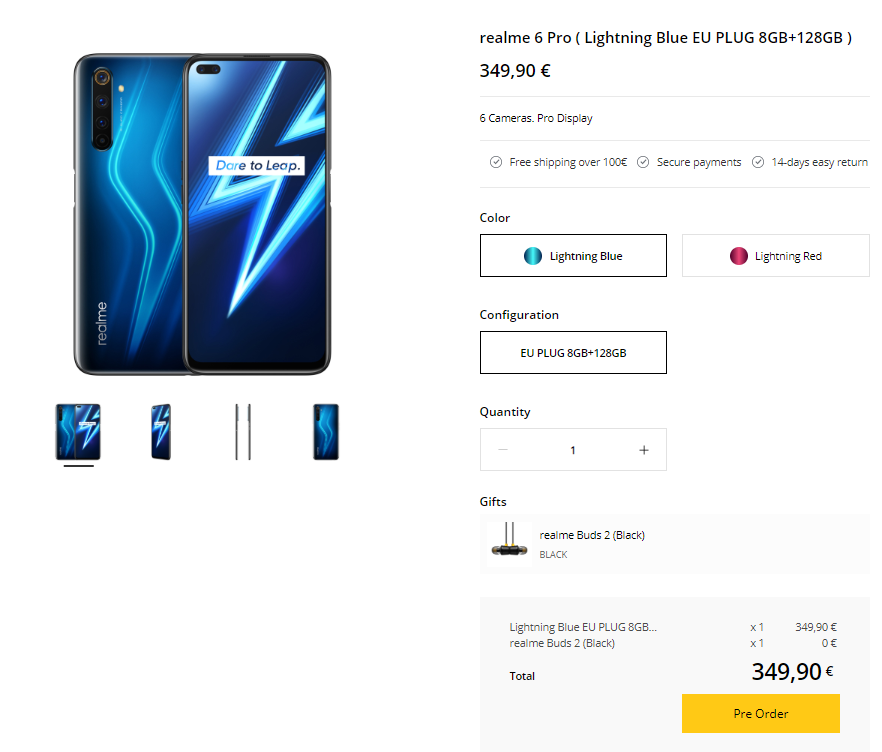
Almost a month after the Realme 6i and Realme 6 went on sale in Europe, their more powerful sibling, the Realme 6 Pro, has now landed in the Old Continent.
The Realme 6 Pro is priced at €349, has 8GB of RAM, 128GB of storage, and is available in Lightning Blue and Lightning Red. The pre-order page says orders will include a pair of Realme Buds 2 earphones. Realme says it is shipping only to Belgium, France, Luxembourg, Netherlands, and Portugal.
The phone has a 6.6-inch FHD+ display with a dual punch-hole, a 90Hz refresh rate, and Gorilla Glass 5. There is a Snapdragon 720G processor under the hood that draws power from a 4300mAh battery with support for 30W wired charging.
The Realme 6 Pro has a 64MP + 8MP + 12MP + 2MP quad-camera setup on its back while the front is home to a 16MP + 8MP dual camera combo. It has a side-mounted fingerprint scanner, NFC, Bluetooth 5.1, an audio jack, Dolby Atmos, and a triple card tray for two SIM cards and a MicroSD card.
You can pre-order the Realme 6 Pro on the official website and on Amazon before its open sale on May 7.
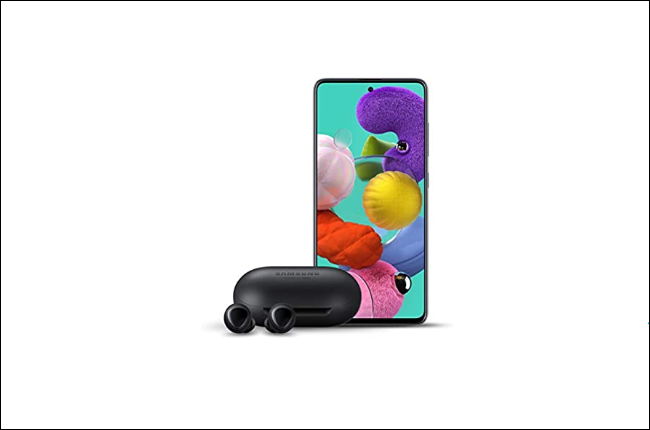
The premium mid-range smartphone is available in 4GB RAM and 128GB storage and is priced at $399. Another awesome aspect is that Samsung bundles the smartphone with a free Galaxy Buds worth $109. Only the Prism Crush Back colour option is available. In addition, the Korean tech giant is also offering two months of YouTube Premium and six months of Spotify Premium subscriptions with the purchase for free.
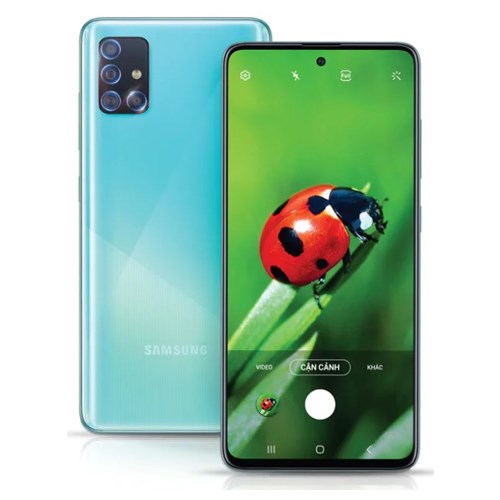
The Galaxy A51 utilises a 6.5-inch Infinity-O S-AMOLED display. It supports 20:9 aspect ratio and full HD+ resolution of 1080 x 2400 pixels. The display is fitted with an in-screen fingerprint reader. The device also supports face recognition.
The Exynos 9611 chipset that includes 2.3GHz octa-core processor. The phone comes in multiple RAM options of 4 GB, 6 GB and 8 GB. Its storage variants are 64 GB and 128 GB. There is a dedicated microSD card slot for more storage. The phone packs an f/2.2 aperture 32-megapixel lens on the front and an L-shaped quad-camera setup housed in a rectangular module on its back. The Galaxy A51’s quad-camera system a 48-megapixel main lens with f/2.0 aperture, a depth sensor of 5-megapixel with f/2.2 aperture, a macro lens of 5-megapixel with f/2.4 aperture and an ultrawide lens of 12-megapixel with f/2.2 aperture.
For interface, it runs on Android 10 OS customized with the latest One UI 2.0. The phone equally packs a 4,000mAh battery that supports 15W fast charging
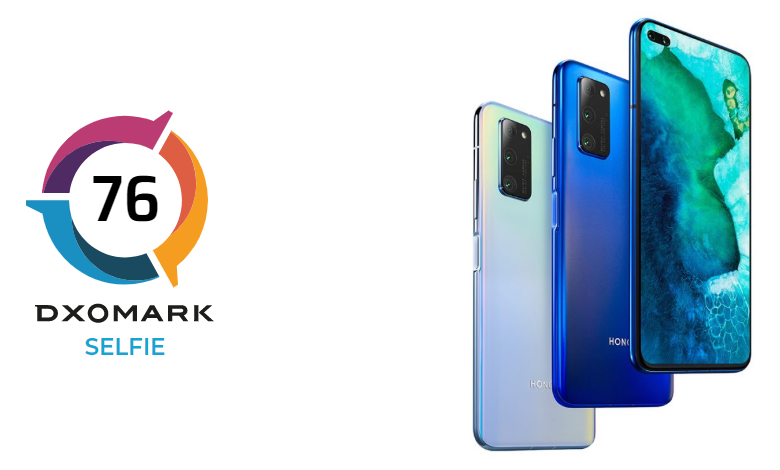
Honor V30 Pro launched late last year scores only 76 points in DxOMark Selfie. The score is too less for a phone with 122 points for its rear cameras. On top of it, the device ain’t champ in audio either with a substandard score of 59 points.
The pictures from the phone’s front camera have unnatural low contrast on faces as well as exposure instabilities across different shots. But target exposure on the face is mostly accurate in all conditions. Further, the images also suffer from limited dynamic range resulting in highlight clipping in challenging high-contrast scenes.
The pictures also tend to have problems with colours. Saturation is quite low with unnatural skin tones. White balance is unstable producing color casts and there is noticeable colour-shading in low-light shots.
The fixed focus with a large image sensor results in poor focus performance. Images lack sharpness and focus if the subject is either too close or far away from the phone. This handset is not suitable for clicking pictures using a selfie stick.
The properly shot pictures from the Honor V30 Pro’s selfie camera have good textures, however, beautification erodes away fine detail. Noise is well-controlled in ideal lighting but becomes more visible indoors and low-light scenarios. Additionally, the bokeh mode on the phone is unstable with noticeable exposure and white balance instabilities.
On the other hand, videos from the front camera have good details, thanks to 4K quality. Target exposure on face and white balance are stable outdoors and under typical indoor lighting. The stabilization performance is also good with keeping the video smooth and steady.
But the cons of photography continues in videography as well. The videos have visible highlight clipping on faces and in the background in high-contrast scenes. Also, the videos have poor color rendering with low saturation on skin tones. There are also visible hue shift, ringing artifcats, and narrow depth of field.
In general, the Honor V30 Pro is not suitable for selfies just like it is for audio. However, the phone’s rear cameras perform extremely well.
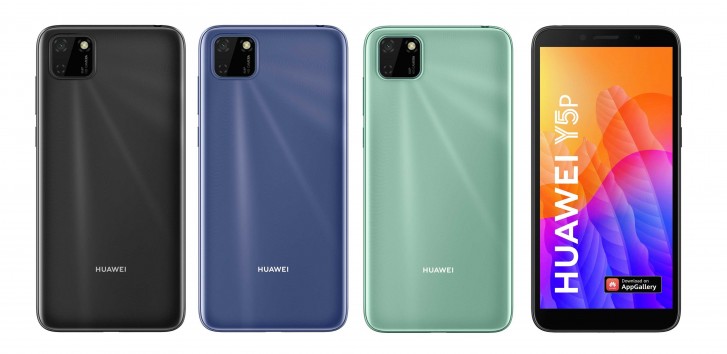
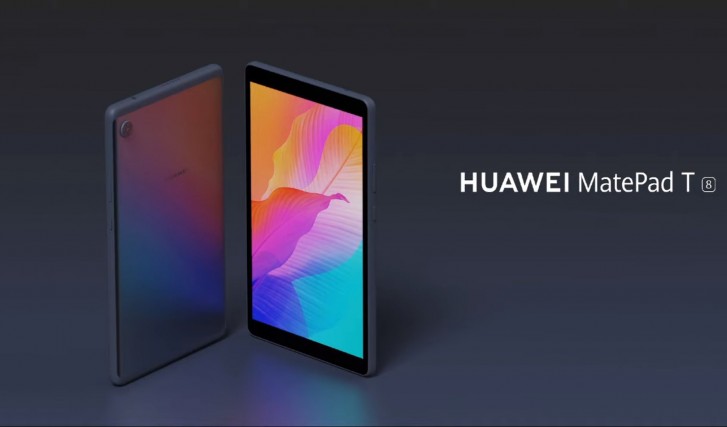
Huawei has been releasing smartphones on all fronts, both flagship, mid-range and entry-level models. Just recently, the Huawei Y6P and Y5P popped up on the radar signifying an impending launch. Well, without much funfair, Huawei has unveiled the duo in Romania. The two smartphones were launched alongside the MatePad T8 tablet.
Huawei Y6P
Huawei Y6P – Specs & Features
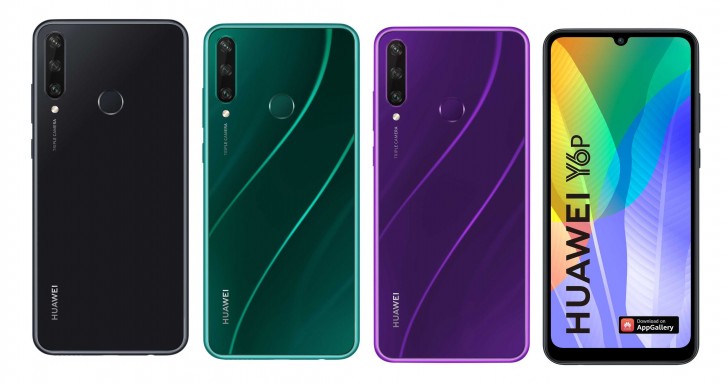
The Huawei Y6P features a 6.3-inch IPS LCD display with an HD+ resolution. The display has a waterdrop notch which houses an 8MP selfie camera. At the rear aspect, the phone sports a triple camera setup consisting of a 13MP main camera alongside a 5MP ultrawide camera sensor and a 2MP depth of field camera. The device also has a rear-mounted capacitive fingerprint scanner.
The Y6P is powered by a MediaTek Helio P22 chipset paired with 3GB RAM and 64GB of storage, which is expandable. Keeping the lights on is an impressive 5000mAh battery which over the dated micro-USB port. The phone runs the latest EMUI 10.1 based on Android 10 but you get Huawei’s own Harmony Mobile Services instead of Google Mobile Services (GMS).
The Huawei Y6P is available in black, green, and purple colors with a starting price of RON 799 (€165). Pre-orders start tomorrow in Romania with a RON 200 (€40) discount.
Huawei Y5P
Huawei Y5P – Specs & Features
On its part, the Huawei Y5P packs a 5.45-inch TFT LCD panel with the traditional top and bottom bezels even though slightly trimmed. The phone comes with an 18:9 aspect ratio. There is a 5MP selfie shooter at the top bezel.
The back panel has an 8MP camera with LED flash. The Helio P22 chipset along with 2 GB of RAM powers the device. There is a 32 GB internal storage on the phone. A microSD card is available for additional storage. Under the hood, there is a 3,020mAh battery. The Y5P runs on EMUI 10.1 based on Android 10 but still without GMS.
As for the pricing, the Huawei Y5P which comes in black, blue and mint colors will go on pre-order tomorrow for 599 RON (€125). There is also an early bird discount of RON 200 (€40) discount.
Huawei MatePad T8 – Specs & Features
Huawei recently transitioned the MediaPad series to MatePad and the MatePad T8 is the third model dropping this year after the MatePad Pro 5G and MatePad 10.4. The new tablet completes the cycle as the MatePad Pro is a flagship slate, the MatePad is a mid-range tablet and this new model is a budget-level slate. The model features an 8-inch LCD panel with a resolution of 1280 x 800 pixels. It ha the classic bezels at the top and bottom edges of the display. The top houses a 2MP selfie shooter which most will likely not put to use. At the rear, there is a 5MP primary camera.
Under the hood, the MatePad T8 crams an Octa-core MediaTek MTK8768 chipset paired with 2GB of RAM. There are 16GB and 32GB internal storage options that are expandable via the microSD slot. The tablet equally crams a sizeable 5100 mAh battery and boots EMUI 10.0.1 on top of Android 10 out of the box.
The Huawei MatePad T8 comes with a pocket-friendly RON 500 (€100) price tag and is available in a single color variant which is blue. The slate will go on sale later this month.
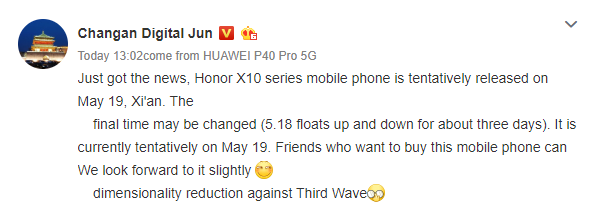
The last Honor launch event took place in mid-April. The brand unveiled Honor 30 series comprising of Honor 30, Honor 30 Pro, and Honor 30 Pro Plus at the event. Now, according to a tipster on Weibo, the next Honor event will take place somewhere around 18-19 May. At this conference, the company is expected to launch Honor X10 and other products.
The Honor X10 has been leaking for a while now suggesting an imminent launch. According to previous reports and rumours, it will be the cheapest 5G smartphone from the house of Huawei.
The latest leak suggests this handset will launch alongside several other Honor-branded products. The event date is not confirmed but the tipster claims it will be held on either May 18 or 19. He also mentions the date might vary by a maximum of 3 days.
Talking about other devices, the company will be announcing new Honor MagicBook models with updated processors. We can expect them to be powered by AMD Ryzen 5 4500U and Ryzen 7 4700U. Apart from laptops, the brand will also unveil new Honor tablet, router, and smart TV if the info shared by the leakster turns out to be true.
As far as Honor X10 is concerned, according to previous leaks, it could be powered by Kirin 820 5G chipset. Further, It will feature 6.63-inch 20:9 IPS LCD screen with 1080 x 2400 pixels (FHD+ resolution). The fingerprint will be side-mounted and the device will measure 163.7 x 76.5 x 8.8mm in dimension as well as weigh 203 grams.
The handset will sport a 40MP + 8MP + 2MP triple camera setup on the back and a 16MP front camera. The battery of the phone will be of 4,200 mAh with possible support for 22.5W fast charging
Last but not least, the Honor X10 will come in these colors – Light Speed Silver, Racing Blue, Burning Orange and Speed Probe Black respectively.
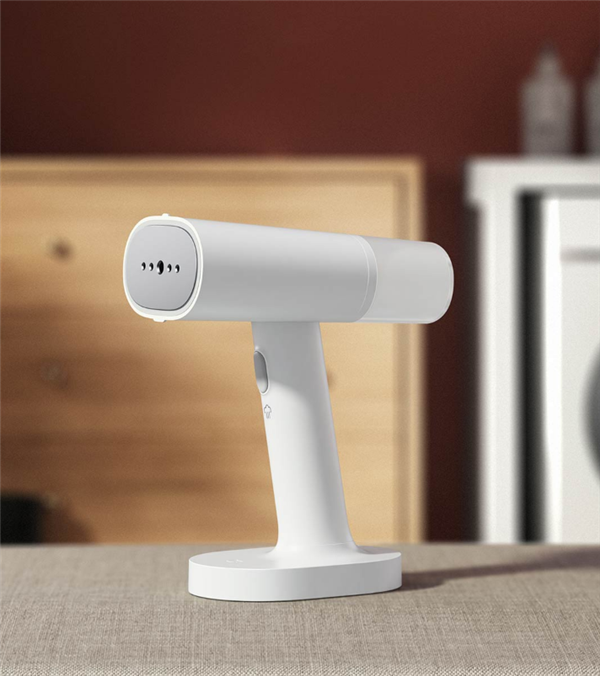
Xiaomi has disclosed that it will launch a new MIJIA Handheld Ironing Machine under crowdfunding at Xiaomi Mall / Xiaomi Home at 10 am tomorrow (May 6). The product will have a price tag of only 99 yuan (~$14).
This happens to be the first ironing product that will be launched under the MIJIA brand. As usual, it adopts a minimalist design for which Xiaomi is known and comes in white only. The steam iron has a separate water tank which will have to be detached to refill with water. The steam head is made from an aluminium die-casting panel with good thermal conductivity. The head can exhale 120°C high-temperature steam to achieve 99.9% sterilization and mite removal.
The MIJIA Handheld Ironing Machine is said to utilise micro-supercharging technology in order to release 20kPa of 120°C steam. It only needs 30 seconds to heat up in order to be used to iron clothes as it comes with a 1200W power rating.
In addition, the Mijia handheld ironing machine uses a 160ml removable large water tank, which can iron 6 shirts at a time. The weight of the entire machine is 780 grams (when the tank is empty).
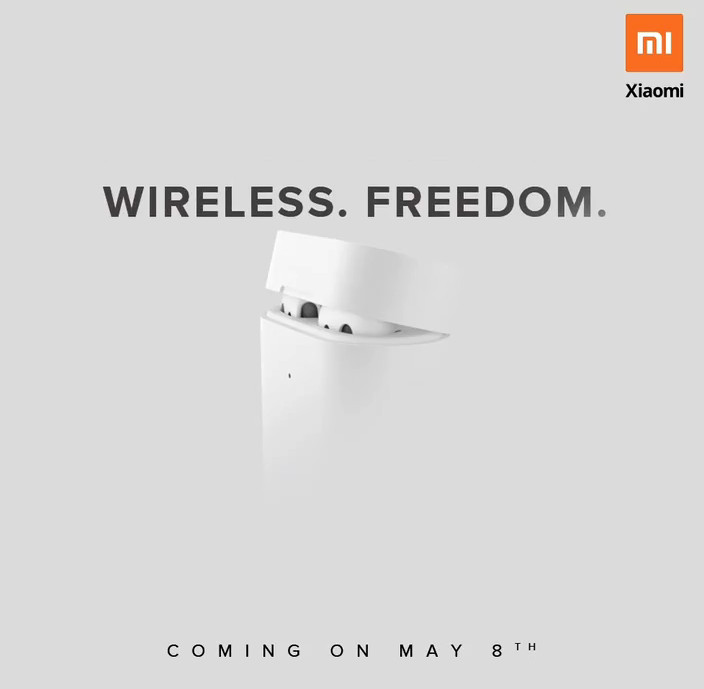
Xiaomi India’s CEO Manu Kuma Jain has released a short teaser which hints at the impending launch of wireless earbuds. The earbuds will be released on May 8 which happens to be the date scheduled for the Mi 10 series launch.
The teaser clearly shows the product will bear a similar design with the Mi Airdots Pro 2 which was launched in Europe recently as Mi True Wireless Earphones. That is likely the name with which it will hit the Indian market.
The Mi AirDots Pro 2 was first launched in China back in September last year. Xiaomi has also introduced the Mi AirDots Pro 2s with a similar design, but with improved dual Bluetooth chip for a more stable connection and low latency and wireless charging.
The two earphones come with Bluetooth 5.0 (LDHC/SBC/AAC codes) to connect to Android and iOS devices, 14.2mm drivers, Touch controls for volume and track change, Dual microphones for noise cancellation, and voice control. They also have an Infrared sensor for intelligent wear detection so it automatically pauses when you remove them, Semi-in-ear design to fit your ear canal, making it comfortable to wear and doesn’t fall off easily and light-weight body. The Mi AirDots Pro 2s offers up to 24 hours battery life compared to 14 hours in the Pro 2 and the standalone battery life of up to 5 hours compared to 4 hours.
There was not even a single way-out for the users who would have wanted to add their Android TV in Google Home-based Speaker Group until the last few days. Surprisingly, the users can now add Android TV into the Speaker Group and can simultaneously play music. It will open a new sphere of possibilities for the advanced Google Home app users. The service works in sync with Google Cast protocol which can enable music listening across all the supported devices concurrently without any wire.
Google Home app was limiting the Speaker Group compatibility to Google Cast-enabled devices like Google Home smart speakers, Chromecast Audio devices, and third-party Cast-enabled devices while barring the Android TVs. Surprisingly a Twitter user @androidtv_rumor notices the ability to add his Android TV in a Google Home-based Speaker Group functionality. The feature was found after updating the Chromecast built-in app to version 1.47.207274. In today’s guide, we will let you the steps to add Android TV in Google Home Speaker Group.
Prerequisites:
Android TV box or Smart TV with inbuilt Google Cast.
Working Internet connection.
Make sure to update Google Cast built-in to the version 1.47.207274.
Steps to add Android TV in Google Home Speaker Group
Update your Chromecast built-in app on your TV to version 1.47.207274 either by signing up for a beta program or sideloading it on your TV.
Update the Google Home app on your smartphone.
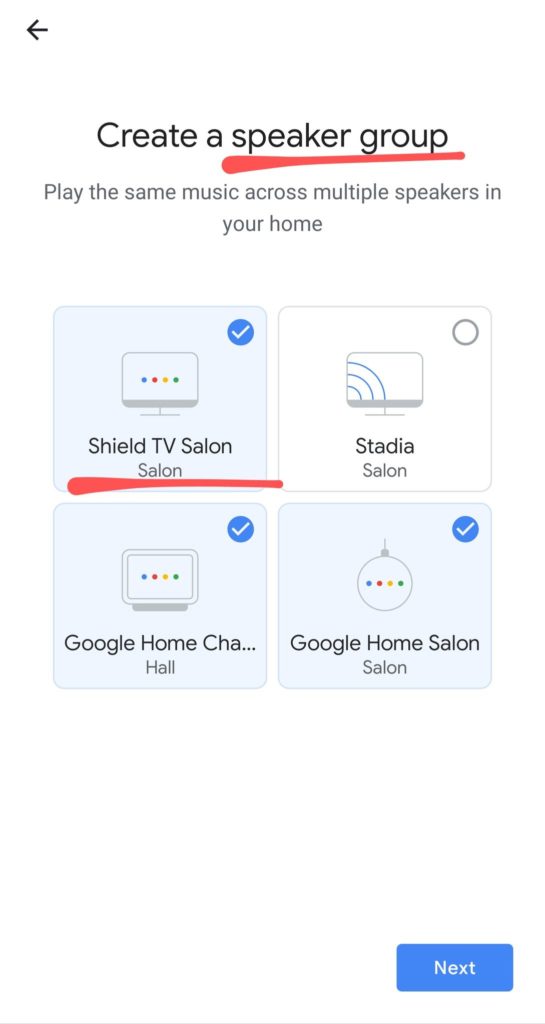
Open the Google Home app and tap on the ‘+’ icon to tap on the ‘Create Speaker group’.
Now select your Android TV along with other supported Home devices.
Tap Next, and then name the group before saving it.
Done, You can now choose the newly created group to cast from any service like Spotify, etc.
We hope you’ve successfully added Android TV in your Google Home Speaker Group easily. Moreover, the update brings the ability to turn off ongoing notifications for Android TVs on all the network-connected devices.
The unexpected feature rollout for the Google Home app is giving some indication towards the launch of Android TV-powered Chromecast. However, the new Chromecast Ultra was due for launch at Google I/O 2020 but the event got canceled due to the ongoing COVID-19 crises across the glove.
If you get any difficulty while adding Android TV to Google Home-based Speaker Groups then let us know via the comments below.
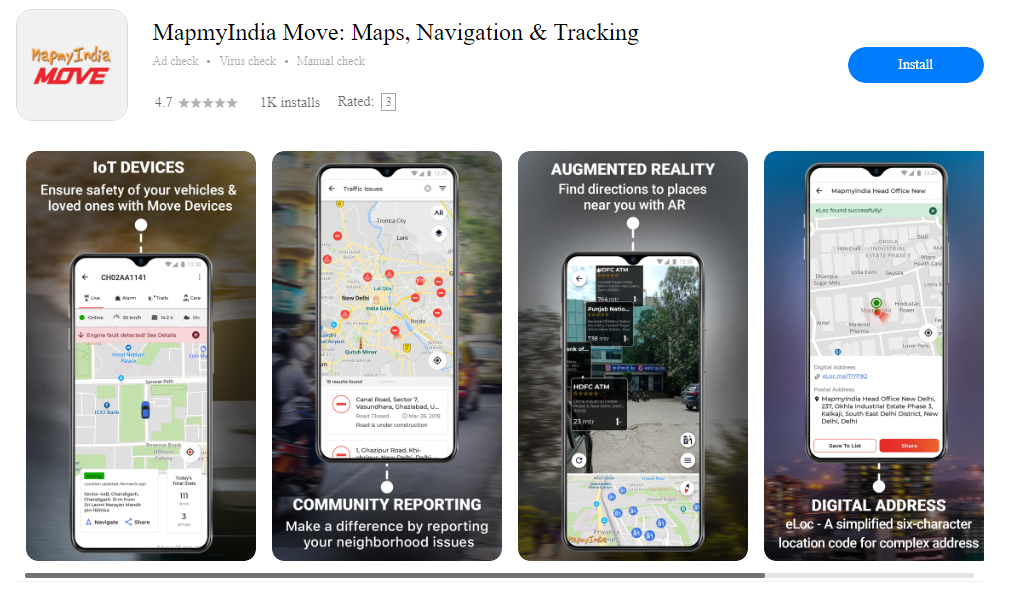
Huawei has been lately partnering with various firms to let their apps available on its AppGallery, the official apps store for Huawei and Honor smartphones. Last we saw the company signing a deal with Hungama Digital Media Entertainment. Now, the Chinese smartphone maker has inked a deal with MapmyIndia to bring Move app to its platform.
Move is one of the homegrown Indian maps apps. The developer behind it is MapmyIndia, a company working on maps for 25 years. This is not the only app for navigation on AppGallery. Recently, Huawei even managed to get Here WeGo app on its platform.
However, the Move app will come pre-installed on all the new smartphones launching in India with Huawei and Honor brandings. It is already live on AppGallery and interested users can install them on their devices right away.
The Move app by MapmyIndia has almost all the features of Google Maps app, however, it surely can’t replace it. If you are using Huawei/Honor devices with HMS (Huawei Mobile Services) in India, then it is probably the best alternative.
Huawei’s AppGallery is currently the third-largest app sore behind Google Play Store and Apple App Store. The company has been investing more in building up its own platform to fill the voids left by the removal of GMS (Google Mobile Services).
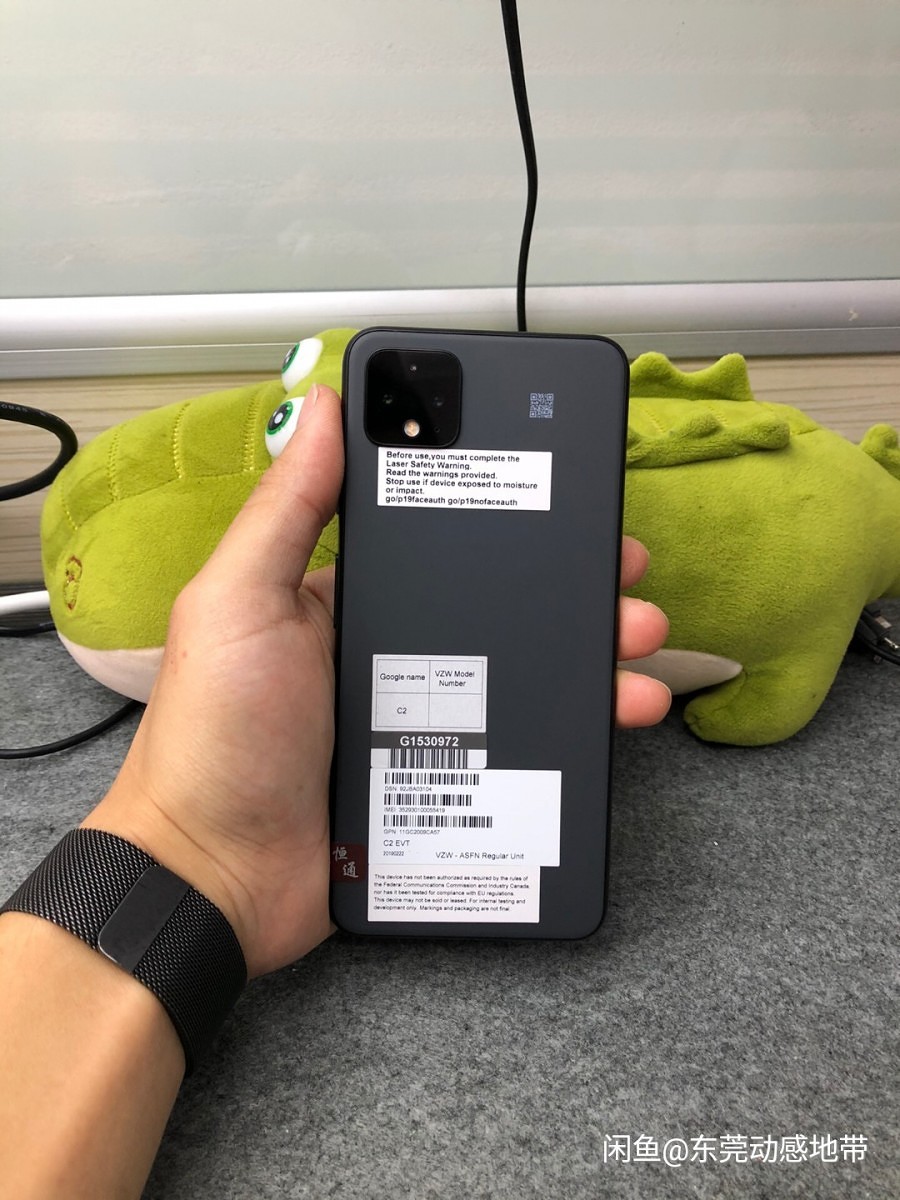
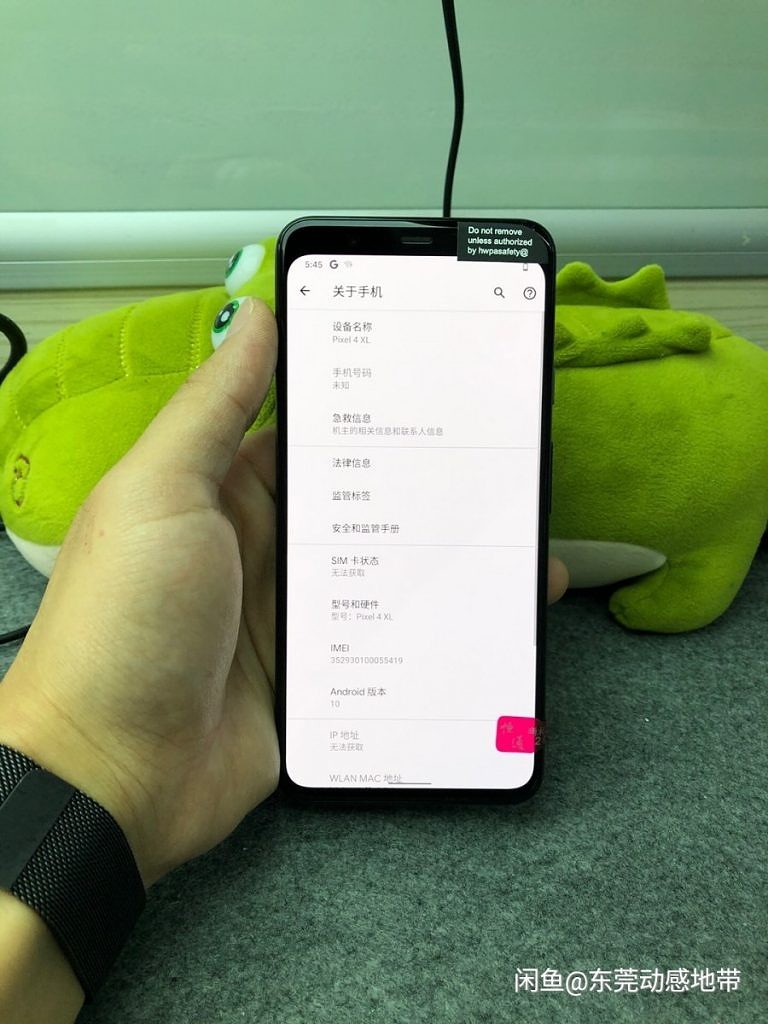
In October 2019, Google unveiled the Pixel 4 and Pixel 4 XL flagship smartphones. Both phones are selling in three color editions such as Oh So Orange, Clearly White and Just Black. Alleged shots of a prototype of Pixel 4 XL in matte gray color have surfaced.
The images of the Google Pixel 4 XL matte gray edition were spotted by a Twitter user on Taobao. The listing mentions the device as an “engineering machine.” The handset has 6 GB of RAM and 64 GB of built-in storage and is listed with a pricing of 2,699 Yuan (~$382). The pricing is much cheaper than the current $600 cost in the U.S. XDA claims that the IMEI identifier available online has revealed that the device is indeed the Pixel 4 XL.
Since the device carries a sticker that states that the device has not been authorized by Federal Communications Commission and Industry Canada rules. Also, it has not been tested for compliance with EU regulations. Hence, it is unlikely that the new color variant will be made available for purchase ever.
In related news, the Google Pixel 4a smartphone is rumored to debut as May 22. The mid-ranger is expected to come with a 5.81-inch OLED panel that produces full HD+ resolution. The Snapdragon 730G processor will be driving the device along with 6 GB of RAM. The handset has a 3,080mAh battery and 18W fast charging. It has a front camera of 8-megapixel and a rear shooter of 12-megapixel.
The Pixel 4a is expected to arrive in the market in 64 GB and 128 GB storage choices. It may arrive with a starting price tag of $399.
Nearly a year ago, Samsung and AMD announced a partnership on mobile GPU for Samsung’s future mobile processors. We expected the Exynos 990 will be the first processor to feature the first of the new GPUs but that wasn’t the case. Now, a new report says the 5nm Exynos 1000 will feature the new GPU which is based on AMD’s technology.
ITHome reports that they have been informed that the new GPU will appear in the Exynos 1000 which is expected to be the name of Samsung’s next flagship chipset that should power the successor to the Galaxy S20.
The GPU is currently referred to as RDNA-Exynos and has reportedly surfaced on Geekbench. A comparison of its scores shows it surpassing the Adreno 650 GPU of the Snapdragon 865. Below is a table showing the performance of the two GPUs:
RDNA-Exynos
Adreno 650
Manhattan 3.1
181.8 fps
123 fps
Aztec Normal
138.25 fps
53.5 fps
Aztec High
58 fps
20 fps
The Exynos 1000 should be announced by the fourth quarter of the year. However, before that, another flagship chipset called the Exynos 992 is expected to launch. This processor will power the upcoming Galaxy Note20 series.
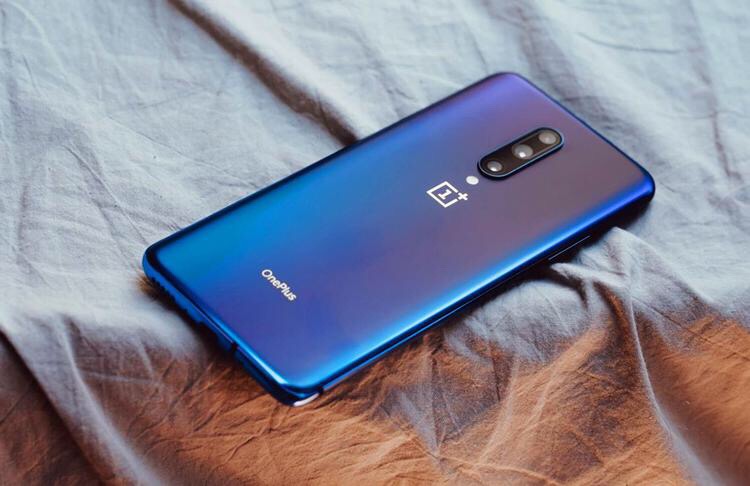
OnePlus is well-known for OxygenOS. The brand’s close to stock Android mobile software is favoured by users around the world. But a user on Reddit pointed something that no one thought of broadly. The brand has been long promoting its OS to be bloat-free but its devices do come with certain third-party applications pre-installed.
OnePlus has tweeted multiple times advertising its OxygenOS Android Skin to be free of bloatware. However, its smartphones do feature some third-party applications like Netlfix and Facebook out of the box.
Oneplus 7 pro
OnePlus recently ended its OnePlus IDEAS beta program which allowed users to share new feature ideas. The company revealed 5 features that will be implemented in OxygenOS, one of them being AOD.
The brand received over 5,000 ideas and one of the popular ones was allowing users to choose the apps they want to install while setting up the phone. This idea was suggested to further enhance the bloat-free experience.
However, OnePlus denied this idea by saying users expect certain applications like clock, calculator, and gallery out of the box. It also mentioned the inclusion of Netflix and Facebook is to enhance HDR playback (seriously?).
We all know these two apps can be installed from the Play Store. It is true that most people indeed use them. Hence, it is beneficial for those set of users to get them out of the box. On the other hand, this experience surely can’t be called bloat-free as these apps cannot be uninstalled.
Moreover, this is a serious issue on carrier versions of OnePlus smartphones. These handsets come with more pre-installed apps that nobody ever uses.
This bloatware problem can be easily fixed by the idea suggested by that user but OnePlus is not interested in the feature, at least for now.
The Realme X50 5G Pro, Realme 6 Pro and Realme 5i smartphones were made official earlier this year, but the company did not announce them in European markets. Fresh information states that Realme’s online store and Amazon will begin with the sales of the aforementioned smartphones in Europe.
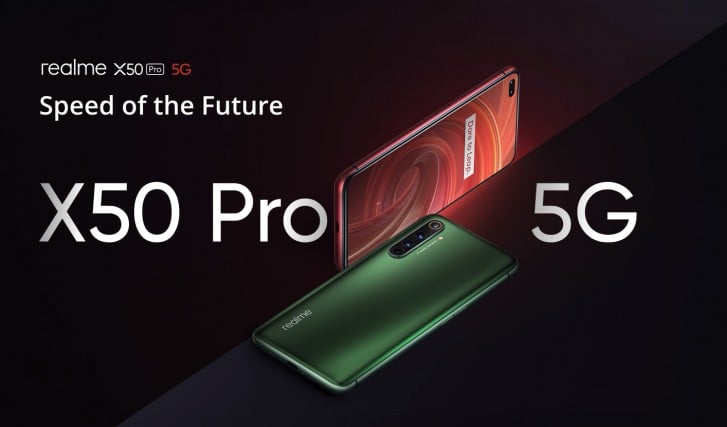
Realme X50 Pro 5G
The Realme X50 Pro 5G will be available in variants like 8 GB RAM + 128 GB storage, 8 GB RAM + 256 GB storage and 12 GB RAM + 256 GB storage. These models are priced at 600 euros, 670 euros and 750 euros. The online store of Realme and Amazon have started with the pre-orders. The sales of the two phones are scheduled to begin by mid-May.
The Realme X50 Pro 5G has a 6.44-inch S-AMOLED display with full HD+ resolution and 90Hz refresh rate support. The Snapdragon 865 SoC powers the device. The rear side of the phone 64-megapixel + 12-megapixel + 8-mgeapixel + 2-megapixel quad camera system. It has a 32-megapixel + 8-megapixel dual selfie camera setup. The 4,200mAh battery of the Realme X50 Pro 5G is coupled with 65W fast charging. It is equipped with in-screen fingerprint reader.
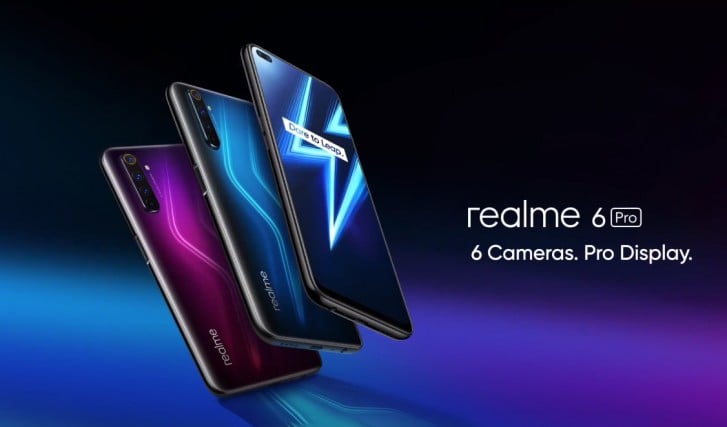
The Realme 6 Pro with 8 GB of RAM and 128 GB of native storage. It is already up for pre-orders. The sales of the smartphone are slated to begin on May 7. The handset will be available for 350 euros.
The Realme 6 Pro has a 6.6-inch IPS LCD screen with a 16-megapixel + 8-megapxiel dual camera system housed inside dual punch-hole cutout. It has a 64-megapixel + 12-megapixel + 8-megapixel + 2-megapixel quad camera system. The Snapdragon 720G processor fuels the device and it has a 4,300mAh battery with 30W fast charging support. It has a side-facing fingerprint reader.
Realme 5i
The Realme 5iv has 4 GB of RAM and 64 GB of built-in storage and is priced at 160 euros. Its sales are also slated to begin in mid-May.
The Realme 5i has a 6.52-inch IPS LCD display with HD+ resolution support. It has an 8-megapixel front camera and a 12-megapixel + 8-megapixel dual rear cameras. The Snapdragon 665 SoC fuels the device and it is packed with a 5,000mAh battery. It has a rear-mounted fingerprint reader.
Xiaomi has launched the new Mi Commerce in India. The offline to online platform arrives in India to help retailers advertise from their homes during the time of the Coronavirus pandemic. The Chinese tech giant is emphasizing on the new service being a “product discovery platform” that will help boost sales in the region.
According to official notes, Xiaomi will employ exclusives stores (that are found online only through the company’s platform) that will be able to showcase the availability of their products. Furthermore, the company has also planned on working on providing capital loans for all of its offline retail store partners. Notably, essential and crucial personnel like the frontline and the police will receive a service discount as well.
The Mi Commerce platform has been launched in Kerala, in South India and arrives after the government announces the relaxation of lockdowns in various areas. The service will soon arrive in other government dictated Green and Orange zones. As of right now, upwards of 15 percent of retail partners are already operational in the country. The company expects this number to grow to over 60 percent and include more than 10,000 exclusive retail partners soon also become operational.
According to Xiaomi India’s Managing Director, Manu Jain, “During this time, a lot of customers might have concerns to go out of their home and walk into a physical store. We understand this and want to support all our 10,000 retail partners, especially all the exclusive retail partners such as Mi Home, Mi Stores, and Mi Studios. For them, we are building this O2O solution.” The exact viability and implications of this platform remain to be seen, but we are hopeful that it helps resuscitate the declining economy in the Southeast Asian nation.
It is no longer news that Vivo is working on its very first smartwatch. While its release date is unknown, we may have an idea of what it looks like thanks to images from an alleged patent.
The photos were posted on Twitter by a user that goes by @_the_tech_guy. There is no link to the patent, so we can not confirm the authenticity, and thus advise you to take it with a pinch of salt.
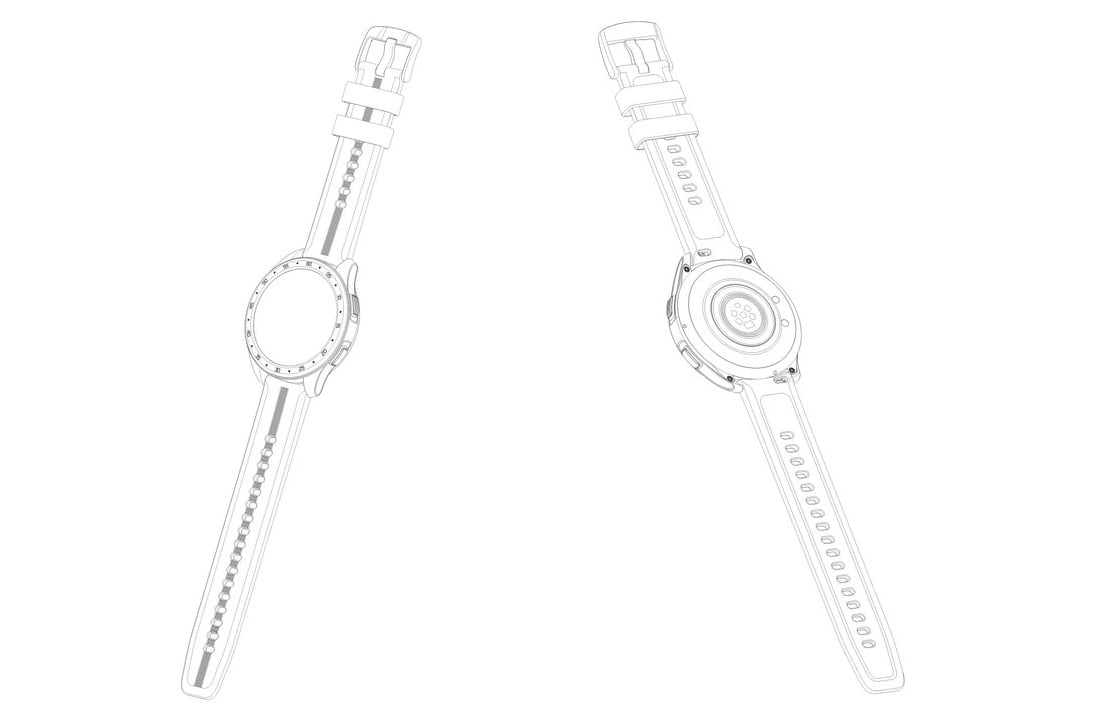
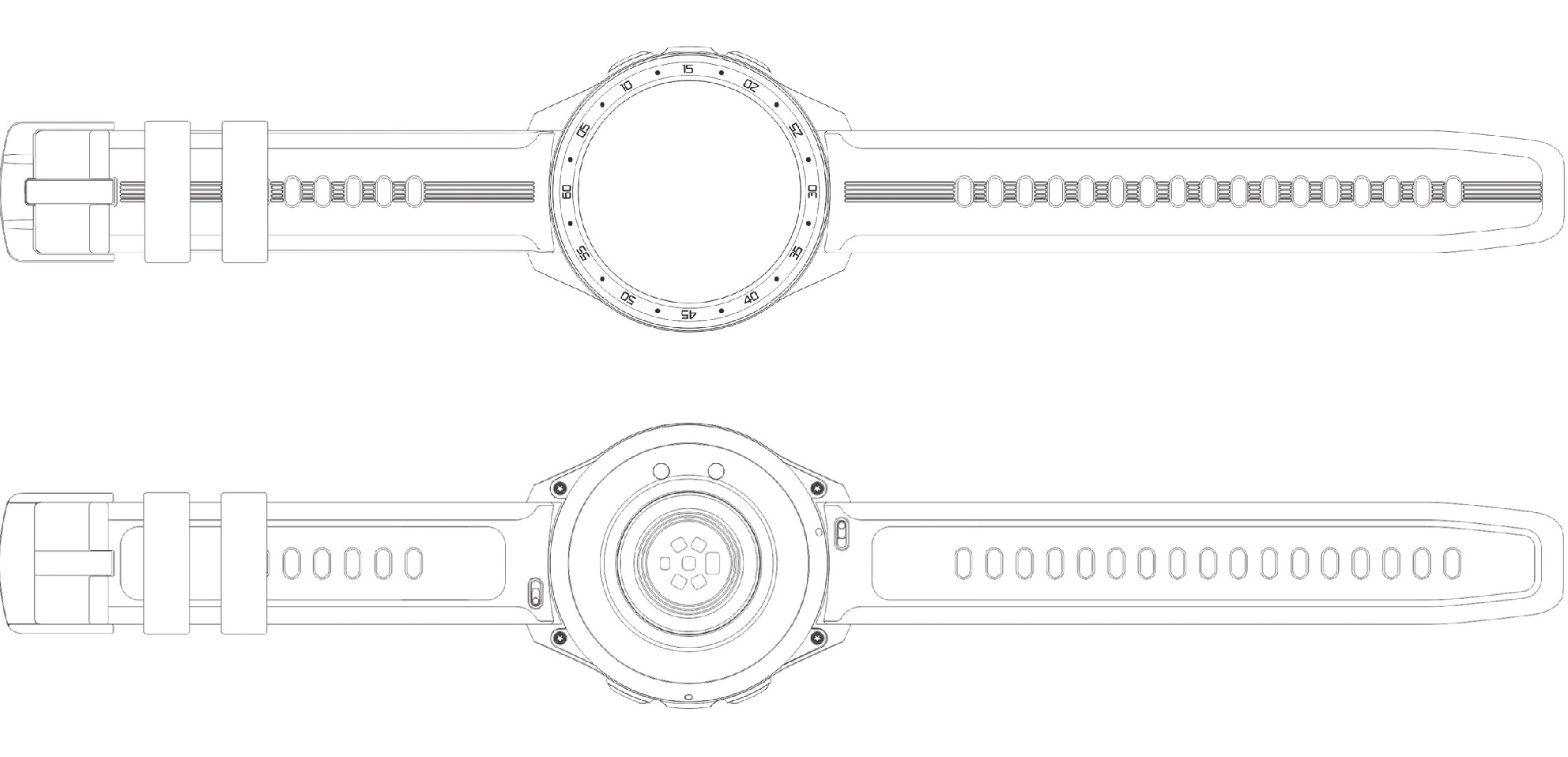
According to the images, Vivo’s first smartwatch may have a round display with a tachymeter around the bezel. The right side of the watch is home to two buttons while the left is bare. The rear of the smartwatch has sensors that should be for heart rate tracking as well as two contact pins that should be for the charging base.
The smartwatch makes use of quick-release straps, so we expect Vivo to make available official replaceable straps of different designs and materials. Unfortunately, there are no details about the features and parameters such as screen size and other related dimensions.
It is interesting to see Vivo adopt a design similar to a traditional watch. However, there is no saying that it may launch another smartwatch with a square face like OPPO and Xiaomi.
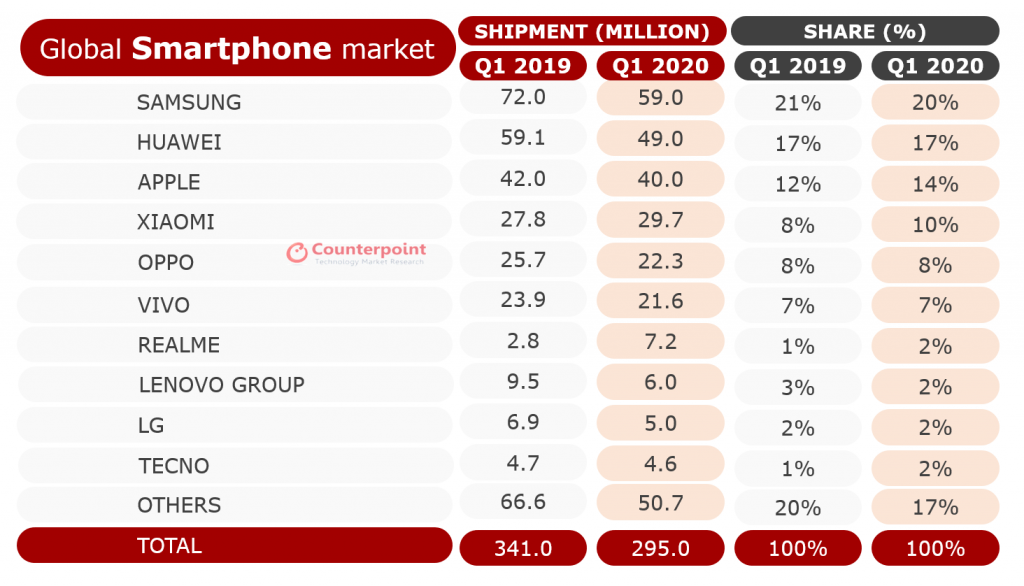
The analysts at Counterpoint Research released their global smartphone shipments report for Q1 2020. As expected the market plummeted 13% YoY due to COVIID-19 global pandemic. However, brands like Relalme and Xiaomi showed an increase of 157% and 7% YoY growth rates respectively. In fact, they are the only company to be less affected. Also, the market share of 5G phones rose to 8% compared to 1% last year at the same time.
For the first time ever since Q1 2014, the global smartphone shipments dropped below 300 million units in a quarter. China as the primary smartphone market of the world was severely affected by the pandemic, which originated from the region.
Smartphone shipments declined by 27% YoY in China making the region account for 22% overall global market share from 26% last year. This also affected the supply chain, which can lead OEMs to look for countries like India and Vietnam in the future.
Samsung led the market but its shipments dropped by 18% YoY. It is expected to further decline given all the primary markets for the OEM is still under lockdown. Whereas, Huawei, which ranked second with 17% YoY decline has the potential to grow as the Chinese market is recovering. Also, in third place, Apple only saw a 5% YoY decline but its iPhone revenues dropped by 7% YoY.
As far as recovery is concerned, analysts predict mid-range smartphones to be the biggest winner of the pandemic. Sales of entry-level handsets are expected to go down due to the current economic situation, especially in developing nations. But high-end devices will start selling once again after certain normalcy.
However, mid-range devices will continue to thrive. On top of it, OEMs are expected to launch 5G-enabled sub $300 smartphones, which will further increase the market share of 5G as well as mid-range handsets.
Further, the most affected are the OEMs whose primary channel of business is offline. Also, the market share of the top 10 brands has increased from 80% in Q1 2019 to 83%. This suggests the brands that rank 11 and above like HMD Global are yet to see worst quarters.
We use cookies on our website to give you the most relevant experience by remembering your preferences and repeat visits. By clicking “Accept”, you consent to the use of ALL the cookies.
This website uses cookies to improve your experience while you navigate through the website. Out of these, the cookies that are categorized as necessary are stored on your browser as they are essential for the working of basic functionalities of the website. We also use third-party cookies that help us analyze and understand how you use this website. These cookies will be stored in your browser only with your consent. You also have the option to opt-out of these cookies. But opting out of some of these cookies may affect your browsing experience.
Necessary cookies are absolutely essential for the website to function properly. This category only includes cookies that ensures basic functionalities and security features of the website. These cookies do not store any personal information.
Any cookies that may not be particularly necessary for the website to function and is used specifically to collect user personal data via analytics, ads, other embedded contents are termed as non-necessary cookies. It is mandatory to procure user consent prior to running these cookies on your website.