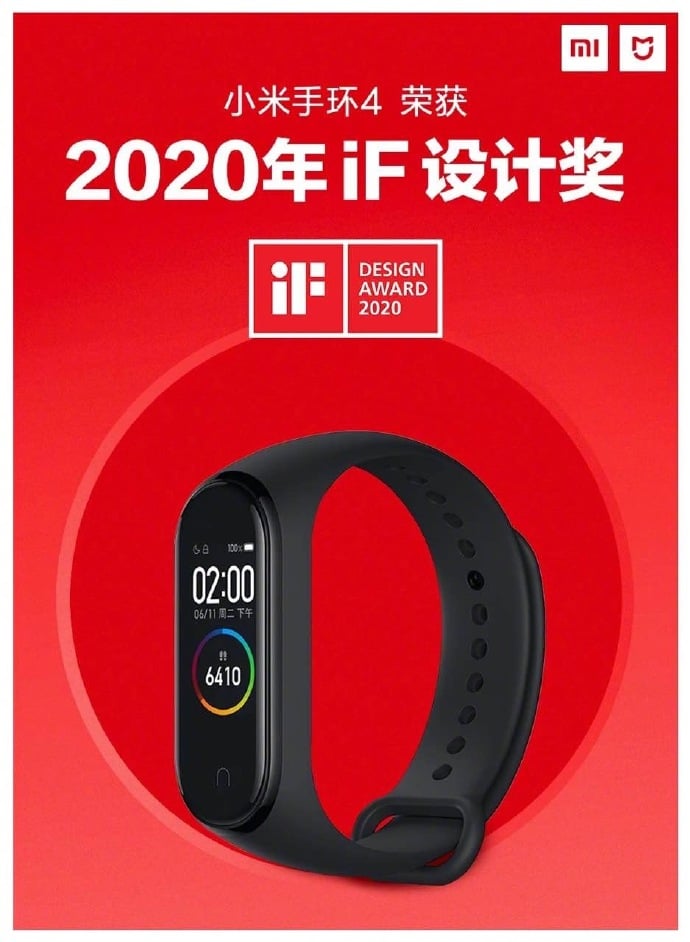
The winning entries for the German iF Design Awards 2020 were announced recently. A number of smartphones were among the winning products, including several models from China like the Xiaomi MIX 3, Mi 9T, Redmi K20 Pro, Meizu Zero, among others. Xiaomi’s sub-brand MIJIA has now revealed that a staggering 19 MIJIA products were among the winning products.
The MIJIA brand has gained renown for amazing products that often times get released with affordable price tags. The iF design award-winning products include the MI Band 4, Mijia handheld wireless vacuum cleaner, MIJIA table lamp Pro, Xiaomi Water Purifier Lentil, Mijia Smart Door Lock, MIJIA Instant Water Dispenser C1, MIJIA Rice Cooker, MIJIA Juicer, Mitu Children bicycle, MIJIA Night Light 2, Wireless car charger, MIJIA Laser projector and several others.
The Mi Band 4 emergence as one of the awardees won’t pass unnoticed. This is because the Mi Smart Band 4 is the fourth model of Xiaomi’s smart fitness tracker to have won the award. The Mi Band, Band 2 and Mi Band 3 were also winners in previous years.
Also worthy of note the fact that most of the products on the list are cheap products. The minimalist designs and decent quality definitely played key roles in the choices of selection by the jurors.
We are less a day away from the official launch date of the Xiaomi Mi 10 series composed of Mi 10 and Mi 10 Pro. In this article, we collected all the latest and most reliable pieces of info about the specifications, features, and prices of the new flagship lineup.
Xiaomi Mi 10 and Mi 10 Pro (5G) Rumor Roundup
Design
Several renders and leaked photos surfaced online, and an earlier image revealed that the Xiaomi Mi 10 could adopt a scheme similar to what we have seen with the Xiaomi Mi Mix Alpha.
Xiaomi Mi 10 official poster
However, according to the latest official renders from Xiaomi, the Mi 10 will feature a simpler design with solid colors. The Mi 10 is confirmed to feature a quad-camera setup in a vertical arrangement with an LED flash at the bottom. The front will feature a curved display with a thin chin at the bottom. As you can see in the image above, the phone will feature a punch-hole camera on the top left corner.
Unofficial leaks have also revealed more details about the device, including its thin chin. Apart from the officially revealed cyan and peach colors (as seen in the official image above), a leaked image (down below) reveal an additional green and blue color options for the device. A white color option is also confirmed.
Leaked Xiaomi Mi 10 poster is in line with the official design
According to a leaked image of the Mi 10 Pro, the phone will feature an additional camera in the rear setup. If you look closely at the image below (leaked), the Mi 10 Pro will come with five cameras. On the front side, it is expected to house a punch-hole display with curved sides, just like the standard Mi 10 model. So the camera seems to be the only major difference between the designs of the two models.
Both Mi 10 and Mi 10 Pro will have a curved AMOLED display, but the vanilla Mi 10 is confirmed to feature a 90 Hz refresh rate and 180Hz touch sampling rate. Xiaomi has already revealed a lot of details about the standard Mi 10 model, so let’s take a look at it first.
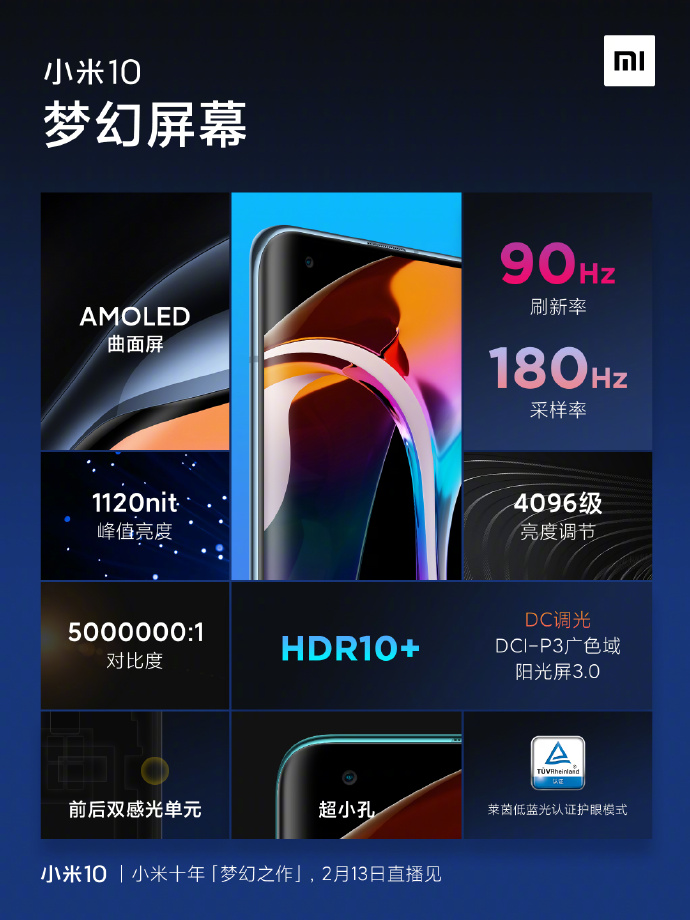
The Mi 10 will come with a 6.67-inch curved edge AMOLED display. It will support HDR+ and DCI-P3 color gamut as well as DC dimming. It will be a custom made panel with a contrast ratio of 5000000:1 and a peak brightness of 1120 nits. Xiaomi claims that this panel features industry-leading levels of JNCD (Just Noticeable Color Difference) and Delta E values and its better than the iPhone 11 Pro Max’s screen. Further, each display is calibrated one by one before heading out of the factory. You can read all about the Mi 10’s display from our coverage here.
As for the Xiaomi Mi 10 Pro, we don’t have any official information. It is said that the phone could feature a larger display with a 120Hz refresh rate, just like the Poco X2 and Galaxy S20 models. Other display specs are expected to be identical to the non-Pro model.
Specifications and Software
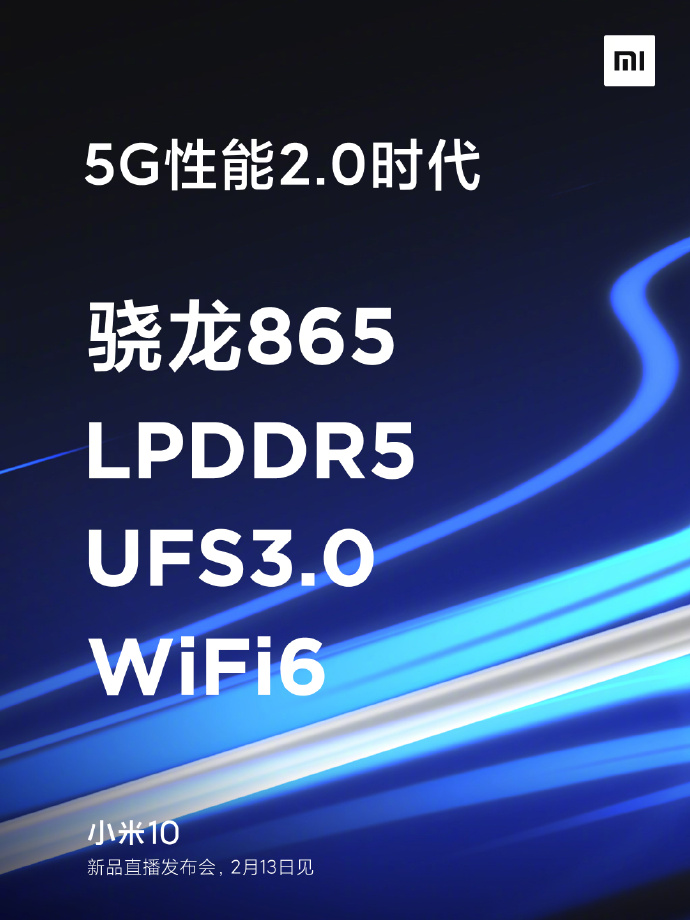
Xiaomi Mi 10 and Mi 10 Pro will be fueled by the new Snapdragon 865 SoC by Qualcomm (confirmed) which comes bundled with an integrated 5G modem supporting both sub-6 GHz frequencies and mmWave. So both Mi 10 and Mi 10 Pro will support 5G connectivity. It is the most powerful Qualcomm’s chipset and it packs the Adreno 650 GPU for very high graphics performance. The chipset will be paired with up to 16 GB of LPDDR5 RAM and internal storage of 128, 256 or 512 GB depending on the chosen configuration. Xiaomi has confirmed that the base variant of the Mi 10 will start at 8GB RAM and 128GB of storage. So, there’s no 64GB version anymore, clearly hinting at its premium placement this year.
Xiaomi Mi 10 specs confirmed
Android 10 will be obviously installed out of the box, customized by the MIUI 11. Unfortunately, it seems there will be no headphone jack. The only way to use wired earphones will be using an adapter for the USB-C port. According to leaked benchmarks Xiaomi Mi 10 scores more than 560,000 points on AnTuTu.
Both the Mi 10 models are confirmed to feature a Vapour Chamber cooling system with multiple layers of graphite. In addition to this, the company claims that the phone uses AI machine learning as well as five temperature sensors to help monitor and adjust temperatures between 1 to 5 degrees. In short, the company promises overheating shouldn’t be a problem on the Xiaomi Mi 10 series. You can read more about the phone’s cooling system here.
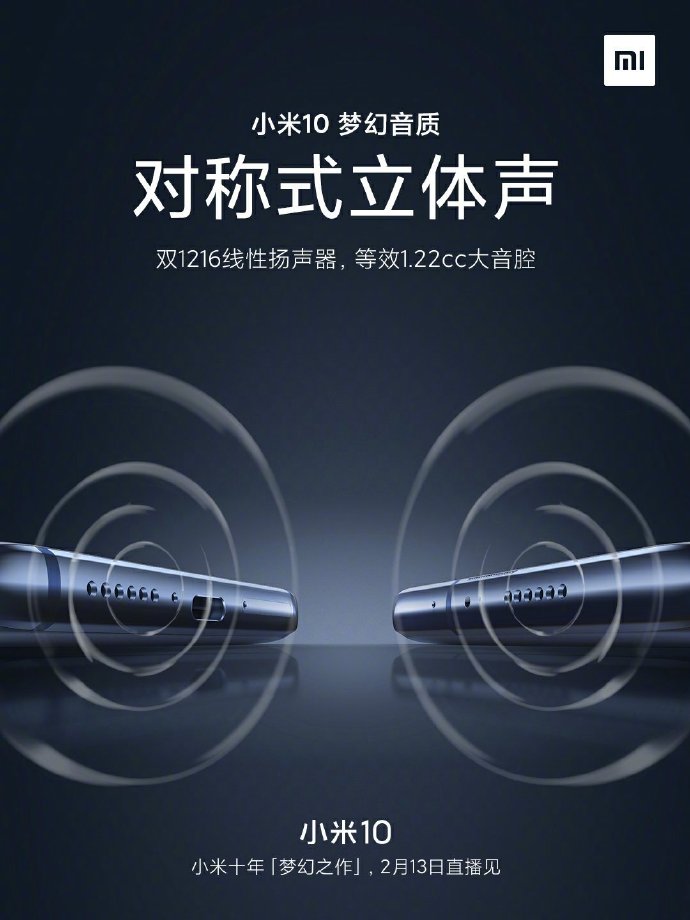
The Mi 10 series is also confirmed to feature stereo speakers, a much-welcomed change from its predecessors.
Other features confirmed on the Mi 10 include Wi-Fi 6 802.11ax, LPDDR5 RAM, and UFS 3.0 storage.
Camera
Xiaomi Mi 10 and Mi 10 Pro are expected to come with different camera setups. The Mi 10 Pro will naturally be the most amazing. It is rumored to sport a Penta rear camera setup including a 108 MP main sensor (the one we have already seen on the Xiaomi Mi Note 10, also known in China as the Xiaomi Mi CC9 Pro), a 20 MP ultrawide sensor, a 12 MP telephoto sensor, a 5 MP depth sensor and a macro sensor. However, these are based on unconfirmed reports.
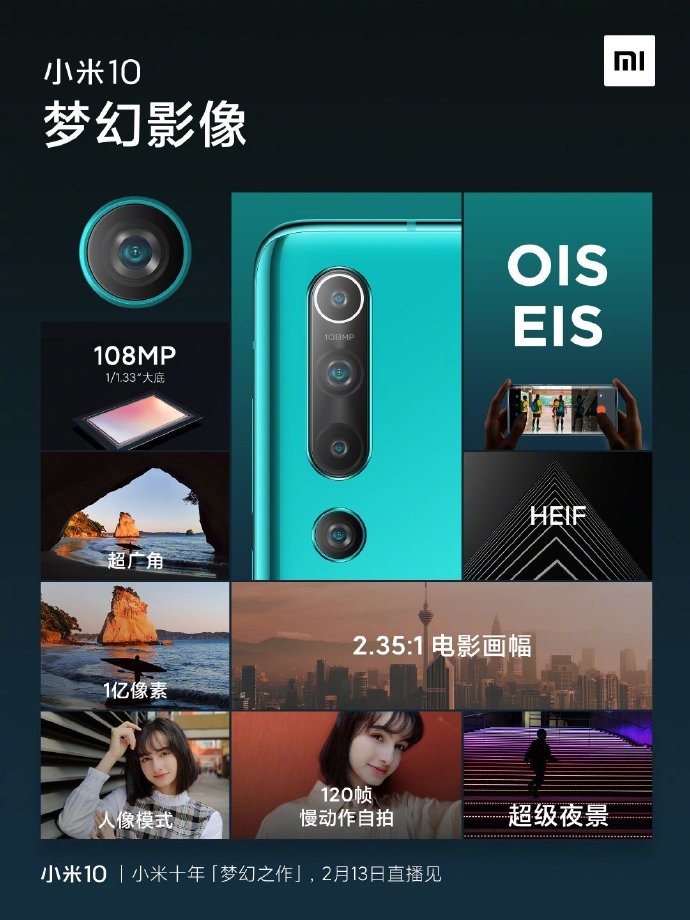
But Xiaomi has officially confirmed some of the specs on the standard Mi 10 model. The phone will feature a 108MP sensor with 8K video recording support. It will also have 10x hybrid optical zoom and up to 50x digital zoom with OIS and EIS. What’s more, the Mi 10 series will be able to shoot in HEIF format, a file format that takes up less space as compared to the standard JPEG. The phone gets support for slo-mo selfies and recording for a 2.35:1 cinematic aspect ratio. Xiaomi claims it will break new records on DxOMark tomorrow! So we are really excited to see the capability of the Mi 10 series.
The Mi 10 Pro camera specs are still under wraps but as mentioned above, expect an additional camera on the Pro variant on top of the 108MP setup found on the standard model. You can read all about the Mi 10 and its camera specs from here.
Battery
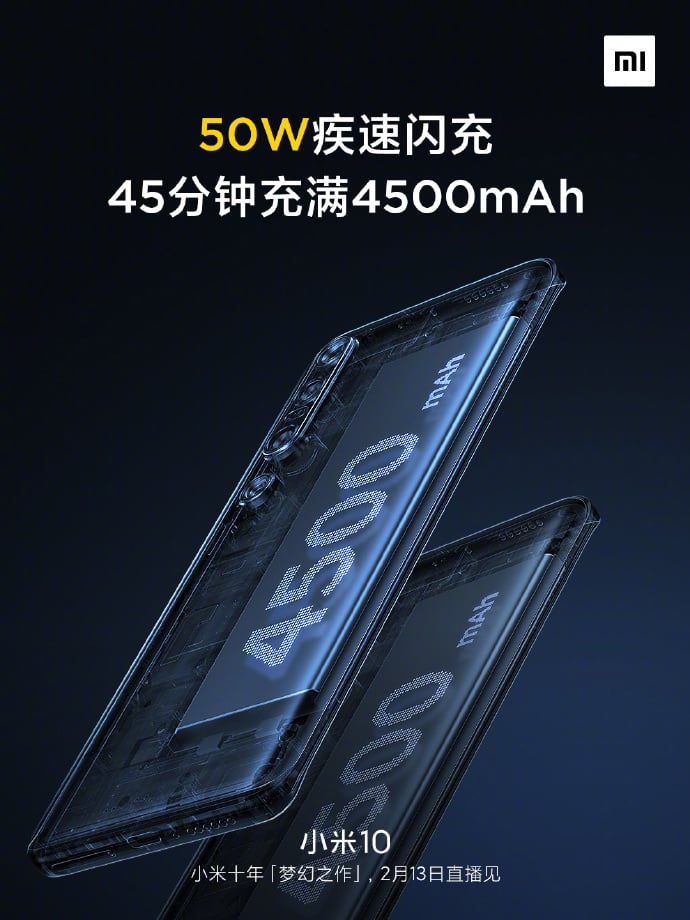
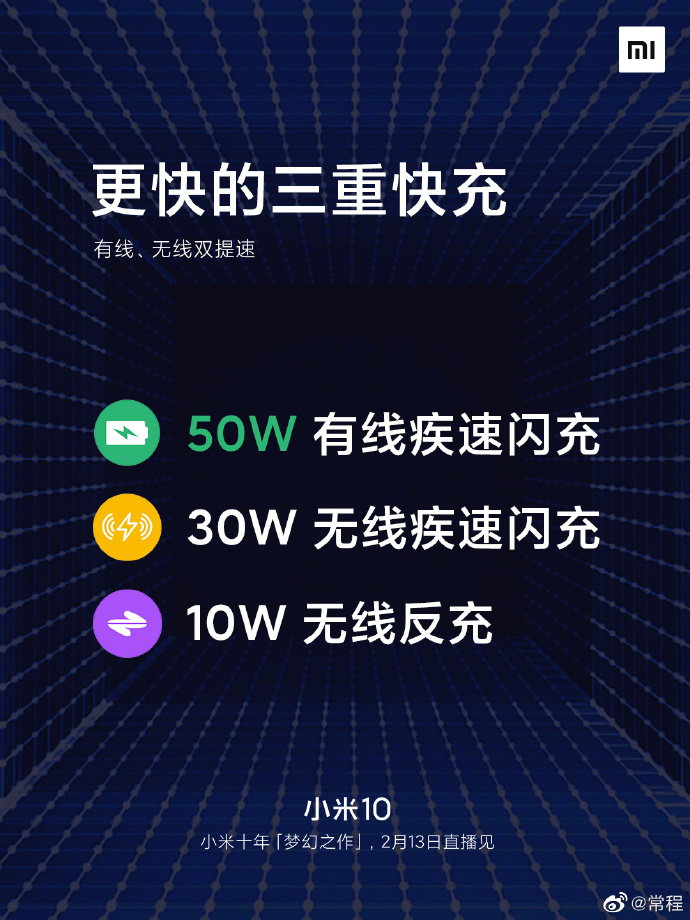
Xiaomi Mi 10 is confirmed to pack a big 4500 mAh battery with 50W fast charging. The phone will support 30W wireless charging and 10W reverse wireless charging.
Mi 10 battery capacity
Mi 10 charging speed
The company is yet to reveal the battery and charging specs of the Mi 10 Pro. But it is said that the Pro version could feature one of the fastest charging technology available right now, charging at 66W power. Currently, the fastest charging smartphone is the Oppo Reno Ace with a 65W fast charging technology. The Mi 10 Pro is said to fully charge from 0 to 100 percent in just 35 minutes. A tipster suggested that the Mi 10 Pro could have a smaller battery. This could be a possibility given how a Xiaomi executive explained the charging speed and battery capacity of a phone are inversely proportional. So, if the Mi 10 Pro comes with a faster 66W charger, the company could be forced to reduce its capacity to just around 4000mAh. But these are just speculations at the moment. You can read more about the battery specs of the Mi 10 from here.
Xiaomi Mi 10 and Mi 10 Pro – Launch, price, and availability
Xiaomi Mi 10 series could be pretty expensive at launch. The company executives have stressed how the Mi 10 is aimed at the premium segment and this year it wants to get a hold on the high-end market. Rumors claim the Mi 10 base variant could start at 4200 yuan ($599), so we imagine the Pro variants to be pretty expensive as compared to its predecessor. We speculate a starting price between 4000 Yuan (~$574) and 4,500 Yuan (~$646) for the Mi 10. This would be higher than the starting price of the Mi 9 Pro 5G: 3699 yuan ($533). The Mi 10 Pro is expected to be priced much higher.
When OPPO announced the Reno3 Pro smartphone in China, it also unveiled a true wireless earbud dubbed OPPO Enco Free earbuds. The Chinese company has already confirmed that the Reno3 Pro will be launched in India but a date has not been fixed. A new tip has also emerged that the Enco TWS earbud will also be unveiled on that day. Tipster Mukul Sharma @stufflistings made this known on his Twitter page.
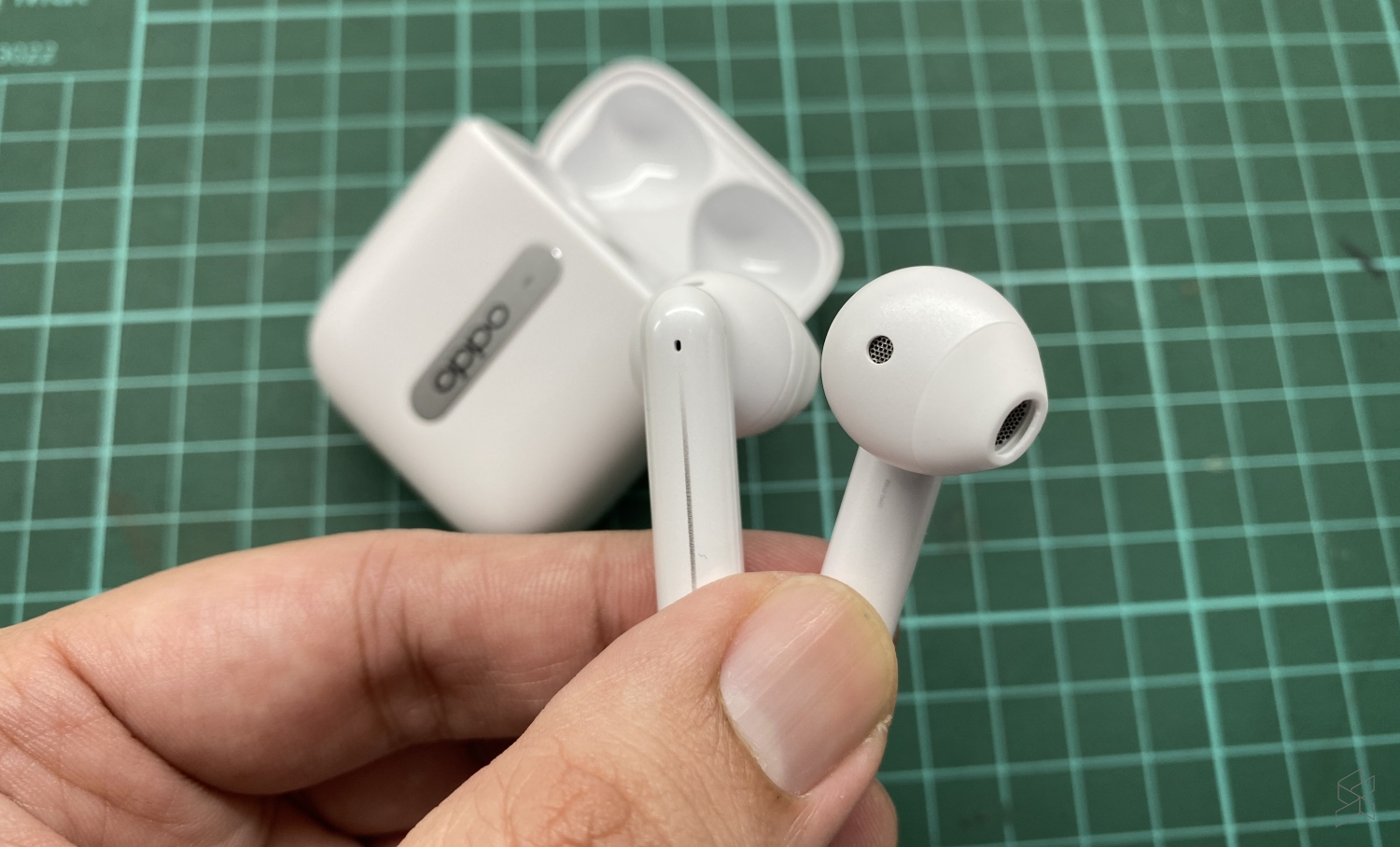
The OPPO Enco wireless earbuds are similar in design and form factor to the Apple AirPods but with some few differences. The charging case has an OPPO-branded strip on the front carved with radium which differentiates it from the AirPods. This strip also features an LED status indicator for the charging case and the case itself is charged via a USB Type-C charging cable. The earbud weighs just 4.6g and also feature the iconic grey strip at the rear of its body just like is found on the case.
In terms of functionality, the Enco Free earbuds come with a noise reduction microphone which will allow for a better audio experience for users. The earbud also utilizes ultra-dynamic speakers making it the first true wireless earphones to use such. These speakers are equipped with dual magnetic circuit design and an FPC arm balance system that allows for a superior sound quality output. Notably, the earbuds can be used up to 25 hours in total if used alongside its charging case.
Further, the buds are equipped with “Bluetooth low-latency dual-pass” technology. In other words, both individual earbuds connect to a smartphone via Bluetooth simultaneously. OPPO says this enables the wearables to achieve better audio-visual synchronization effect and reduce the latency by 76 percent during gaming in comparison to traditional Bluetooth earphones. It also comes with intuitive touch control.
The earbuds are way cheaper than the Airpods as it costs just 699 Yuan or roughly 100 US Dollars. The price in India won’t be too different from this one.
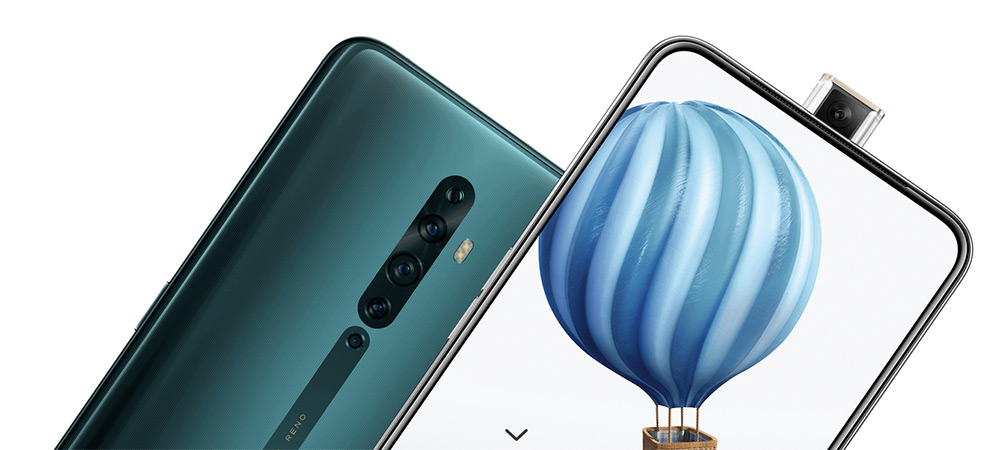
The OPPO Reno2 F just received a price cut in India. This is the second price revision following the device’s launch back in August 2019. The highlight of the Reno 2F is its rear quad camera setup along with the pop-up selfie camera module. Other key specifications include a full HD+ AMOLED display, 3.0 VOOC charge and an in-display fingerprint scanner.
OPPO Reno 2F price cut in India
OPPO has just announced a Rs. 2,000 (~$28) price drop on the Reno 2F. This comes at the heels of a similar discount by the company back in November 2019, effectively bringing the price down from Rs. 25,990 (~$365) at the time of launch to Rs. 21,990 (~$308) today. Potential customers can buy the Reno 2F for the updated price on Amazon or any OPPO-authorized offline dealerships across India. Thanks to the updated price, the OPPO Reno 2F now competes with the Samsung Galaxy A51, Realme X2, and Redmi K20 Pro.
The OPPO Reno 2F flaunts a 6.53-inch full HD+ AMOLED display with a resolution of 2340 x 1080 pixels. The display sports an aspect ratio of 19.5:9 and is protected by Corning Gorilla Glass 5 certification. The smartphone draws power from an octa-core MediaTek Helio P70 chipset with 8GB of RAM and 128GB of native storage, further expandable via a microSD card.
In terms of optics, the Reno 2F flaunts a quad rear camera setup comprising of a 48-megapixel primary ISOCELL GM1 sensor from Samsung, along with an 8-megapixel secondary lens with an aperture ratio of f/2.2, and two 2-megapixel sensors with aperture ratios of f/2.4 for monochrome photography and depth sensing. The smartphone features a 16-megapixel selfie camera housed within the pop-up unit.
The OPPO Reno 2F draws power from a 4,000 mAh battery with 20W VOOC 3.0 fast charging. Connectivity options include dual SIM 4G VoLTE, Bluetooth v4.2, Wi-Fi 802.11 a/b/g/n/ac, GPS, microUSB, and a 3.5mm headphone port. The smartphone is available in two color options, including Lake Green and Sky White.
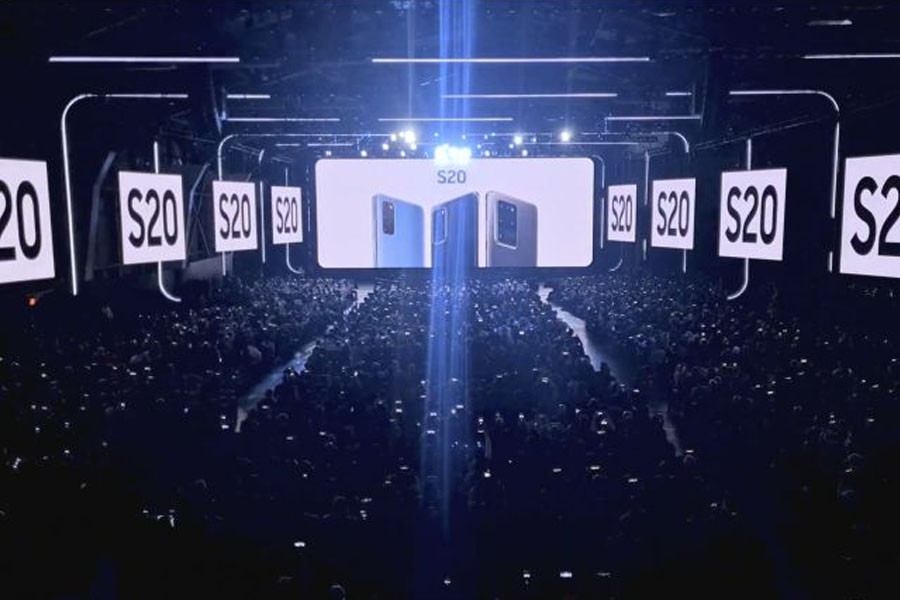
Samsung successfully unwrapped the Galaxy S20 lineup through the Galaxy Unpacked 2020 event in San Francisco, U.S.. Interesting updates regarding the possible Indian launch of its flagship devices have started rolling in. For starters, the Indian variants of the Galaxy S20 lineup are powered by an inferior processor compared to the international model. Unlike the US variants that support 5G connectivity, S20 models for India will come with support for 4G VoLTE.
Samsung showcased the Galaxy S20, S20+, and the S20 Ultra at Galaxy Unpacked 2020 on Feb. 11 along with the Galaxy Z Flip and the Galaxy Buds+ truly wireless earbuds. The Galaxy S20 lineup sports the Snapdragon 865 chipset internationally. However, the Indian variants will be powered by the Exynos 990 SoC. According to notable gadget tipster Ishan Agarwal, Samsung might launch the Galaxy S20 lineup in India on March 8, alongside the Galaxy Z Flip.
He also revealed that the pre-booking of the Galaxy S20 series will be carried out between Feb. 14 and March 6 in India. While the S20 series and Z Flip are up for pre-registrations in India, there is no official word as of now. Hence, the audience is advised to take this information with a pinch of salt.
Samsung Galaxy S20, S20+, S20 Ultra, Z Flip Specifications, and Features
Galaxy S20– The Samsung Galaxy S20 flaunts a 6.2-inch Infinity-O Dynamic AMOLED quad HD+ display. It draws power from a 2.76 GHz octa-core Exynos 990 SoC with 8GB of LPDDR5 RAM and 128GB of internal storage, expandable up to 1TB. The rear triple camera setup consists of a 64-megapixel primary camera, 12-megapixel wide-angle lens, and a 12-megapixel ultrawide sensor. The front camera uses a 10-megapixel sensor. The Galaxy S20 draws power from a 4,000 mAh battery with 25W fast charge support.
Galaxy S20+ – The S20+ flaunts a larger 6.7-inch AMOLED display with quad HD+ resolution and 120Hz refresh rate support. It shares the basic specifications with the Galaxy S20. The differences include a large 4,500 mAh battery, along with an additional rear depth sensor.
Galaxy S20 Ultra– The Galaxy S20 Ultra flaunts a 6.9-inch quad HD+ display with 120Hz refresh rate. The smartphone is available in 12GB and 16GB of LPDDR5 RAM and 128GB, 256GB and 512GB of native storage. It draws power from a 5,000 mAh battery with 45W fast charge support. The quad primary camera setup comprises a 108-megapixel sensor and a 48-megapixel telephoto lens apart from the usual depth and wide-angle sensors. The front camera uses a 40-megapixel sensor.
Galaxy Z Flip – The Galaxy Z Flip flaunts a flexible 6.7-inch primary display along with a 1.1-inch secondary display. It is powered by a Snapdragon 855+ SoC with 8GB of RAM and 256GB of native storage. The device draws power from a 3,300 mAH battery and runs on Android 10. The dual-camera setup consists of two 12-megapixel sensors, while the front camera uses a 10-megapixel lens. Connectivity options include 4G LTE, Bluetooth v5.0, and USB Type-C.
Samsung Galaxy S20, S20+, S20 Ultra, Z Flip Price and Availability
Samsung is yet to officially unveil the prices for the India-bound devices. In the U.S., the Galaxy S20, S20+, S20 Ultra and the Z Flip starts from $999 (~Rs.71,200), $1,199 (~Rs.85,450), $1,399 (~Rs.99.700), and $1,380 (~Rs.98,350) respectively in the international market.
The S20 is available in Cosmic Grey, Cloud Pink, and Cloud Blue. The S20+ misses out on the Cloud Pink variant but is instead available in a Cloud Black avatar. The S20 Ultra is available in Cosmic Grey and Cosmic Black, while the Galaxy Z Flip can be bought in Mirror Black, Mirror Gold, and Mirror Purple.
In December 2019, Xiaomi became the first Chinese TV maker to cross 10 million shipments in a year. Today, the company has revealed key figures of its Mi TV business in China. Xiaomi announced today that one in five TVs sold in China was a Mi TV. The company cited a report from the market research firm Beijing Zhongyi Kang.
Xiaomi shared an image featuring Mi TV lineup’s key achievements in China last year. Mi TVs were the top-selling TVs in five major size segments in 2019: 32-inches, 43-inches, 50-inches, 65-inches, and 70-inches. The brand now has a market share of 19.25% in China. It was also the number 1 TV maker in China for four consecutive quarters.
Jiang Cong, the GM of Xiaomi Mi TV in China said that the brand’s success was driven by its Triathlon strategy that entails three components – Hardware, Internet Services, and New Retail. He added that with sales support, the Mi TV brand will be able to invest in better technology, picture quality and other keys areas of R&D for superior quality TV models in the future.
Figures translated: No.1 brand in four quarters | 10.46 shipments in 2019(Jan 1 – Dec 31) |1 in 5 TVs sold in China was a Mi Tv | Best Selling TV brand in 5 size segments: 32″, 43″, 50″, 65″, 70″ | Mi TVs accounted for 33% sales in 65″, 41% sales in 70″, and 25% in 75″ size segments online
Google always stuns users by bringing aboard intuitive features using a realistic approach. They have evolved the Android ecosystem by adding support for AI-based features, 5G, and other new technologies. Similarly, Google’s Call Screen feature on Pixel smartphones is an excellent example of the company to facilitate the users.
Google’s Call Screen helps the user to filter spam calls by understanding the purpose and person behind the call. It is an automated system, which can save you from marketing and sales calls even without picking up the phone.
It is based on the same base as the Google Duplex, which is an automatic Google-Assistant powered feature that enables the restaurants to make appointments. The significant advantage of both the Call Screen and Google Duplex is that they use a natural-sounding voice. It allows a more productive environment for business owners and users.
Google-Assistant is the key player while attending calls. Google has made the Call Screen work without any internet connection by using on-device technology. It even promotes the safety and security of the user’s data.
However, the system will alert the caller that a screening service is in use.
How Call Screen Works?
The user needs to tap the Screen Call button to initiate the feature. Then, Google Assistant will ask the caller’s identity and the purpose of calling and will transcribe the conversation in real-time on display. Then, the user can decide to either pick the call or not. There’s also an option to mark the call as spam.
How to enable Call Screen on all Pixel devices?
Note: It is only available for the user residing in North America.
Earlier, the Call Screen feature was limited to the latest Pixel devices, but recently Google announced its compatibility with old Pixel smartphones. The compatibility is still rolling out to all the devices, and it may take a few more months for a successful rollout. However, the user who would like to enjoy the service can proceed with the below steps:
Make Sure you’re running on the latest firmware of the Phone app.
Now, Open Phone App and go to More > Settings > Spam and Call Screen.
Toggle the option to See Caller and Spam ID is active.
Tap Call Screen, and under “Unknown call settings” select the callers and then choose an option from: -Ring phone -Automatically screen or Decline robocalls. (Automatic Call Screen using Google Assistant). -Silently decline
You can save audio calls by activating the feature.
You have successfully turned on the Call Screen option.
Now, Google Assistant will keep screening the unknown numbers and will perform the action that you’ve selected. It will show the transcript of the caller’s response. The users can also save Call Screen audio by simply toggling the option in Call Screen options.
If you don’t get the Call Screening option, then you have to wait for some time.
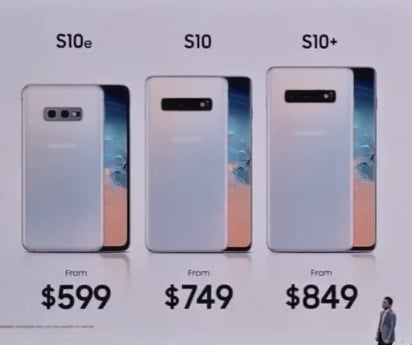
Samsung has decided to borrow a leaf from Apple following the launch of the Galaxy S20 series. The manufacturer announced official price cuts for its Galaxy S10 lineup. The announcement shows that Samsung will continue manufacturing the phones which were released last year.
Based on the price cuts, the Galaxy S10e will now begin at $599 while the Galaxy S10 will have a starting price of $749. The Galaxy S10+, on the other hand, will have a starting price of $849.
When the three phones were launched last year, the Galaxy S10e had a starting price of $749, the Galaxy S10 sold for $899, and the Galaxy S10+ launched for $999.
The price cuts have not yet taken effect when we checked at the time of writing. So if you plan to purchase any of the models of the Galaxy S10 series, you may want to delay your purchase until the new prices come into effect.
Through the Galaxy Unpacked 2020 event, Samsung unveiled the highly anticipated Galaxy S20, Galaxy S20+, Galaxy S20+ Ultra 5G-enabled premium flagship phones. The Galaxy Z Flip clamshell phone with flexible screen was unveiled alongside the S20 series. At the event, the South Korean company also unveiled Galaxy Buds+ wireless earphones. It has arrived as a successor for the Galaxy Buds earbuds that was made official along with the Galaxy S10 series last year.
Samsung Galaxy Buds+ specifications and features
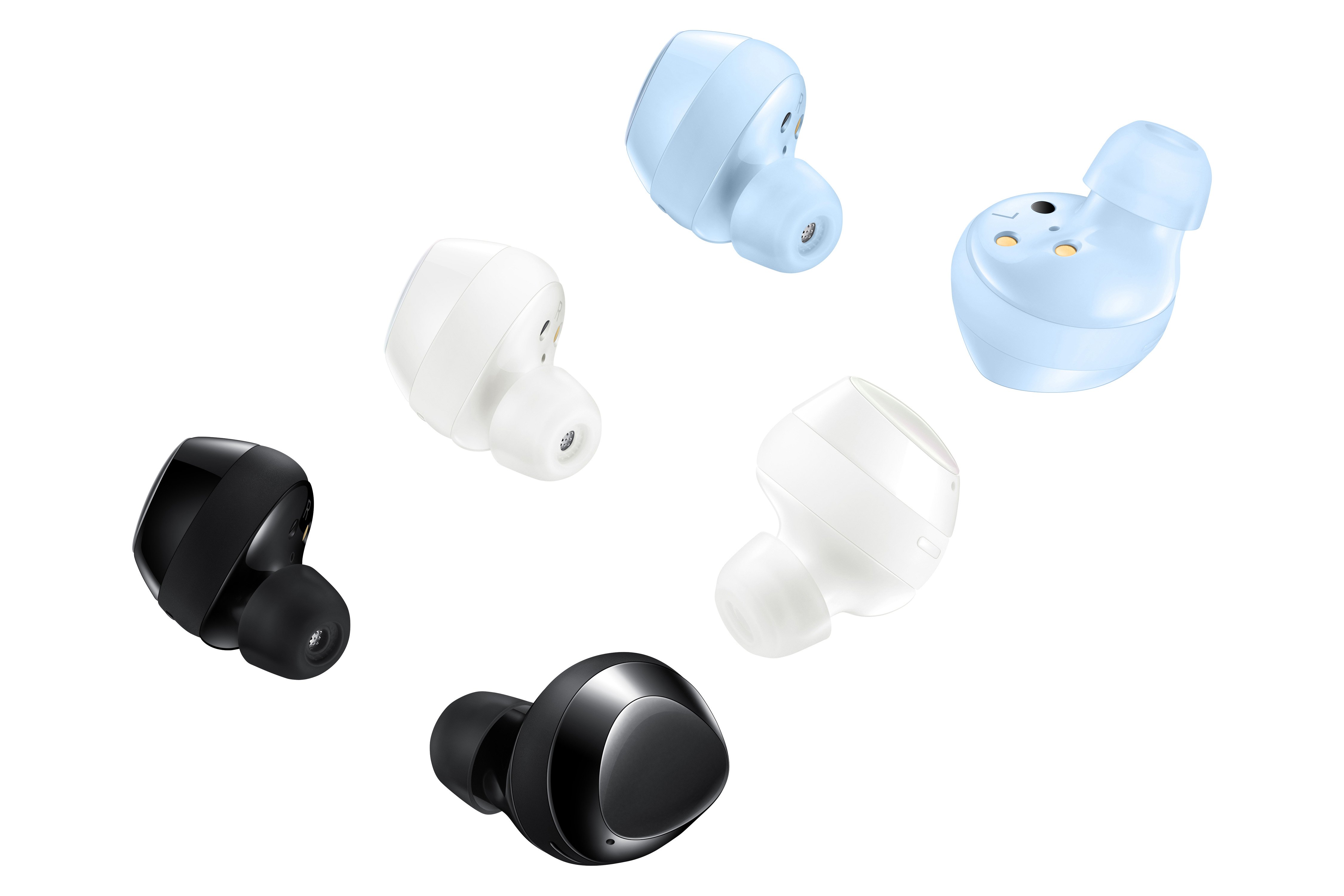
The AKG tuned Galaxy Buds+ truly wireless earbuds comes with 2-way tweeter and woofer speakers that promise rich treble and bass. The earbuds are equipped with as many as three microphones for crisp and clear calls. With improved Ambient Sound technology onboard, users can choose from available options like Low, Medium, High and Extra High for adjusting the level of noise cancellation. Each earbud measures 17.5 x 19.2 x 22.5mm and weighs 6.3 grams. The charging case for the Galaxy Buds has 38.8 x 70 x 26.5mm dimensions and it weighs 39.6 grams. Appearance-wise, it looks similar to the predecessor model.
The Galaxy Buds+ can be paired with devices running on iOS 7 or higher and Android devices with 1.5 GB RAM and Android 5.0 Lollipop or above. Samsung is offering a dedicated companion app for iOS users. The Galaxy Buds+ supports audio codecs like SBC, AAC and Scalable.
For connectivity, users can rely on Bluetooth 5.0. The touchpads on the Galaxy Buds+ can be used for different functions like play, pause, move to previous / next song, receive / end call and volume up or down. Spotify users can continue listening to their favorite songs with a single press. Spotify can play recommended songs based on users’ preferences through tap and hold function.
Each of the Galaxy Buds+ has an 85mAh battery. The wireless charging case contains a 270mAh battery. By charging it once, the Buds+ can last for up to 11 hours of battery life. By charging for only 3 minutes, it can last for 1 hour, claims the company. The Buds+ charging case doubles the battery life of the earbuds to 22 hours. The earbuds support Qi wireless charging. It can be also charged through USB-C.
Samsung Galaxy Buds+ price
The Galaxy Buds+ have arrived in the U.S. with a price tag of $149. It can be bought in colors like black, blue and white. It will be available for purchase starting from Feb. 14 in the U.S.
Xiaomi’s hotly-anticipated Mi 10 series of smartphones will come with WiFi 6 connectivity support. To sustain this feature, the Chinese tech giant is prepping to launch a Wi-Fi 6 router dubbed the Xiaomi AIoT AX3600.
On February 12th, Xiaomi revealed an image of its impending WiFi 6 router, giving us a brief glimpse of its appearance. The router adopts a highly-appealing design that complements the seven antennas on it, as seen in the recently exhibited photo. The image was shared via a post on Xiaomi’s official Weibo account.
The aforesaid AX3600’s antennas comprise a dedicated AIoT antenna that packs an independent dual-band Wi-Fi chip. This chipset is capable of automatically detecting new devices and even configuring the network with a single click. Moreover, the AX3600 enables users to remotely complete the configuration process using a remote control.
Touted as the company’s first Wi-Fi 6 router, the AX3600’s configuration was officially announced by Xiaomi earlier this month. Integrated with 512MB of RAM, the router adopts OFDMA technology and can efficiently transmit data to various terminal devices simultaneously.
Furthermore, it supports dual-frequency concurrency, MU-MIMO technology, delivers up to 2976Mbps theoretical rate, and the antennas can serve multiple types of equipment at the same time. The AX3600 Wi-Fi 6 router is powered by Qualcomm‘s 4-core A53 1GHz chip and is equipped with 6 high performing external signal amplifiers, including the 2.4GHz and 5GHz bands that feature 2 and 4 external high performing signal amplifiers, respectively.
The online-only Mi 10 launch kicks off at 14:00 on February 13th. The existence of the Xiaomi AIoT AX3600 was originally confirmed by Digital Chat Station. According to Xiaomi, the AX3600 is the first-of-its-kind router to employ an enterprise-grade platform for the consumer market. More shreds of details are likely to surface online ahead of the new router’s launch. Xiaomi will be taking the covers off the Mi 10 series, as well as the AX3600 Wi-Fi 6 router at an online event, which will take place on Thursday in China.
While companies like LG, Sony are backing out of MWC 2020, Huawei has officially confirmed its presence at the event in Barcelona, Spain. The company released a teaser on its Weibo account earlier today, hinting at some of the products expected to be showcased at the event, including a foldable smartphone.
In the teaser image, Huawei is stressing on its 1+8+N strategy. Huawei revealed this strategy last year wherein, “1” is the device that has all control — a smartphone that is small, portable, and easy to use. The larger devices or access points represent “8”, which includes tablets and wearables to enhance your smartphone experience. And finally, “N” is the layer where everything comes together — the network as well as the company’s IoT devices.
And the image shows off eight categories including laptops, tablets, TV, headphones, watches, VR glasses, automobiles, and speakers. So, we might see products from some of these categories from the company at the event. According to the image shared by Huawei last year, the smartphone is at the central part of this strategy. And in the above image, we can see a bar-shaped object at the center is split into two halves, likely hinting at a foldable smartphone. While some say Huawei might show off its new Mate XS foldable, it’s likely that the company displays last year’s Mate X at this event. The successor to the device, powered by Kirin 990 5G, is expected to launch only by March 2020. The recent coronavirus outbreak might have affected its launch plans, but so far we haven’t got any update from the company.
Despite this confirmation from Huawei, it remains to be seen whether MWC will take place this year. The association is currently discussing the fate of the event and will announce a final decision on Friday, February 14. Meanwhile, companies like TCL, Vivo, LG, AT&T and others have already announced their withdrawal from MWC this year.
A few hours ago, Xiaomi revealed that the display parameters of the upcoming Xiaomi Mi 10 seriesv. Now, the Chinese manufacturer and its executives are busy teasing about the battery capabilities of the smartphone. The Mi 10 will come equipped with a 4,500mAh battery that will carry support for 50W fast flash charging.
With 50W rapid charging, the 4,500mAh battery of the Mi 10 can be fully charged in just 45 minutes. Apart from fast wired charging, the Mi 10 will support 30W wireless fast flash charging which is comparable to mainstream wired charging. The phone will also come with support for 10W reverse wireless charging enabling other devices like headphones and smartwatches to be charged.
Xiaomi’s Vice President Chang Cheng has said that Xiaomi considered a lot of combinations of charging speed and battery capacity which includes 4,850mAh battery with 18W fast charging, 4,700mAh battery with 30W rapid charging, 4,500mAh battery with 50W fast charging and 4,050mAh battery with 65W fast charging.
Finally, the company came to the conclusion that 4,500mAh battery with 50W rapid charging is the best choice for the Xiaomi Mi 10 considering various factors like the thickness of the device and how a higher wattage (65W) would have forced the company to offer a battery with reduced capacity. This reminds us of the OPPO Reno Ace that came with a faster 65W rapid charging capabilities for its 4,000mh battery.
Xiaomi’s Wang Teng Thomas said the higher the charging power, the greater will be the impact on the battery capacity. He said that whether it is wired or wireless or reverse charging, the Mi 10 is faster than other fast charging features offered by competitor brands.
Xiaomi will be announcing the Snapdragon 865 powered Xiaomi Mi 10 series tomorrow through an online launch conference at 2 PM (local time). Until then, the company is expected to reveal some more information on the Mi 10 and Mi 10 Pro phones.
The OPPO Find X2 launch event will be held at the Mobile World Congress (MWC) 2020 on Feb. 22. A render of the phone had surfaced earlier this week to reveal its front and rear design. It was found that the phone supports a punch-hole screen with curved edges and triple rear cameras.
A leaked photo of what appears to belong to the real OPPO Find X2 was leaked by designer Ben Geskin a couple of days back. As renders had revealed previously, the image shows off three cameras on its rear.
Since the purported OPPO Find X2 is in a protective case, its complete rear design cannot be seen. However, the image reveals that there is a vertical camera setup at the top-left corner of the rear shell of the device. It appears to be equipped with three cameras and an LED flash.
The camera design seems to resemble what was seen in the leaked render of the OPPO Find X2. The render had revealed that the top lens of the phone has a squarish appearance. It could be a periscope telephoto lens. The render had revealed a small strip between the second the third lens which could be a color temperature sensor. Its presence assists the cameras to capture photos with accurate colors.
Oppo Find X2 Image leaked by Ben Geskin on Twitter
Rumors have it that the OPPO Find X2 has a periscope telephoto lens of 13-megapixel. Its main Sony IMX689 48-megapixel lens is said to be a custom sensor co-developed by Sony and OPPO. The Sony IMX708 superwide lens with widest photography capabilities is expected to make its debut on the Find X2.
The OPPO Find X2 may come with a 6.5-inch display with a punch-hole that features a Sony IMX616 32-megapixel selfie snapper. The display is expected to support quad HD+ resolution and 120Hz refresh rate along with a touch sampling rate of 240Hz. The other features that will be offered by the phone’s screen include 100 percent DCI-P3 color gamut support, HDR up to 1200nits brightness and SDR to HDR conversion.
The Snapdragon 865 mobile platform will be powering the device. The phone may come with a charger that supports 65W fast charging capabilities. The device will be equipped with other features like LPDDR5 RAM, USB 3.0 storage and Wi-Fi 6. There is no word on the pricing of the device.
The Galaxy S20 series of phones comprising the Galaxy S20, Galaxy S20+, Galaxy S20 Ultra was unveiled today alongside Samsung‘s hotly-anticipated Galaxy Z Flip during a press event. Interestingly, the South Korean tech behemoth used the Galaxy S20 to shoot and live stream the entire Unpacked 2020 event, which took place in San Francisco.
The camera crew that was assigned the task of shooting the aforesaid unveiling event of the company’s latest flagship smartphones were given the Galaxy S20 Ultra. To facilitate the process of shooting and handling, Samsung placed the devices into specially-designed mounts that also offered more stability.
The press-conference was shot and live-streamed in Full HD resolution of 1080p on YouTube. Despite been shot using a smartphone, the video turned out to be clear and bright.
The impressive video output shows the phone’s capability of shooting near-flawless videos. Samsung also announced its latest-generation truly wireless earphones dubbed the Galaxy Buds+ at the press conference.
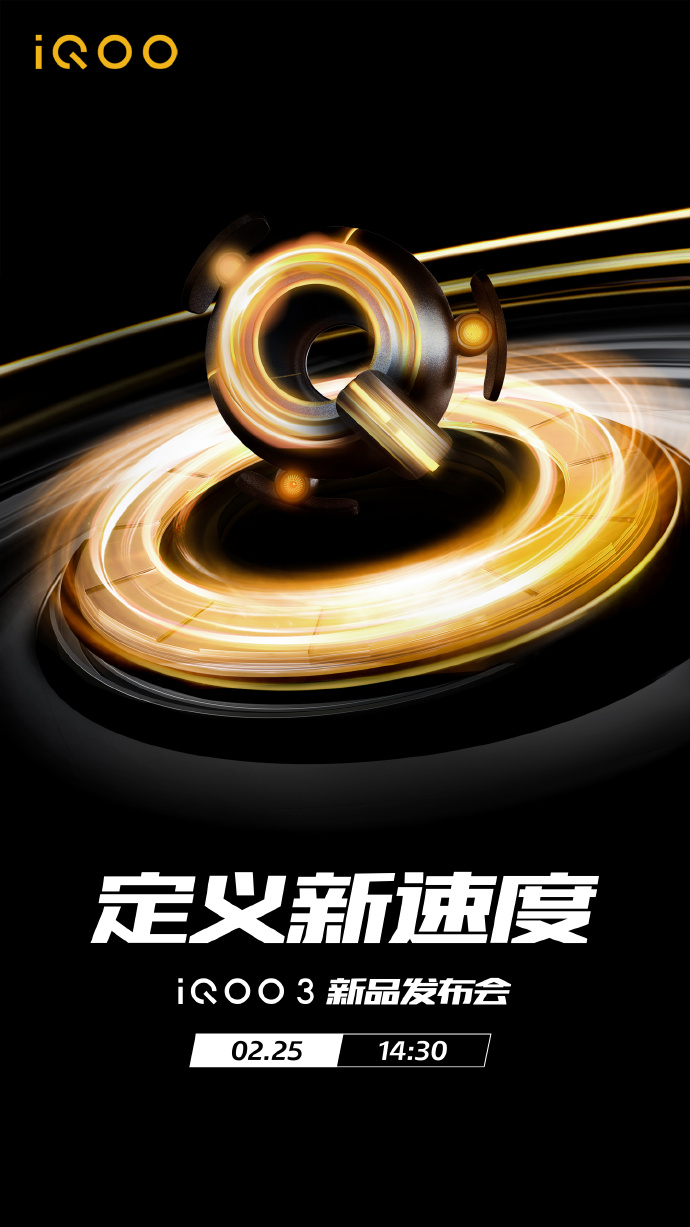
iQOO is gearing up to launch its first smartphone in China and India. Yesterday, the company confirmed that its first phone for China will be dubbed as iQOO 3. A poster released by the company revealed that it will be sporting a punch-hole screen and a 48-megapixel quad camera setup. Today, the company confirmed that it will be holding an unveil event for announcing the iQOO 3 in China on Feb. 25.
Due to the Coronavirus outbreak, smartphone OEMs in China have decided to hold online-only launch event to announce their new devices. The iQOO 3 flagship phone will be announced through a livestream launch event on Feb.25 starting at 2:30 PM (local time). iQOO is reportedly planning to launch an unveil event in India on the same date. While the iQOO brand has been existing since last year in China, it will be launching its first smartphone on the said date in India. Hence, it remains to be seen whether iQOO first phone for India arrives with iQOO 3 moniker or some other name.
It is believed that the alleged iQOO 3 phone for India will be priced under Rs. 40,000 (~$561). It is expected to debut as the India’s first 5G smartphone and released in the market the first phone to be driven by Snapdragon 865 mobile platform. Interestingly, 5G networks haven’t commercialized in India.
The iQOO 3 will be sporting an S-AMOLED display of 6.44 inches. It will be a punch-hole screen that will offer full HD+ resolution of 1080 x 2,400 pixels, an aspect ratio of 20:9 and a regular refresh rate of 60Hz. Like all the predecessor iQOO phones, the iQOO 3 is said to be equipped with an in-display fingerprint reader.
The Snapdragon 865 mobile platform driven iQOO 3 is expected to hit the Chinese markets in RAM choices like 6 GB, 8 GB and 12 GB of RAM. It could be first smartphone in the world to arrive with the latest UFS 3.1 storage technology. The smartphone will be preloaded with Android 10 OS.
The iQOO 3 could be drawing power from a 4,410mAh battery. The 3C listing of the phone had revealed that the phone could be shipping with a 55W fast charger. It could be coming with a front camera of 16-megapixel. The rear shell of the device has a 48-megapixel quad camera system.
iQOO India is expected to introduce a 4G phone too in India. The handset that may not launch with the iQOO 5G phone in the country on Feb. 25. It is expected to come with flagship-grade specs and could be priced under Rs. 35,000 (~$491).
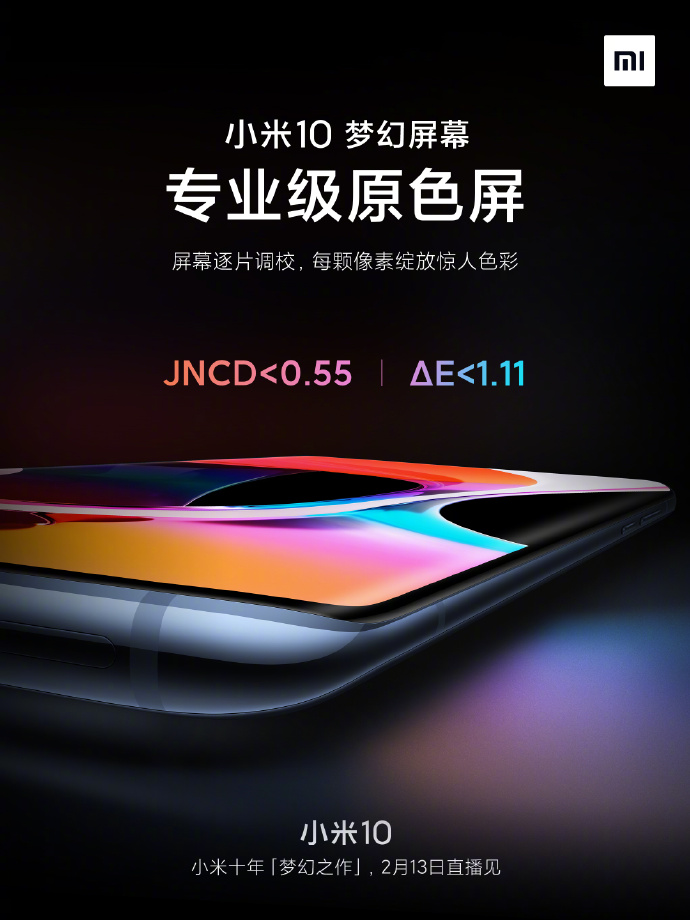
On Feb. 13, Xiaomi will be holding a livestream event in China to unleash the Xiaomi Mi 10 series which includes the Xiaomi Mi 10 and Xiaomi Mi 10 Pro. Both phones are expected to come equipped with an identical front design. The rear appearance of both phones could be same and the only major difference between the regular and Pro model will be that the latter will have an additional camera. Ahead of the launch, the Chinese manufacturer has been sharing the key details of the smartphone. It has already revealed information on the camera capabilities and vapor chamber liquid cooling system. Today, Xiaomi shared a new poster which contains plenty of information on the display of the Mi 10 series.
The Xiaomi Mi 10 is equipped with a 6.67-inch display. It is a custom-made AMOLED screen with curved edges that offers a contrast ratio of 5000000:1. There is a punch-hole at the top-left corner of the screen. It promises a peak brightness of 1120nits and it can reach 4,096 levels of automatic brightness adjustment.
Xiaomi claims JNCD (Just Noticeable Color Difference) and Delta E values of the custom screen have reached industry-leading levels. In other words, the Mi 10 display will offer professional-grade color accuracy. The JNCD <0.55 value confirms that the display of the Xiaomi Mi 10 is better than iPhone 11 Pro Max’s screen that has a JNCD <0.9 value. The Delta E value of the Mi 10’s screen is 1.11 which is significantly better than other flagship phones. The company states that each display is calibrated one by one before leaving the factory.
The display of the Xiaomi Mi 10 will carry support for 90Hz refresh rate along with 180Hz high frame rate sampling. The HDR10+ complaint display supports DCI-P3 color gamut and offers good viewing experience under bright sunlight. It supports full DC dimming. Lastly, the TUV Rheinland approved screen of the Mi 10 effectively filters the harmful blue rays. While it is not mentioned, the screen of the Mi 10 will be embedded with an in-screen fingerprint scanner. The Xiaomi Mi 10 Pro is likely to sport the same screen that is available on the Mi 10 phone.
The Xiaomi Mi 9 that was unveiled in February last year and the Xiaomi Mi 9 Pro 5G that had debuted in September were both equipped with waterdrop notch screens. The Mi 10 series will be the first flagship phones from the company to come equipped with punch-hole displays that promise high screen-to-body ratio.
Samsung has jumped from 10 to 20 with the naming of its new flagship phones. But that is not the only change it has done with the name. There is no Galaxy S20e that succeeds the Galaxy S10e. What you have is just the Galaxy S20. There is a Galaxy S20 Plus but we also get a Galaxy S20 Ultra.
Galaxy S20 Series Design
The Galaxy S20 and Galaxy S20 Plus have undergone a makeover when compared to their predecessors, the Galaxy S10 series, but it is a design change we have already seen on some recent Samsung phones.
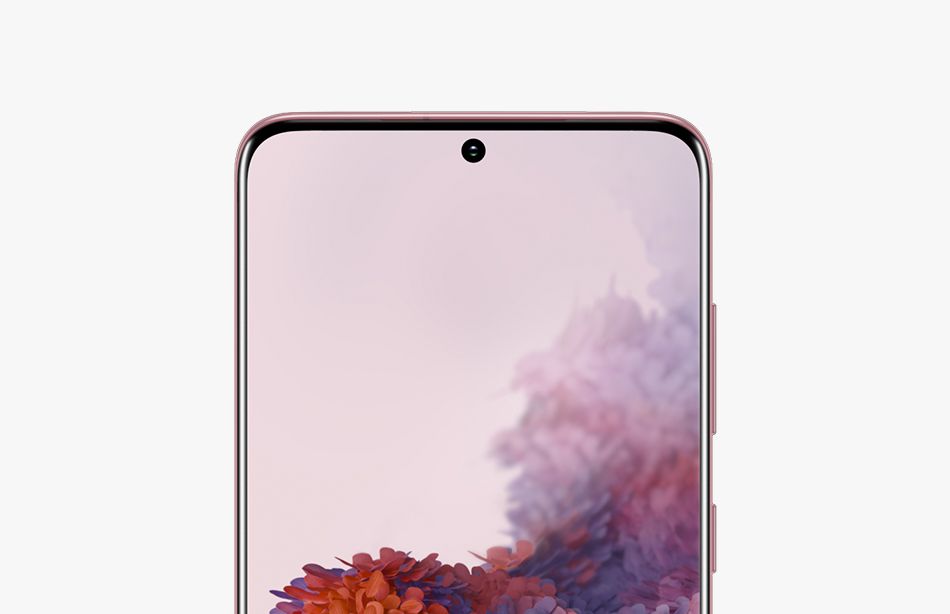
There is a new type of Infinity-O display with the hole for the camera in the middle and quite smaller too. The displays are also less curved.
On the back, Samsung has ditched the horizontal camera layout for a rectangular camera housing that stacks the sensors vertically.
Galaxy S20 and Galaxy S20 Plus Specs
The Galaxy S20 is the smaller of the two with a 6.2-inch screen while the Plus model has a 6.7-inch screen. Both are Dynamic AMOLED displays with a 120Hz refresh rate and 240Hz touch sampling rate.
Both phones have a single 10MP selfie camera. Those who loved the Galaxy S10 Plus’s extra selfie camera may be disappointed to see that there is only one camera on this year’s Plus model.
The two phones are powered by the Snapdragon 865 processor or Samsung’s own Exynos 990 chipset. The processor is dependent on the market with countries like the US getting the Snapdragon variant while Europe, Africa, and the Middle East will get the Exynos variant.
Below are the configurations available for the two phones:
Galaxy S20
8GB RAM + 128GB
12GB RAM + 128GB
Galaxy S20 Plus
8GB RAM + 128GB
12GB RAM + 512GB
The Galaxy S20 and Galaxy S20 Plus will keep the MicroSD card slot, allowing users to add up to an extra 1TB of space.
The two phones share nearly the same rear camera configuration. There is a 12MP primary camera on both phones with a 1/1.76” sensor size. Samsung says the sensor is about 1.65x bigger than that of the Galaxy S10 and is able to capture more light. There is a 12MP ultrawide angle camera too and a 64MP telephoto camera that has 3x hybrid optical zoom and up to 30x space zoom. The Galaxy S20 Plus has an extra sensor, a DepthVision camera, for a quad camera setup. Just like the Galaxy S20 Ultra, they can also record 8K videos and you can capture 33MP stills from your video recording.
[envira-gallery id=”305025″]
The Galaxy S20 has a 4000mh battery with support for 25W fast wired charging while the Galaxy S20 Plus has a 4500mAh battery with support for 25W wired charging. Both phones support reverse wired and wireless charging.
Just like last year’s flagships, there is an ultrasonic fingerprint scanner under the hood. Both phones also have an IP68 rating making them safe to use even if it is wet. However, it is important to remember that the warranty doesn’t cover damage caused by liquids.
The two phones have NFC support, eSIM support, dual-SIM support WiFi 6, Bluetooth 5.0, and a USB-C 3.2 port.
Samsung says the Galaxy S20 series will come with support for Live Caption, making them the first non-Pixel Android phones to have the feature. They have also partnered with Google to have Duo built-in with the phone app. Samsung has also signed a partnership with Microsoft to bring Forza Street to the Galaxy S20 series.
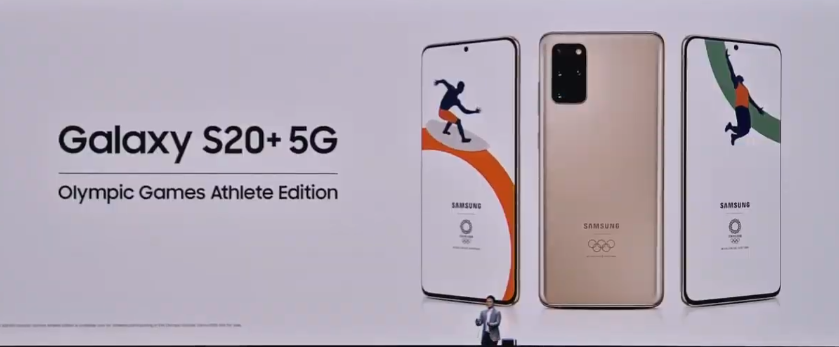
Galaxy S20+ 5G Olympic Games Athlete Edition
Samsung also announced that there will be a special Galaxy S20+ 5G Olympic Games Athlete Edition that will be made available for athletes at this year’s Tokyo 2020 Olympic Games. This special edition comes in Gold, a colorway not available for any of the standard edition. You also won’t be able to officially buy one since it will be gifted to all athletes.
Price and Availability
The Galaxy S20 is priced at $999 in the US for the 5G version with 12GB RAM and 128GB of storage. The 8GB RAM + 128GB version (4G) is not sold in the US. The phone is available in Cosmic Gray, Cloud Blue, and Cloud Pink.
The Galaxy S20 Plus is priced at $1199 for the 8+128GB version while the 12+512GB version is $1349. It is available in Cosmic Gray, Cloud Blue, and Cosmic Black.
In Europe, the Galaxy S20 is €899 for the base model (4G) with 8GB RAM and 128GB of storage. The 5G version which has 12GB of RAM and 128GB of storage is €999.
The Galaxy S20 Plus in Europe is €999 if you want the 4G model with 8GB RAM and 128GB of storage while the 5G version with 12GB RAM and 128GB of storage is €1099. There is no 512GB version of the Galaxy S20 Plus in Europe.
Pre-orders begin February 13 and ship with a free pair of Galaxy Buds+. You also get a pair of wired AKG USB-C earphones in the box.
The Galaxy S20 series was unveiled at the Samsung Unpacked event yesterday. Samsung’s new series includes the Galaxy S20 which replaces the Galaxy S10e and the Galaxy S20+ that takes over from the Galaxy S10 Plus. However, the highlight of the series is none other than the Galaxy S20 Ultra.
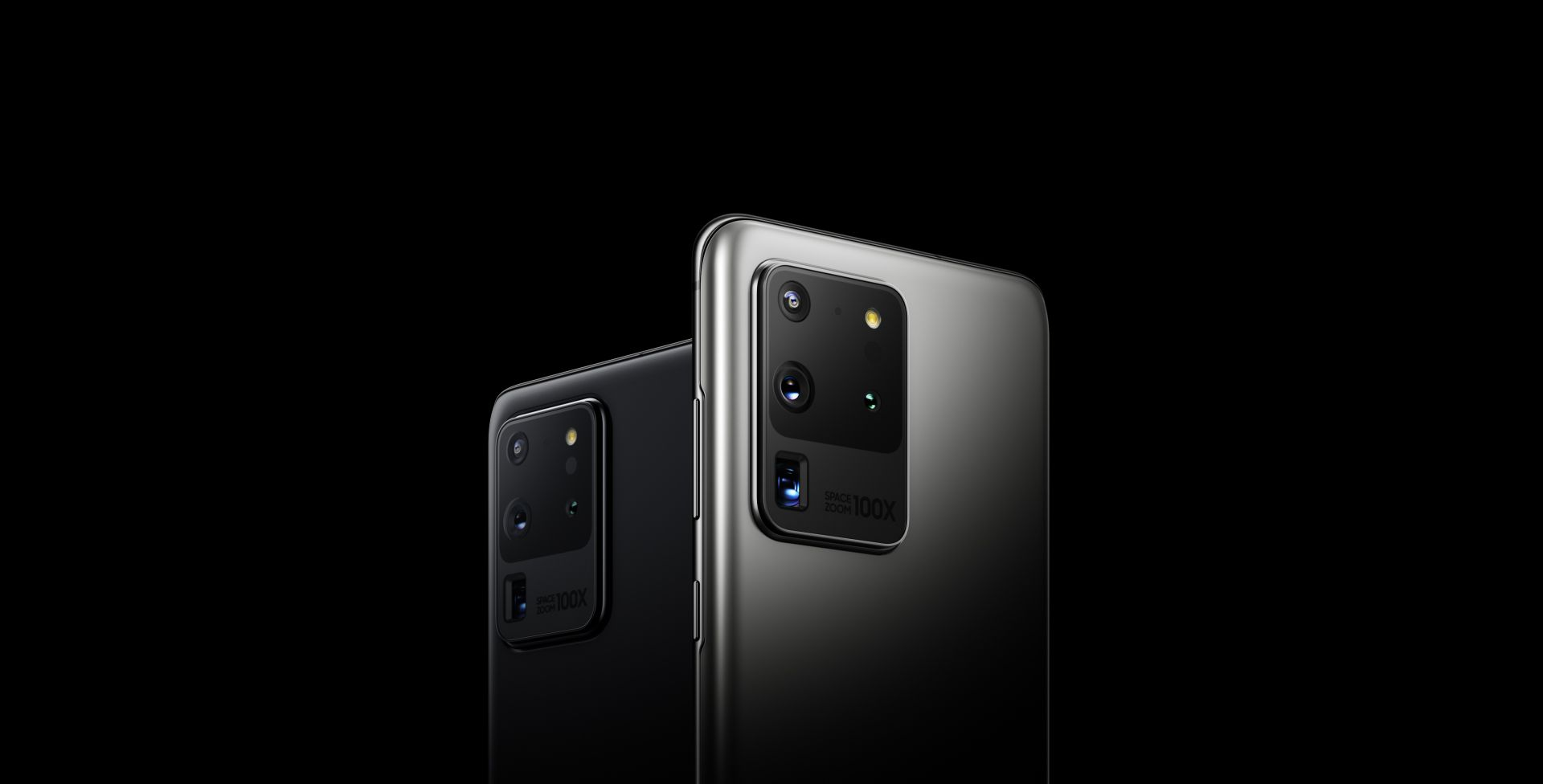
The Galaxy S20 Ultra pushes Samsung’s flagship phones beyond a level that the Plus models of the Galaxy S10 and Galaxy Note10 ever did. It maxes out at everything, from the main camera which is a 108MP sensor to its zoom that gets you closer to your subject by 100x, to the RAM which goes up to 16GB, and its battery capacity that is 5000mAh. The Galaxy S20 Ultra is definitely in a different class of its own but will likely not be for long when other flagships arrive.
Specs and Features
The Galaxy S20 Ultra has the same curved QHD+ Infinity-O display with a centered hole punch as its siblings. However, it is larger at 6.9-inches, making it even bigger than the 6.8-inch Galaxy Note10+. Just like the other S20 models, this also has a 120Hz refresh rate and a 240Hz touch sampling rate. Samsung says the device automatically switches between 60Hz and 120Hz refresh rate.
The Galaxy S20 Ultra has a 108MP primary sensor with a 1/1.33” large sensor which uses 9-in-1 pixel binning. It also has a 12MP f/2.2 120° ultrawide angle camera, a 48MP telephoto camera with a periscope lens, and a DepthVision (depth of field) camera. The front-facing camera jumps from 10MP in its siblings to a 40MP f/2.2 camera.
The Galaxy S20 Ultra has 10x hybrid optical zoom while its Super Res Zoom or digital zoom goes up to 100x. If you own an 8K TV, you can record in 8K with the Galaxy S20 Ultra.
The phone has an in-display fingerprint scanner for security. It packs a massive 5000mAh battery with support for 45W fast charging and ships with a 45W adapter. It also supports 15W wireless charging, and reverse wireless charging. Samsung ships it with Android 10 with One UI 2.0 on top.
Price and Availability
The Galaxy S20 Ultra is available in 4G and 5G variants but the prices we got our hands on are for the 5G version. The base model with 12GB of RAM and 128GB of storage is priced at $1399 but you can grab the 16GB version with 512GB of storage for $1599. The phone is available in Cosmic Black and Cosmic Grey and all pre-orders ship with a free pair of Galaxy Buds+.
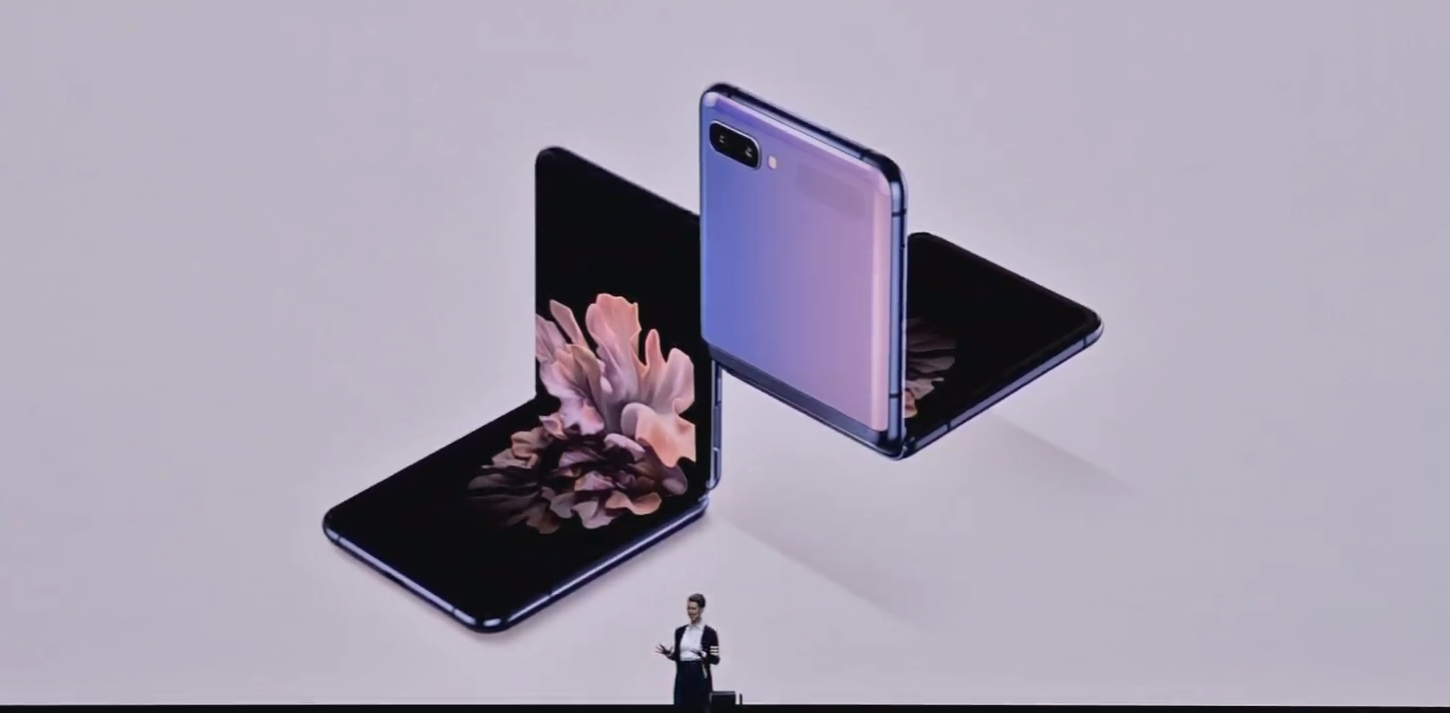
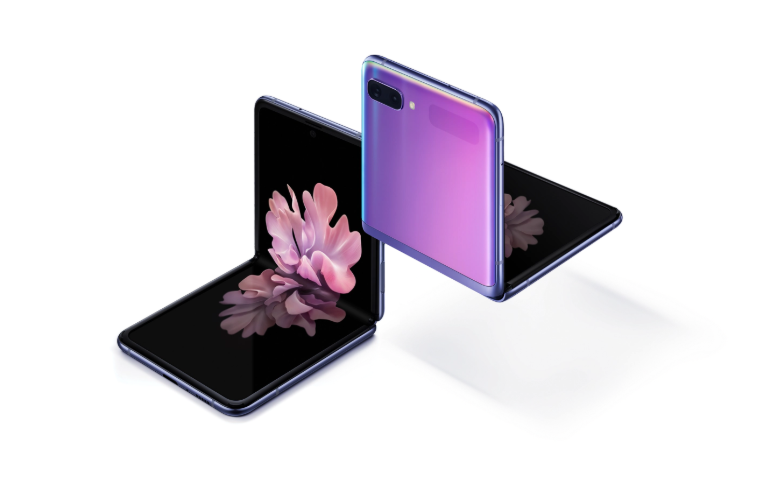
Samsung kicked off the galaxy Unpacked Event with the launch of the Galaxy Z Flip. The Galaxy Z Flip Z is its second foldable smartphone, following the launch of the Galaxy Fold last year. While the Galaxy Z Flip has a design different from the Galaxy Fold, what has not changed is its expensive price.
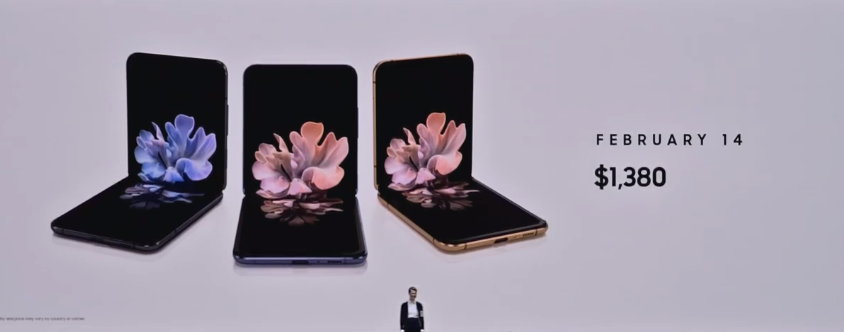
The Galaxy Z Flip has a price tag of $1380 and is available in Mirror Purple and Mirror Black. However, some select markets will get a third color variant called Mirror Gold.
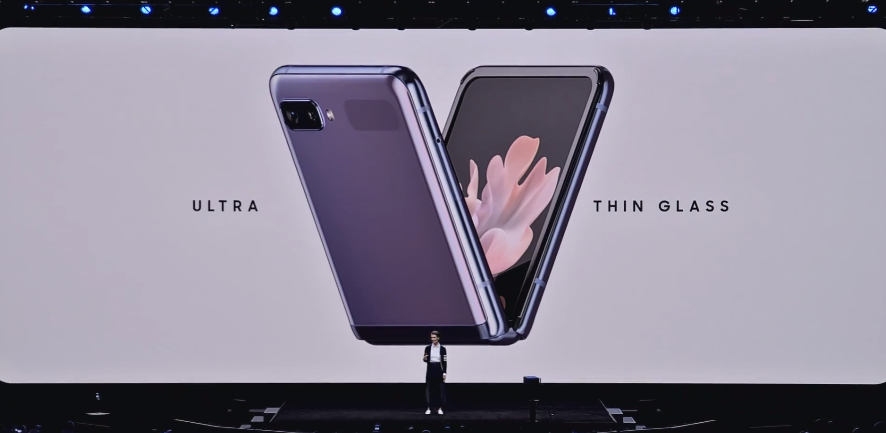
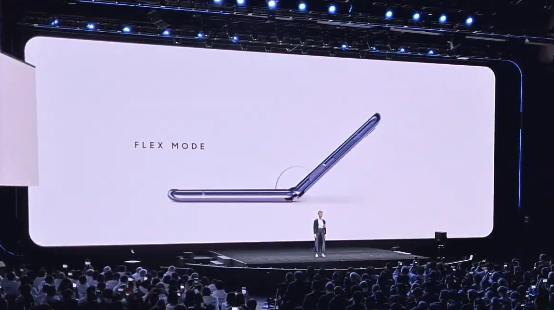
That amount gets you a phone that has a 6.7-inch flexible hole-punch display covered with Ultra-Thin Glass (UTG). Samsung has designed the phone to be used in three ways – closed mode where the phone is shut and the user operates it by using the small 1.1” Super AMOLED cover display on the back; in open mode where the phone is opened up flat to be used as a regular smartphone; and finally, Flex Mode, where the display can be stopped at any angle much like the way you can adjust the screen of your laptop.
In Flex Mode, certain apps have been designed to make the best use of this position. For example, the upper part of the phone can play a YouTube video while the lower part can display the chat or comment section associated with the video.
The Galaxy Z Flip has a Snapdragon 855+ processor, 8GB of RAM and 256GB of UFS 3.0 storage. It has a 12MP f/1.8 1.4um primary rear camera paired with another 12MP camera but with an f2.2 aperture. It also has a 10MP f/2.4 selfie camera. There is a fingerprint scanner on the right-side frame of the upper part of the device.
There is a 3300mAh battery inside the device with support for 15W fast charge and it ships with One UI 2 based on Android 10.
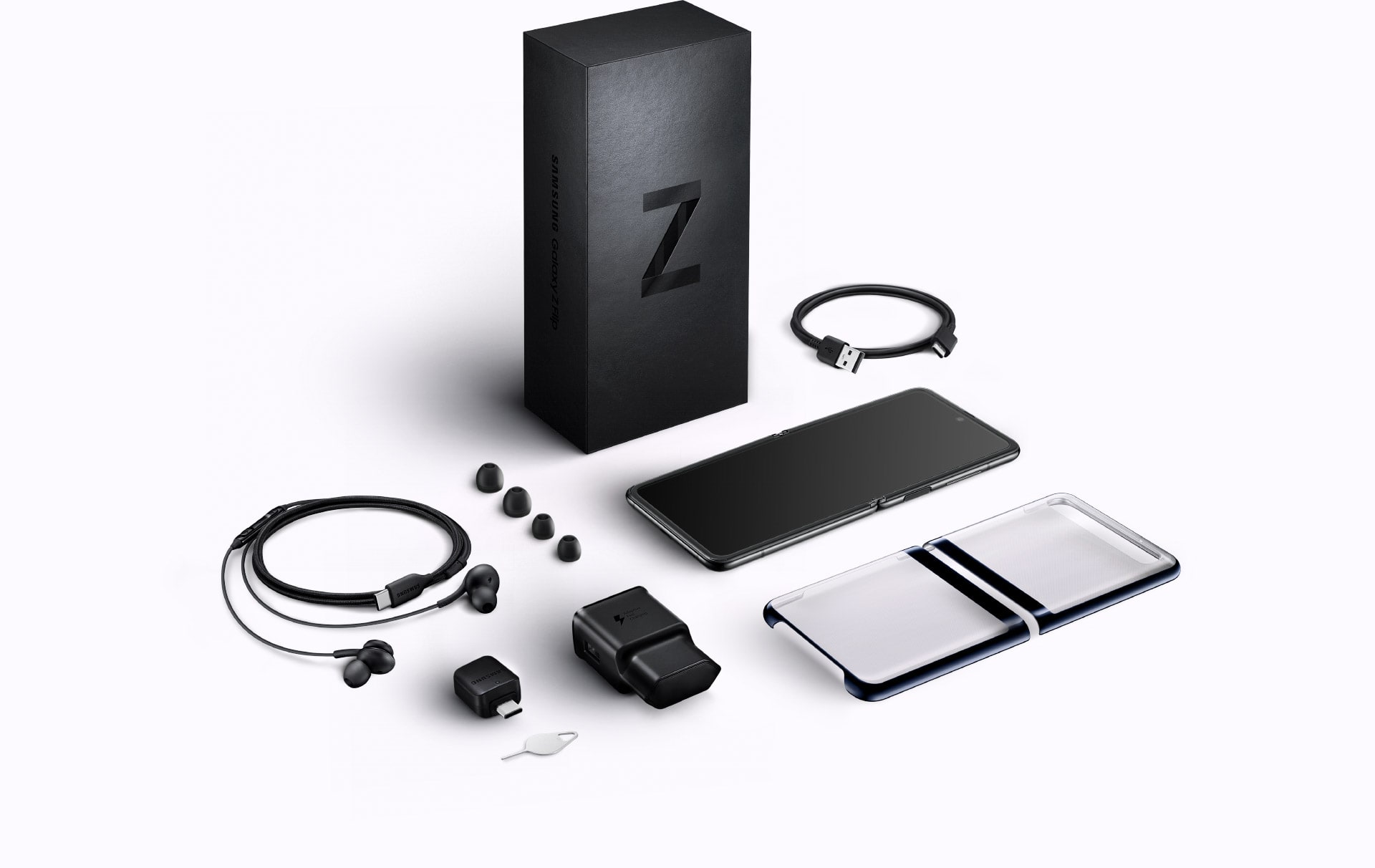
The Galaxy Z Flip will be available starting this Friday, February 14. There will also be a Thom Browne Edition Limited Edition that will be unveiled in New York tomorrow (February 12) at the New York Fashion Week. The Galaxy Flip Z will come with a free YouTube Premium subscription and will include a pair of AKG USB Type-C earphones and a case inside the box.
The launch of the Mi 10 series is just two days away but Xiaomi has no problem revealing more features of the phone. Today, it has unveiled a bunch of new posters that confirm certain features of the upcoming phones.
Mi 10 Camera Specs
The Mi 10 will have four rear cameras, one of which is a 108MP sensor with 1/33” sensor size. One of the posters released today reveals more details about the cameras.
[envira-gallery id=”304981″]
Apart from having a 108MP sensor, Xiaomi says the Mi 10 will be able to record in 8K. It will also have 10X hybrid optical zoom, 50x digital zoom, and have both OIS and EIS. That sure are big improvements when compared to the Mi 9 from last year but that is not all.
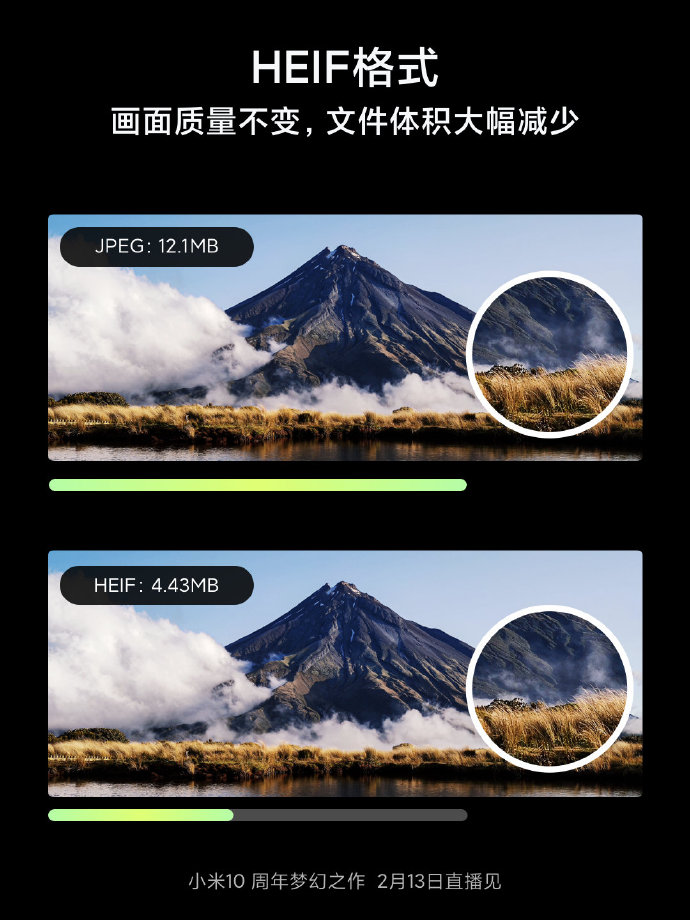
The Mi 10 will be able to shoot in HEIF format. This is an image format based on the HEVC encoder but uses less space compared to JPEG. The poster below compares an image saved in JPEG and HEIF. As you can see, the HEIF format is more than 50% smaller in size.
Xiaomi says the Mi 10 will have support for slow-mo selfie and be able to record in a 2.35:1 movie format. The phone is also expected to set a new DXOMARK record.
Mi 10 Audio
Xiaomi has stubbornly stuck to mono speakers for years but that changes with the Mi 10. The upcoming flagship will have stereo speakers according to two new teaser posters released today.
One of the images shows a cross-section of the phone’s internals and we see there is a 1216 linear speaker at each end of the phone. The accompanying post says the sound cavity for the speaker is equivalent to 1.2cc and the gain difference between the two speakers is close to zero. In a separate post, CEO of Xiaomi, Lei Jun, said the one-way amplitude has been increased from 0.4mm to 0.65mm and the number of magnets has been increased from 3 to 7.
The second image shows the Mi 10 will have a 6-hole speaker grille at the bottom and another 6-hole speaker grille at the top. The top grille is unusual as most phones with stereo speakers use the cut-out for the earpiece as the outlet for the top speaker.
Mi 10 Battery Capacity
Xiaomi has not released a poster yet for the battery capacity but fans with a keen eye have spotted the battery capacity in the first poster above for the stereo speakers.
If you zoom in on the battery in the image, it reads that the Mi 10 packs a 4400mAh battery (~4500mAh). That is a huge bump in capacity when compared to that of the Mi 9 which launched with a 3300mAh battery. However, a big battery is the standard now that phones are launching with 5G support.
Xiaomi Mi 10 will come in White
Xiaomi shared a poster of the Mi 10 this week that shows the phone in cyan and peach. Vice President of Xiaomi, Chang Cheng, revealed today on Weibo that the phone will also be able in white.
The Mi 10 series launches on Thursday, February 13, in China and will be announced at a global event in Spain on February 23.
We use cookies on our website to give you the most relevant experience by remembering your preferences and repeat visits. By clicking “Accept”, you consent to the use of ALL the cookies.
This website uses cookies to improve your experience while you navigate through the website. Out of these, the cookies that are categorized as necessary are stored on your browser as they are essential for the working of basic functionalities of the website. We also use third-party cookies that help us analyze and understand how you use this website. These cookies will be stored in your browser only with your consent. You also have the option to opt-out of these cookies. But opting out of some of these cookies may affect your browsing experience.
Necessary cookies are absolutely essential for the website to function properly. This category only includes cookies that ensures basic functionalities and security features of the website. These cookies do not store any personal information.
Any cookies that may not be particularly necessary for the website to function and is used specifically to collect user personal data via analytics, ads, other embedded contents are termed as non-necessary cookies. It is mandatory to procure user consent prior to running these cookies on your website.












 On February 12th,

 The online-only Mi 10 launch kicks off at
  More shreds of details are likely to surface online ahead of the new router’s launch. Xiaomi will be taking the covers off the Mi 10 series, as well as the AX3600 Wi-Fi 6 router at an online event, which will take place on Thursday in China.