Realme launched the Realme Q smartphone in China yesterday which is actually just a rebranded Realme 5 Pro. But the smartphone wasn’t the only product it announced. Realme also launched its very first power bank at the event.
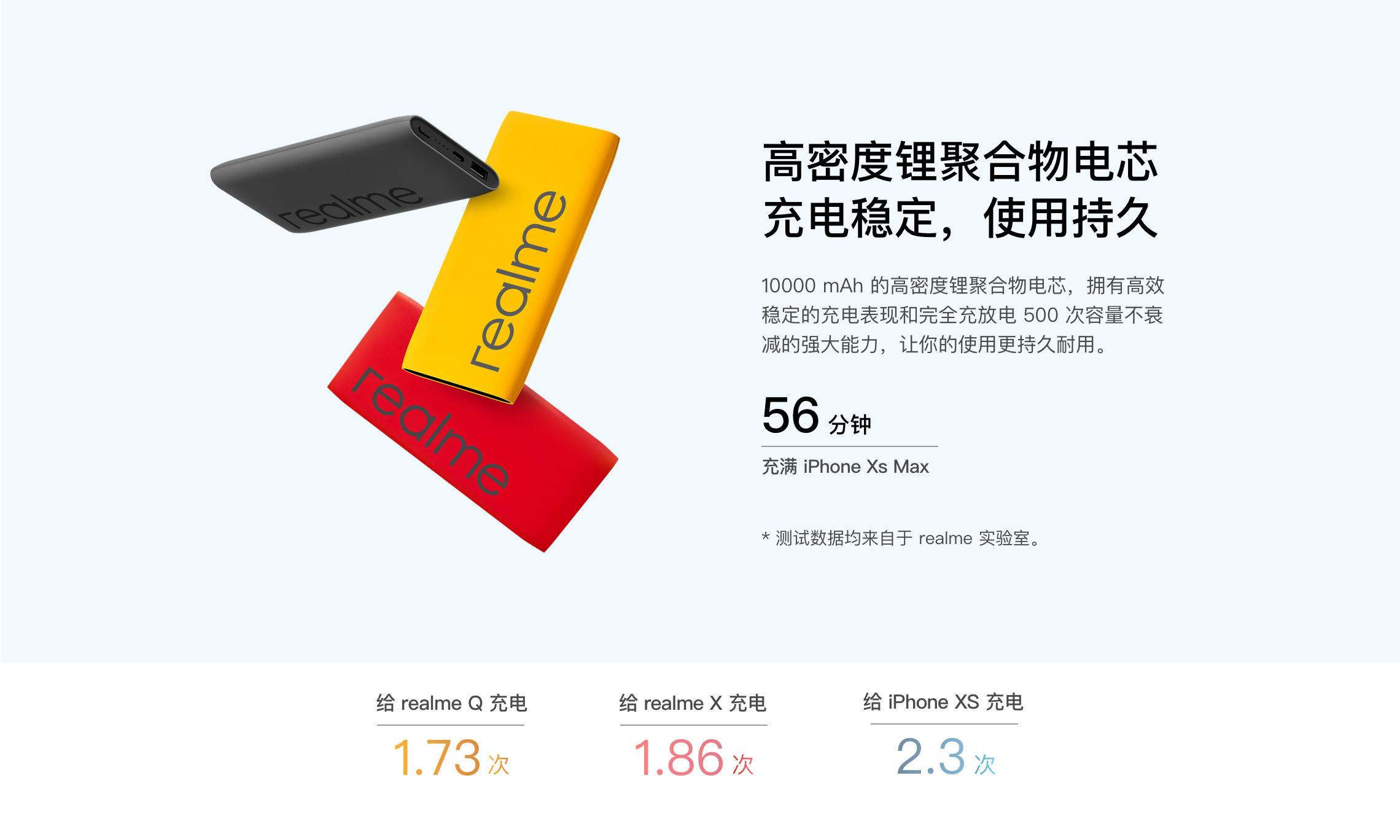
Called the Realme Fast Charge Power Bank, it has a design that reminds one of the Nokia N8. It comes in three colors – a bright yellow, an equally flashy red, and the classic gray. All three have the manufacturer’s name written in a large black font.
The Realme Fast Charge Power Bank has two ports – a USB Type-C port and a full-sized USB A port. The Type-C port doubles as an input and output port. Both ports support 18W fast charging which means you can also charge the power bank with an 18W fast charger. Realme adds that it will charge the iPhone XS Max from empty to full in 56 minutes. There is a power button on the far right as well as four LEDs to serve as battery level indicators.
The power bank has a 10000mAh lithium battery which Realme claims will charge the Realme Q 1.73 times, the Realme X 1.86 times, and the iPhone XS 2.3 times. Realme even adds that it can even charge some laptops and also low-power devices like wearables. The power bank has 12 different protections built-in.
The Realme Fast Charge Power Bank is priced at ¥99 (~$14) and will go on sale on September 12 on the official Realme online store.
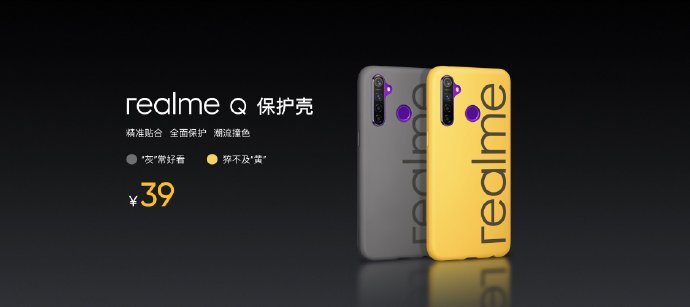
Realme also announced the Realme Buds 2 in China for ¥49 (~$6.89) and a set of Realme Q iconic cases in yellow and gray priced at ¥39 (~$5.48) per piece. Both are available for pre-order.
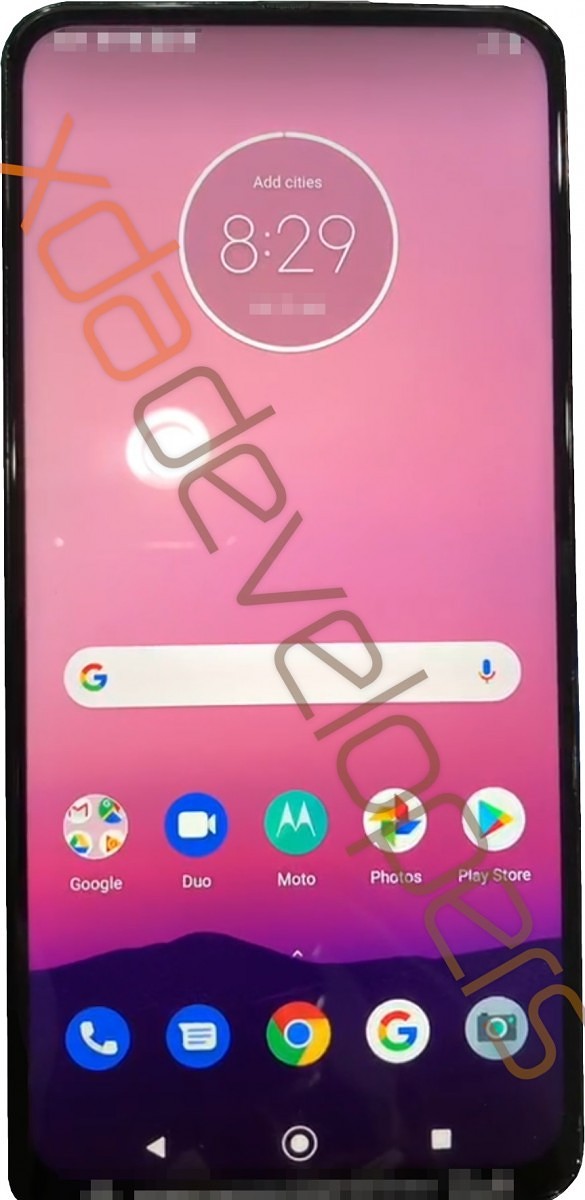
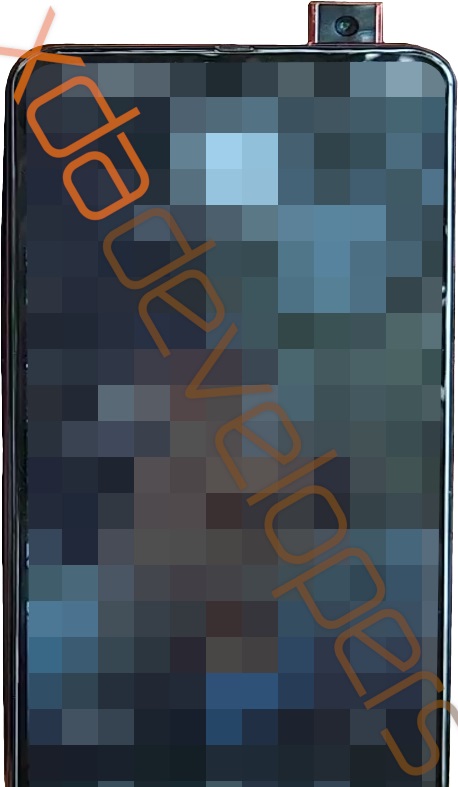
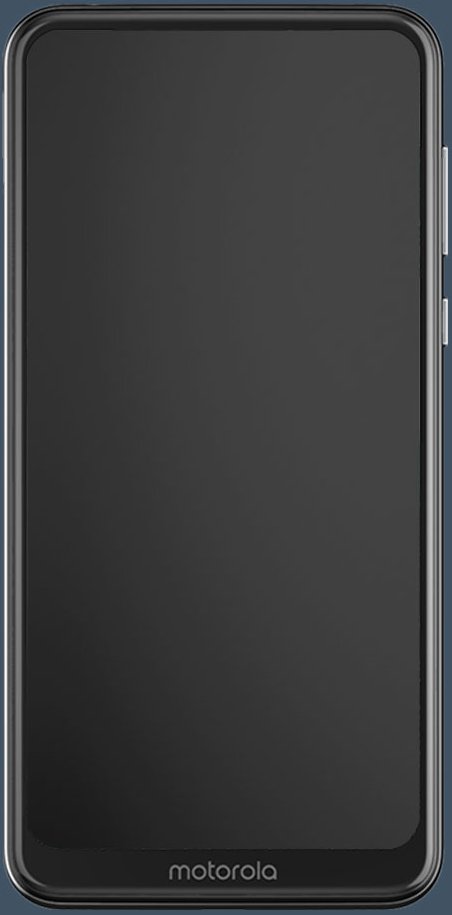
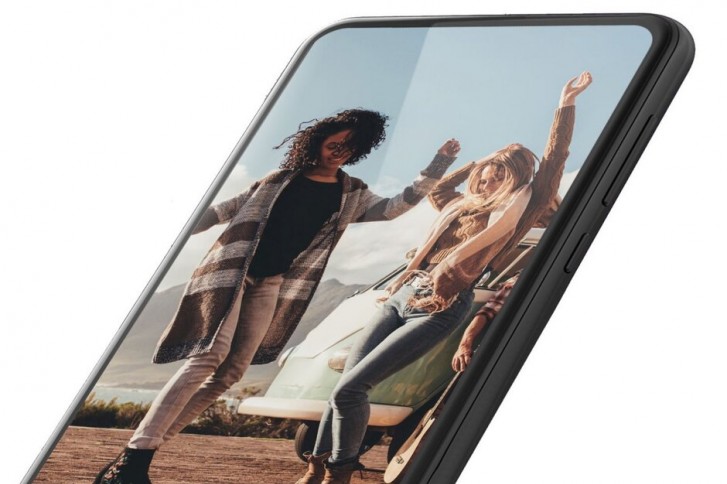
In the previous month, popular tipster Evan Blass had shared leaked render of a mysterious Motorola phone with notch-less display. Today, XDA Developers shared live shots of the mysterious smartphone with the pop-up selfie camera in action. The new images again reveal that it will be offering users with a very high screen space.
As it can be seen in the newly leaked images, the left, right and top bezels of the phone are quite slim. It has a slightly thick bottom bezel. The display is flat, but there is no confirmation on whether it features an AMOLED or LCD display. The top bezel of the phone seems to be featuring a slim-sized earpiece.
The handset seems to be Android One device. Compared to other phones with pop-up camera module, this one has a slightly different appeal as it features the module on the right side of the top edge of phone. The red tinge around the pop-up selfie snapper suggests that it could be featuring a red colored rear. There is no information on the screen size or configuration of the pop-up selfie snapper.
1 of 2
The images that were shared by Blass in the previous month had only revealed the notch-less design of the phone and it did not reveal its elevating camera. There are no details on the specs of the phone. There is a possibility that it could end up as G-series or Z-series Moto phone. It could be packed with upper mid-range specs. Hopefully, more details of the mysterious appears in the near future.
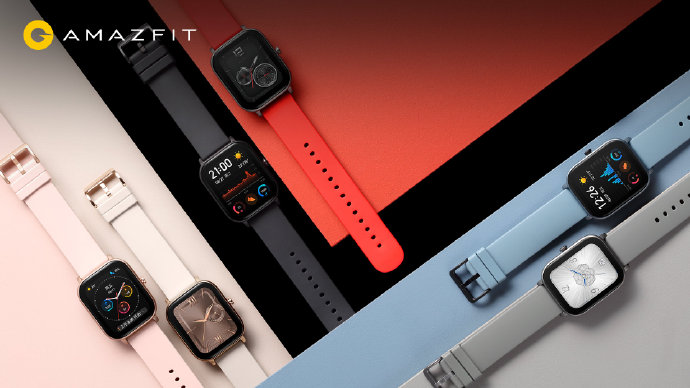
The Amazfit GTS is priced at €130 and packs a number of interesting features. It has a 1.65-inch rectangular Super Retina-grade AMOLED display with 2.5D Gorilla Glass 3 protection. You get up to a 100 different watch faces too. The watch has GNSS (GPS+GLONASS) and boasts a battery life of 2 weeks (25 hours with GPS turned on). It also has a heart-rate sensor with continuous tracking and can track up to 12 different sporting activities. It is waterproof up to 50 meters.
The GTS uses 20mm quick release silicone straps and comes in six different colors. It works with Android and iOS devices. Huami hasn’t announced the UK and US pricing yet.
Amazfit Stratos 3
When the Amazfit Sports Watch 3 launched, we told you it would launch globally as the Stratos 3, and we were right.
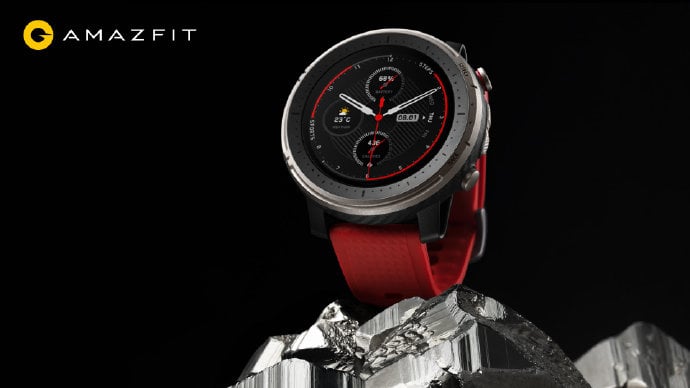
The Stratos 3 is designed for professionals and enthusiasts. It has a circular dial – a 1.34” JDI Full-Moon reflective low-power display covered with Gorilla Glass 3. There are two operating systems on the watch as well as two chips – one for each OS. It also has four buttons on the right side of the frame.
The Amazfit Stratos 3 has 4GB of storage and 512MB of RAM. There is a built-in music player, so you can load it up with podcasts to listen to while you work out. It can track up to 19 different activities, has a continuous heart rate tracker and V02 max measurement.
In Ultra Endurance Mode, the Stratos 3’s 300mAh battery will last up to 2 weeks on a single charge while sports mode will see the battery life drop to half. It also has GNSS (GPS, Beidou, GLONASS, and Galileo) and NFC and has a 5ATM water-resistant rating. Of course, you also get notifications from apps and calls when paired to your phone.
There is a premium version called the Stratos 3+ (Sports Watch 3 Elite Edition) with Sapphire Glass instead of Gorilla Glass, a titanium bezel instead of stainless steel, and quick release fluoro-rubber straps instead of silicone straps.
Pricing and availability have not yet been revealed for both the Stratos 3 and Stratos 3+.
It looks like things are going to get even more interesting for 5G in the mobile market. The first half of the year was filled with new 5G flagship smartphone announcements but now, companies are going to focus on two major areas in 5G.
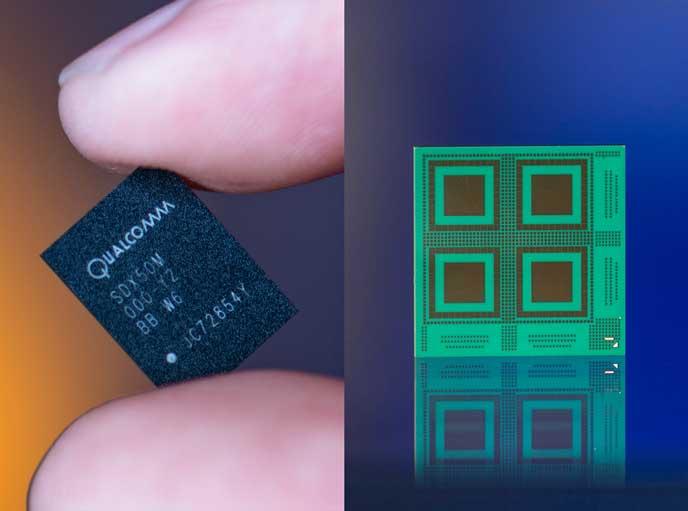
First, releasing an integrated 5G solution for mobile devices and second, getting 5G inside cheaper smartphones. Qualcomm will march ahead in full speed to make this possible as the chipmaker announced today at IFA 2019 that its future mid-range Snapdragon 600 and 700 series chipsets will feature integrated 5G modems.
This is a big deal for not just Qualcomm but for the entire mobile industry. Qualcomm chipsets power a majority of smartphones in the world today and if an affordable 5G chip is made available to manufacturers, we could see a tremendous boost in the adoption of this new technology. In fact, Qualcomm has revealed that it is already in talks with at least 12 different smartphone vendors like OPPO, Realme, Vivo, Redmi, Motorola, LG, and HMD Global (Nokia). It’s likely that the two upcoming HMD Global 5G phones will have this 700 series chipset inside.
These chips are already being samples and the first 5G integrated Snapdragon 700 series smartphones should roll out by the end of this year. As for smartphones with Snapdragon 600 series featuring 5G support, we’ll have to wait till the second half of 2020.
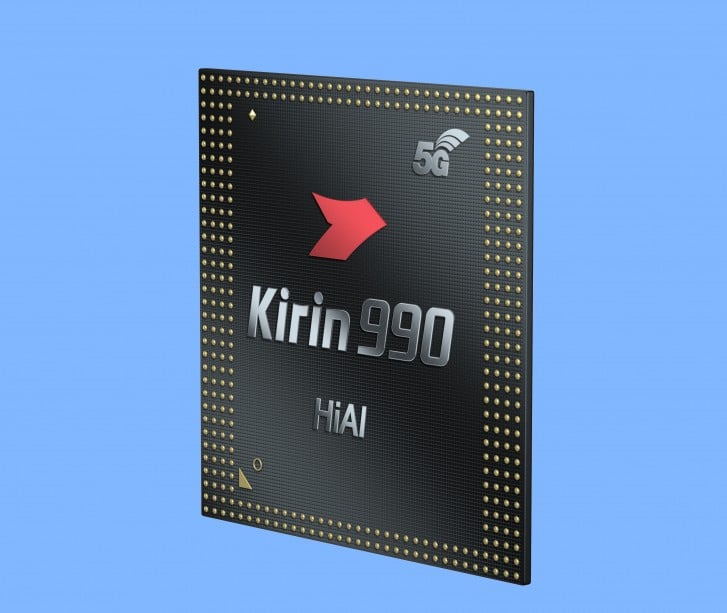
Huawei’s Kirin 990 will probably be the FIRST integrated 5G chipset to hit the market
Will the new Huawei’s SoC surprise everyone with its high performance and efficiency or will it will lag behind Qualcomm, Samsung and Apple chipsets that will power the upcoming flagships?
The public opinion is already divided, but before building an opinion it is better to gather all the information. And there are a lot of factors influencing it. Here, you will find 10 important things to know about the new HiSilicon Kirin 990, many of which may end up surprising you.
1Kirin 990 has an integrated 5G modem
Just like the newly-announced Exynos 980, the Kirin 990 is a chipset which integrates a 5G modem. And it will be the world’s first flagship chipset with an integrated 5G modem to hit the market. Until now, we have seen mobile processors with an external 5G modem in the shelves. To be accurate, Kirin 990 will come in two variants: one with 5G support which will include a Balong 5000 modem, and one LTE-only model. The 5G variant supports sub-6 GHz 5G networks on SA and NSA architectures and it will obviously be included in the most expensive versions of the upcoming Huawei’s flagships. The LTE-only variant should end up in less expensive flagships from the brand.
2Kirin 990 is built with the best production process
Huawei’s Kirin 990 mobile platform is built at 7 nm+ with the most advanced production process out there: TSMC’s 7FF+ with EUV. Note that only the 5G version of the chip is built with this production process, while the 4G variant is built at 7 nm just like the old Kirin 980. An advanced production process allows chipsets to be compact, efficient and powerful. And that is exactly the case of the Kirin 990.
Thanks to this advanced manufacturing process, Kirin 990 5G is the world’s first chipset with more than 10.3 billion transistors, while the 4G version has about 8 billion transistors which is still a huge amount.
3Kirin 990 should be better than Qualcomm Snapdragon 855
According to both Huawei and the first benchmarks, Kirin 990 will be slightly better than Qualcomm’s flagship option of this year: the Snapdragon 855. During the launch event at IFA 2019, Huawei showed the Geekbench results of both the chipsets and highlighted that Kirin 990 has 10 percent better single-core performance than Snapdragon 855 and 9 percent better multi-core performance. Huawei also claims that it has a 12 percent better big-core efficiency, 35 percent better middle-core efficiency, and 15 percent better little-core efficiency. Note that these terms indicate the three clusters which the Kirin 990 includes.
The 5G variant of the chipset has an octa-core architecture composed of 2x Cortex-A76 CPUs running at 2.86 GHz (big-cores), 2x Cortex-A76 (middle) clocked at 2.36 GHz and 4x Cortex-A55 (little) running at 1.95 GHz. The clock frequency of the middle and little cores is slightly lower for the 4G version of the SoC (2.09 and 1.86 GHz respectively).
4World’s first chipset with ISP 5.0 (BM3D) for DSLR-quality noise reduction
If there is one feature which has been Huawei’s focus in the past few years, that’s photography. The Kirin 990 is able to provide DSLR-quality image noise reduction through a new filtering algorithm called BM3D (Block Match 3D) which significantly improves its noise reduction capability in images.
5Support for 8K video recording
Kirin 990 even supports 8K video recording at 30 fps with HDR. And it is able to improve noise reduction even in videos. The Kirin 990’s NPU is able to cooperate with the ISP in order to provide a better image quality on all levels, with tons of revolutionary features and technologies. That is why you will see a lot of improvements in photography and videography.
6Same GPU as 980 but better graphics performance
Kirin 990 includes a Mali G76 MP16 GPU clocked at 700 MHz: it is the same GPU as the Kirin 980, yet it provides better performance because it integrates 16 cores: 6 more cores compared to the 10 cores found on the Kirin 980. Both the 4G and the 5G version will have this architecture for the GPU. While the Mali G76 has a slightly lower frequency, Huawei believes a wider GPU will improve the chipset performance even if the frequency and the voltage are lower.
7A separate Kirin A1 co-processor for less intensive tasks
In order to improve the Kirin 990, Huawei has adopted a co-processor called Kirin A1 for Bluetooth, audio decoding and applications which do not require a lot of power. Thanks to this additional unit, the load on the chipset is reduced and the overall performance is indirectly improved.
8Quad-core NPU for AI with DaVinci architecture
If we compare the Kirin 990 with its predecessor, the biggest difference we’ll notice is the NPU (Neural Processing Unit). An element which is often ignored by the average user, but is very important in everyday application. Huawei has used the new DaVinci architecture for the NPU of the Kirin 990, which was first seen on Kirin 810 launched earlier this year. The ‘Big’ Da Vinci cores support both INT8 and FP16 quantization of networks which offers better power solutions to ML inference problems. Further, Huawei has added a Tiny Core NPU that is a smaller and very power-efficient version of Da Vinci architecture connected over the AXI bus. It has lower performance but it can process a lot of tasks to save energy.
9Kirin 990 is coming soon on Huawei Mate 30
As we said earlier in this article, Kirin 990 will be the world’s first chipset with an integrated 5G modem to hit the market. Indeed, it will debut in less than two weeks on the Huawei Mate 30 series. The new flagship line-up will be officially unveiled on September 19 and it will start hitting the shelves in October.
10There will be more affordable Honor smartphones with the chipset
If you are a Huawei fan you know that the company usually releases more affordable devices with its flagship chipsets, after its most important flagship phones. Usually, the first affordable high-end devices to come with Huawei’s flagship chipsets are released by its sub-brand Honor.
We know for sure that Honor’s first 5G flagship, the Honor V30 5G will feature this Kirin 990 5G. We won’t be surprised to see more smartphones with this chipset in the coming months.
India has always been a hotbed for Chinese smartphone makers and Xiaomi has achieved tremendous success in the Asian country since it set sail over there. The Chinese smartphone giant has disclosed that has sold over 100 million smartphones in India since it opened shop five years ago.
Mi fans, with immense pride we announce that we've has officially shipped 100 Mn smartphones. 💯
We reached this mark in just 5 years. The fastest brand to do so. ️#NoMiWithoutYou
The announcement was made by Xiaomi India head Manu Kumar Jain. Citing IDC reports, the Xiaomi exec disclosed that the monumental feat was achieved in the period starting in Q3 2014 until July 2019. He also disclosed that the Redmi A series and the Redmi Note series contributed significantly to this feat. The sales also include those from sub-brands such as the Poco F series.
Xiaomi Shop
For a company that entered the Indian market in 2014, this feat is indeed a wonderful one. To put it in a statistical perspective, 100 million phones sold in 5 years translates to an average of 20 million phones per year, 1.67 million phones per month, 55,000 phones sold each day. It also means the company sold an average of 2.3k phones by the hour and 38 smartphones each minute or 2phones each second. We won’t need to look beyond the pricing and build quality of Xiaomi phones to see why the company has continued to achieve success in India where it has ranked as the number 1 smartphone vendor for the past five quarters.
Huawei announced a new version of its wireless earbuds today at IFA 2019. The Freebuds 3 not only has a new design but also comes with a brand new chipset called the Kirin A1.
Kirin A1
Huawei is following in the steps of Apple whose first-gen and second-gen AirPods use the W1 and H1 proprietary chips respectively.
The HUAWEI Kirin A1 chip is here! It comes armed with:
The Kirin A1 is an ultra-low-power processor that brings advanced Bluetooth and powerful audio. It is the world’s first Bluetooth 5.1 and Bluetooth 5.1 LE wearable chipset.
Freebuds 3
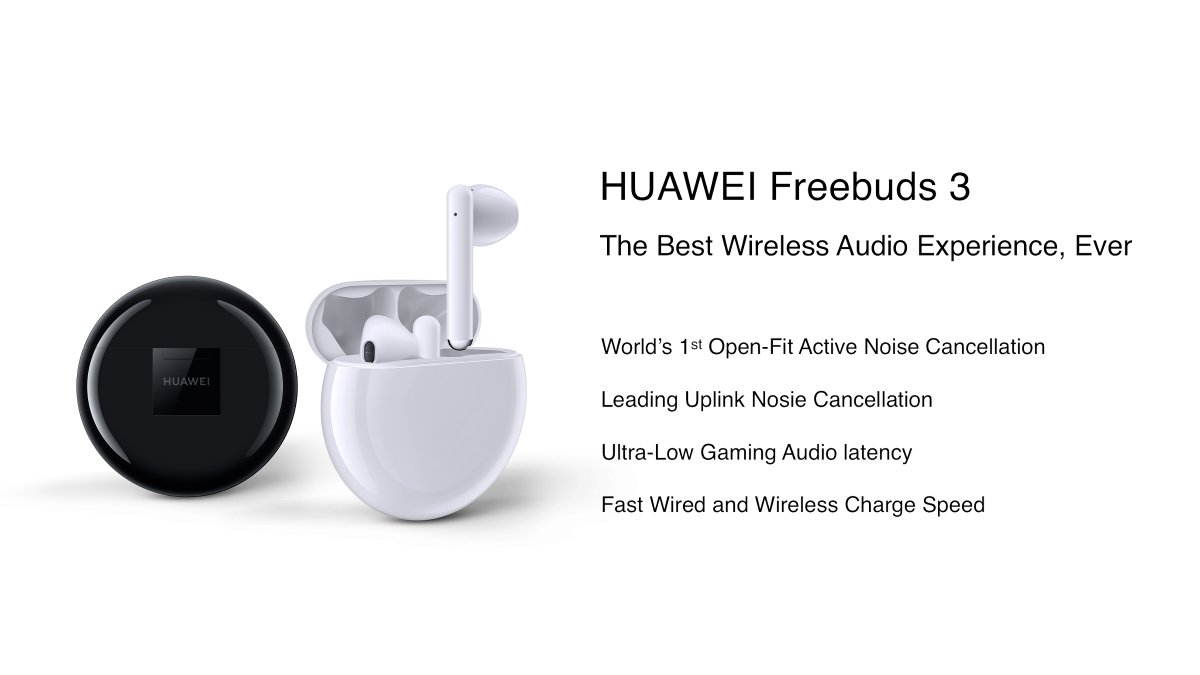
The Freebuds 3 true wireless stereo headset features a new design Huawei calls Dolphin Bionic inspired by a dolphin’s vocal cavity. The case is also different, circular like a perfectly round pebble with a glossy finish.
With the new Kirin A1 chip, Huawei promises low latency and low power consumption as the earbuds use what is called an isochronous dual channel Bluetooth connection. Each earbud is paired to the phone on a separate channel rather than one earbud being the master while the other is the slave in some earbuds.
Huawei is obsessed with titles and it claims the Freebuds 3 is the world’s first earbuds with open-fit active noise cancellation with up to 15-decibel ambient noise reduction. The bone sensor makes a comeback and will work with the Mic Duct for noise cancellation and a crystal clear conversation when making calls.
It also has a latency of 190ms which makes it perfect for gaming, and the noise cancellation is adjustable using the companion app.
HUAWEI Freebuds 3 deliver the world’s first open-fit active noise cancellation.
The Freebuds 3 boasts a 4-hour battery life which can be extended to 20 hours with the charging case. The case is said to support both fast wired and wireless charging speeds.
Huawei didn’t announce a price but says it will be available next month in Europe and cost less than the $199 Airpods. It will come in black and white color variants.
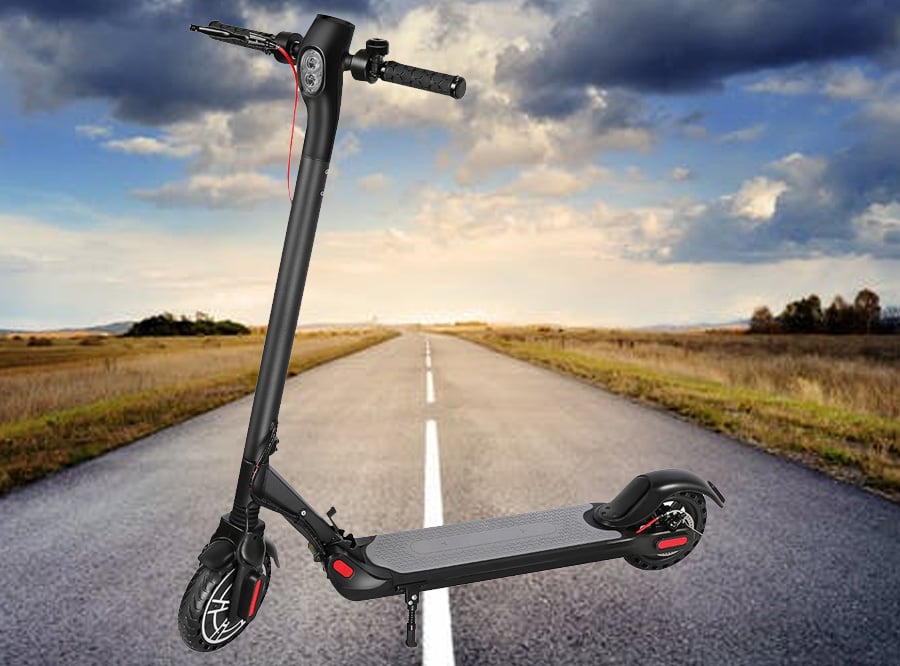
If you have been searching for an inexpensive e-bike that warrants safety and can turn heads at the same time, you might want to give the KUGOO ES2 Folding Electric Scooter a test drive.
Equipped with an 8.5-inch tire, coupled with shock absorption capability, the KUGOO ES2 is designed to offer a comfortable and safe riding experience. It is backed by a 7.5Ah high-capacity lithium battery that not only helps you achieve high speeds but also ensure a longer range.
The electric scooter comes with three-speed modes including 15km/h, 20km/h, and 25km/h. Moreover, it adopts a 3-seconds fast-folding design, allowing you to carry it wherever you go. As if that weren’t enough, it has a built-in USB port that you can use to power your mobile devices.
Offering complete control on your fingertips, the KUGOO ES2 Folding Electric Scooter can be easily paired with the app. Furthermore, it uses a wide array of bright LEDs for a brighter headlight that makes riding even during the night safe and sound.
The KUGOO ES2 boasts an impressive array of other features including a dual-brake system, and an exquisitely lit LED chassis. This space-saving electric bike has dimensions of 112x33x43cm and is made using high-quality aluminum alloy + ABS + PC materials for durability. While you’d normally expect a feature-rich electric scooter to set you back a pretty penny, the KUGOO ES2 Folding Electric Scooter can now be yours for just $439.99 through GeekBuying. This is a noteworthy 24 percent reduction in the EV’s original asking price of $582.18.
On top of that, you can use coupon code ES2KUGOOEU. The coupon helps you save $12.22 more by bringing the already lowered asking price of the KUGOO ES2 further down to just $427.77 during the checkout process. You can choose between the black or the white color option.
You can follow this link to grab the discount and take advantage of the coupon before it expires.
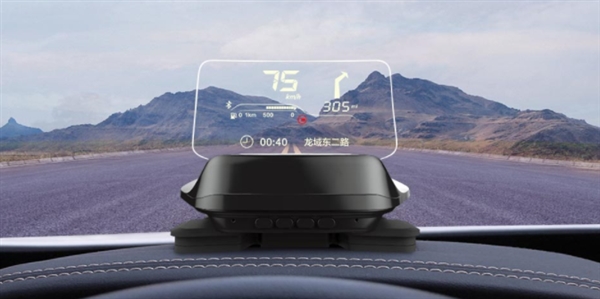
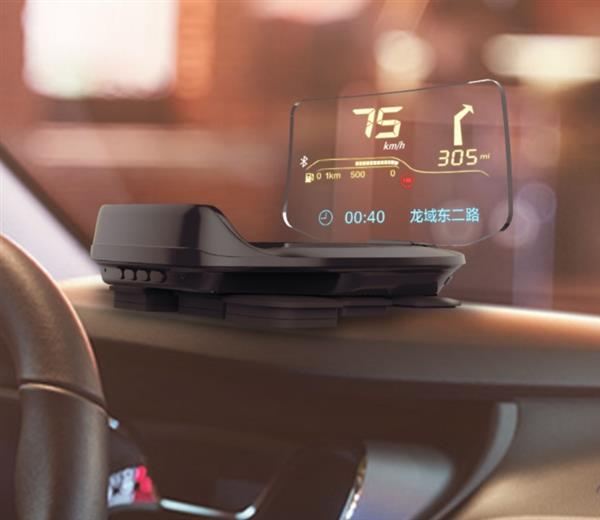
Chinese tech giant Xiaomi launched the Car Robot Smart HUD Bluetooth version under the crowdfunding platform. Three months after, the Smart Heads Up Display is now available to buy on the Youpin website.
Head-Up Displays also known as HUD, is becoming increasingly common in all types of new cars, ranging from the Mazda3 to the BMW 7 Series, but you don’t have to trade in your older model just to get one. Several aftermarket solutions let you modernize your current ride, whether you prefer an affordable device or a high-end product with a price tag to match. The Bluetooth version of the Car Robot HUD is an affordable model with a 499 yuan ($70) price tag. There is a higher version that retails for 1,499 yuan ($210).
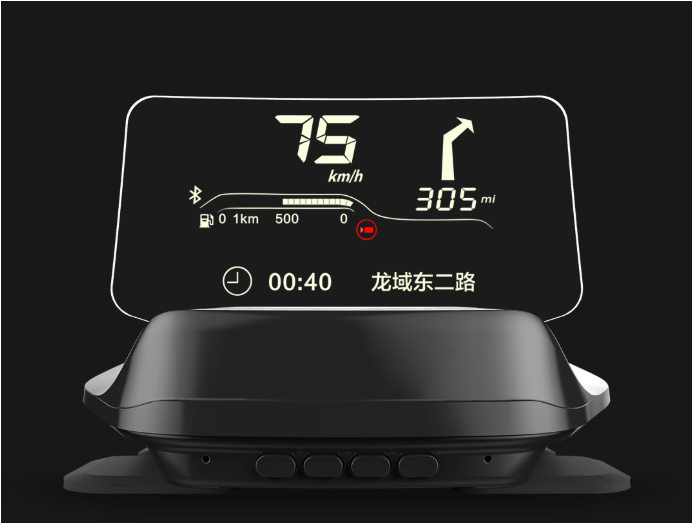
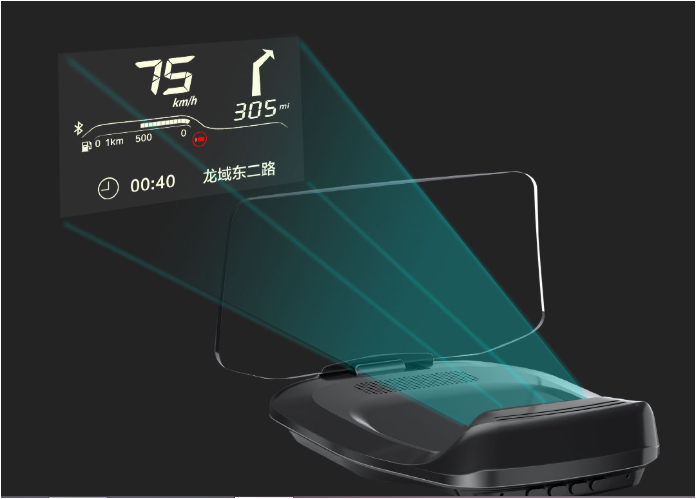
The head-up display was first used in military fighter jets and falls somewhere between a tech feature and a safety feature. The device reduces dangerous distractions by displaying key information, such as a car’s speed and navigation directions, directly in the driver’s line of sight. Some systems project information onto the windshield; others project it on a separate screen. The Car Robot Smart HUD comes with its own screen. It uses FREE-FORM technology and is compatible with more than 90% of car models around.
It adopts a low-profile and semi-concealed design, which can not only integrate with the car but reflects the distraction-free driving the gadget is meant to project in the first place. The body is made from polycarbonate and ABS mixing process. It has high-temperature resistance, anti-UV and doesn’t deform or discolour easily.
Furthermore, the smart HUD features a built-in light-sensing system that adjusts the screen brightness according to the brightness of the current environment. The display is smooth and has good contrast and also doesn’t flicker. In addition to the automatic brightness feature, you can also manually adjust through the physical button on the body or via the app. There are three different brightness modes for you to choose from. As th name implies, this is a Bluetooth version but communication with the car’s system is via the OBD port. There is an OBD connector inside the box. The Bluetooth 4.0 can be used to pair the device with a smartphone.
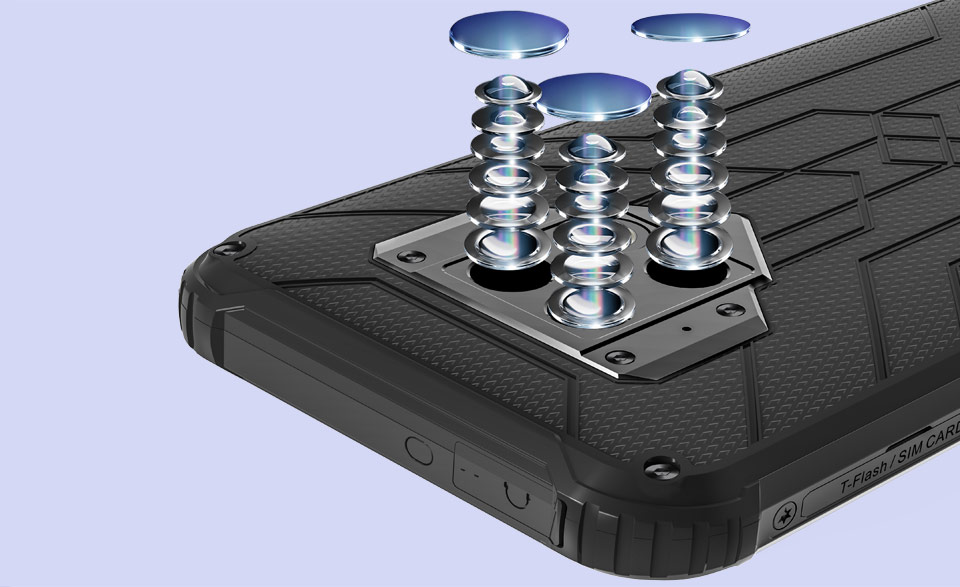
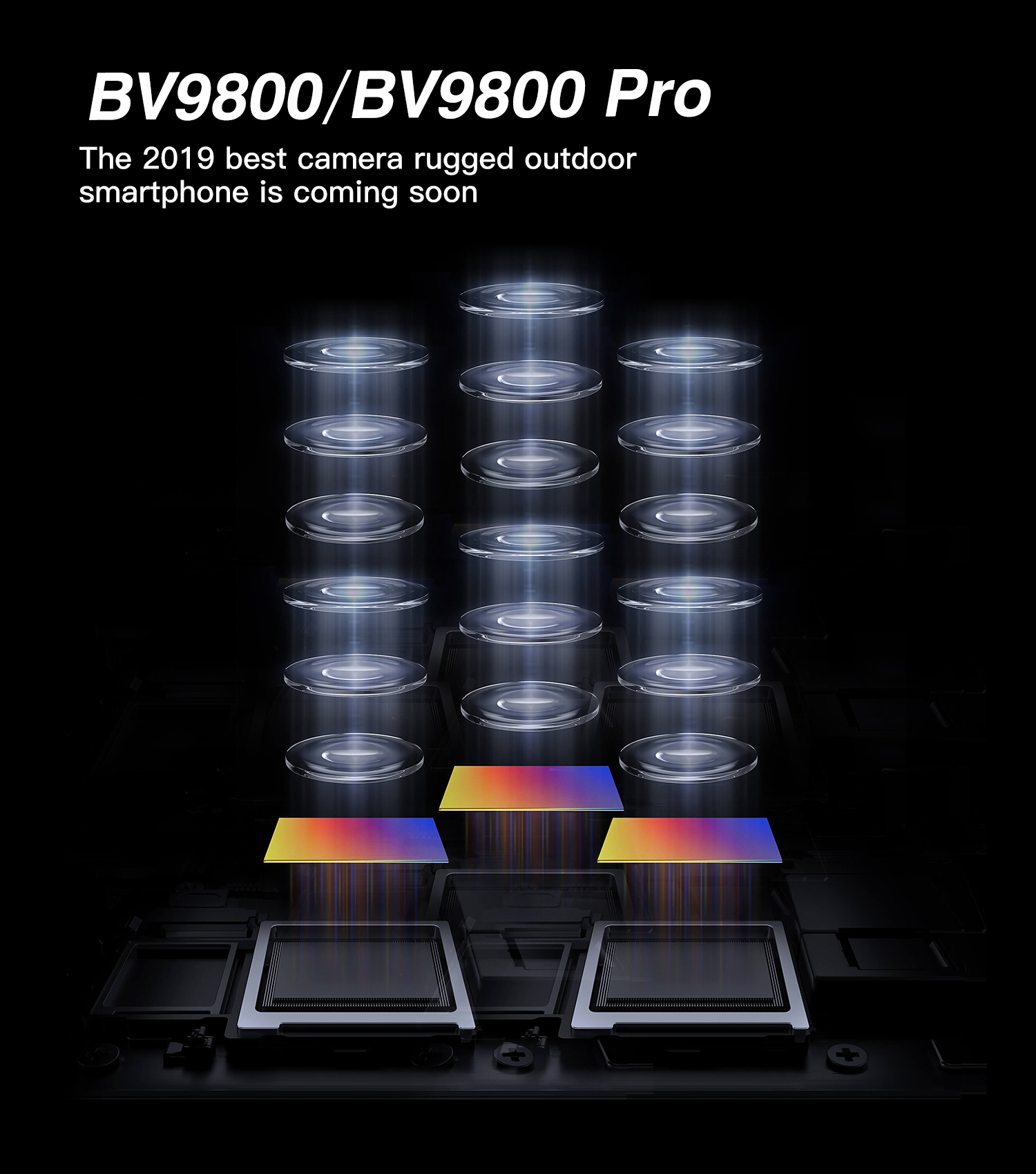
Earlier Blackview released a poster that hints at a best camera rugged outdoor smartphone that will soon hit the market. The poster doesn’t contain too many details of what the company will be launching and the launching time but today, information from the company sheds some light to the mystery: The new model is called Blackview BV9800/BV9800 Pro. Let’s take a look at some more details.
Firstly, the new device will come with a triple rear camera setup with the main sensor being the famous Sony IMX586 48MP sensor. The IMX586 is currently the most widely used camera sensor in the midrange to flagship devices and devices like Honor View 20, OnePlus 7, VIVO X27, Oppo Reno 10x Zoom, and Xiaomi Mi 9 sporting Sony’s best mobile camera sensor to date. Of course, these devices cost from around $600 to $900+.
According to DxOmark camera testing website, the IMX586 ranks at the top of their list both in video and photo shooting. Not only does it feature a high pixel count but also is large at 1/2″ with 1.6μm pixel size (via pixel binning). As Blackview revealed, the 48MP sensor will be combined with a 5MP depth camera to achieve beautiful bokeh effect. The 3d camera will sport an ultra-wide lens offering a 120º field-of-view and a 16MP sensor.
It was about time a rugged phone with the Sony sensor hit the market and who would be better to bring one than Blackview that has a long tradition in the rugged smartphone market. The sensor is proven to be one of the best around and the fact that it will be available in the budget rugged phones BV9800/BV9800 Pro is very positive. To learn more about BV9800/Pro, visit the product page.
Xiaomi’s ecosystem comprises multiple companies that make amazing products, and Yeelight is no exception.
Known for making a wide array of lighting products that promises to ‘color the night and bring your dreams to life,’ Yeelight has teamed-up with LightInTheBox to offer three smart lighting solutions that have an intense impact on the human senses. More importantly, these products are available for considerably lowered prices. Let’s check them out.
Yeelight YLFW01YL Smart Atmosphere Candela Light
Sporting an elegant minimalist design the Yeelight YLFW01YL adopts the latest BLE Mesh technology for an unparalleled candlelight experience. Aside from its perfect appearance, the smart candlelight ambient lamp offers the most realistic lighting both clockwise and counter-clockwise.
While the market is crammed with smart lights that offer comparable features, they don’t come cheap. The Yeelight YLFW01YL, on the other hand, can now be yours for a lowered price of just $39.04 from LightInTheBox.
This is a noteworthy 43 percent reduction in the smart light’s original asking price of $67.75. To avail this discount, all you need to do is to follow this link without wasting time.
Yeelight YLTD03YL Smart Adjustable LED Desk Table Lamp
Thanks to its unique design, you can see this smart eye -protection desk lamp at a glance. It offers AA level illumination without the hazard of blue light.
With Ra Color Rendering Index (CRI), the quality of color reproduction of the Yeelight YLTD03YL is greater than 95. As a result, there is no flash and you get more pure lightning.
The Yeelight YLTD03YL usually retails for $164.99, but you can now buy it for a lowered price of only $97.89 from LightInTheBox. This 41 percent discount is valid for the white color option and you can grab it by visiting this link.
A great addition to Xiaomi Yeelight Series, the Yeelight RGBW E27 Smart LED Bulb is designed to enhance the lighting experience of your daily life. It is equipped with a whopping 16 million colors RGB light, along with 1700-6500K adjustable white light for superior ambient lighting.
The Xiaomi Yeelight 220V E27 Smart LED Bulb can be effortlessly controlled from anywhere in the house using WiFi technology. On top of that, it has an unbelievably long lifetime of up to 11 years so you don’t need to worry about replacing a bulb for quite some time.
While aforesaid features completely justify the $42.89 price tag it normally carries, you can now get your hands on the Xiaomi Yeelight 220V E27 Smart LED Bulb for a reduced price of just $19.46 from LightInTheBox.
To get this 55 percent off, simply follow this link. Note that the discount is valid for Spain, America, Britain, Germany and India.
Xiaomi has launched the Dr. Bei Q3 Sonic Electric Toothbrush. Thetoothbrushadopts a compact build as small as a lipstick and it is designed for female users. The toothbrush comes with an affordable 169 yuan ($23) price tag.
In terms of the appearance, the Dr. Bei Q3 Sonic Electric Toothbrush is no bigger than a lipstick, with the weigh standing at 45 grams. This compact build makes it easy to fit the brush into the pocket or even a cosmetic bag.
It utilises a plastic body with a Peach color gradient design and sparkling special effects. The brush has a metal ring at the waistline. The sonic motor isn’t too loud, with a sound intensity of 31,000 beats per minute. The device also comes with three-speed modes; clean, gentle and massage. There is a smart memory function onboard the brush which reminds you to change the brushing area every 30 seconds, and complete 360° surround cleaning in 2 minutes.
On the brush head, the Dr Bei Sonic Electric Toothbrush uses DuPont diamond soft bristle, with fine 0.12mm thickness. The bristle is flexible and comfortable and enables better cleaning power and more care for the gums.
Further, the toothbrush comes with an IPX7 waterproof build which is sort of a compulsory feature of electric toothbrushes. This makes it possible to immerse completely in a bowl of water or rinse under a running tap. and can be completely safely rinsed. The sonic toothbrush packs a durable battery that is touted to last up to 30 days. There’s a USB port for charging the battery.
The Armor X3 isn’t a brand-new model since it’s been on the market for some time and besides the fact that it is an entry-level rugged phone, it features some interesting functions like the Customizable Button, Gloves Pattern, etc. Today, Ulefone released a demonstration video to show users what the Customizable Button can do. Let’s have a look.
As you can see in the video, the button supports 3 different actions at the same time through single click, double click, and long press. Besides all the installed apps that are supported, the button also supports quick activation of the voice recorder, flashlight, screenshot, underwater photography, and SOS emergency call. What’s more, setting it up is simple.
The rest of the specs are already known but let’s go through them one more time. So, it is water, dust, and drop resistant as are all the Armor Series phones and comes with a 5.5″ HD+ display with 18:9 aspect ratio. In addition, there is a 4-core SoC backed by 2GB of RAM and 32GB of storage as well as a 5000mAh battery. The rear camera consists of an 8MP/2MP dual setup while the selfie shooter sports a 5MP sensor that offers face unlock too. Lastly, the Armor X3 features dual-SIM/dual-standby and Android 9 Pie.
Right now, you can get the Armor X3 at just $83.60 on the company’s official Aliexpress store together with a free tempered glass. Overall speaking, Armor X3 is definitely the most wallet-friendly among its range. For more details, visit ulefone.com.
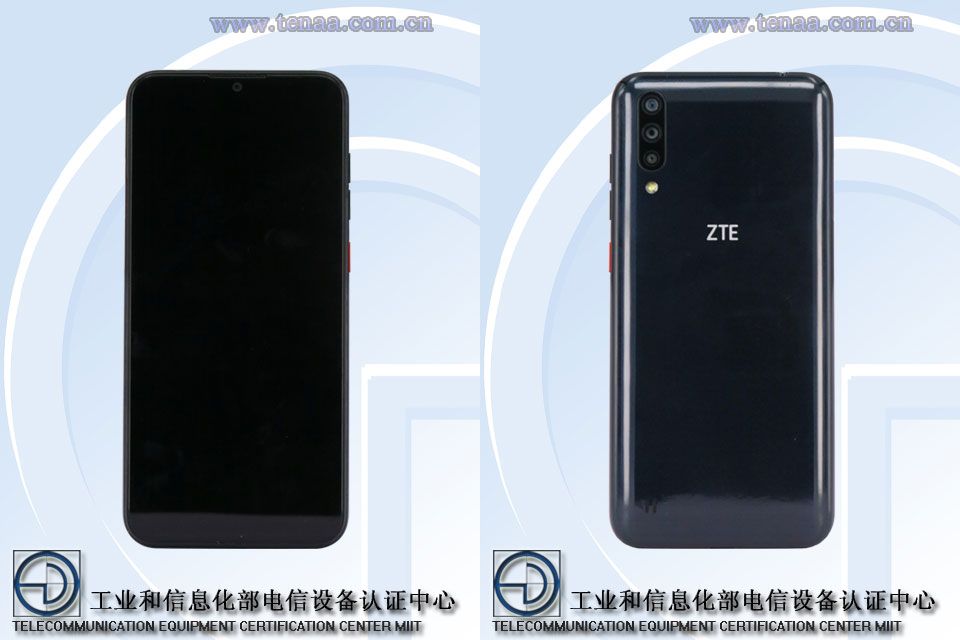
An upcoming ZTE phone with model number ZTE A7010 has appeared on TENAA. The entire specifications of the phone along with its images have surfaced on the Chinese regulatory platform. It appears that the ZTE A7010 may debut as a Blade series smartphone.
The images of the ZTE A7010 smartphone has a waterdrop-style notch. The right side of the phone has volume rockers and a red-colored power key. The chin of the device of the phone appears a bit thick. The rear side of the phone is fitted with a triple camera setup followed by an LED flash. The company’s logo is placed on the backside of the phone. Black and Peacock Blue are the two color editions of the ZTE A7010.
ZTE A7010 Specifications
The ZTE A7010 smartphone has dimensions of 155 x 72.7 x 8.95mm and it weighs 194 grams. It is fitted with a 6.088-inch IPS display that produces HD+ resolution of 720 x 1560 pixels. The smartphone is powered by 2.0GHz octa-core processor. There is 4 GB of RAM on the device and it comes with a native storage of 64 GB. The Android 9 Pie OS will come preloaded on the device.
The triple camera setup of the ZTE A7010 includes a primary lens of 16-megapixel, an 8-megapixel sensor and a 2-megapixel third lens. On its front is a 5-megapixel snapper for capturing selfies. There is no fingerprint scanner on the device. The 3,900mAh minimum capacity battery fuels the smartphone.
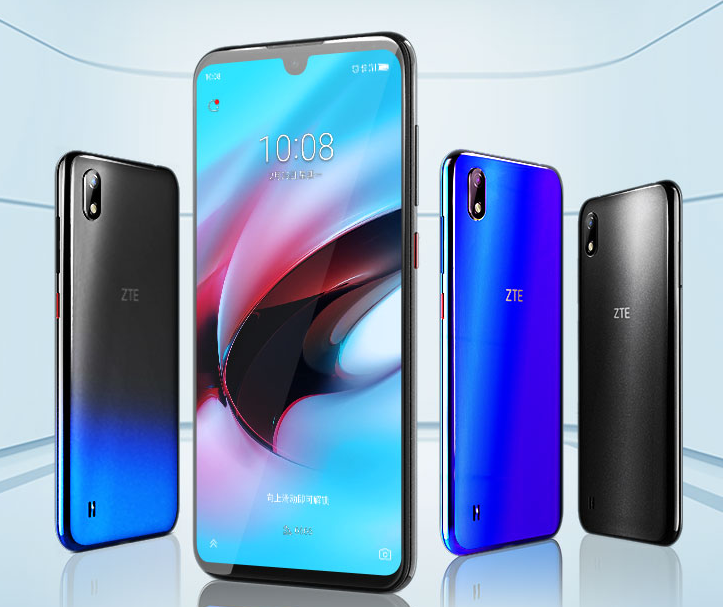
The ZTE Blade A7 phone was announced in May 2019 has a model number of A7000. Hence, it appears that the newly spotted ZTE phone with A7010 model number could be an updated edition of the Blade A7.
The Blade A7 has a 6.01-inch IPS LCD display with waterdrop notch. It carries support for 720 x 1560 pixels and 19.5:9 aspect ratio. The MiFavor 9.0 based Android 9 Pie OS comes preloaded on the device. The Helio P60 fuels the smartphone. It has a rear camera of 16-megapixel and it is equipped with a front-facing of 5-megapixel.
The Blade A7 comes in two model such as 2 GB RAM + 32 GB storage and 3 GB RAM + 64 GB storage. The handset houses a 3,200mAh battery.
Apple is going to announce this year’s iPhone lineup on September 10th but that doesn’t mean that you have to wait until the new flagship hits the market. We already know that there will be 3 new iPhone models and maybe a new Apple Watch which all will come with wireless charging support, so let’s check out some interesting charging solutions from Choetech.
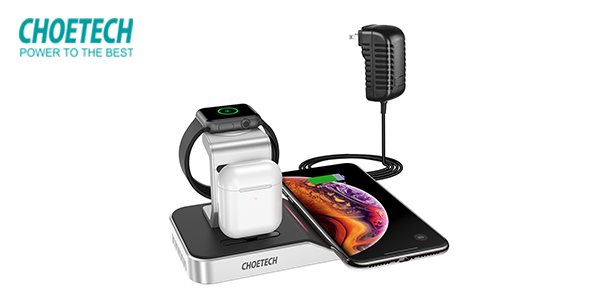
4 in 1 iPhone and Apple Watch Wireless Charging Dock (MFi Certified)
Apple finally canceled the release of its wireless pad but Choetech has something similar to offer. Designed with four charging areas, the wireless charging dock can charge up to 4 devices simultaneously. So, you can use it to charge your iPhone, Apple Watch, and Airpods simultaneously! of course, it is MFi-certified by Apple and ensures quality and safety. You can find it on Amazon.
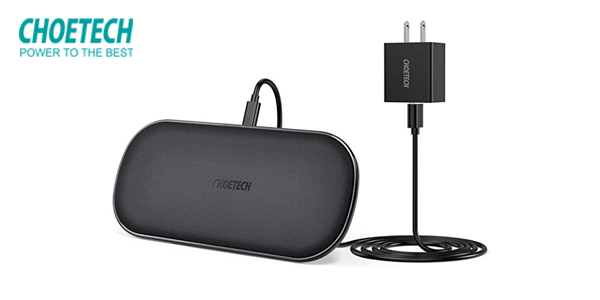
Choetech Fast Dual Wireless Charger
This wireless charging pad is so powerful that you can use it to charge 2 phones at the same time at up to 18W output! It features 5 coils that provide a wider charging area so that there’s no need to fumble with your smartphone for a better charging position. It sports an anti-slip PU leather surface that prevents your smartphone from sliding. It is available on Amazon in Black and White colors and starts at just $36.49.
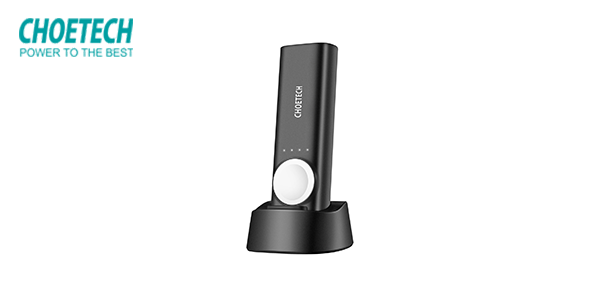
2in1 Portable Wireless Quick Charger for iWatch
The Choetech 2in1 power bank has a capacity of 5000mAh and the company has embedded a magnetic charging module where you can place your Apple Watch. This means that you can charge your iPhone and Watch at the same time. It is super-portable and super-useful if you fell asleep and forgot to charge your iDevices. Of course, this too is MFi-certified and has built-in protection for over-current, over-voltage, over-temperature and short-circuit. You can find it here.
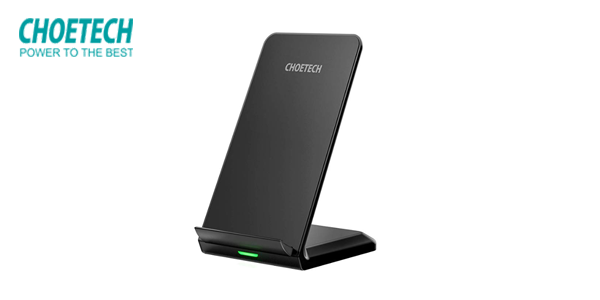
Choetech Fast Wireless Charging Stand
Next up is an intelligent wireless charging stand that can identify charge models for 10W/7.5W/5W charging. There are 2 built-in coils that offer a much wider charging area and 10% quicker charging speed and can also operate even with a case on within 5mm/0.2 inch (4mm/0.16 inch is the best). It is Qi-certified and you can charge your phone in a vertical position so that you can always see notifications. Find it on Amazon.
18W PD Type-C Wall Charger + Type-C to Lightning Cable
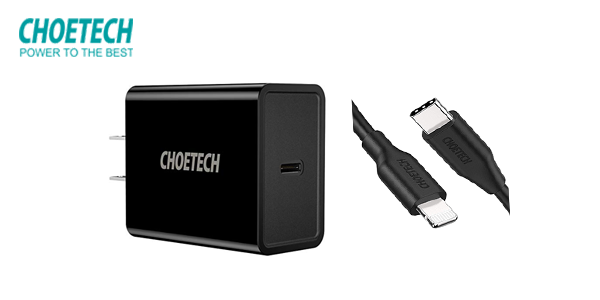
We already know that previous the last couple of years, iPhone models support fast charging but Apple didn’t bother to put a fast charger in the box so you have to buy one yourselves. Choetech’s fast charger is just what you want as it not only supports 18W PD but also provides the necessary USB Type-C to Lightning cable. It is very compact and is MFi-certified. You can get it on Amazon here.
Choetech Wireless Car Charger
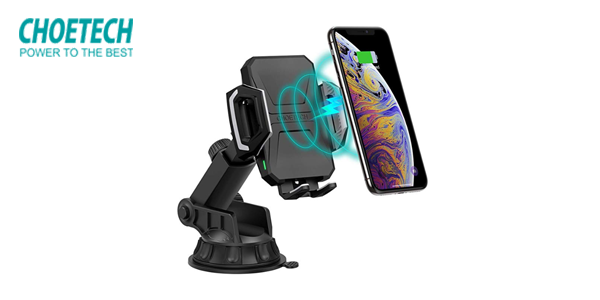
Finally, Choetech also provides a car wireless charger in the form of a phone holder. This 2in1 accessory supports 10W/7.5W/5W fast wireless charging modes and a non-scratch silicone mat that ensures stability and protection. There is a rotating ball joint on both mounts that provides flexible viewing angles for vertical or horizontal use, according to your liking. It costs just $21.65 on Amazon.
In recent years, pricing of the premium flagship offerings from the likes of Apple and Samsung have been climbing up and have crossed the $1,000 mark. Along with the premium offering, Apple had launched the iPhone XR last year, keeping the company’s earlier price point of around $750.
Now, according to the report from the market analysts, the shipments of the Apple iPhone XR crossed the 30 million units mark making it the best-selling smartphone in the first half of this year.
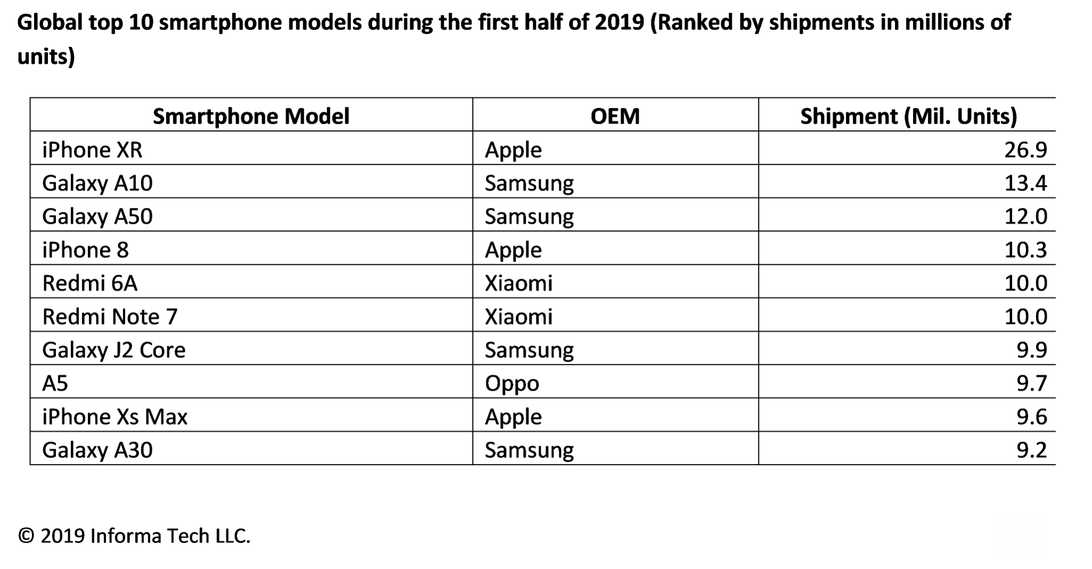
While the iPhone XR certainy isn’t cheap being priced at $749, however, it’s the least expensive offering compared to the other iPhones launched last year — iPhone XS and XS Max. According to the IHS Market, 13.6 million iPhone XR units shipped in the first quarter and 13.3 million shipped in the second quarter — bringing the total to 26.9 million for the first half of the year.
The second best-selling smartphone for the H1 2019 is the Samsung Galaxy A10, which shipped almost half of the units compared to the iPhone XR. Commenting on this, Jusy Hong, Research and Analysis Director said:
“Compared to the Android-based smartphone makers, Apple maintains a relatively small model lineup. This means that Apple’s total sales volume is divided among fewer models. As a result, each of Apple’s iPhone models tends to generate higher shipment numbers than comparable Android smartphones, such as those sold by Samsung.”
The Samsung Galaxy A50, Apple iPhone 8, and Xiaomi Redmi 6A are ranked third, fourth, and fifth bestselling smartphone respectively. Other devices in the list include Redmi Note 7, Galaxy J2 Core, Oppo A5, iPhone XS Max, and the Galaxy A30.
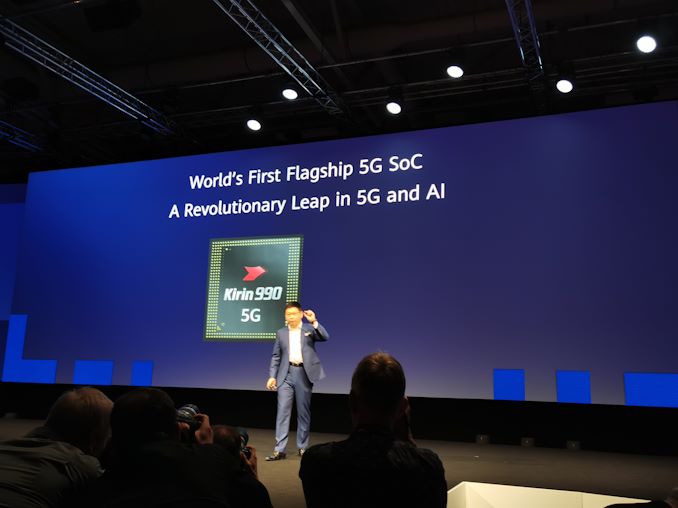
In years past, Europe’s biggest electronics show, IFA 2019, was the place Huawei chose to unveil a new Mate, the biggest of its flagship phones. That’s not the case in 2019. We won’t see the Mate 30, the latest in the series, until Sept. 19, when it’s due to launch in Munich. Instead, Huawei has unveiled its next-generation silicon that will power its upcoming mobile products, the Kirin 990 chipset.
Built with a 7nm extreme ultraviolet lithography (EUV) process, Huawei says its new integrated chip is smaller than Qualcomm’s Snapdragon 855 + X50 5G modem, allowing for more compact 5G smartphones. The Kirin 990 5G is also the world’s first mobile SoC with more than 10 billion transistors, making it more efficient with power consumption.
But perhaps the most exciting thing about the Kirin 990 is that it’s also the first full-frequency 5G SoC — it’ll support both non-standalone and standalone architectures as well as TDD/FDD full frequency bands. The Kirin 990 is a true unified design, supporting Sub-6 GHz 5G networks on both SA and NSA architectures. To date, neither Qualcomm, nor Samsung, (nor Apple), have a unified chip design, Huawei is the first.
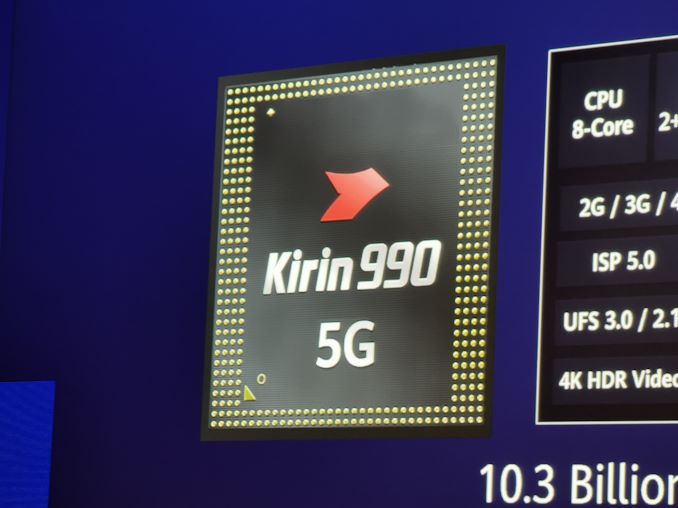
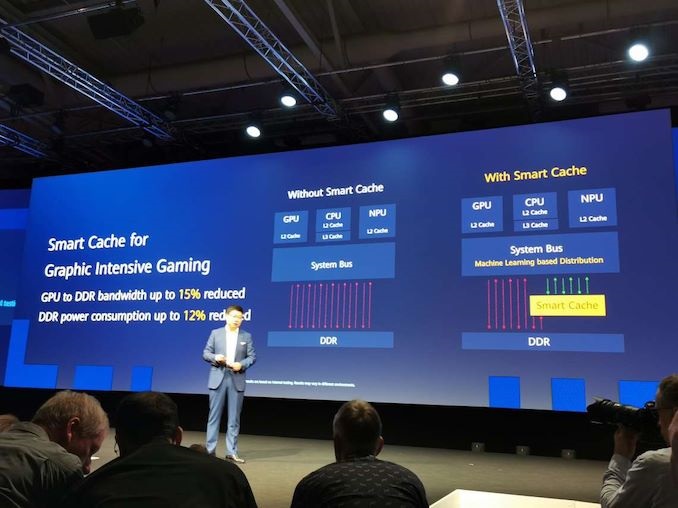
The Kirin 990 5G is a 7nm octa-core chipset that has 10.3 billion transistors. It uses two big, two middle and four little cores to optimize multitasking, with clock speeds of 2.86GHz, 2.36GHz and 1.95GHz respectively. The 990 5G also packs a 16-core Mali G76 graphics processor which should offer plenty of power for mobile gaming, as well as smart cache built in to reduce bandwidth by up to 15 percent.
To aid with mobile photography, a new fifth-generation Dual ISP boasts DSLR-level hardware noise reduction and block-matching and 3D filtering. Huawei’s smartphone cameras already produce stunning low-light results, but it looks like that can be improved further. Dual-domain noise reduction will also be available for use on video production, as well as frame-by-frame AI color adjustments.
Aside from implementing the 5G modem, the biggest change in the Kirin 990 is going to be the NPU, or Neural Processing Unit. Boiled down to basics, it’s a coprocessor optimized for the sort of vector math that’s the lifeblood of machine learning frameworks like Facebook’s Caffe2 and Google’s TensorFlow.
Qualcomm’s AI Engine, Samsung’s own Neural Processing Unit, and Apple’s A12 Bionic achieve the same ends through different means, but Huawei claims its homegrown Da Vinci architecture — the evolution of the NPU in the Kirin 970 and 980, which were designed by Cambricon — is far and away the most capable.
There’s still a bit of worry within all this however. The Kirin 990 relies extensively on Arm’s chip designs for both its CPU and GPU elements. However, Huawei’s relationship with the British chip designer was thrown into disarray earlier this year when the US imposed sanctions on the Chinese company.
Huawei has a press event in Munich on the 19th of September, where we are expecting the Huawei Mate 30 and Mate 30 Pro flagship phones to be announced – and likely a 5G model as well, which perhaps might be the Pro 5G only. We’re extremely eager to hear more and experience the Kirin 990, so hopefully we get to see its full potential when the time comes.
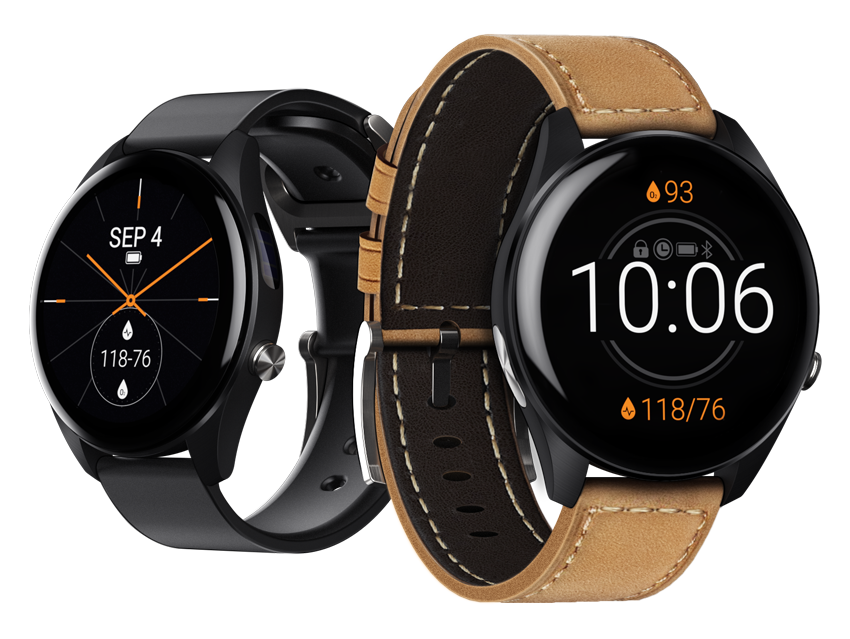
At the on-going IFA 2019 in Berlin, Asus announced the global launch of its latest gaming smartphone Asus ROG Phone II. Along with that, the Taiwanese company has also launched a new wearable device — Asus Vivowatch SP.
The Asus Vivowatch SP is a smartphone that comes with ECG capabilities and helps in tracking blood pressure and stress levels. The PPG Optical Sensors is placed at the back while the Medical-grade ECG sensors is on the side of the case.
While exact details about the display has not been revealed, the smartwatch uses a TFT Full-colour display with Gorilla Glass protection on top. It also has an anti-fingerprint coating to keep smudges off.
It also comes with GPS and an altimeter for more precise exercise data, which can be quite helpful especially when you are in areas with poor coverage. The device is also rated waterproof up to 5ATM (50 meters of depth).
There’s also Asus HealthAI support that should guide you based on your stats and habits. As per the company, this HealthAI platform has been developed with leading team of health experts.
The Asus Vivowatch SP comes with a ceramic bezel that reduces fingerprints and has support for changeable bands so that you can match it with your style. The company has also promised a non-stop battery life of 14-day but has not revealed the battery capacity.
At this time, the company has just unveiled this Vivowatch SP smartwatch and the device will get launched in the fourth quarter of this year, i.e. Q4 2019. The pricing and availability details of this device will be revealed when the official launch takes place.
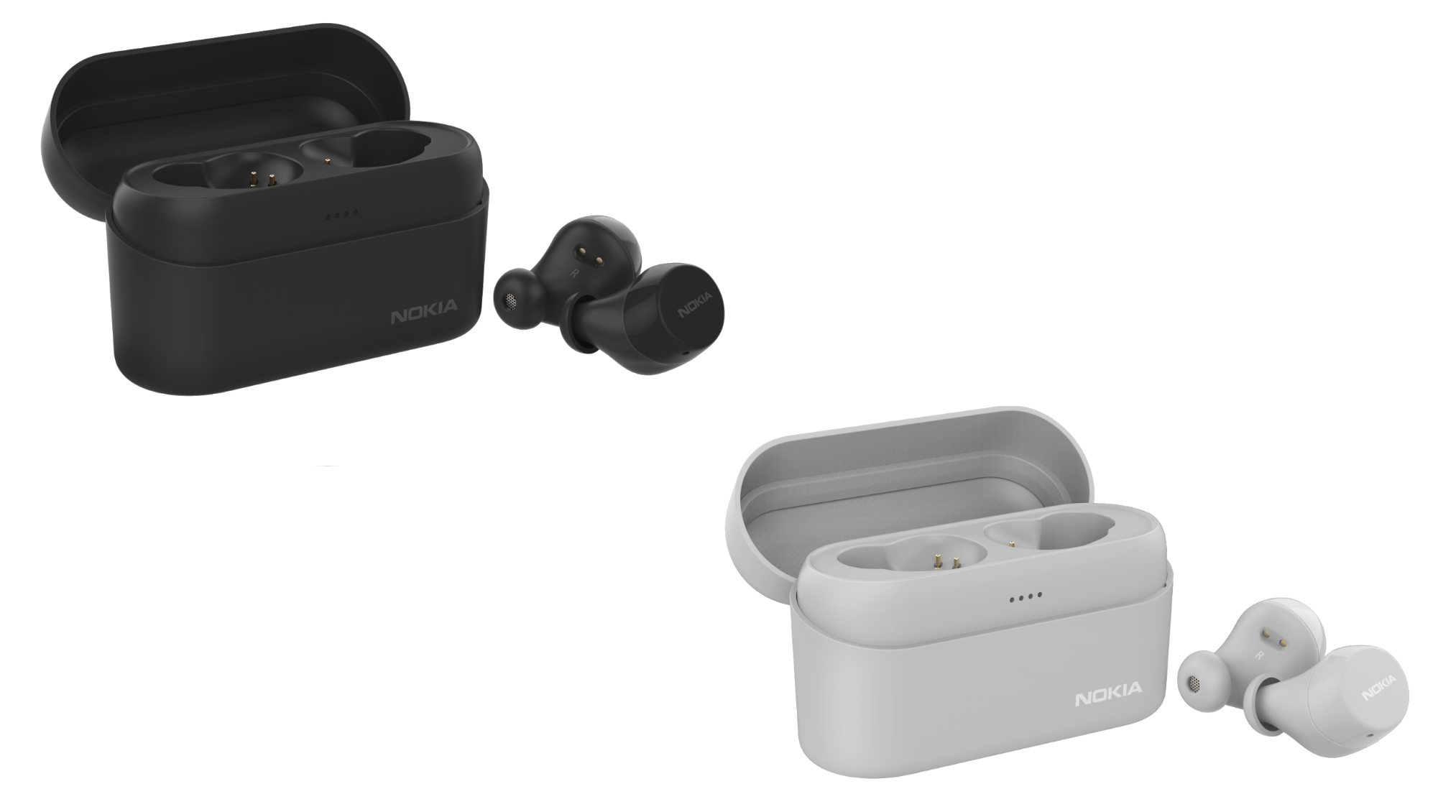
Alongside the slew of new phones from Nokia, HMD Global also had a few other surprise announcements up their sleeves for IFA 2019. Say hello to the Nokia Power Earbuds, a pair of true wireless earbuds from the company that promise amazing battery life, water resistance and lightweight designs.
Each earbud packs 6mm graphene drivers. They’re Bluetooth 5.0 compatible and offer easy access to your phone’s voice assistant. On top of this, they’ve also got touch controls for your controlling music or volume. They’re even IPX7 rated and can survive in 1 m of water for up to 30 minutes, which is fairly important for a tiny pair of earbuds like these.
Each earbud packs 50 mAh battery and offers up to 5 hours of usage. The charging case comes with 3000mAh battery that Nokia claims can charge the buds 30 times in total, and each charge giving you around five hours of playback time. So all in all you get 150 hours of life from a single charge. It’s also really nice that the case uses USB-C for charging.
The Nokia Power Earbuds come in two colour options, those being Charcoal Black and Light Grey. They’re priced at €79 ($88) and will go on sale from October. We haven’t gotten an official sale date, or even a list of countries where the earbuds will go on sale, though we’re pretty sure it’ll come to most countries that offer Nokia devices.
Vivo is expanding its Z-series lineup in India. In July, it launched the Vivo Z1 Pro phone and now it has unveiled the feature-rich Vivo Z1X phone. The USP of the phone is that it is equipped with AI 48-megapixel triple rear cameras and a 4,500mAh battery with fast charging support.
Checkout the Vivo Z1X launch story to known all about its specifications. The pricing and availability of the Vivo Z1X is India is as follows.
Vivo Z1X Phantom Purple
India has received the Vivo Z1X in two models like:
6 GB RAM + 64 GB storage – Rs. 16,990 (~$238)
6 GB RAM + 128 GB storage – Rs. 18,990 (~$265)
The first sale of the Vivo Z1X is scheduled to take place at 12 PM on Sept. 19. Buyers can visit Vivo India’s online store or Flipkart to purchase the phone. Users can choose from two color options such as Fusion Blue and Phantom Purple.
The Vivo Z1X smartphone has a 6.38-inch S-AMOLED display with waterdrop notch. It supports full HD+ resolution, 19.5:9 aspect ration and is integrated with an in-screen fingerprint reader. The Sony IMX582 48-megapixel + 8-megapixel + 2-megapixel triple camera system and 32-megapixel selfie snapper are available for photography on the device. The Snapdragon 712 SoC fuels the phone and it is backed by a 4,500mAh battery that supports 22.5W FlashCharge technology from Vivo.
We use cookies on our website to give you the most relevant experience by remembering your preferences and repeat visits. By clicking “Accept”, you consent to the use of ALL the cookies.
This website uses cookies to improve your experience while you navigate through the website. Out of these, the cookies that are categorized as necessary are stored on your browser as they are essential for the working of basic functionalities of the website. We also use third-party cookies that help us analyze and understand how you use this website. These cookies will be stored in your browser only with your consent. You also have the option to opt-out of these cookies. But opting out of some of these cookies may affect your browsing experience.
Necessary cookies are absolutely essential for the website to function properly. This category only includes cookies that ensures basic functionalities and security features of the website. These cookies do not store any personal information.
Any cookies that may not be particularly necessary for the website to function and is used specifically to collect user personal data via analytics, ads, other embedded contents are termed as non-necessary cookies. It is mandatory to procure user consent prior to running these cookies on your website.





 While you’d normally expect a feature-rich electric scooter to set you back a pretty penny, the KUGOO ES2 Folding Electric Scooter can now be yours for just $439.99 through GeekBuying. This is a noteworthy 24 percent reduction in the EV’s original asking price of $582.18.