At this price, it competes with the most value-for-money tablet on the market — Xiaomi Pad 6.
If you feel like Xiaomi’s offering is a bit more expensive, there’s a cheaper alternative in the form of Samsung Galaxy Tab S6 Lite 2024. There’s also Lenovo Tab P12 which costs about the same.
These three competitors are offered by brands that have a better presence in India than Honor. So you can theoretically expect a better after-sales experience from these products.
So the question arises whether the Honor Pad 9 is worth buying in India. Let’s find out.
1. Honor Pad 9 is one of the few large-screen tablets
Lenovo Tab P12
There aren’t many tablets with a huge display on the market, especially in the budget range. The Honor Pad 9 is one of those rare specimens.
It sports a 12.1-inch LCD panel. This screen offers a resolution of 2560 x 1600 pixels. The display not only supports 10-bit color depth but also up to a 120Hz refresh rate and 500 nits peak brightness level.
There’s only one such large-screen tablet in this price segment. That product is Lenovo Tab P12 (review), which retails at ₹25,999.
Lenovo’s offering comes with an even larger 12.7-inch LCD screen with a higher resolution (2944 x 1840 pixels). But the refresh rate is limited to 60Hz and the peak brightness level is lower at 400 nits.
So if a large display is your priority, there’s no better option than Honor Pad 9 in its segment.
2. Honor Pad 9 ships with a useful accessory
Samsung Galaxy Tab S6 Lite 2024
Unlike most tablets, the Honor Pad 9 comes bundled with a first-party accessory. To be precise, it ships with a Bluetooth keyboard.
This official accessory converts the tablet into a productivity machine. It also acts as a protective case.
Though other tablets in the segment also have first-party accessories, they need to be purchased separately. This increases the overall price of the product.
However, if you are more of a stylus person, you may want to consider aforementioned Lenovo Tab P12 or Samsung Galaxy Tab S6 Lite 2024. The latter offers an overall better stylus experience.
The Samsung product is yet to be released in India but when it does, it will cost about the same as Honor Pad 9. The 2022 edition of Galaxy Tab S6 Lite is currently up for grabs at a cheaper price, however, we recommend you get the latest model.
3. Honor Pad 9 faces stiff competition
Xiaomi Pad 6
Anyhoo, the biggest competitor for Honor Pad 9 or any other tablet in this segment is the Xiaomi Pad 6. It continues to be the best value in the Android space even after a year.
The device is not only powered by a flagship Qualcomm Snapdragon 870 chip but also boots feature-rich HyperOS software. Thus, it will age better compared to other tablets in the segment.
It is costlier than the Honor Pad 9 at ₹25,999. Additionally, you will have to spend extra for the stylus and keyboard accessories.
But if you can afford the price difference, there’s no better Android tablet in this segment.
Xiaomi continues to roll out HyperOS updates to more devices. In our previous article, we shared with you the arrival of HyperOS on Xiaomi 11T Pro, and now Xiaomi is rolling out the HyperOS update to POCO F4 with the OS 1.0.1.0.ULMMIXM update. More phones will be getting Xiaomi’s HyperOS update is great news since their recent software updates have made things run really well.
Xiaomi’s recent changes offer a smooth experience. MIUI has always been among the Android interfaces with abundant customization options. HyperOS enhances this further by adding various customization options such as improved homescreen and widget animations, and various lockscreen styles.
HyperOS for POCO F4 has been released (POCO Tester Release)
POCO F4 was already running on MIUI 14 based on Android 13, which is the latest MIUI version before the introduction of HyperOS. With the OS 1.0.1.0.ULMMIXM update, POCO F4 will now have HyperOS based on Android 14. If you don’t see the update on your phone yet, please allow some time for it to be released in more regions. Also, please note that only users registered on Mi Pilot will receive this update. Public releases will be available at a later time.
POCO F4 – OS 1.0.1.0.ULMMIXM update
The new HyperOS update for the POCO F4 is approximately 5GB in size and comes with the April 2024 security patch. The new HyperOS update was initially made available on global devices, which can be identified by the “MI” abbreviation in the update’s version number.
POCO F4 was introduced two years ago in June, and we can say that the phone still holds up very well in 2024. The device is powered by the Snapdragon 870 chipset, which is still powerful enough for many tasks however it’s worth noting that the device debuted with Android 12, and the Android 14 update marks the final Android upgrade for the POCO F4.
Samsung is expected to unveil several new products at its upcoming Unpacked event, rumored on July 10. Among the expected releases is the Galaxy Watch 7, which, as per earlier reports, will come in three different versions.
A recent report from AndroidHeadlines sheds more light on Samsung’s upcoming wearables. It seems that there will be two models in the Galax Watch 7 series, much like the Galaxy 6 lineup: the standard Galaxy Watch 7 and the Watch 7 Classic.
However, Samsung might introduce a completely new Ultra lineup, with its debut product being the Galaxy Watch Ultra.
The new smartwatch has been spotted by folks over at AndroidHeadlines with its name on a certification database, confirming its existence. It seems Samsung may be following in Apple’s footsteps by introducing an “Ultra” variant alongside its main series.
The Galaxy Watch Ultra has been sighted in three distinct models: SM-L705U for the US, SM-L705N for Korea, and SM-L705F for the global market.
However, apart from these details, not much else has been revealed about Samsung’s upcoming smartwatches.
Earlier reports suggest that Samsung is upping the ante by doubling the internal storage of the Galaxy Watch 7 to 32GB, a significant improvement over the 16GB found in previous models.
The increase in storage capacity will give users more room to download apps, watch faces, and store offline music playlists.
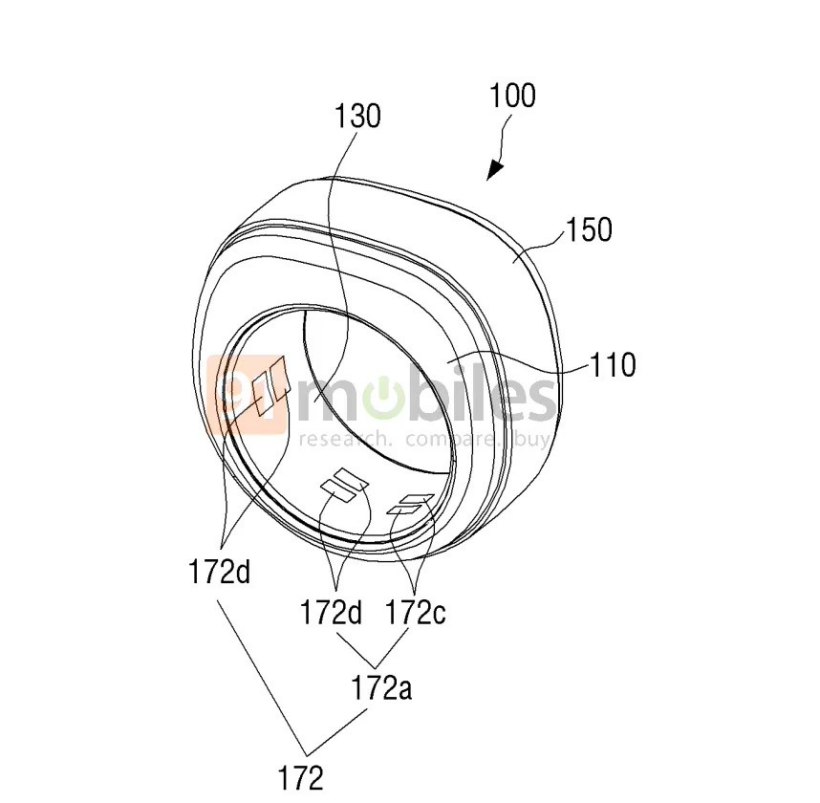
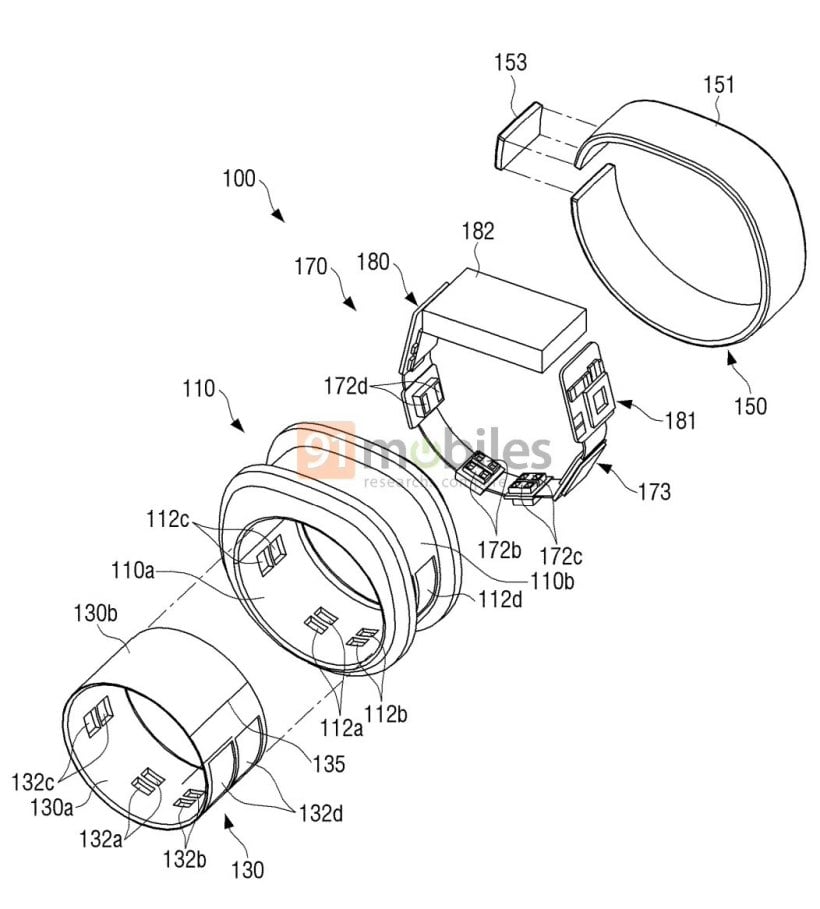
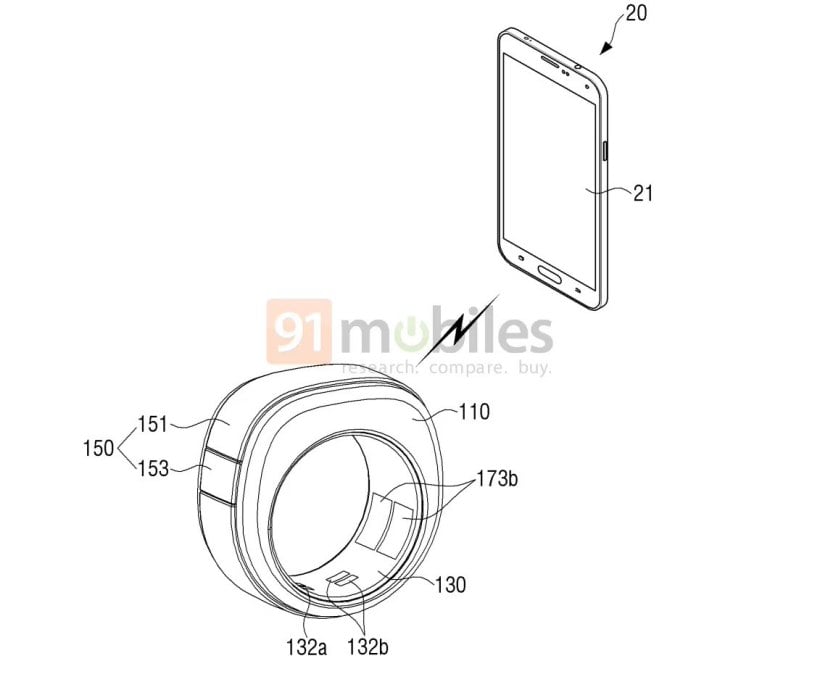
Additionally, it’s expected that the Galaxy Watch 7 series will run on Wear OS 5 based on Android 14. Alongside the smartwatches, Samsung is rumored to unveil its new foldable phone, the Galaxy Ring, and the Galaxy Buds 3 at the July 2024 Unpacked event.
Motorola‘s next gen foldable smartphone could be arriving in India soon. The new flip phone from the company could be dubbed the Moto Razr 50 Ultra and it appears that its Indian release could be near. So here’s what we know so far.
Moto Razr 50 Ultra India launch near?
Back in January 2024, the company announced the Moto Razr 40 Ulta in a new Peach Fuzz color option in the Indian market. Now, it appears that the successor is already in the works and could be arriving in the region soon. The Moto Razr 50 Ultra was spotted on the Bureau of Indian Standard certification. It was spotted carrying the XT2453-1 model number.
Unfortunately, the BIS certification did not reveal any finer details like the specs and design of the upcoming flip phone. However, it does hint that the Indian release isn’t too far away. Based on what we know so far, the Razr 50 Ultra will likely offer a design similar to the Razr 40 Ultra. It will likely feature Qualcomm’s Snapdragon 8 Gen series processor. To recall, the Razr 40 Ultra came with the Snapdragon 8+ Gen 1 SoC.
The Razr 40 Ultra sports a tall 6.9-inch LTPO OLED primary display as well as a 3.6-inch cover screen. The rear packs a 12-megapixel + 13-megapixel dual camera setup on the rear, while the front offers a 32-megapixel selfie shooter. A 3,800mAh battery pack powered this device, which supports 30W wired fast charging and 5W wireless charging. So, we can expect upgrades in terms of battery, processor, and possibly the cameras as well. This is just speculation at the moment so take this report with a pinch of salt for now and stick around for more updates.
Xiaomi‘s entry into the electric car market has been surprisingly popular among Apple users. Despite being a newcomer in the space, the Xiaomi SU7 has captured a remarkable 51.9% of lock-in orders from Apple users.
During the Beijing Auto Show, CEO Lei Jun mentioned that Apple users are among the primary buyers of Xiaomi EVs.
While Apple had reportedly shelved its decade-long car project, Xiaomi, only three years into its EV journey, has already rolled out its first EVs to an enthusiastic reception.
The appeal of the Xiaomi SU7 to Apple users might be due to its compatibility with Apple services like CarPlay. Moreover, the SU7 supports iPad integration in the car, enabling partial vehicle control from the rear seat.
Lei Jun emphasized in a tweet “We’re committed to making Xiaomi SU7 the most Apple-friendly EV available – the perfect choice for iPhone and iPad users.”
Apple users have shown remarkable interest, with 51.9% lock-in orders coming from them. With support for CarPlay and iPad, we're committed to making Xiaomi SU7 the most Apple-friendly EV available – the perfect choice for iPhone and iPad users.
During the Beijing Auto Show, the CEO also shared some other details about the Xiaomi SU7:
Strong Demand and Initial Deliveries
As of April 24, 2024, Xiaomi SU7 has received over 75,000 lock-in orders.
Xiaomi has successfully delivered over 5,781 units within 28 days of launch, setting a new record for a new brand.
Xiaomi attributes this success to the SU7’s product strength and the company’s extensive experience in manufacturing.
Positive Reviews and User Base
The SU7 has garnered praise for its battery life, performance (including a lap time on the Zhejiang Circuit surpassing some luxury cars), smart features (especially smart parking and NOA driver assistance), and sun protection capabilities.
Notably, Xiaomi reports a high number of female buyers (around 40-50%) attracted by the car’s design, storage space, and heat insulation.
Interestingly, a significant portion of buyers (29%) are former BBA (Mercedes-Benz, BMW, Audi) users impressed by Xiaomi’s technology.
Apple users account for over half of SU7 buyers, possibly due to Xiaomi’s focus on compatibility with Apple devices.
2024 Plans and Ambitions
To meet demand, Xiaomi is accelerating production and aims to deliver 100,000 units by the end of 2024.
They plan to open 219 stores across China to improve service and delivery speed.
Software updates are planned, including the introduction of end-to-end valet parking, and city NOA functionality in May and August, respectively.
Xiaomi is demonstrably invested in R&D, with a team of over 6,000 including 3,500 in R&D and over 1,000 technical experts.
Their long-term goal is to become a top 5 global automaker within 15-20 years, and they are actively recruiting talent to achieve this.
The Oppo Find X7 was recently spotted with an all White makeover in China. Our report covered leaked hands-on images of the white Find X7. Now, the new color variant of the flagship device has officially been announced in the region. So let’s check it out.
Oppo Find X7 now available in White
The Chinese brand’s Find X7 series was first announced earlier this year. These models arrived as the company’s latest premium grade smartphones. The base Find X7 was released in multiple color options, namely Black, Purple, Dessert Silver, and Sea & Sky. This model is now getting a fresh White color option in the Chinese market and will be sold alongside the existing color variants.
Oppo Find X7 sports a tall 6.78-inch curved OLED display that offers a 1.5K resolution and a 120Hz refresh rate. The high end device is equipped with the MediaTek Dimensity 8300 SoC that is paired with up to 16GB of RAM and 1TB of internal storage. Under the hood, a large 5,000mAh battery pack powers this device, which supports 100W wired fast charging.
For optics, the rear features a triple camera setup that consists of a 50-megapixel primary, 50-megapixel ultra wide angle, and a 64-megapixel periscope telephoto shooter. Meanwhile, the front sports a 32-megapixel selfie shooter. Apart from the new colors, there is no other difference in terms of design, specs, or pricing. It starts from 3,999 Yuan (roughly 552 US Dollars) for the 12GB + 256GB variant.
Samsung hasn’t confirmed it yet, but a fresh leak from SamMobile suggests that the next Galaxy Unpacked event might happen on Wednesday, July 10th, 2024, in Paris, France.
The timing lines up neatly with the 2024 Summer Olympics, also taking place in Paris from July 26th onwards. Being a major sponsor, Samsung can leverage this strategic location to showcase its new foldable phones and wearables on a global stage.
One of the most anticipated devices at the event is the Galaxy Ring. It marks Samsung’s debut in a new health and fitness wearable category. Although its specifics are scarce, we’ll probably see its debut at upcoming Unpacked events.
For fans of foldable technology, the event is expected to reveal the successors of the Galaxy Z Fold 5 and Z Flip 5.
The Z Flip 6 might not see many design changes, focusing more on internal improvements. However, rumors suggest that the Z Fold 6 will feature a wider display and a slimmer, lighter build.
There’s even chatter about a premium version, the Galaxy Z Fold 6 Ultra, which could also make its debut at Unpacked.
Another possible reveal could be the Galaxy Watch 7 which is now rumored to come in three variants, unlike the Galaxy Watch 6 which has two models. Additionally, we might see new additions to the Galaxy Buds lineup.
While Samsung hasn’t spilled the beans yet, the leak offers a pretty good glimpse of what to expect at the upcoming Galaxy Unpacked event. We’ll be sure to keep you updated on any new announcements regarding these devices.
Realme has just announced a new budget smartphone. The new Realme C65 5G is an affordable device but packs some decent specs that makes it a great deal for its price point. So here are all the details like its specs, pricing, and more.
Realme C65 5G Specs
The Chinese brand sports a tall 6.67-inch display that offers HD+ resolution, 120Hz refresh rate, 240Hz touch sampling rate, and 625 nits of peak brightness. Under the hood, it is equipped with the MediaTek Dimensity 6300 SoC that is paired with up to 6GB of RAM and 128GB of internal storage. You can even expand this storage by up to 2TB via a microSD card. A large 5,000mAh battery pack powers this device, which supports 15W wired fast charging.
The rear packs a 50-megapixel Samsung JNI primary camera on the rear, while the front packs an 8-megapixel selfie shooter. It runs on the Android 14 OS based Realme UI 5 custom skin out of the box. Other notable features include an ultra slim 7.89mm body, 3.5mm headphone jack, IP54 water and dust resistance rating, Bluetooth 5.3, and a side mounted fingerprint scanner. It is worth noting that this is different from the 4G C65 model that launched in Vietnam earlier this month.
Pricing and Availability
The Realme C65 5G has been announced in two color options, namely Feather Green and Glowing Black. It is also available in three storage configuration, which includes a 4GB + 64GB, 4GB + 128GB, and 6GB+128GB variant. The device has a starting price of 9,999 INR for the base model, while the other two versions cost 10,999 INR and 11,499 INR respectively. The company is even offering up to 1,000 INR discount on this model, which is set to go on sale later today at 4 PM IST via Flipkart and Realme.com.
Huawei Pura 70 series is now available in China with improved cameras, some generative AI features (such as the controversial object removal feature), and improved performance. A recent addition to the series makes it easier to find out the phone.
The feature is called the “floor-level detection” function (translated from Chinese which works in conjunction with the Huawei Cloud. It can accurately locate which floor the phone is on. The feature also works without an internet connection.
Notably, you will need to upgrade to the Huawei Cloud to version 15.0.0.300 or above to use this feature. You will need to turn on the phone tracking feature by going to Cloud Space inside the Huawei Account in the Settings app.
You can log in to your Huawei account from another Huawei device and visit the device search page in Huawei Cloud to use this feature. According to reports, this feature currently covers densely populated areas such as airports, stations, etc across more than 10,000 mainstream cities in the Country. The availability of the feature could be expanded further in the near future.
For those unfamiliar, the Pura 70 series comes in four different versions, the Pura 70, Pura 70 Pro, Pura 70 Pro+, and the Pura 70 Ultra. The top variant offers a retractable zoom lens, which is rare in mainstream smartphones. Huawei names it a “super-concentrated macro telephoto” camera which offers 3.5X optical zoom with a focal length of 90mm. You can learn more about the mechanism of this retractable camera of the Pura 70 Ultra here.
Realme has introduced a new addition to its charging lineup – the SUPERVOOC 240W charger. The adapter comes packed with features and works with a wide range of devices. So let’s dive into its specs and features here.
Realme SUPERVOOC 240W Charger Specifications:
The charger sports a classic white design with a sleek form factor. It measures 57.82mm x 57.94mm x 30.39mm and weighs 173 grams. Its body combines a matte and glossy finish, divided by a section in the middle.
For user convenience, there’s a small concave area on both the front and back of the charger. However, keep in mind that the input end comes with fixed standard pins, so it can’t be folded for travel.
The key highlight of this charger is the use of a dual GaN (Gallium Nitride). The technology allows for a power density of 2.34W/cc, contributing to a smaller and more compact charger size while maintaining its power.
Safety is also a priority as the SUPERVOOC 240W charger has received TUV Rheinland Safe Fast Charge certification.
Realme’s new adapter excels in versatility too. It’s backward compatible with all devices supporting Realme’s SuperVOOC protocol, allowing it to charge a wide range of Realme phones equipped with SuperVOOC technology.
Moreover, it supports various fast charging protocols, including QC 3.0, VOOC, SuperVOOC, PD3.0 (up to 65W), and even Realme’s own SVOOC 240W.
All in all, the Realme SUPERVOOC 240W charging headset offers a combination of impressive charging speeds, a compact design, and broad compatibility with various fast charging standards.
Price and Availability
You can purchase the Realme SUPERVOOC 240W charging headset on JD.com, a major Chinese e-commerce platform, for 299 yuan (approximately $42 USD). That price makes it an appealing option for users seeking both fast charging speeds and affordability.
Nothing has just launched two new hearables, namely Nothing Ear and Ear (a) in markets like the US, Europe, and India. The brand’s next major announcement is likely to be the Nothing Phone (3). The name suggests that it could be a flagship offering similar to the Snapdragon 8+ Gen 1-powered Nothing Phone (2), which made its announcement in July 2023. Here is a look at what to expect from the Phone (3).
A recent report claimed that the Nothing Phone (3) will feature the Snapdragon 8s Gen 3 chipset. It is a relatively new chipset and only a few phones featuring it, such as the Xiaomi Civi 4 Pro, the Redmi Turbo 3, and the iQOO Z9 Turbo, have been launched in China.
The Redmi Turbo 3 is likely to be rebranded as the Poco F6 in India. There is a possibility that the Z9 Turbo may make it to the Indian market with a different branding. Hence, there is a possibility that the Nothing Phone (3) may rival these phones in India and some other markets. Unfortunately, the other specs of the Phone (3) haven’t surfaced yet.
2. Price
The Nothing Phone (3) is rumored to be priced between Rs 40,000 (~$480) and Rs 45,000 (~$540) in India. To recall, the Phone (2) was announced with a starting price of Rs 44,999 (~$540) last year.
3. Launch timeframe
The announcement of the Nothing Phone (2) in July 2023 raises the possibility that the Phone (3) will make its debut around the same time this year. Notably, this year has seen a trend in which phone successors from the previous year launched approximately a month earlier. Therefore, there is a possibility that the Phone (3) could arrive by the end of Q2 this year.
4. CMF by Nothing’s First Smartphone in Works
CMF, Nothing’s sub-brand that offers affordable devices with a focus on color, material, and finish, is said to be working on its first smartphone. The device is said to have an “A015” model number and “Tetris” codename. India seems to be one of the markets to receive the device as it was recently approved by India’s BIS certification platform.
Vivo X100 Ultra flagship phone is expected to launch in May in China. The 3C authority in China has reportedly approved the device ahead of its launch. At the same time, the alleged S19 Pro has surfaced in 3C’s database. Here is a look at the details that have emerged from these phones’ certifications.
Vivo X100 Ultra
Vivo S19 series, Vivo X100s Ultra 3Ccertified
According to reports, the upcoming Vivo X100 Ultra has the V2366GA and V2366HA model numbers for the Chinese market. The “GA” variant is a 5G phone, while the “HA” model reportedly supports satellite connectivity. The 3C authority has approved the 5G variant of the X100 Ultra, as seen above. It reveals that the device may ship with 80W charging. It appears that the satellite connectivity variant may also receive 3C certification in the coming days.
Reports have claimed that the Vivo X100 Ultra will have the Snapdragon 8 Gen 3 chipset and a 6.78-inch Samsung AMOLED E7 2K 120Hz display onboard. According to reports, the phone’s rear camera setup includes a 50-megapixel LYT-900 main camera, a 50-megapixel ultra-wide lens, a 50-megapixel telephoto camera, and a 200-megapixel periscope telephoto camera that supports 4.3x optical zoom and 200x digital zoom. It is also expected to offer 50W wireless charging.
The Vivo X100 Ultra is expected to launch with the Dimensity 9300+ powered Vivo X100s and X100s Pro in May in China. It is also being said that the device will be called the Vivo X100s Ultra instead of X100 Ultra.
Vivo S19 series
The image above confirms the 3C’s approval of the V2364A and V2362A Vivo phones. According to reports, China will receive these devices as the Vivo S19 and Vivo S19 Pro, respectively. At present, there is no concrete information on the specifications of both phones. It is speculated that the S19 and S19 Pro, along with the S19e, will be unveiled in June.
Huawei is already embroiled in another controversy, this time, with regards to its new Huawei Pura 70 smartphone.
The Pura 70 series (our hands on here) boasts an AI-powered object removal function, designed to make photo editing seamless. Yet, this feature has sparked controversy and concern among users. Disgruntled customers took to Weibo, a popular Chinese social media platform, to demonstrate a worrying flaw: the AI’s ability to inadvertently remove parts of clothing from images with just a tap.
Videos posted by users show how easily clothing can be edited out, raising alarms over the potential for misuse. Such capabilities could lead to privacy invasions and the sharing of inappropriate content without consent, highlighting serious ethical and privacy issues.
We actually tried to recreate this in our unit and it was worrying to see the feature in action. We hope Huawei fixes this very soon.
Meizu has unveiled a new set of earbuds that take their design cues from the Zhuhai Grand Theatre in China. The charging compartment resembles a seashell, cradling the ear hooks that connect like “golden pearls.”
The entire headset weighs just 86 grams and is 23mm thick. Skin-friendly silicone ear hooks with inner titanium wires ensure a comfortable and secure fit.
Casio has launched a new limited-edition watch made of recycled waste, called the ‘Back to G-SHOCK’ G-5600BG-1. The watch was launched as part of its Earth Day celebration and to honor its anniversary on April 12.
The watch includes resin scraps from other Casio products. It also features Tough Solar technology that turns any light source into power and keeps its charge well.
Human Mobile Devices (HMD) Global, the company known for Nokia-branded Android phones, just unveiled new smartphones in its Pulse series. While these phones are aimed at a global audience, HMD also introduced a specific model for the US market, called the HMD Vibe.
Back in October, Qualcomm introduced the Snapdragon X Elite chip that aims to compete with Apple Silicon. Yesterday, the company introduced another offering from the Snapdragon X lineup, the Snapdragon X Plus.
Just as the naming suggests, it’s a more affordable and slightly less capable version of the Snapdragon X Elite. Both the chips are expected to become available to power Windows-on-Arm laptops in mid-2024.
Samsung is reportedly planning to release the first-ever foldable “Ultra” device, the Galaxy Z Fold 6 Ultra. This follows the successful “Ultra” line introduced with the Galaxy S series. Specific Z Fold 6 Ultra details are under wraps, but rumors suggest the standard Z Fold 6 might retain the familiar triple-camera system and get a slimmer, lighter design. An S Pen slot similar to the S24 Ultra is also a possibility.
The battle between iOS and Android rages on. While Apple releases new iPhone models annually, manufacturers like Samsung, Xiaomi, and Oppo relentlessly pursue increased market share. This has been going on for a while, but the tide seems to be turning.
A recent report indicates iPhone activation market share has hit a new low, with Android dominating the landscape.
OPPO Find X7 was already introduced together with OPPO Find X7 Ultra on January 12th. OPPO introduced the Find X7 in purple, brown, blue, and black colors initially, and it appears that in addition to these color options, OPPO will also offer the white edition.
Oppo has launched its latest budget offering, the Oppo A60, in Vietnam. The device is now listed on Oppo Vietnam’s website. The new A-series lineup phone was previously spotted across various certification and benchmark listings, indicating its imminent arrival. Here is a look at the specifications, features, and price of the A60.
Oppo A60 specifications and features
OPPO A60
The Oppo A60 comes with a 6.67-inch IPS LCD screen featuring an HD+ resolution of 1604 x 720 pixels, a refresh rate of 90 Hz, and a peak brightness of 950 nits. The device incorporates a side-facing fingerprint scanner for security.
The A60t features a 6nm-built Snapdragon 680 4G chipset and 8 GB of LPDDR4x RAM. Storage options include 128 GB and 25 6GB variants, with expandable storage of up to 1TB via the microSD card slot. The device packs a 5,000mAh battery with support for 45W SuperVOOC fast charging.
Oppo A60 display
On the imaging front, the Oppo A60 sports a dual-camera setup with a 50-megapixel primary sensor and a 2-megapixel secondary lens. The device features an 8-megapixel front camera for selfies.
The Oppo A60 features an all-plastic build in blue and purple color options, measuring 7.68mm thick and weighing 186 grams. The device offers an IP54 rating for dust and water resistance. Additionally, it offers stereo audio via a dual speaker setup and includes a 3.5mm audio jack for wired earphones. It comes preloaded with ColorOS 14, based on Android 14.
Oppo A60 price and availability
OPPO A60
The Oppo A60 (official listing) has arrived in the Vietnamese market in two options, such as 8 GB RAM + 128 GB storage and 8 GB RAM + 256 GB storage. These variants are priced at 5,490,000 VND (~$216) and 6,490,000 VND (~$256), respectively. The phone can be purchased in two colors, such as Blue Purple and Blue.
After recently launching the Honor 200 Lite 5G smartphone in France, the brand has now debuted a new tablet in its home market of China called the Honor Pad 9 Pro. This launch comes about two months after the brand unveiled the Honor Pad 9 at MWC 2024.
The Honor 9 Pro tablet features a 12.1-inch TFT LCD display with a resolution of 2560 x 1600 and 144Hz refresh rate. The display also offers 1.07 billion colors, covering the entire DCI-P3 color gamut.
Under the hood, it has a MediaTek Dimensity 8100 chipset, with options of up to 12GB of RAM and 256GB of storage. The tablet operates on MagicOS 8.0 based on Android 14 and features a 10050mAh battery with support for 35W fast charging. The tablet has 4 speakers and 4 tweeters for audio.
For optics, the tablet has a 13MP rear camera and a 5MP front camera. The tablet has a thickness of 6.64mm and a weight of about 589 grams. As for connectivity, the tablet offers Wi-Fi 6, Bluetooth 5.2, 5G capabilities, and a Type-C port.
Pricing & availability
The tablet is available in two colors: Starry Gray and Sky Blue. The pricing is set at 2199 Yuan ($303) for the 8GB/256GB version and 2499 Yuan ($345) for the 12GB/256GB version.
itel has launched its new T11 Pro TWS in India. It is the successor of the itel T11. One of the highlights of this TWS earphone is its “360° Super Bass Technology”. An instant pop-up pairing also works for this TWS with the brand’s 4G non-Go version phones. Let’s take a look at the specifications, pricing, and availability of this wireless earphone.
itel T11 Pro TWS
itel T11 Pro Specifications and features
This TWS comes in two different colors – Aurora Blue and Ashy Green. Inside, it boasts a 13mm large drive that meets the requirement of itel’s “360° Super Bass Technology”. The earphone reportedly boasts an optimized DSP to improve the bass. It should offer an immersive audio experience both in music and gaming. Speaking of gaming, the itel T11 Pro also offers a 45ms low latency for lag-free listening in gaming.
It equips 40mAh batteries inside both of the earbuds and a 500mAh battery inside the charging case. With this capacity, the product offers a 42-hour battery life (including a charging case) along with support for fast charging through Type-C. The earbuds offer 120 minutes of playback with just 10 minutes of charge.
The T11 Pro also equips a total of four mics for ENC (Environmental Noise Cancellation) in calls. However, no specific data about the capability of noise cancellation (during calls) has been shared. It also offers an IPX5 dust and water resistance rating, which can protect from sweat and light water splash.
Driver: 13mm, with support for 360° Super Bass Technology
Connectivity: Bluetooth 5.3
Battery life: 42 hours (including charging case)
Noise cancellation: ENC for calling
Pricing and availability
The itel T11 Pro TWS is priced at 1,299 in India. The product will be available for purchase from today in the country. Additionally, itel notes that it will be available in 50+ countries.
There has been a significant breakthrough in laser technology! Chinese scientists have unveiled the world’s thinnest optical crystal, a key component for lasers. This revolutionary material is a rhombohedral boron nitride crystal, just micrometers thick, and boasts dramatically improved efficiency. Lasers play a crucial role in various fields like micro-nano processing, healthcare, and quantum technologies. Their miniaturization is a key development goal.
The research team used lightweight boron nitride as the base material
The research team at Peking University achieved this breakthrough by using a novel “corner phase matching theory” and lightweight boron nitride as the base material. This “corner rhombohedral boron nitride” crystal exhibits an energy efficiency increase of at least 100 times compared to traditional crystals of similar thickness.
The ultra-thin crystal achieves a remarkable 8% efficiency in optical frequency doubling conversion across a wide range of spectrums, making it 100 to 10,000 times more efficient than conventional crystals at the same size.
This innovation goes beyond efficiency gains. Corner phase matching grants boron nitride crystals the ability to control the polarization of light, paving the way for a new generation of lasers with extreme wavelengths, sizes, and stability.
Professor Liu Kaihui, part of the research team, predicts this technology could miniaturize lasers to the micron level and potentially revive previously unsuitable materials for creating optical crystals. This discovery holds immense potential for the future of laser technology.
Gear up for some free games this week, courtesy of the Epic Games Store! Here’s what you can add to your library at no cost:
INDUSTRIA is a first-person shooter that takes you on a mind-bending trip. Set against the backdrop of the falling Berlin Wall, you find yourself inexplicably transported to a parallel universe while searching for a missing colleague. Explore a hauntingly beautiful world that blends the familiar Cold War-era East Berlin with a strange, industrial landscape. Brace yourself for a suspenseful narrative as you uncover the secrets of this mysterious place. Expect to encounter deadly enemies in every corner, so be prepared to defend yourself with a variety of weapons – there are four at your disposal. The unique soundtrack adds to the atmosphere, with a blend of synthesizers, acoustic instruments, and melancholic vocals that will stay with you long after you finish the game. With an estimated playtime of around 4 hours, INDUSTRIA offers a concise but impactful narrative experience.
LISA: The Definitive Edition – With this game, players will get to delve into the dark and twisted world of Olathe in this narrative-driven RPG. LISA: The Definitive Edition brings together both LISA: The Painful and its sequel, LISA: The Joyful, offering a complete story for new and returning players alike. Brace yourself for an emotional rollercoaster as you explore the harsh realities of Olathe and uncover the secrets buried beneath the surface. This isn’t your typical RPG – be prepared for a dark and mature story with plenty of tough choices to make.
Don’t forget to grab these free titles before they’re gone! And keep your eye out next week, because Orcs Must Die 3 will be the free game of choice, offering some tower defense action to your Epic Games library.
Two of the biggest names in the smartphone industry, Xiaomi and Apple, launched their current base flagship models last year, the Xiaomi 14 and the iPhone 15. Both phones boast impressive features, but which one reigns supreme? This deep dive explores their strengths, weaknesses, and what sets them apart.
The Xiaomi 14 boasts a slightly larger 6.36-inch C8 OLED panel compared to the iPhone 15’s 6.1-inch Super Retina XDR display. The iPhone 15 comes with a resolution of 2556×1179 while the Xiaomi 14 has a 2670×1200 resolution.
Both panels support HDR and True Tone, but the Xiaomi 14 takes the lead with a significantly higher peak brightness of 3000 nits, exceeding the iPhone 15’s 1600 nits. Additionally, the Xiaomi 14 offers a wider range of refresh rates, ranging from 1Hz to 120Hz, while the iPhone 15 remains fixed at 60Hz.
2. Design and Build
The Xiaomi 14 adopts a flat design with rounded corners, while the iPhone 15 retains its familiar curved edges. The Xiaomi 14 boasts an ultra-narrow body (71.5mm) for easier one-handed use, compared to the iPhone 15’s slightly wider frame. Both phones offer IP68 water and dust resistance, but the Xiaomi 14 introduces a unique Pink color with a high-tech nano leather material, offering a softer touch.
3. Performance
The Xiaomi 14 packs the latest Qualcomm Snapdragon 8 Gen 3 processor, promising top-notch performance. It offers RAM options ranging from 8GB to 16GB, paired with high-speed LPDDR5X memory. This combination ensures smooth multitasking and handling of demanding applications.
The iPhone 15, on the other hand, relies on Apple’s proprietary A16 Bionic chip with 6GB RAM. Apple‘s processors are known for their efficiency and raw power. So both phones deliver exceptional performance.
Storage options are similar, with both phones offering 128GB, 256GB, and 512GB variants. However, the Xiaomi 14 goes a step further with a 1TB option for those needing massive storage space.
4. Camera
Xiaomi 14 comes with a triple rear camera setup while the iPhone 15 features a dual camera setup. The Xiaomi 14 boasts a 50MP (OIS) main sensor with a larger 1/1.31″ size, potentially capturing more light and detail. It also offers a 50MP ultra-wide and a 50MP 3.2X telephoto camera, all utilizing Leica Summilux lenses.
The iPhone 15 features a 48MP main sensor with 2x telephoto and second-generation sensor-shift optical image stabilization, promising sharper, clearer images. It also includes a 12MP ultra-wide camera. Both phones offer 4K video recording capabilities, with the Xiaomi 14 even supporting 8K video recording.
5. Battery and Charging
The Xiaomi 14 packs a 4610mAh battery, much larger than the iPhone 15’s 3274mAh capacity. However, the iPhone 15 boasts a more efficient processor, potentially resulting in comparable battery life in daily usage.
The Xiaomi 14 shines in charging speed, offering 90W wired charging for a full charge in 31 minutes, compared to the iPhone 15’s 20W wired charging for a 50% charge in around 30 minutes.
Both phones offer wireless charging, with the Xiaomi 14 reaching 100% in 46 minutes with 50W charging and the iPhone 15 supporting 15W MagSafe wireless charging.
6. Operating System and Features
The Xiaomi 14 runs on the latest Android 14 with HyperOS on top, offering a lot of customization features. The iPhone 15 utilizes iOS 17, known for its intuitive interface and seamless integration with other Apple devices. It incorporates additional features like Face ID facial recognition and a second-generation Ultra Wideband chip while the Xiaomi 14 comes with an in-display fingerprint scanner. Both phones feature Dolby Atmos and USB Type-C.
7. Pricing
The Xiaomi 14 boasts a significantly lower starting price at $552 compared to the iPhone 15’s $799. This price difference is particularly noticeable for higher storage options, with the Xiaomi 14’s 16GB + 1TB model costing $690 compared to the iPhone 15’s 512GB option at $1099.
8. Conclusion
Choosing between the Xiaomi 14 and the iPhone 15 depends on your priorities. If you prioritize raw power, a larger display, and fast charging, the Xiaomi 14 is a compelling option. However, if you value a sleek design, a user-friendly interface, and seamless integration within the Apple ecosystem, the iPhone 15 might be the better choice. Ultimately, both phones offer premium features and impressive specs, making the decision a matter of individual preference and budget.
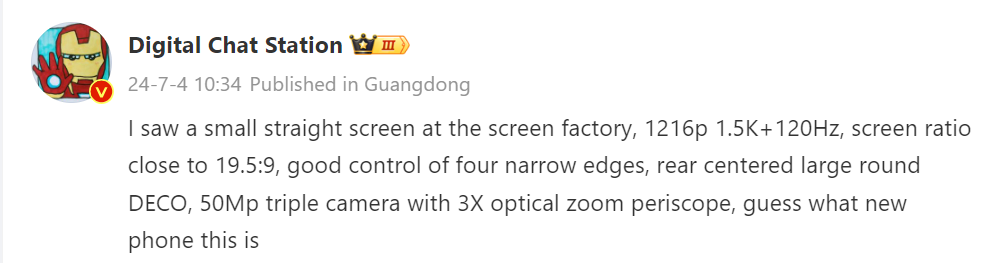
In June, Oppo may unveil the Reno 12 series of smartphones in China. The lineup is expected to face competition from the Vivo S19 series, the Honor 200 series, and the Huawei Nova 13 lineup. It was reported at the beginning of this week that the Reno 12 may arrive with a newer Dimensity 8300 chipset. Today, tipster Digital Chat Station released a new Weibo post to leak almost everything about the Reno 12.
Oppo Reno 12 specifications (rumored)
Reno 12 leak by DCS
DCS reports that the engineering prototype of the Oppo Reno 12 features the Dimensity 8200 chipset. The Reno 11, which debuted in November 2023, also packs the same D8200 chip.
The leak further reveals that the Reno 12’s engineering prototype has 16 GB of RAM, 512 GB of internal storage, and a 5,000mAh battery with 80W rapid charging support. The device will likely run on the ColorOS 14-based Android 14.
The Reno 12’s latest leak has no information about its front camera. However, it states that the rear camera setup will be headlined by a 50-megapixel camera with an f/1.8 aperture. It could feature a custom-made Sony lens as the primary snapper, according to a previous report. An 8-megapixel ultra-wide lens and a 50-megapixel telephoto camera with an f/2.0 aperture and 2x optical zoom support will join it.
The design of the Reno 12 will be one of the main highlights. DCS claims that it will sport a thin and lightweight design, featuring a micro-curvature display on the front. Previous leaks have claimed that the screen will support a 1.5K resolution and a 120Hz refresh rate. The device is also said to offer IP65-rated dust and water resistance.
We use cookies on our website to give you the most relevant experience by remembering your preferences and repeat visits. By clicking “Accept”, you consent to the use of ALL the cookies.
This website uses cookies to improve your experience while you navigate through the website. Out of these, the cookies that are categorized as necessary are stored on your browser as they are essential for the working of basic functionalities of the website. We also use third-party cookies that help us analyze and understand how you use this website. These cookies will be stored in your browser only with your consent. You also have the option to opt-out of these cookies. But opting out of some of these cookies may affect your browsing experience.
Necessary cookies are absolutely essential for the website to function properly. This category only includes cookies that ensures basic functionalities and security features of the website. These cookies do not store any personal information.
Any cookies that may not be particularly necessary for the website to function and is used specifically to collect user personal data via analytics, ads, other embedded contents are termed as non-necessary cookies. It is mandatory to procure user consent prior to running these cookies on your website.