
Add GIZMOCHINA as Preferred Source on Google
Android Go smartphones are the best way to get a decent device for a few bucks. Thanks to this Lite version of Google’s operating system, even device with outdated or extremely low-end hardware can run smooth enough to handle all the base tasks in a sufficient way. That is why it was very expectable that the new Redmi Go would have made a lot of success once in the market. But is it really the best Android Go alternative you can get in its price range or there are better ones? We will try to let you find out by comparing it with two recent Android Go devices which deserve attention: the Nokia 1 Plus by HMD Global and the Asus Zenfone Live L1.
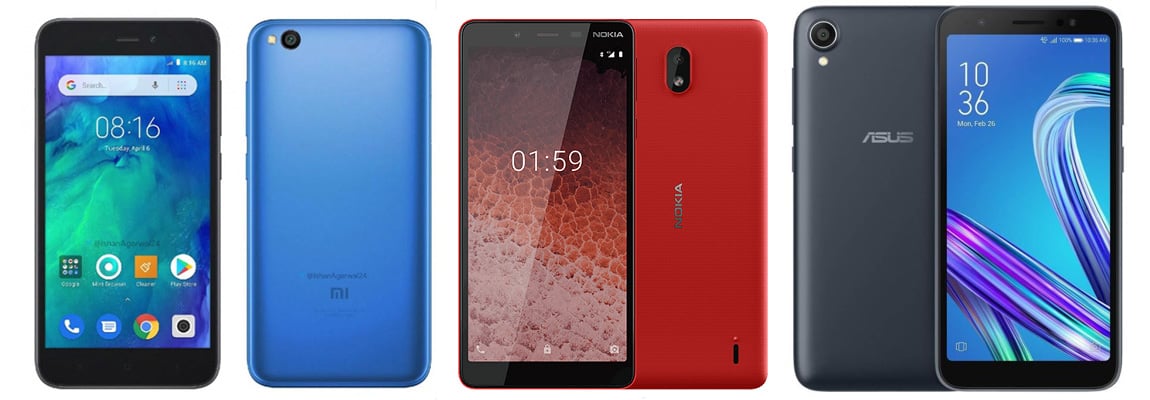
Redmi Go vs Nokia 1 Plus vs Asus Zenfone Live L1
| Xiaomi Redmi Go | Nokia 1 Plus | Asus Zenfone Live L1 | |
|---|---|---|---|
| DIMENSIONS AND WEIGHT | 140.4 x 70.1 x 8.4 mm, 137 grams | 145 x 70.4 x 8.6 mm | 147.3 x 71.8 x 8.2 mm, 140 grams |
| DISPLAY | 5 inches, 720 x 1280 pixels, 294 ppi, 16:9 ratio, LCD | 5.45 inches, 480 x 960p, 197 ppi, 18:9 ratio, IPS LCD | 5.5 inches, 720 x 1440 pixels, 293 ppi, 18:9 ratio, IPS LCD |
| PROCESSOR | Qualcomm Snapdragon 425, quad-core 1.4 GHz | MediaTek MT6739WW, quad-core 1.5 GHz | Qualcomm Snapdragon 425, quad-core 1.4 GHz |
| MEMORY | 1 GB RAM, 8 GB – micro SD dedicated slot | 1 GB RAM, 8 GB – 1 GB RAM, 16 GB – micro SD slot | 1 GB RAM, 16 GB – 2 GB RAM, 32 GB – micro SD dedicated slot |
| SOFTWARE | Android 8.1 Oreo, Android Go | Android 9 Pie, Android Go | Android 8 Oreo, Android Go |
| CONNECTIVITY | Wi-Fi 802.11 b/g/n, Bluetooth 4.1, GPS | Wi-Fi 802.11 a/b/g/n, Bluetooth 4.2, GPS | Wi-Fi 802.11 b/g/n, Bluetooth 4.0, GPS |
| CAMERA | 8 MP f/2.0 5 MP f/2.2 front camera |
8 MP 5 MP front camera |
13 MP f/2.0 5 MP f/2.4 front camera |
| BATTERY | 3000 mAh | 2500 mAh | 3000 mAh |
| ADDITIONAL FEATURES | Dual SIM slot | Hybrid Dual SIM slot | Dual SIM slot |
Design
Cheap materials are very common on affordable smartphones sold for less than €100, and these devices are not an exception. All of them come with a plastic body, with Xiaomi Redmi Go showing very thick bezels around the display due to the 16:9 aspect ratio. In terms of aesthetics, Nokia 1 Plus and Asus Zenfone Live L1 are definitely better and I would personally go for the former because it is slightly more compact than its Taiwanese rival. You can get more color choices with the latter, so make sure to check them out before deciding.
Display
If you are looking for the most detailed and satisfying display, then you should exclude the Nokia 1 Plus immediately due to its below-HD resolution. Fortunately, both Xiaomi Redmi Go and Asus Zenfone come with an HD display, but Redmi Go has an outdated 16:9 panel, while Asus Zenfone Live L1 comes with a taller 18:9 display which boasts narrower bezels. Further, the display is wider. That is why Asus Zenfone Live L1 wins the display comparison.
Specs
Asus Zenfone Live L1 is the most powerful phone here due to its higher-end memory configurations. It comes with up to 2 GB of RAM while Xiaomi Redmi Go and Nokia 1 Plus stop at just 1 GB. The internal storage goes up to 32 GB (furtherly expandable with a micro SD), while you get max 16 GB for the Nokia 1 Plus and just 8 GB for Xiaomi Redmi Go. Note that Nokia 1 Plus is the only one based on Android Pie, so it should come with better software optimization. However, its lower-end chipset and its low amount of RAM do not push it at the same level as the Zenfone Live L1. Nokia 1 Plus has better Wi-Fi connectivity as well as a more advanced Bluetooth version.
Camera
Again, the victory goes to the Asus Zenfone Live L1. It has a rear camera with a way higher resolution and it is able to record videos in 1080p at 30 fps. Further, it has a front-facing LED flash, unlike its rivals. At the second place, we put the Xiaomi Redmi Go with its 8 MP rear snapper, nothing special but it clicks decent shots when light conditions are good. Nokia 1 Plus is a bit disappointing, especially on the video side as it can only record in 720p with its 8 MP rear camera.
Battery
Thanks to the smaller display, a very efficient SoC and a pretty nice 3000 mAh battery, Xiaomi Redmi Go provides a long battery life and it wins the battery comparison, despite it is not based on Android Pie. The second place goes to the Asus Zenfone Live L1 but not in every scenario.
Price
Redmi Go vs Nokia 1 Plus vs Asus Zenfone Live L1: PROs and CONS
Xiaomi Redmi Go
PROs
- Compact design
- Affordable price
- Good battery
- Micro SD dedicated slot
CONS
- Bezels and small display
Nokia 1 Plus
PROs
- Better connectivity
- Better design
- Affordable
- Android Pie
CONS
- Smaller battery
- Low display resolution
Asus Zenfone Live L1
PROs
- Big battery
- Bigger display
- Micro SD dedicated slot
- Front-facing LED flash
- Better hardware
CONS
- Low-end hardware



Comments