
Add GIZMOCHINA as Preferred Source on Google
Ever since the launch of the new flagship smartphones rocking the latest Snapdragon 8 Gen 1 SoC, we have been testing them against one another to bring you more clarity on their performance in various scenarios.
And today, the Gizmochina team brings you the Gaming performance of Xiaomi 12 Pro, the OnePlus 10 Pro, the Realme GT 2 Pro, the iQOO 9 Pro, and the Moto Edge X30, to answer the frequently asked question of which amount these is the best for gaming.
Benchmark tests
To kick things off, we first put all the devices through the usual Geekbench 5, 3DMark, and Antutu Benchmarks to get a baseline.
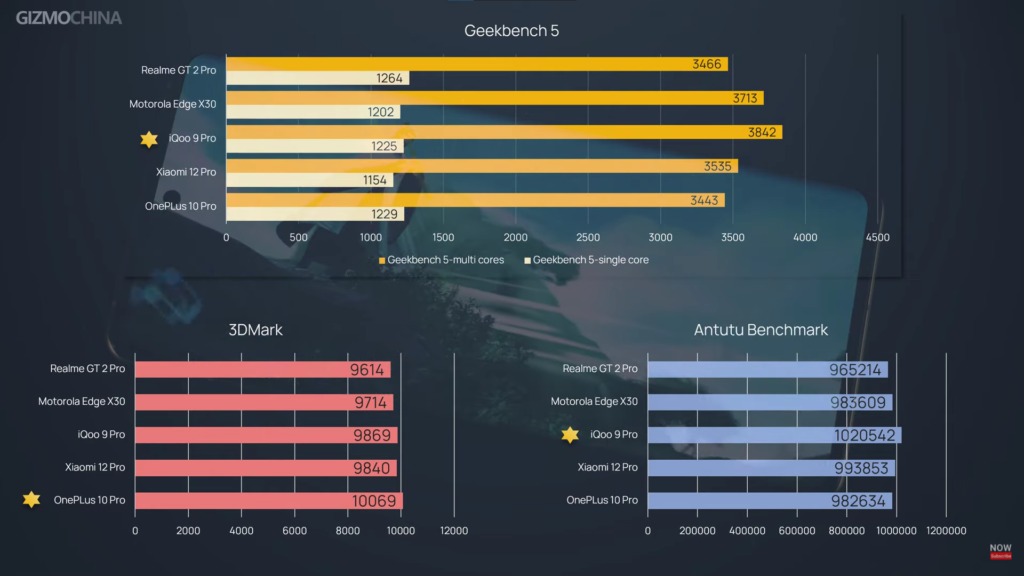
The iQOO 9 Pro puts the best overall performance in Geekbench scoring 3840 points in the multi-core test and 1225 points in the single-core test. It is worth mentioning that the Realme GT 2 Pro and OnePlus 10 Pro managed to outshine the iQOO 9 Pro in single-core performance with 1264 and 1229 points respectively. However, the device had a sizable lead against them in multi-core tests landing it in the first position.
The iQOO 9 Pro also scored the highest in the Antutu benchmark with 1,020,542 points and is followed closely by the Xiaomi 12 Pro which managed a score of 993,852 points. Surprisingly, the OnePlus 10 Pro takes the cake in the GPU-intensive 3DMark Wild Life test with the best peek out of all five devices with 10,069 points.
However, peek performance is not a good metric to display the real-life performance of smartphones as it omits the prolonged use case. So next up, we subject the five Snapdragon 8 Gen 1 flagships to the 3Dmark Wildlife extreme stress test which repeats the same stress test 20 times in a row.
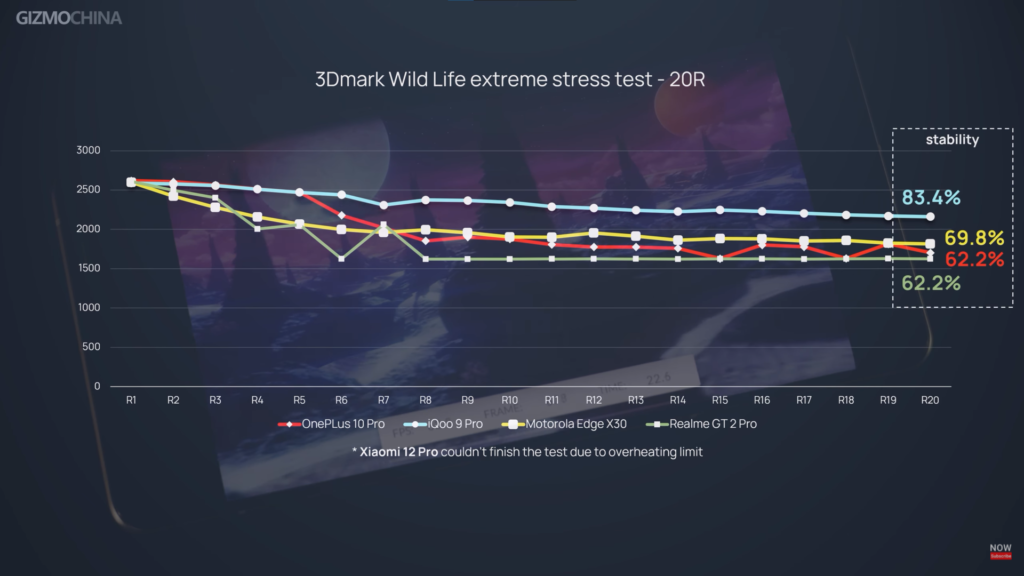
In this stress test, the OnePlus 10 Pro started headstrong however its performance went down from round 8 due to thermal throttling. The iQOO 9 Pro was the only device to maintain durable performance output with excellent stability across the stress test. The Motorola Edge X30 also performed well offering almost 70% stability through the test however it was also the hottest running phone among the five devices. Unfortunately, the Xiaomi 12 Pro wasn’t able to complete the test due to its overheating limit.
Gaming framerate and heating test
But benchmarks are not always indicative of actual game performance so we quickly loaded up some games in the five flagships to test which one is the actual performance king when it comes to gaming.
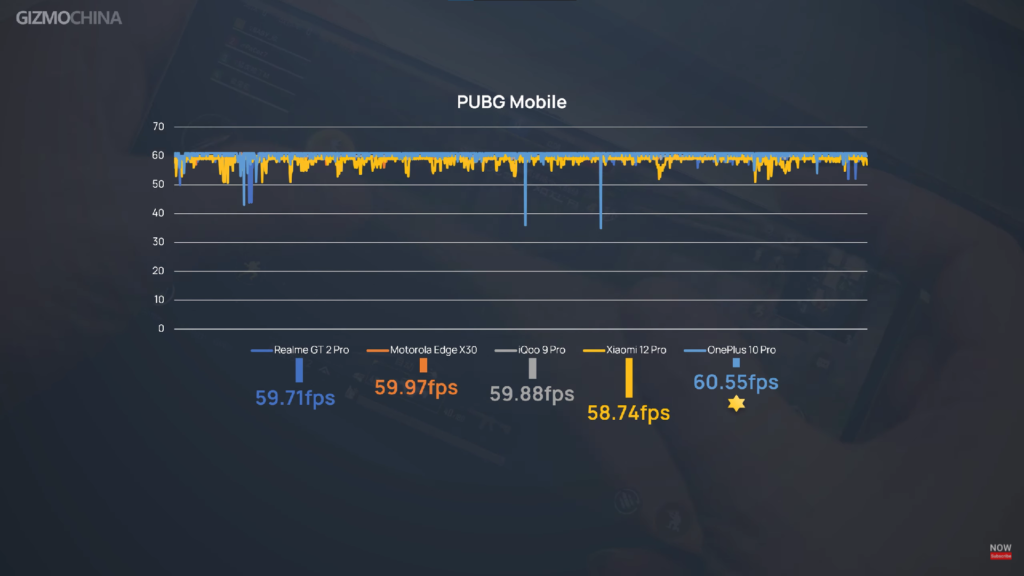
First up, we tested PUBG Mobile which was a breeze for all five devices. All of them managed similar average FPS numbers in the range of 59-60 FPS. But in Genshin Impact, the devices started showing gaps in thermal and frame rate performance.
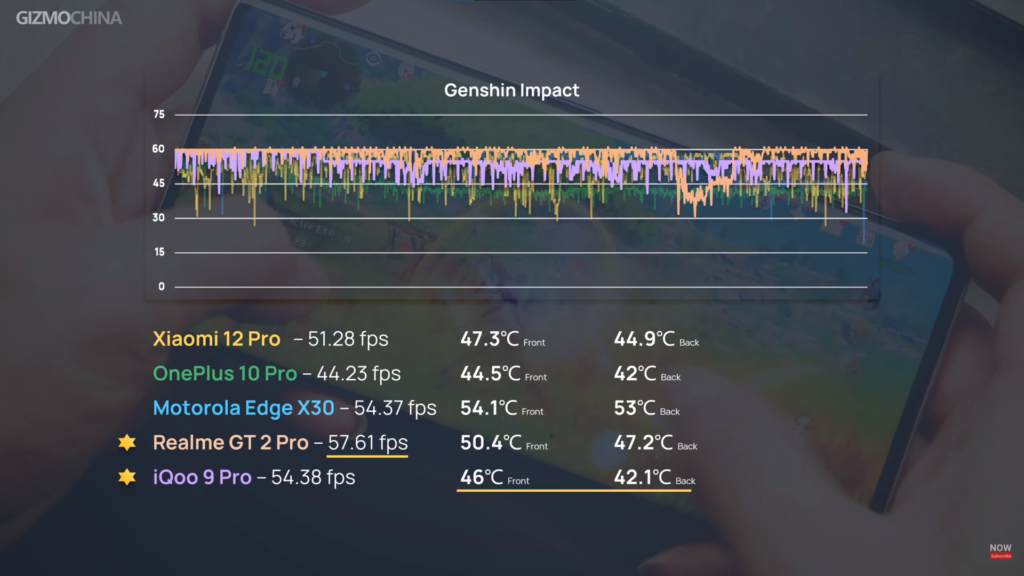
The Realme GT 2 Pro gave us the biggest surprise with its highest average FPS numbers at 57.6. However, once we factor in the heat produced by the smartphones, the iQOO 9 Pro emerges as the true winner of this test by offering 54.5 FPS on average while remaining almost 4-5 degrees cooler than the Realme GT 2 Pro.
For our third and last game test, we ran Nimian Legends at 2k resolution and the highest graphic settings the game has to offer.
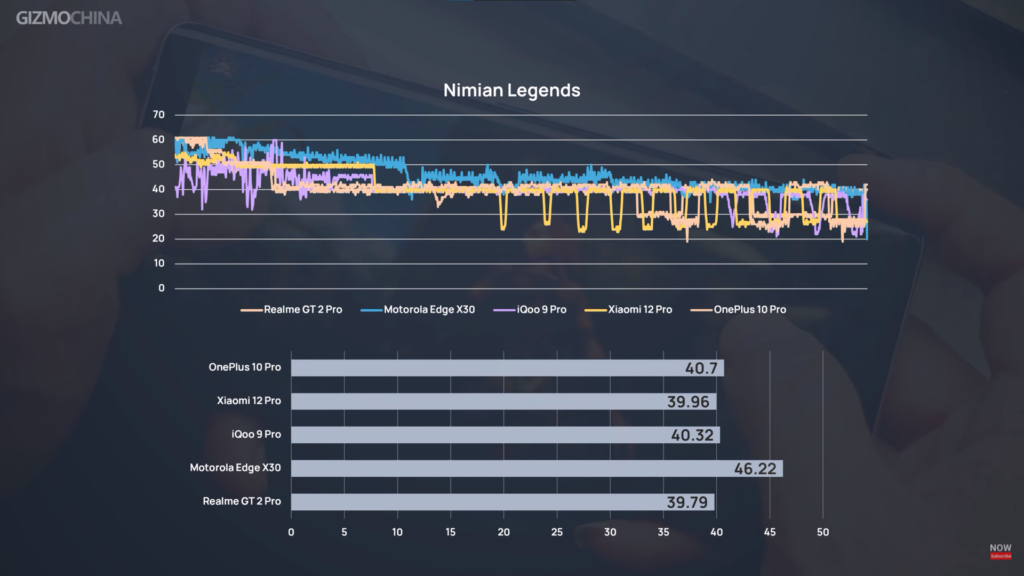
This time around, the Motorola Edge X30 stands out from its competitors with an average of 46.2 frames per second but the phone also got as hot as 56 degrees celsius which made it really uncomfortable to hold. Apart from the Edge X30, the other four devices remained close to each other giving 39-40 FPS on average.
Conclusion

If we only look at the framerate data, the Realme GT 2 Pro and the Moto Edge X30 offer the best performance out of the bunch. However, when we consider the thermal performance of the devices and their stability in maintaining consistent frame rates, the iQOO 9 Pro emerges as the undisputed king of gaming devices out of the five.




Comments