
Add GIZMOCHINA as Preferred Source on Google
Vivo’s sub-brand launched one of the most impressive smartphone series of this year: the iQOO 10 series. It is composed of two variants: the iQOO 10 and the iQOO 10 Pro, each of them released in several memory configurations inside the Chinese market. This series also contains the first phone with 200W fast charging: the most powerful charging technology available on the market. Even the prices are impressive if we consider their specifications. But which of these devices delivers the highest value for money? In order to answer this question, we decided to write a comparison between the iQOO 10 and the iQOO 10 Pro. Obviously, you already know which one is the best, that is why this comparison will be focused on highlighting the few differences between these handsets instead of telling you which one is better.
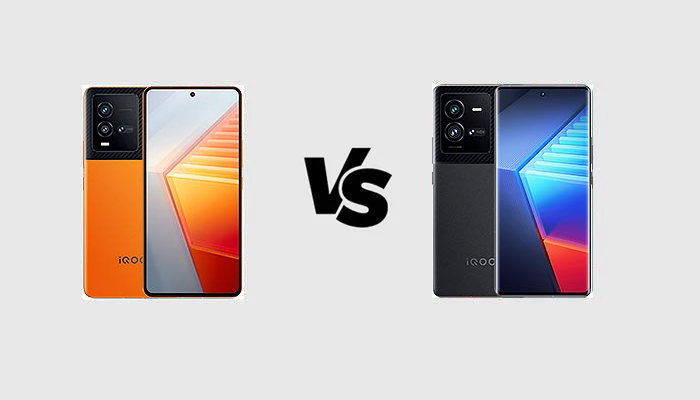
vivo iQOO 10 vs vivo iQOO 10 Pro
| vivo iQOO 10 | Vivo iQOO 10 Pro | |
|---|---|---|
| DIMENSIONS AND WEIGHT | 164.5 x 77.1 x 8.4 mm, 206 g |
164.9 x 75.5 x 9.5 mm, 215 g |
| DISPLAY | 6.78 inches, 1080 x 2400 pixels (Full HD+), AMOLED | 6.78 inches, 1440 x 3200 pixels (Quad HD+), LTPO AMOLED |
| PROCESSOR | Qualcomm Snapdragon 8+ Gen 1, octa-core 3.19 GHz | Qualcomm Snapdragon 8+ Gen 1, octa-core 3.19 GHz |
| MEMORY | 8 GB RAM, 128 GB – 8 GB RAM, 256 GB – 12 GB RAM, 256 GB – 12 GB RAM, 512 GB | 8 GB RAM, 256 GB – 12 GB RAM, 256 GB – 12 GB RAM, 512 GB |
| SOFTWARE | Android 12, Origin OS Ocean | Android 12, Origin OS Ocean |
| CONNECTIVITY | Wi-Fi 802.11 a/b/g/n/ac/6, Bluetooth 5.3, GPS | Wi-Fi 802.11 a/b/g/n/ac/6, Bluetooth 5.3, GPS |
| CAMERA | Triple 50 + 12 + 13 MP, f/1.9 + f/2.0 + f/2.2 16 MP f/2.5 front camera |
Triple 50 + 14.6 + 50 MP, f/1.9 + f/2.2 + f/2.3 16 MP f/2.5 front camera |
| BATTERY | 4700 mAh, fast charging 120W | 4700 mAh, Fast Charging 200W, fast wireless charging 50W |
| ADDITIONAL FEATURES | 5G, dual SIM | 5G, dual SIM, reverse wireless charging |
Design
Even though these phones look similar in terms of design, there are a few important differences making the Pro variant definitely better than the vanilla one. The rear side is slightly different when it comes to the camera module, but the most important difference is on the front, where the Pro variant provides a curved screen at the sides with a higher screen to body ratio, while the vanilla version comes with a flat display. On the other hand, the vanilla version is thinner and lighter, while the Pro one is one of the thickest phones released this year from a mainstream brand. For the rest, there are no important differences: these phones come with a power key and volume buttons both placed on the right side, they come with two different textures on the rear side, and they have no audio jack.
Display
One of the most important differences between the vanilla version and the Pro one is the display. With the Pro variant, you can get a way better panel and one of the best displays in the whole smartphone market. It is an AMOLED panel with a diagonal of 6.78 inches able to show up to one billion colors with a Quad HD+ resolution of 1440 x 3200 pixels, the LTPO 3.0 technology (enabling an adaptive refresh rate from 1 to 120 Hz), the HDR10+ certification, and a very high peak brightness of 1,500 nits. It also features a great ultrasonic in-display fingerprint reader instead of the traditional optical ones. The iQOO 10 has a 6.78-inch AMOLED display as well, but with a lower Full HD+ resolution of 1080 x 2400 pixels, a non-adaptive refresh rate of 120 Hz, and HDR technology. The fingerprint reader is under the display, but it is an optical one.
Specs & Software
There seems to be no difference between the hardware departments of these two phones, so if your goal is only to get the best performance, then you can opt for both of these phones. They are fueled by the Snapdragon 8+ Gen 1 mobile platform: the most impressive SoC by Qualcomm. It is a chipset built at 4 nm with an octa-core architecture composed of one Cortex X2 CPU running at a max frequency of 3.19 GHz, three Cortex A710 CPUs running at 2.75 GHz, four Cortex A510 CPUs running at 1.8 GHz, and an Adreno 730 GPU. The chipset is paired with 8 or 12 GB of RAM and 128, 256, or 512 GB of UFS 3.1 internal storage depending on the chosen memory configuration. These phones run Android 12 out of the box, customized by Origin OS Ocean which is the latest version of Vivo’s user interface based on Android 12.
Camera
The iQOO 10 Pro is a superior phone not only due to its display but even when it comes to the rear cameras. It is one of the best camera phones out there, even though it does not feature a periscope camera. On the rear side, it has a 50 Mp main camera with gimbal OIS, a 14.6 MP telephoto sensor with 3x optical zoom, and a 50 MP ultrawide sensor with a FOV of 150 degrees. The original iQOO 10 has a 50 MP main camera with OIS, a 12 MP telephoto lens with 2x optical zoom, and a 13 MP ultrawide sensor with a FOV of 120 degrees. On the front, they both have a 16 MP selfie camera.
Battery
The battery capacity of these two handsets is the same and you should expect more or less the same battery life because the components are similar. But the charging technologies vary: the vanilla version only features 120W fast charging, while the Pro one has 200W fast charging, 50W fast wireless charging, and reverse wireless charging.
Price
The vanilla iQOO 10 carries a starting price tag of €540 or $540 in the Chinese market, while you need at least €730 or $730 for the Pro. Which one would you pick?
vivo iQOO 10 vs vivo iQOO 10 Pro: PRO and CONS
vivo iQOO 10
PRO
- More affordable
- Same chipset as the Pro
CONS
- Inferior rear cameras
- Inferior display
- Slower charging
- No wireless charging
Vivo iQOO 10 Pro
PRO
- Superior rear cameras
- Faster charging
- Wireless charging
- Better screen
CONS
- Price
RELATED
- iQOO Neo5 vs iQOO Neo5 Lite vs iQOO 7: Specs Comparison
- Xiaomi Mi 11 Ultra vs Samsung Galaxy S21 Ultra vs OPPO Find X3 Pro: Specs Comparison
- OPPO Reno7 vs Reno7 Pro vs Reno7 SE: Specs Comparison
- Motorola Edge X30 vs Galaxy S21+ vs Xiaomi 11T Pro: Specs Comparison
Check the latest videos from our YouTube channel and subscribe:


Comments