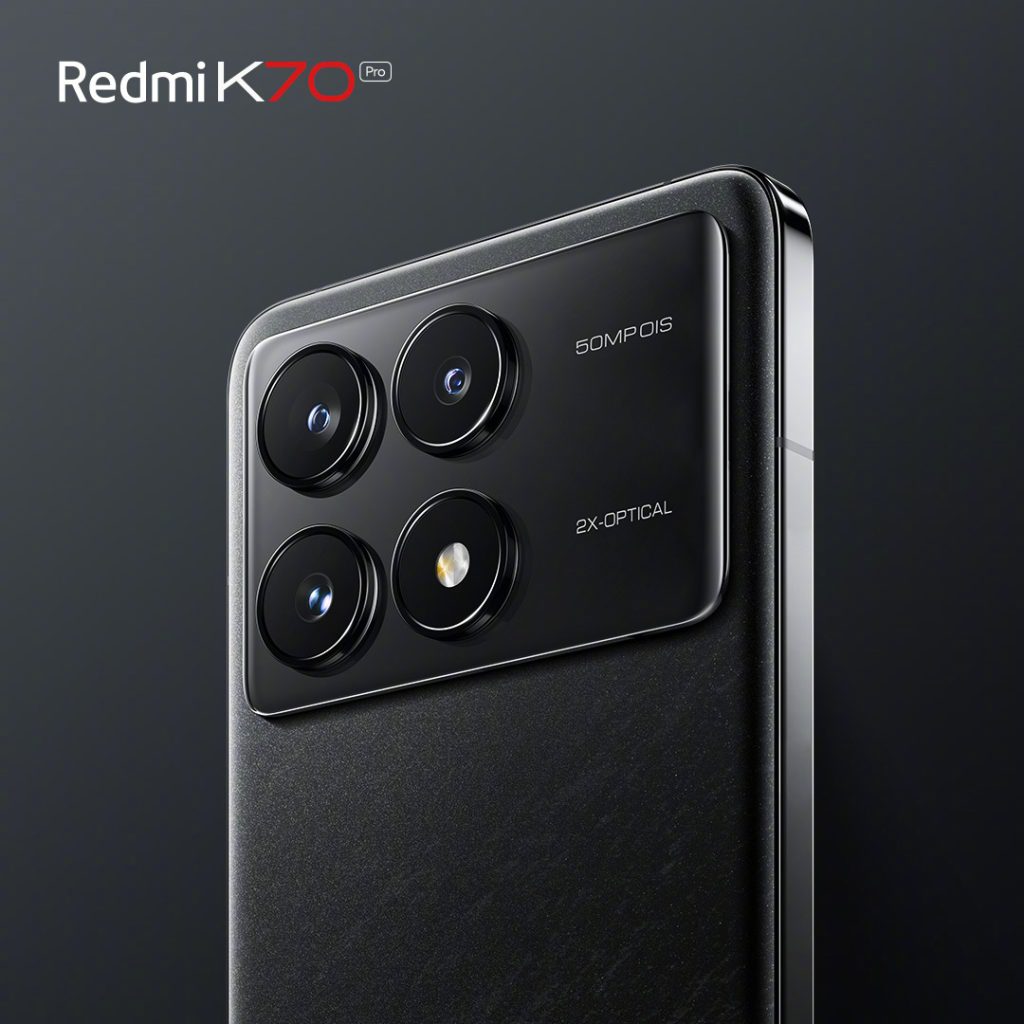
The Redmi brand of the Xiaomi group is set to introduce its next-gen flagship smartphones. These devices are collectively called the Redmi K70 series.
The company has been teasing the features of these phones for the last few days. Also, we have been hearing about them for quite a while through leaks.
The Redmi K70 series is scheduled to launch in China on November 29 (Wednesday). It will be announced at a press conference which will kickstart at 7 PM local time (GMT+8).
The event will be live-streamed on Weibo and other leading Chinese video streaming platforms.
The smartphones will be accompanied by multiple ecosystem products, such as Redmi Book 14/16 2024, Redmi Watch 4, and Redmi Buds 5 Pro.
2. Redmi K70 Series Design
The Redmi K70 series will arrive with a completely new design. The phones will have a flat frame body.
Further, they will house the largest camera module ever on a Redmi smartphone. The pro model will have a metal frame. As of writing this article, It is not known if the frame on the other two handsets will use the same material.
The volume rocker and the power key will be located on the right edge of the devices. While the top side will sport an IR blaster, and the bottom part will consist of a USB Type-C port as well as a speaker grille.
These phones will be available in at least two colors each.
3. Redmi K70 Series Specifications
As of writing this story, only a few things are known about Redmi K70 and Redmi 70 Pro. On the other hand, almost everything regarding Redmi K70e is out. So let’s discuss about it first.
The Redmi K70e will come with a 6.67-inch OLED display with a resolution of 2712 x 1220 pixels and a 120Hz refresh rate. The panel will offer 12-bit color depth (software-based) and 1200 nits peak brightness level.
The device will be powered by a MediaTek Dimenisty 8300-Ultra chip paired with LPDDR5x RAM and UFS 4.0 storage. On the software front, it will boot HyperOS based on Android 14.
The handset will feature a 16MP selfie camera and a triple camera system on the rear comprising a 64MP OmniVision OV64B primary sensor, an 8MP ultrawide unit, and a 2MP macro snapper.
Finally, it will be backed by a 5,500mAh battery with support for 90W charging.
On the other hand, the Redmi K70 and the Redmi K70 Pro will be powered by Snapdragon 8 Gen 2 and Snapdragon 8 Gen 3 chipsets, respectively. They will also ship with Android 14-based HyperOS.
Both of them are expected to have the same 50MP OmniVision OV50E primary sensor and an 8MP ultrawide unit. The third camera on the vanilla variant will be a 2MP unit. Whereas, the pro version will sport a 50MP OmniVision OV50D 2x telephoto shooter.
The duo will carry support for 120W wired charging. But the vanilla model is said to house a 5,000mAh battery as opposed to a 5,120mAh battery inside the pro variant.
4. Redmi K70 Series Expected Price
The Redmi K70 series will most likely cost about the same as the Redmi K60 series or slightly more expensive.
For comparison, the Redmi K60e, the Redmi K60, and the Redmi K60 Pro started at ¥2,199, ¥2,499, and ¥3,299, respectively, at launch.
We use cookies on our website to give you the most relevant experience by remembering your preferences and repeat visits. By clicking “Accept”, you consent to the use of ALL the cookies.
This website uses cookies to improve your experience while you navigate through the website. Out of these, the cookies that are categorized as necessary are stored on your browser as they are essential for the working of basic functionalities of the website. We also use third-party cookies that help us analyze and understand how you use this website. These cookies will be stored in your browser only with your consent. You also have the option to opt-out of these cookies. But opting out of some of these cookies may affect your browsing experience.
Necessary cookies are absolutely essential for the website to function properly. This category only includes cookies that ensures basic functionalities and security features of the website. These cookies do not store any personal information.
Any cookies that may not be particularly necessary for the website to function and is used specifically to collect user personal data via analytics, ads, other embedded contents are termed as non-necessary cookies. It is mandatory to procure user consent prior to running these cookies on your website.