
Add GIZMOCHINA as Preferred Source on Google
Samsung announced the Exynos 2200 mobile chipset in January 2022, whereas the Snapdragon 8 Gen 1 arrived two months earlier in November 2021. Both are high-end chips for smartphones. In fact, both use the same cores and the core cluster is also unchanged.
There are a lot of similarities between the Exynos 2200 and Snapdragon 8 Gen 1 on the spec sheet, making it difficult to pick the right one. To help you with that, I’ll bring the benchmarking numbers and share with you some critical points that you must know to make a better purchase decision.
Exynos 2200 vs SD 8 Gen 1: Spec Sheet
| Exynos 2200 | SD 8 Gen 1 | |
|---|---|---|
| Release Date | January 2022 | November 2021 |
| Process Node | 4 nm (Samsung) | 4 nm (Samsung) |
| CPU | 1 x Cortex-X2 @ 2.8 GHz 3 x Cortex-A710 @ 2.5 GHz 4 x Cortex-A510 @ 1.8 GHz | 1 x Cortex-X2 @ 3 GHz 3 x Cortex-A710 @ 2.5 GHz 4 x Cortex-A510 @ 1.8 GHz |
| GPU | Samsung Xclipse 920 AMD RDNA 2 architecture Variable rate sharing (VRS) | Adreno 730 Snapdragon Elite Gaming Unreal Engine 5 support |
| NPU | Yes | Hexagon |
| Memory | Up to 24 GB LPDDR5 @ 3200 MHz | Up to 24 GB LPDDR5 @ 3200 MHz |
| Storage | UFS 3.1 | UFS 3.1 |
| Camera | 200MP single camera 64MP+32MP dual cameras | 200MP single camera 108MP camera with zero shutter lag AI Semantic Analysis Video Engine |
| Video Recording | 8K @ 30/60fps, 4K @ 120/240fps | 4K/8K @ 120fps Slow-Mo: 4K @ 120fps, 720p @ 960fps |
| Display | 4K @ 120Hz, QHD+ @ 144Hz | On-device: 4K Ultra HD @ 60Hz, QHD+ @ 144Hz External: 4K @ 60Hz |
| Video Playback | 8K @ 60fps | 8K @ 30fps |
| Modem | 5G modem Downlink: 7.3 Gbps | Snapdragon X65 5G modem Downlink: 10 Gbps |
| Connectivity | Bluetooth 5.2 Wi-Fi 6 NFC | Bluetooth 5.3 Wi-Fi 6E support NFC |
Exynos 2200 vs SD 8 Gen 1: Benchmarks
(Geekbench 6)
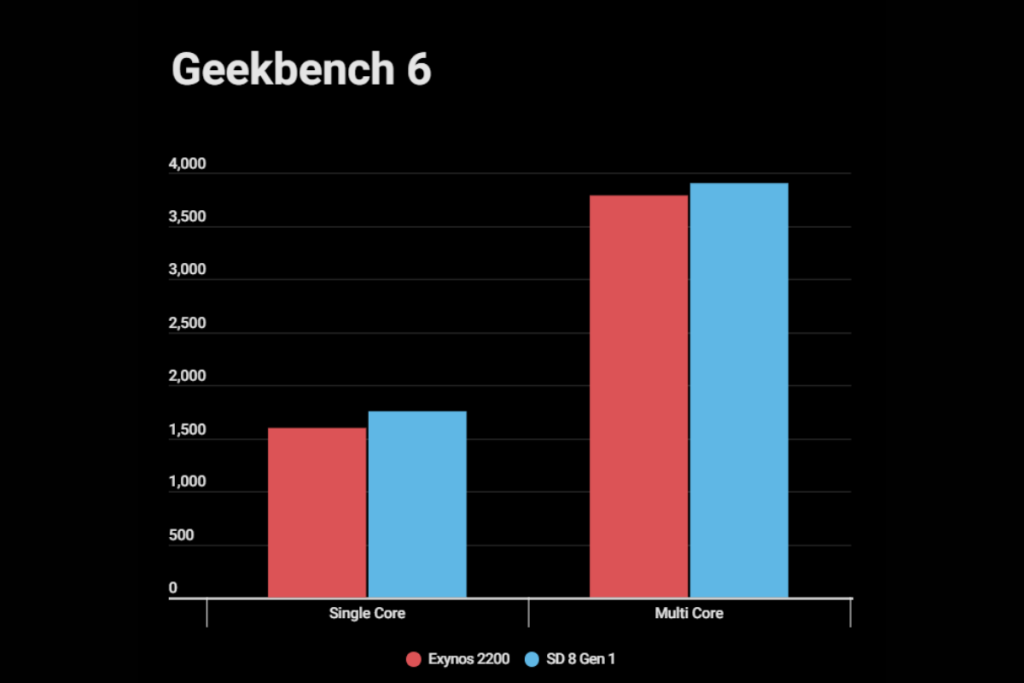
| Exynos 2200 | SD 8 Gen 1 | |
|---|---|---|
| Single Core | 1596 | 1753 |
| Multi Core | 3786 | 3902 |
The Geekbench test measures the CPU performance. Unsurprisingly, the Exynos 2200 and Snapdragon 8 Gen 1 have got similar results.
(AnTuTu 10)
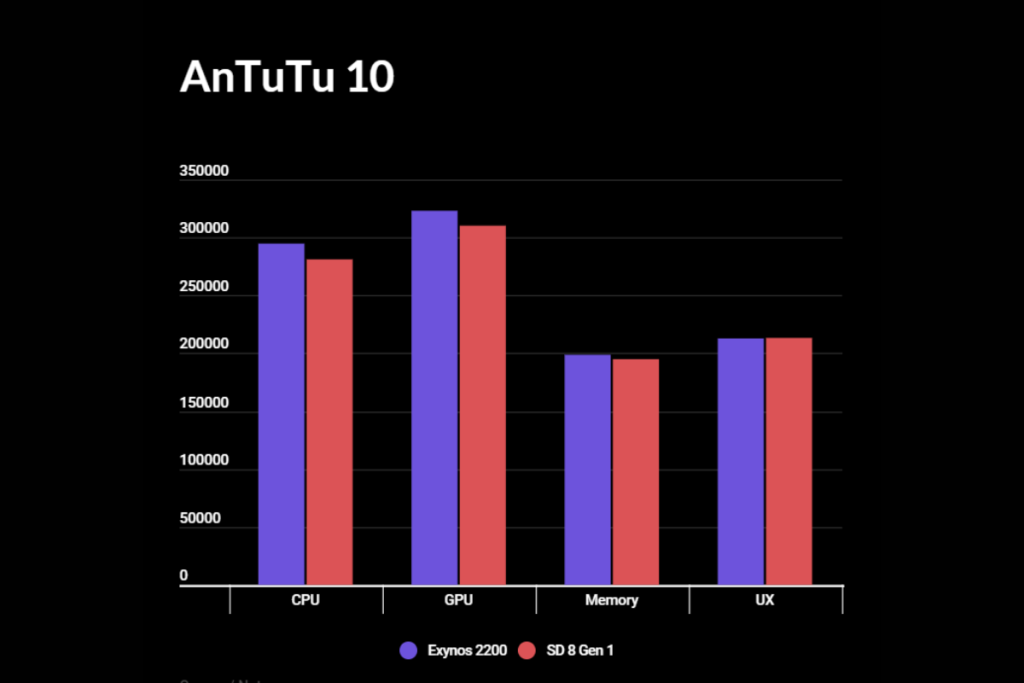
| Exynos 2200 | SD 8 Gen 1 | |
|---|---|---|
| CPU | 294759 | 281156 |
| GPU | 323119 | 310236 |
| Memory | 198765 | 194927 |
| UX | 212867 | 213314 |
| Total Score | 1029510 | 999633 |
Like Geekbench, the AnTuTu results are also pretty similar for the Exynos 2200 and Snapdragon 8 Gen 1. The Exynos chip has slightly higher scores, although the difference is not big.
According to Geekbench and AnTuTu results, the Exynos 2200 and Snapdragon 8 Gen 1 have comparable CPU and GPU performance.
Exynos 2200 vs SD 8 Gen 1: CPU & GPU
The Exynos 2200 and Snapdragon 8 Gen 1 are 8-core chipsets fabricated using Samsung’s 4nm process node. In fact, both chips use the same cores – one Cortex-X2 prime core, three Cortex-A710 performance cores, and four Cortex-A510 power-efficient cores. But the prime core in the Snapdragon 8 Gen 1 chip runs at a higher clock speed of 3 GHz (vs. 2.8 GHz in Exynos 2200).
In addition to a faster prime core, the Snapdragon chip has the advantage of having larger L2 and L3 caches. This should give the Snapdragon chip additional performance boost.
The Exynos 2200 chip has a Samsung Xclipse 920 GPU that uses the AMD RDNA 2 architecture. It supports variable rate shading (VRS) to optimize GPU workloads and provide a stable frame rate. The Snapdragon 8 Gen 1, on the other hand, has an Adreno 730 GPU. The chip comes with Snapdragon Elite Gaming and support for Unreal Engine 5.
Both are high-performance GPUs but the Adreno 730 in the Snapdragon 8 Gen 1 does a better job at gaming. It offers a higher frame rate and stable performance for a long gaming session, compared to the Exynos 2200.
Exynos 2200 vs SD 8 Gen 1: Camera
Both smartphone chips support a maximum of 200MP single camera resolution. The Snapdragon chip uses an 18-bit Qualcomm Spectra ISP and offers features like AI-based auto exposure, AI-based auto-focus, multi-frame noise reduction, and low-light photography architecture.
The Exynos 2200 and Snapdragon 8 Gen 1 chips are capable of recording 4K as well as 8K videos at higher frame rates. The Snapdragon chip supports 4K slow-mo videos at 120fps and 720p at 960fps.
Exynos 2200 vs SD 8 Gen 1: Display
The Exynos 2200 chip supports 4K display resolution with up to 120Hz refresh rate. The Snapdragon 8 Gen 1 also supports 4K display, but a lower screen refresh rate of 60Hz.
Both chips support QHD+ display resolution with up to 144Hz refresh rate. The Snapdragon chip allows up to 4K resolution for the external display with 60Hz refresh rate support, while no such things are mentioned on Samsung’s official website.
Exynos 2200 vs SD 8 Gen 1: Connectivity
Both chips support necessary connectivity features, although there are several differences you should know about. The Snapdragon chip has X75 5G modem which offers up to 10Gbps download speed, whereas the integrated 5G modem inside the Exynos 2200 has a peak download speed of 7.35 Gbps.
The Exynos 2200 chip supports Bluetooth 5.2, whereas the Snapdragon chip supports a newer standard, Bluetooth 5.3. Both chips support 5G/4G/3G/2G, Wi-Fi 6, and NFC. However, the Exynos 2200 doesn’t support QZSS and NavIC positing systems, which the Snapdragon 8 Gen 1 does.
Exynos 2200 vs SD 8 Gen 1: Which Is Better?
The Exynos 2200 and Snapdragon 8 Gen 1 chips have comparable CPU performance. However, the Snapdragon chip leads the GPU race by offering a higher FPS and better performance retention.
While the rest of the specifications are nearly similar, the Snapdragon chip supports a newer Bluetooth standard, more positing systems, and offers a higher peak download speed.
If I had to pick one between the Exynos 2200 and the Snapdragon 8 Gen 1, I’d go with the Snapdragon one.
If you have any questions, write them in the comment section below. I’ll respond at the earliest possible.
Popular Chip Comparisons:
1. Snapdragon 8 Gen 3 vs Dimensity 9300
2. Snapdragon 8s Gen 3 vs 7+ Gen 3
3. Dimensity 9300+ vs Snapdragon 8 Gen 2




Comments