
Add GIZMOCHINA as Preferred Source on Google
Two Japanese companies have collaborated to develop a new drone that can take off, land, and sail on water. The new oceanographic survey drone is the product of a joint engagement between Penta Ocean Construction and Prodrone Co., Ltd. The drone is called the Penta-Ocean Vanguard-DroneAqua (POV-DA).
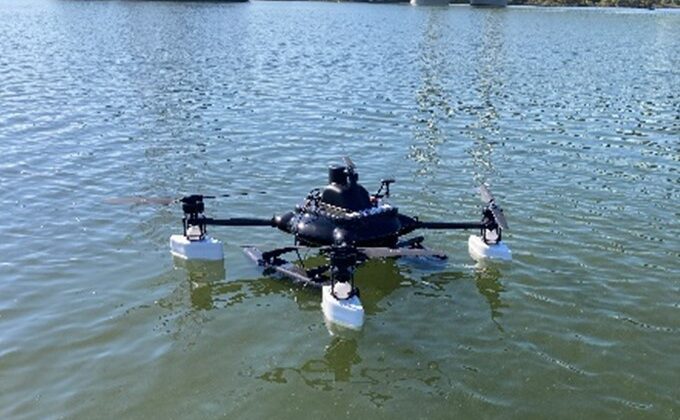
The POV-DA is an innovative oceanographic survey drone with great capabilities and versatility. It is designed for seamless water operations and is equipped with a high-precision GNSS satellite system, a depth-measuring sonar, and thrusters. The drone can transmit and display real-time data on its current location and water depth to operators on land via a remote control console. The advanced tech features in the drone mean that it can navigate to specific monitoring points using its thrusters. The drone can maintain its position even when the sea is turbulent.
The excellent sea-going capabilities of the POV-DA drone mean that the drone is a great tool for carrying out efficient and automatic bathymetric surveys and wave observations. In construction projects that require the building of breakwaters, quay walls, and similar structures, the POV-DA provides an alternative to the traditional depth-sounding using dedicated boats or lead-sounding methods. The time required for depth surveys is significantly reduced when using the new drone. Operators can better monitor underwater construction progress with the real-time data transmission available with the drone.
The POV-DA has a depth survey accuracy within +/- 10cm of the current methods and is a great tool for effective underwater construction management. The POV-DA provides real-time wave height and period data obtained from GNSS readings. The accuracy of the drone’s measurement is also impressive around +/- 10% or less compared to the conventional wave meters. Additionally, the POV-DA can take aerial shots during disasters and provide real-time updates on land and underwater.
The potentials of the POV-DA in ocean operations and disaster management are quite extensive. It could be integrated with additional equipment such as multi-parameter water quality meters, water sampling devices, and such, to broaden its capabilities. It is not clear how much the drone will cost and when it becomes a production model.
(via)

Comments