Add GIZMOCHINA as Preferred Source on Google
As an Amazon Associate, Gizmochina earns from qualifying purchases. Links on this page may earn us a commission at no extra cost to you.
Motorola recently launched the Edge 50, the latest addition to their Edge series. Let’s see how it stacks up against the Motorola Edge 40, which launched last year. Here’s a detailed comparison to help you decide which phone might be a better fit for you.
1. Display
Both phones boast large curved pOLED displays but with some key differences. The Edge 50 has a slightly bigger 6.67-inch screen compared to the Edge 40’s 6.55-inch display. The Edge 50 also boasts a higher resolution (2712 x 1220 pixels) compared to the Edge 40’s FHD+ (2400 x 1080 pixels) resolution. This translates to sharper visuals and a more immersive viewing experience on the Edge 50.
However, the Edge 40 takes the lead in refresh rate, offering a smooth 144Hz refresh rate compared to the Edge 50’s 120Hz refresh rate. While both offer a significant improvement over standard 60Hz displays, the difference might be negligible for most users.
Both phones come with Corning Gorilla Glass protection, however, the Edge 50 utilizes the newer Gorilla Glass 5 for potentially better scratch resistance. The Edge 50 also boasts a higher peak brightness of 1900 nits compared to the Edge 40’s 1200 nits, making it easier to view the display outdoors under bright sunlight.
| Preview | Product | |
|---|---|---|

|
Motorola Edge 40 5G (Eclipse Black, 8GB RAM, 256GB Storage)| 6.55″ pOLED Display | 50MP + 13MP |… | Check Price on Amazon |
Please Note: When you buy something using the links in our articles, we may earn a small commission at no cost to you.
2. Performance
The Edge 50 packs a punch with the Qualcomm Snapdragon 7 Gen 1 Accelerated Edition 4nm SoC. This is a newer and potentially more efficient processor compared to the MediaTek Dimensity 8020 6nm processor found in the Edge 40. While both processors can handle everyday tasks and multitasking with ease, the Snapdragon 7 Gen 1 might offer a slight edge in performance and power efficiency.
Both phones come with 8GB of RAM, which is ample for most users. However, it’s worth noting that the Edge 50 uses the faster LPDDR5 RAM compared to the LPDDR4X RAM in the Edge 40. This can lead to quicker app loading times and smoother multitasking on the Edge 50.
Both phones offer a single 256GB storage option, but while the Edge 40 features UFS 3.1, the Edge 50 has the older UFS 2.2, which is a downgrade in terms of storage technology.
3. Software
The Edge 50 runs the newer Android 14 operating system, while the Edge 40 comes with Android 13 out of the box. This means the Edge 50 will benefit from the latest features and security updates for a longer period. Motorola promises 2 years of Android updates and 3 years of security updates for both phones, so software support shouldn’t be a major deciding factor.
4. Cameras
The camera systems on both phones are quite similar, featuring 50MP main sensors with OIS. The Edge 50 is equipped with the Sony LYT-700C sensor, while the Edge 40 uses the OmniVision OV50A sensor.
However, the Edge 50 adds a telephoto lens with 3x optical zoom compared to the Edge 40 which lacks a dedicated zoom lens. This gives the Edge 50 an advantage for capturing sharper images at a distance.
Both phones offer a 13MP ultrawide sensor with macro capabilities and a 32MP front-facing camera. Overall, the camera systems are likely to deliver good results in most lighting conditions, with the Edge 50 offering a slight edge with the addition of the telephoto lens.
5. Battery
The Edge 50 packs a larger 5000mAh battery compared to the Edge 40’s 4400mAh battery. This could translate to longer battery life on the Edge 50. Both phones support the same 68W fast charging, allowing you to quickly top up your battery when needed. Additionally, both phones offer 15W wireless charging for convenience. The Edge 40 supports 5W reverse charging as well.
6. Durability and Design
Both phones have IP68 ratings for dust and water resistance, ensuring protection against spills and splashes. The Edge 50 also features MIL-STD-810H certification, making it more durable and able to withstand extreme conditions such as shocks, vibrations, drops, and temperature fluctuations. Motorola claims the Edge 50 is the world’s slimmest smartphone with this military-grade certification, having passed 16 rigorous durability tests.
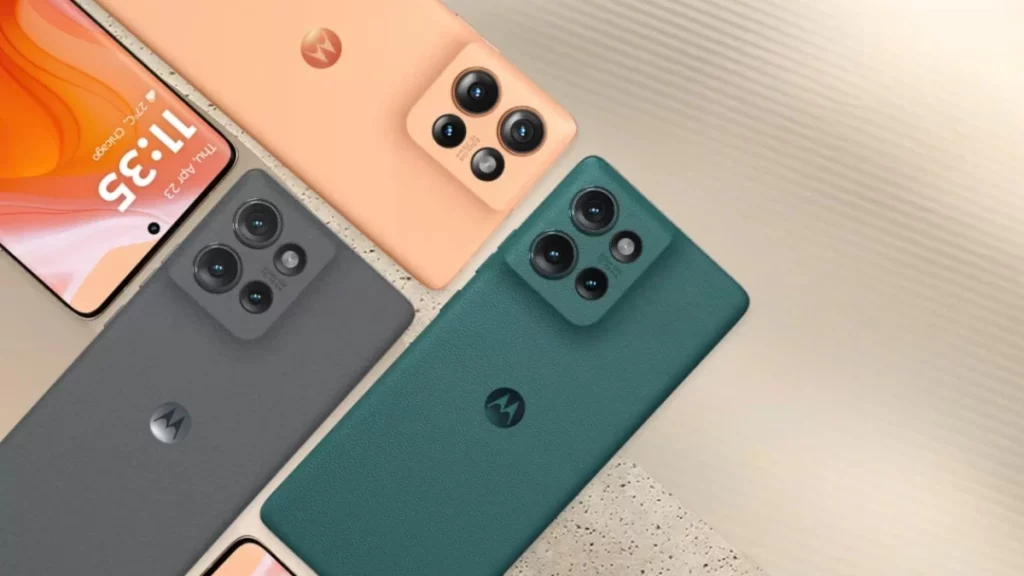
Both the Edge 50 and Edge 40 boast sleek designs with a focus on premium materials. The Edge 50 offers a vegan leather finish in Jungle Green and Pantone Peach Fuzz variants, while the Koala Grey option comes with a vegan suede finish. The Edge 40, on the other hand, offers an acrylic back in Eclipse Black and vegan leather options in Nebula Green and Lunar Blue.
While both phones have a similar thickness, the Edge 50 is slightly heavier than the Edge 40. Both devices feature an in-display fingerprint sensor for convenient unlocking.
7. Pricing and Availability
The Motorola Edge 50 is priced at Rs. 27,999 for the 8GB + 256GB variant and will be available from August 8th onwards. The Edge 40, on the other hand, is priced at Rs. 26,999 for the 8GB + 256GB model and was launched in May 2023.
8. Conclusion
Both the Motorola Edge 50 and Edge 40 are excellent mid-range smartphones that offer a premium design, impressive features, and great value for money. However, if you’re looking for the latest software, a slightly larger display, and a more versatile camera system, the Edge 50 is of course the better choice.