
Add GIZMOCHINA as Preferred Source on Google
In the fiercely competitive smartphone market, Apple’s iPhone 16 and Google’s Pixel 9 stand out as two of the most sought-after devices. Both smartphones are packed with premium features, stunning displays, and advanced camera systems. However, each caters to different user preferences and priorities.
This article will provide a comprehensive comparison of the two devices across several key parameters: Design, Display, Media, and Software; Performance and Battery; and Cameras. By analyzing features, similarities, differences, and advantages, we aim to help you determine which device is the better buy.
Design
Features
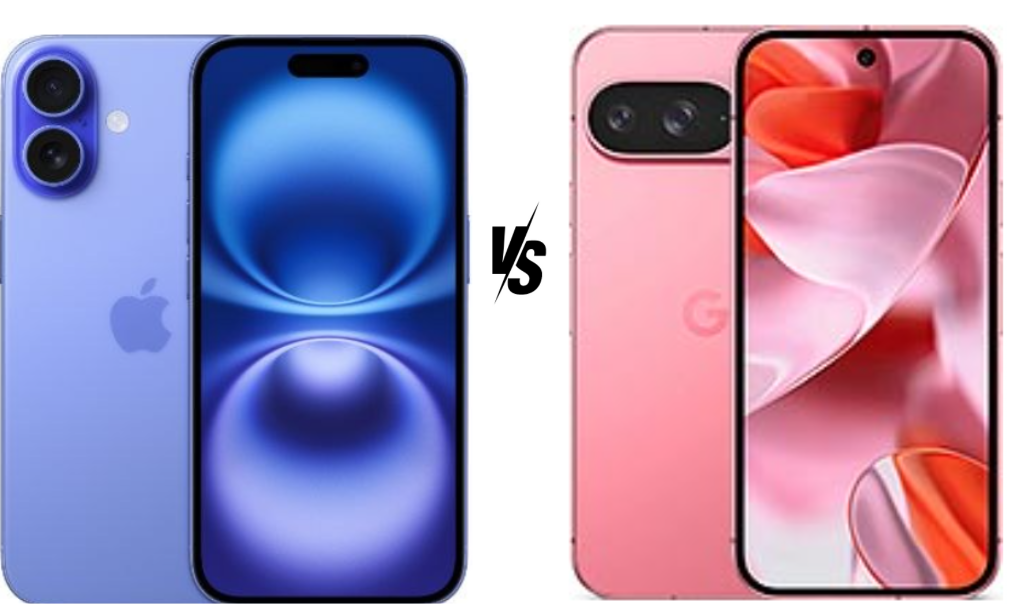
The iPhone 16 boasts a sleek and modern design, featuring a glass front and back made from Corning-made glass, complemented by an aluminum frame. This construction not only exudes premium quality but also enhances durability. The device is IP68 rated, meaning it is resistant to dust and can withstand submersion in water up to 6 meters for 30 minutes.
In contrast, the Pixel 9 features Gorilla Glass Victus 2 on both its front and back, which offers similar durability. The aluminum frame adds to its robust design, and like the iPhone 16, it is also IP68 rated, providing protection against dust and water up to 1.5 meters for 30 minutes.
Similarities
Both phones prioritize premium materials in their design, making them visually appealing and durable. They also share IP68 ratings, which means users can feel confident taking these devices into environments where dust and moisture are concerns.
Differences
While both devices feature glass backs and aluminum frames, the iPhone 16 is designed to withstand more significant water depths. The size and weight of each phone also differ slightly, with the iPhone 16 measuring 6.1 inches compared to the Pixel 9’s 6.3 inches, making the Pixel slightly larger and potentially more cumbersome for one-handed use.
Advantages
The iPhone 16’s more advanced water resistance may appeal to users who prioritize durability. However, the larger display of the Pixel 9 could be advantageous for media consumption, offering a bit more screen real estate.
Verdict:
While both designs are premium, the iPhone 16 edges out due to better water resistance and improved drop protection. However, those seeking a unique design might prefer the Pixel 9.
Display, Media, and Software
Features
The iPhone 16 features a Super Retina XDR OLED display, measuring 6.1 inches with a resolution of 1179 x 2556 pixels. This results in a pixel density of approximately 460 ppi, providing sharp and vibrant visuals. The display supports HDR10 and Dolby Vision, ensuring that users enjoy an immersive viewing experience. The brightness levels are impressive, reaching 2000 nits in high brightness mode.
On the other hand, the Pixel 9 offers a 6.3-inch OLED display with a resolution of 1080 x 2424 pixels and a pixel density of around 422 ppi. Its display also supports HDR10+, enhancing color and contrast. The peak brightness is even higher at 2700 nits, making it exceptional for outdoor visibility. Moreover, the Pixel 9 features a 120Hz refresh rate, resulting in smoother scrolling and animations.
Similarities
Both devices offer vibrant OLED displays with high brightness levels, HDR support, and a premium visual experience. Additionally, both run sophisticated operating systems, with the iPhone 16 operating on iOS 18 and the Pixel 9 on Android 14.
Differences
The Pixel 9’s display has a higher refresh rate, which may appeal to gamers and users who enjoy smooth animations. Conversely, the iPhone 16 excels in pixel density, providing slightly sharper images despite its lower peak brightness compared to the Pixel 9.
Advantages
For media consumption, the Pixel 9’s larger size and high refresh rate provide an edge in terms of smoothness and vibrancy, while the iPhone 16 offers superior pixel density for those who prioritize clarity. Additionally, users who prefer Apple’s ecosystem and seamless integration with other Apple devices will find iOS more advantageous.
Verdict:
For media consumption and gaming, the Pixel 9 takes the win due to its 120Hz refresh rate and higher peak brightness, making it more fluid and vibrant. However, for users who value Dolby Vision, the iPhone 16 may still appeal.
Performance and Battery
Features
The iPhone 16 is powered by Apple’s A18 chip, built on a 3 nm process. This hexa-core CPU is complemented by a 5-core GPU, which ensures top-notch performance across demanding tasks, from gaming to video editing. The device comes with options for 128GB, 256GB, or 512GB of internal storage paired with 8GB of RAM.
In contrast, the Pixel 9 features the Google Tensor G4 chipset, utilizing a 4 nm process. This octa-core CPU includes a powerful Cortex-X4 core for high-performance tasks, alongside a Mali-G715 MC7 GPU. The Pixel also offers 128GB or 256GB storage options, with 12GB of RAM enhancing multitasking capabilities.
Similarities
Both devices provide robust performance and are capable of handling multitasking, gaming, and high-performance applications smoothly. Each phone lacks an external memory card slot, placing a focus on their internal storage options.
Differences
The A18 chip in the iPhone 16 is generally considered superior in terms of raw performance and efficiency compared to the Tensor G4. The Pixel 9, however, provides additional RAM, which can aid in multitasking and using demanding applications without lag.
Advantages
For users seeking top-tier performance, particularly for gaming and professional use, the iPhone 16 may be the better choice. Conversely, the Pixel 9’s RAM may be more beneficial for those who regularly use multiple apps simultaneously.
Battery
When it comes to battery life, the iPhone 16 houses a 3561 mAh battery, while the Pixel 9 has a larger 4700 mAh battery. The iPhone supports 25W wired charging, which can charge the device to 50% in 30 minutes, alongside wireless charging options. The Pixel 9 offers faster 27W wired charging with similar wireless capabilities.
Verdict:
For raw performance, the iPhone 16 is the winner, thanks to the A18 chip. However, the Pixel 9 offers a larger battery and faster charging, making it better for users prioritizing battery life over processing power.
Cameras
Features
The iPhone 16 features a dual-camera setup, including a 48 MP wide lens and a 12 MP ultra-wide lens. Its advanced image processing capabilities, combined with features like sensor-shift OIS and Dolby Vision HDR video recording, ensure stunning photo and video quality. The front-facing camera is a 12 MP sensor, enhanced with features like Face ID and spatial audio capabilities.
The Pixel 9, on the other hand, offers a more advanced dual-camera configuration, featuring a 50 MP main lens and a 48 MP ultra-wide lens. Google’s focus on computational photography allows the Pixel to capture stunning images with rich detail and vibrant colors, thanks to features like Night Sight, Best Take, and Ultra-HDR. The selfie camera is a 10.5 MP ultra-wide lens, ideal for group selfies and video calls.
Similarities
Both smartphones excel in camera technology, offering impressive main and ultra-wide lenses that cater to a variety of photography needs. They also share capabilities for 4K video recording, ensuring high-quality video capture.
Differences
The Pixel 9 has a slight edge in the megapixel count for both its main and ultra-wide cameras, allowing for more detailed images. Google’s software-driven approach to photography often leads to superior low-light performance and computational photography advantages compared to the iPhone 16.
Advantages
For photography enthusiasts, the Pixel 9’s computational photography capabilities can provide a better experience, especially in diverse lighting conditions. However, the iPhone 16’s video capabilities and overall performance may appeal more to those who prioritize videography.
Verdict:
If you’re into videography, the iPhone 16 is the clear winner with its superior video capabilities. For still photography, especially in varied conditions, the Pixel 9 stands out due to its software enhancements.
Conclusion: Which is Better in terms of specs?
Both the iPhone 16 and Google Pixel 9 excel in different areas. The iPhone 16 offers a sleek, high-quality design, superior processing power with the A18 chip, and an unparalleled video recording experience. However, the Pixel 9 shines with its AI-driven features, better battery life, faster charging, and industry-leading computational photography.
| Feature | iPhone 16 | Google Pixel 9 | Specs Winner |
| Design | Durable, better water resistance (IP68, 6m) | Unique design, industrial look (IP68, 1.5m) | iPhone 16 |
| Display | 6.1″ Super Retina XDR OLED, 60Hz, Dolby Vision | 6.3″ OLED, 120Hz, HDR10+, 2700 nits brightness | Pixel 9 |
| Performance | A18 chip, faster for gaming & multitasking | Google Tensor G4, optimized for AI tasks | iPhone 16 |
| Battery | 3561mAh, efficient, slower charging | 4700mAh, longer life, faster charging | Pixel 9 |
| Camera (Photos) | 48MP, dual-pixel PDAF, sensor-shift OIS | 50MP, Best Take, Ultra-HDR, superior software | Pixel 9 |
| Cameras (Video) | Dolby Vision HDR, 3D spatial audio | 4K, solid but less impressive than iPhone | iPhone 16 |
Final Verdict:
If you’re someone who prioritizes raw power, video recording, and an all-around premium experience, the iPhone 16 is the better choice. However, if you value cutting-edge AI features, superior battery life, and top-tier photography, the Google Pixel 9 is the better buy.


Please Note: When you buy something using the links in our articles, we may earn a small commission at no cost to you.
Ultimately, the decision will come down to whether you value Apple’s polished ecosystem and performance or Google’s software-centric innovations and camera prowess.


Comments