
Add GIZMOCHINA on Google:
The first Snapdragon X Elite laptops began shipping in June this year. This ARM-based PC chip stands out compared to Intel chips primarily due to its superior power efficiency. On one hand, it means much longer battery life, on the other, it ensures a thin and lightweight body as it doesn’t require same cooling measures anymore.
The first Snapdragon X Elite laptops began shipping in June this year. This ARM-based PC chip stands out from Intel chips primarily due to its superior power efficiency. On one hand, it offers much longer battery life; on the other, it allows for thinner and lighter designs, as it no longer requires the same cooling measures. But ever wondered how that big of a change Qualcomm made possible by just replacing the chipset?
While it started with bold efficiency claims from the company and ended with positive reviews regarding battery life, detailed information about the chipset was scarce until now.
In the latest news, Snapdragon X Elite’s kernel images and module distribution map have been exposed and compared with Apple M4, which leads to some surprising discoveries.
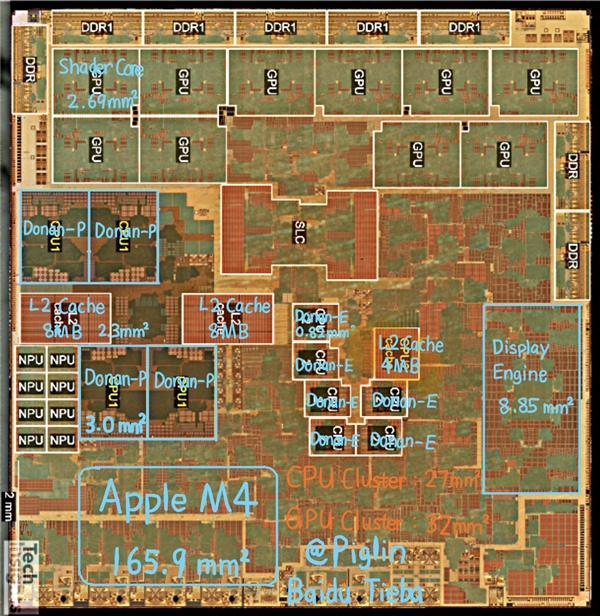
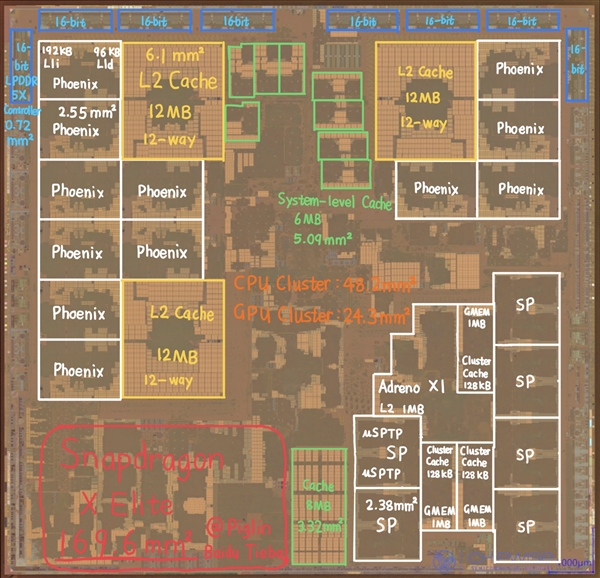
Snapdragon X Elite is only slightly larger than Apple M4
The Snapdragon X Elite has a core area of 169.6 square millimeters, which is almost exactly the same as the Apple M4. However, the Snapdragon chip is based on TSMC’s 4nm process while the Apple M4 is based on TSMC’s 3nm process.
So the Apple M4 can pack more transistors per square millimeter compared to the Snapdragon X Elite, which uses TSMC’s 4nm process. For those unfamiliar, as processes shrink, the space between transistors decreases, allowing more transistors to fit in the same die area. Therefore, the Apple M4 is likely to have a higher transistor count despite the similar core area, which suggests better performance and energy efficiency as compared to Qualcomm’s offering. But surprisingly, the difference in performance and energy efficiency doesn’t seem to be that big.
Notably, while transistor density is a big factor, architecture, design choices (e.g., number of CPU cores, cache size, clock speeds), and optimization also significantly impact performance. For instance, the design of the individual cores and the use of AI accelerators also matter.
A much larger CPU cluster and a relatively compact GPU
The Snapdragon X Elite is equipped with up to 12 Oryon architecture CPU cores, codenamed Phoenix, with a single area of 2.55mm2. This is slightly smaller than the Apple M4’s 3mm2 performance core and is exactly the same as the A16’s performance core. Each core has 192KB of L1 instruction cache and 96KB of L1 data cache, while every four cores share 12MB of 12-way L2 cache (36MB in total), with a single group area of 6.1mm2.
While the CPU cluster occupies significantly more space, the Adreno X1 GPU turns out to be only 24.3mm2, which is 25% smaller than that of Apple’s M4.
(Via)



Comments