Add GIZMOCHINA as Preferred Source on Google
Apple recently surprised the world at an event by introducing the new iPad Pro, powered by the M4 processor. While the iPad Pro itself is a powerful device, the true star of the show was the Apple Silicon M4 chip, making its debut.
As the fourth generation of Apple Silicon chip, the M4 is the company’s most powerful processor yet. But what exactly is the M4, and what features does it bring to the table? Here’s everything you need to know.
1. What Does Apple M4 Chip Offer to Users?
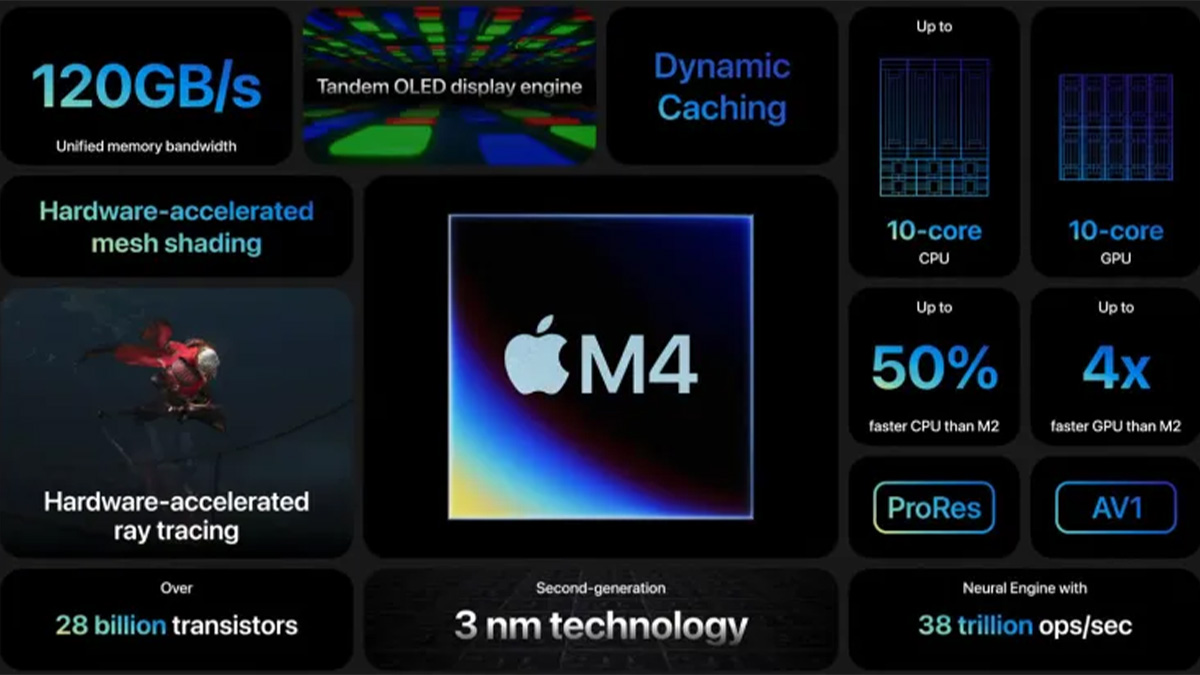
The Apple M4 chip marks a significant advancement in both performance and efficiency. Built on TSMC’s second-generation 3 nanometer process, this chip boasts a remarkable 28 billion transistors, surpassing its predecessor, the M3, with 25 billion. More transistors in a computer chip means it can do more calculations, while using less space and power.
The Apple M4 chip is a big upgrade over the M3, offering improved performance in both CPU and GPU tasks. It features a 10-core CPU, providing a 50% increase in performance compared to the Apple M2 chip. The new chip also introduces several advancements, including a new display engine that enhances the precision, color, and brightness, (for the iPad Pro’s Ultra Retina XDR display).
Hardware-accelerated technologies like dynamic caching, ray tracing, and mesh shading optimize performance across a variety of applications. Additionally, the chip’s 120GB/s memory bandwidth ensures smooth multitasking and efficient handling of data-intensive tasks.
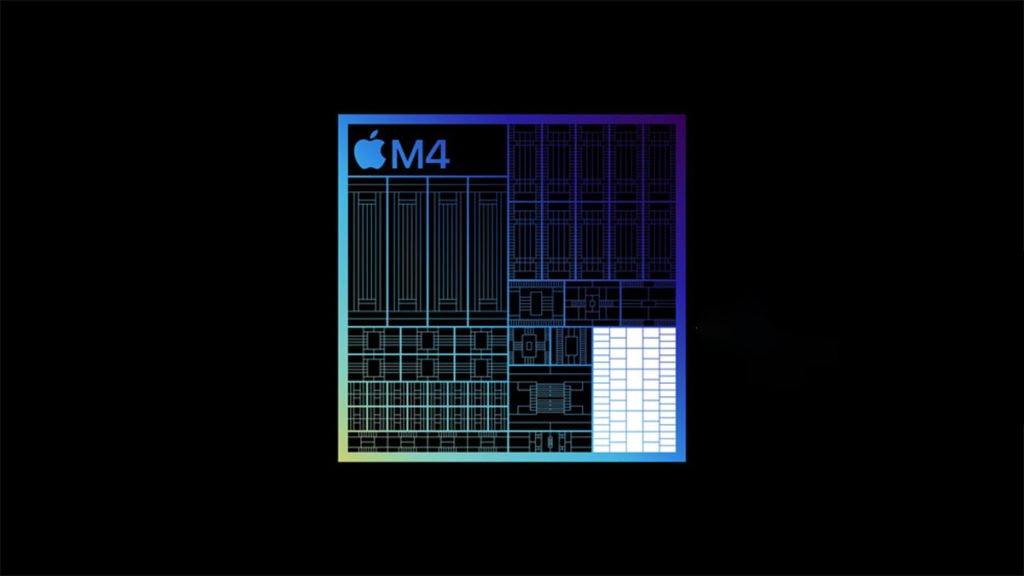
Unfortunately, the M4 chip is currently exclusive to the iPad Pro. However, it is expected to extend its reach beyond the iPad. Rumors suggest it may soon find its way into MacBook Air and MacBook Pro models. Additionally, variants like the M4 Pro and M4 Max are also speculated.
2. Apple M4 vs. M3 Comparison
| Feature | Apple M4 | Apple M3 |
|---|---|---|
| Process Node | 2nd-generation 3nm | 1st-generation 3nm |
| CPU Cores | 8-core (4 performance, 4 efficiency) | 8-core (4 performance, 4 efficiency) |
| GPU Cores | 8-core or 10-core | 8-core or 10-core |
| Neural Engine | 16-core (38 trillion operations per second) | 16-core (18 trillion operations per second) |
| Memory Bandwidth | 120Gbps | 100Gbps |
| Transistors | 28 billion | 25 billion |
| Dedicated Display Engine | Yes | No |
| External Display Support | 1 (iPad Pro) | Up to 2 (MacBook Air) |
| 8K Video Support | Yes | No |
CPU:
- Up to 10-core CPU (4 performance cores and 6 efficiency cores)
- Improved branch prediction
- Wider decode and execution engines for performance cores
- Deeper execution engine for efficiency cores
- Enhanced, next-generation ML accelerators
- Up to 1.5x faster CPU performance than the M2 chip
GPU:
- Up to 10-core GPU
- Up to 4x faster graphics performance than the M2 chip
Neural Engine:
- 16-core Neural Engine
- Capable of 38 trillion operations per second
- 60x faster than the first Neural Engine in A11 Bionic
Other features:
- Fabricated on a 3nm process
- LPDDR5X-7500 RAM support
- Wi-Fi 6E and Bluetooth 5.3 support
- Thunderbolt 3/USB 4 and DisplayPort support
RELATED:
- iPad Air 6th Gen vs iPad Air 5th Gen: Did Apple finally deliver a worthy next-gen upgrade?
- Apple iPad Pro (2024) vs iPad Pro (2022): Which flagship tablet should you buy?
- WhatsApp Last Seen Not Updating? Here’s How to Fix It
- Apple iPad Pro 2024’s New Tandem OLED Display Explained