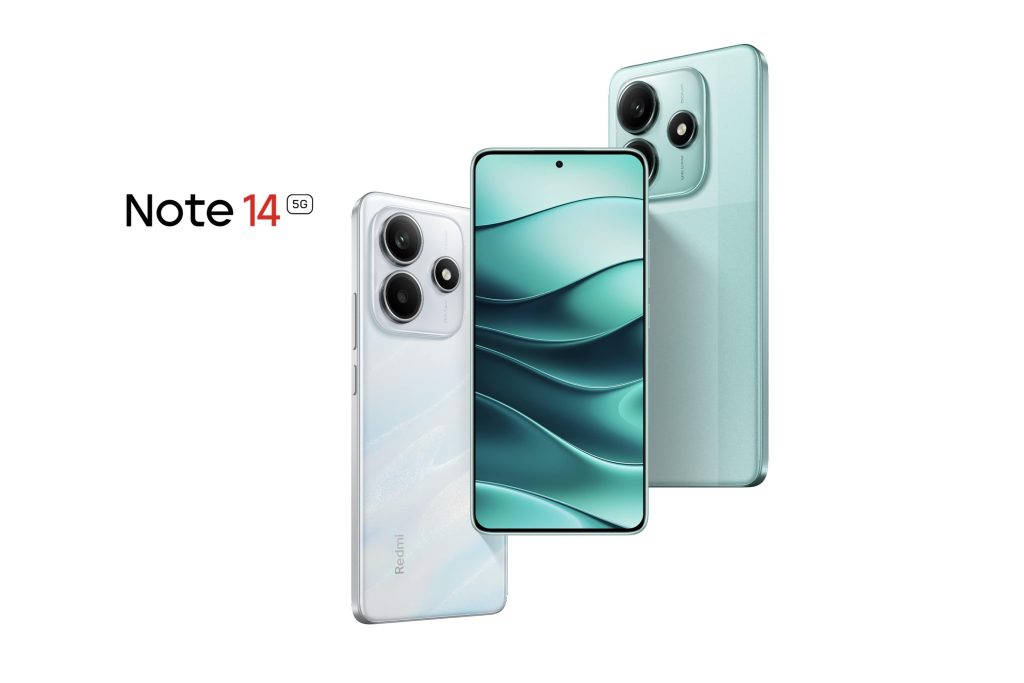
Recently, the Redmi Note 14 series was made official in China. The lineup consists of three devices — a standard and two pro models.
Like previous generations, the pro variants have received several upgrades over their predecessors. On the other hand, the vanilla model is more or less the same as its forerunners with minor differences.
This has been the case for quite a while now. The standard Redmi Note has become the most boring device in the lineup with nothing interesting to offer.
However, there’s always a new vanilla Redmi Note every year. So what does the new Redmi Note 14 have to offer? Let’s find out.
The Redmi Note 14 has almost the same display as the Redmi Note 13 with one major difference. The screen on the newer model is brighter at 2,000 nits compared to 1,000 nits on the older phone.
With a boost in brightness, the display on Redmi Note 14 also supports HDR10 and HDR10+ content. The panel is further complemented by dual stereo speakers, which are absent in last two regular Redmi Notes.
Anyways, the size and display remain the same at 6.67-inch and FHD+ (2400 x 1080 pixels) as the Redmi Note 13. Other retained specs are 120Hz refresh rate, 240Hz (up to 2160Hz) touch sampling rate, and Corning Gorilla Glass 5 protection.
Interestingly, the new model lacks support for 1920Hz PWM dimming. But it comes with a slightly better IP64 rating for splash resistance as compared to IP54 on the older device.
2. Better Primary Camera
The Redmi Note 14 has a new primary camera. It comes with a 50MP sensor with f/1.5 aperture and OIS. For comparison, the Redmi Note 13 has a 108MP main camera without OIS and a slower f/1.7 aperture.
The new camera is still limited to 1080p 30fps video recording. However, it supports 720p 120fps slow-motion video recording.
The secondary 2MP is still a depth sensor and the front 16MP selfie camera remains the same.
3. Slightly More Powerful
The Redmi Note 14 houses a MediaTek Dimensity 7025 Ultra chipset. The only other phones with this chip are Motorola Moto G64 and Moto G55.
This mobile platform has a better GPU than the one included with the Dimensity 6080 SoC inside the Redmi Note 13. Thus, the newer handset should fare better in gaming.
Otherwise, the day-to-day performance should be more or less the same. Both also come with the same LPDDR4x RAM and UFS 2.2 storage.
4. Same Price
Redmi Note 14 is priced similarly to the Redmi Note 13 in China, except for one variant.
The device starts at ¥1199 (~$170) for 6GB + 128GB and goes all the way up to ¥1699 (~$240) for 12GB + 256GB. While the mid 8GB + 128GB and 8GB + 256GB variants are priced at ¥1399 (~$200) and ¥1499 (~$215), respectively.
The 8GB + 128GB version is ¥100 (~$15) costlier than that of Redmi Note 13 at launch.
We use cookies on our website to give you the most relevant experience by remembering your preferences and repeat visits. By clicking “Accept”, you consent to the use of ALL the cookies.
This website uses cookies to improve your experience while you navigate through the website. Out of these, the cookies that are categorized as necessary are stored on your browser as they are essential for the working of basic functionalities of the website. We also use third-party cookies that help us analyze and understand how you use this website. These cookies will be stored in your browser only with your consent. You also have the option to opt-out of these cookies. But opting out of some of these cookies may affect your browsing experience.
Necessary cookies are absolutely essential for the website to function properly. This category only includes cookies that ensures basic functionalities and security features of the website. These cookies do not store any personal information.
Any cookies that may not be particularly necessary for the website to function and is used specifically to collect user personal data via analytics, ads, other embedded contents are termed as non-necessary cookies. It is mandatory to procure user consent prior to running these cookies on your website.