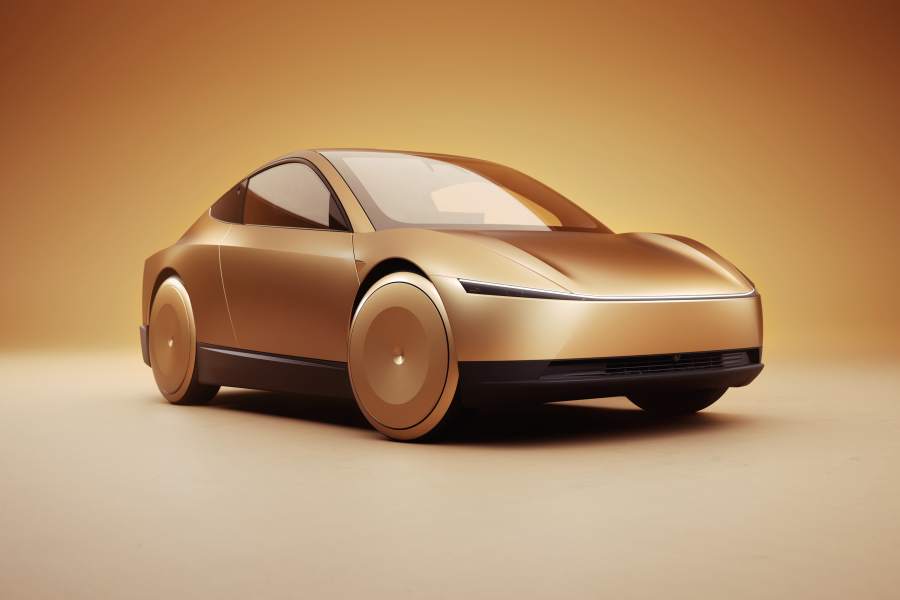
Tesla unveiled its innovative new Cybercab earlier today (11th October 2024). The ambitious robotaxi carries a $30,000 price tag and features a completely autonomous design with no steering wheels or pedals. While all of this sounds pretty futuristic and impressive, one innovation that stood out for me was the innovative new wireless charging technology. So what is it all about? Can it revolutionize electric vehicles? Read on to find out.
The American EV maker’s Cybercab features a sleek new design that borrows looks from the Cybertruck and Robovan. It is a two seater vehicle that is designed to offer a relaxing ride to passengers. This is clearly signified in Tesla’s decision to remove the steering wheel entirely. The Cybercab arrives with a gold finish on the exterior, with a light bar that houses matrix headlights.
The smart taxi also relies heavily on cameras and sensors for a 360 degree view. Its hatchback design blends comfort with a lounge-like atmosphere. Elon is clearly pushing hard on the FSD (full self driving) cars with this announcement. Musk is expecting this small EV that costs less than $30,000 to arrive sometime before 2027. So we can expect a mid to late 2026 release.
2. Induction Wireless Charging: Future of EVs?
Tesla Cybercab could be changing the game in electric vehicles. The robotaxi is the first of its kind, introducing wireless induction charging technology. Why is this so important? current gen EVs still have a wired charging format. But the new Cybercab features no physical charging port, the first Tesla car to remove it. Thanks to inductive charging, the self driving vehicle charges wirelessly using electromagnetic fields to transfer energy from a charging pad to the battery.
In the official announcement, Elon Musk casually stated “The robotaxi has no plug. It just goes over the inductive charger and charges. So, yeah, that’s kind of how it should be.” He also added that “The future has to look like the future”, and these design choices are clearly of a vehicle from the near future. Unfortunately, the launch event did not reveal any finer details like the technical specs of this robotaxi. So we are unsure about Cybercab’s battery size or how induction technology’s charging rate.
3. The Possibilities are Endless
Interesting rumors have also pointed at the induction tech possibly using mats or tracks on roads as well. All of this, in theory, could also help with the long queues at public charging stations that plague cities that have a higher adoption of EVs. There are many issues related to charging faced by EV owners.
One of the big issues also includes charging station compatibility. The infrastructure around EVs for the public includes meeting the requirements to plug and power your car. But these incompatibility problems might disappear if the entire EV segment switches to a common wireless charging standard like Qi wireless charging on smartphones. Although, it is still too early to tell since we’re still a few years from such vehicles hitting the road, but Tesla’s Cybercab does offer us a glimpse of EVs in the future.
We use cookies on our website to give you the most relevant experience by remembering your preferences and repeat visits. By clicking “Accept”, you consent to the use of ALL the cookies.
This website uses cookies to improve your experience while you navigate through the website. Out of these, the cookies that are categorized as necessary are stored on your browser as they are essential for the working of basic functionalities of the website. We also use third-party cookies that help us analyze and understand how you use this website. These cookies will be stored in your browser only with your consent. You also have the option to opt-out of these cookies. But opting out of some of these cookies may affect your browsing experience.
Necessary cookies are absolutely essential for the website to function properly. This category only includes cookies that ensures basic functionalities and security features of the website. These cookies do not store any personal information.
Any cookies that may not be particularly necessary for the website to function and is used specifically to collect user personal data via analytics, ads, other embedded contents are termed as non-necessary cookies. It is mandatory to procure user consent prior to running these cookies on your website.