
Add GIZMOCHINA as Preferred Source on Google
As an Amazon Associate, Gizmochina earns from qualifying purchases. Links on this page may earn us a commission at no extra cost to you.
When deciding between the iPhone 16 Pro Max and Vivo X100 Ultra, you’re choosing between two powerhouse flagship smartphones that push the boundaries of technology. Both devices offer cutting-edge features, from high-performance chipsets to impressive cameras and displays, but they cater to different user needs. Let’s break down these factors in a detailed comparison to help you decide which device is better.
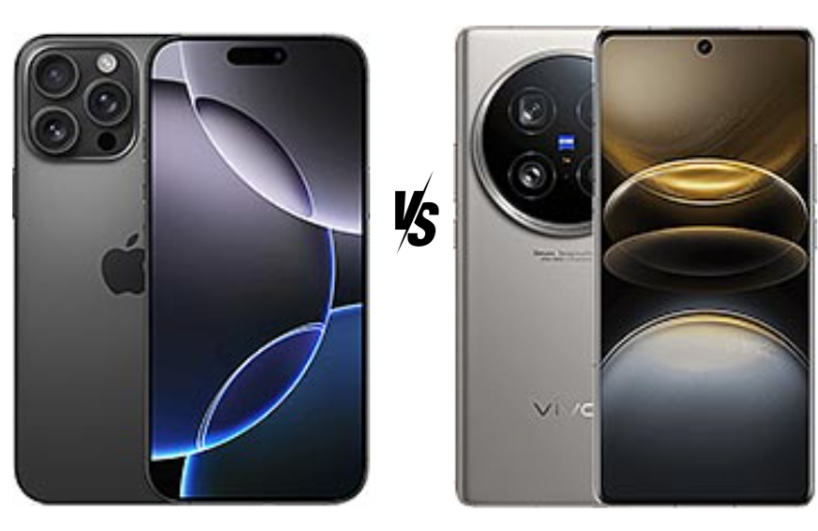
Specs:
| Feature | iPhone 16 Pro Max | Vivo X100 Ultra | Best Specs |
| Design | – Titanium frame with Corning-made glass (front & back)- IP68 (6m for 30 min)- Dual SIM (Nano & eSIM options) | – Aluminum frame with glass (front & back)- IP69/IP68 (1.5m for 30 min)- Dual SIM (Nano-SIM) | iPhone 16 Pro Max – Titanium |
| Display | – 6.9 inches LTPO Super Retina XDR OLED- 120Hz, Dolby Vision, HDR10- 2000 nits (HBM)- 1320 x 2868 pixels (~460 ppi) | – 6.78 inches LTPO AMOLED- 120Hz, Dolby Vision, HDR- 3000 nits (peak)- 1440 x 3200 pixels (~517 ppi) | Vivo X100 Ultra – Display |
| Performance | – Apple A18 Pro chip (3nm)- Hexa-core (2×4.05 GHz + 4×2.42 GHz)- Apple GPU (6-core) | – Snapdragon 8 Gen 3 (4nm)- Octa-core (1×3.3 GHz Cortex-X4 + 3×3.2 GHz Cortex-A720 + 4x other cores)- Adreno 750 | iPhone 16 Pro Max – Chipset |
| Battery | – 4685 mAh- 50% charge in 30 minutes (wired), 25W wireless- 4.5W reverse wireless | – 5500 mAh- 80W wired, 30W wireless charging, reverse wired | Vivo X100 Ultra – Battery |
| Camera | – Triple camera:48 MP (wide), 12 MP (periscope telephoto), 48 MP (ultrawide)- 5x optical zoom- 4K@120fps, ProRes video, LiDAR scanner | – Triple camera:50 MP (wide), 200 MP (periscope telephoto), 50 MP (ultrawide)- 3.7x optical zoom- 8K@30fps | Vivo X100 Ultra – Zoom & 8K |
Design
Features:
- iPhone 16 Pro Max: The iPhone 16 Pro Max features a premium build with a glass front and back made by Corning, framed by a titanium alloy (Grade 5). It is rated IP68 for dust and water resistance, capable of withstanding submersion in water up to 6 meters for 30 minutes.
- Vivo X100 Ultra: The Vivo X100 Ultra comes with a glass front and back supported by an aluminum frame. It also carries an IP69/IP68 rating, which allows for protection from dust and water immersion up to 1.5 meters for 30 minutes.
Similarities: Both phones are durable, designed for premium aesthetics, and offer top-tier water and dust resistance. Neither has a 3.5mm headphone jack, in keeping with modern design trends, but both support advanced audio through their respective stereo speakers.
Differences: iPhone 16 Pro Max uses a more durable titanium frame, making it more resistant to drops and impacts compared to the aluminum frame of the Vivo X100 Ultra. The iPhone’s build quality is further enhanced with Corning-made glass, known for its scratch resistance, whereas Vivo relies on more traditional glass materials.
Advantages: If durability and premium materials are your priorities, the iPhone 16 Pro Max has the edge with its titanium frame and Corning glass. The Vivo X100 Ultra still provides a robust, water-resistant design but doesn’t quite reach the same level of material toughness.
Which Is Better?: For long-term durability and a sleek, ultra-premium feel, the iPhone 16 Pro Max takes the win, though the Vivo X100 Ultra remains an excellent option if you prefer a slightly smaller form factor and lighter build.
Display, Media, and Software
Features:
- iPhone 16 Pro Max: The iPhone features a 6.9-inch LTPO Super Retina XDR OLED display, offering a resolution of 1320 x 2868 pixels. It supports HDR10, Dolby Vision, and peaks at 2000 nits in HBM (High Brightness Mode). It runs on iOS 18, Apple’s latest software, known for its smooth user interface, frequent updates, and optimized performance.
- Vivo X100 Ultra: Vivo offers a slightly smaller 6.78-inch LTPO AMOLED display with a higher 1440 x 3200-pixel resolution. It supports HDR, Dolby Vision, and peaks at an impressive 3000 nits brightness. The Vivo X100 Ultra runs on Android 14 with Vivo’s custom OriginOS 4.
Similarities: Both displays offer stunning visuals with HDR support, high peak brightness levels, and 120Hz refresh rates for smooth scrolling and gaming experiences. They are designed for media consumption with vibrant colors and deep contrasts.
Differences: The Vivo X100 Ultra has a sharper display (517 ppi vs. 460 ppi) and significantly higher brightness, making it better suited for use in direct sunlight. The iPhone 16 Pro Max, while slightly larger, offers excellent brightness and color accuracy, especially with Dolby Vision. The software also differs drastically: iOS 18 is more polished and secure, with a focus on privacy, while Android 14 with OriginOS provides more customization but can be overwhelming for some users.
Advantages: For those who prioritize customization and a sharper display, the Vivo X100 Ultra offers more flexibility with Android 14 and a higher resolution screen. However, if you value software optimization, seamless integration, and security, iOS 18 on the iPhone 16 Pro Max is unmatched.
Which Is Better?: This boils down to user preference. For display quality, Vivo X100 Ultra edges out with its higher brightness and sharper resolution, but if software and seamless integration across devices matter more, the iPhone 16 Pro Max remains the better choice.
Performance and Battery
Features:
- iPhone 16 Pro Max: Powered by Apple’s new A18 Pro chip (3nm), the iPhone delivers hexa-core CPU performance (2×4.05 GHz + 4×2.42 GHz) and a 6-core GPU. It comes with 8GB of RAM and storage options up to 1TB. The 4685 mAh battery supports fast wired (PD2.0) and MagSafe wireless charging, offering 50% in 30 minutes.
- Vivo X100 Ultra: The Vivo X100 Ultra is equipped with Qualcomm’s latest Snapdragon 8 Gen 3 (4nm) chip with an octa-core CPU (1×3.3 GHz Cortex-X4 & 3×3.2 GHz Cortex-A720 & 2×3.0 GHz Cortex-A720 & 2×2.3 GHz Cortex-A520), paired with up to 16GB of RAM. Its 5500 mAh battery supports faster 80W wired charging and 30W wireless charging.
Similarities: Both phones come equipped with top-of-the-line processors and large batteries designed for intensive tasks like gaming, multitasking, and media editing. Neither supports expandable storage, but both offer large internal storage options.
Differences: The Vivo X100 Ultra has the edge in RAM and battery capacity (16GB and 5500mAh vs. 8GB and 4685mAh), making it more suitable for power users who demand the best from their devices. However, Apple’s A18 Pro chip offers superior single-core performance and better optimization, which allows it to compete despite its lower RAM.
Advantages: The iPhone 16 Pro Max is more energy-efficient, thanks to its 3nm architecture, resulting in better long-term battery life. On the other hand, the Vivo X100 Ultra has faster charging and a larger battery, making it ideal for users who need their phone to recharge quickly during the day.
Which Is Better?: The Vivo X100 Ultra wins in terms of raw battery life and charging speed, but the iPhone 16 Pro Max offers a more balanced, efficient performance with better long-term software optimization.
Cameras
Features:
- iPhone 16 Pro Max: Triple-camera system with a 48 MP main sensor, 12 MP periscope telephoto (5x optical zoom), and a 48 MP ultrawide camera. It also features a TOF 3D LiDAR scanner and can record up to 120 fps in 4K and 240 fps in 1080p with Dolby Vision and ProRes.
- Vivo X100 Ultra: Also with a triple-camera setup, Vivo includes a 50 MP main camera with gimbal OIS, a 200 MP periscope telephoto camera (3.7x optical zoom), and a 50 MP ultrawide lens. The front camera offers a staggering 50 MP resolution, supporting 4K video.
Similarities: Both smartphones have high-end camera systems designed for professionals and enthusiasts alike. They support various advanced video recording modes, including HDR and Dolby Vision, and have top-tier image stabilization technologies.
Differences: The Vivo X100 Ultra offers superior optical zoom with its 200 MP periscope telephoto lens, compared to the iPhone 16 Pro Max’s 12 MP telephoto. Additionally, Vivo’s 50 MP front-facing camera is significantly more powerful than the iPhone’s 12 MP selfie camera.
Advantages: For photographers and videographers, the Vivo X100 Ultra offers more versatility, particularly in zoom and resolution. However, the iPhone 16 Pro Max is famous for its consistency, color accuracy, and software-driven computational photography, making it an excellent all-around camera.
Which Is Better?: If camera versatility is key, the Vivo X100 Ultra takes the crown with its higher zoom and selfie capabilities. However, the iPhone 16 Pro Max is better for everyday photography and videography, particularly for those who prefer consistent results with minimal tweaking.
Conclusion: Which is the Better Buy?
Both the iPhone 16 Pro Max and Vivo X100 Ultra are exceptional devices, each excelling in different areas. The iPhone stands out for its durable design, efficient performance, and seamless software experience, particularly for those invested in Apple’s ecosystem. It’s the better option if you prioritize durability, long-term software support, and ease of use.
On the other hand, the Vivo X100 Ultra impresses with its stunning display, superior camera zoom capabilities, and longer battery life. It’s an excellent choice for power users and photography enthusiasts who need top-tier hardware, customization, and battery performance.


Please Note: When you buy something using the links in our articles, we may earn a small commission at no cost to you.
Our Verdict:
If you are already an Apple user or value a smooth, polished experience, the iPhone 16 Pro Max is a solid investment. However, if you prefer Android’s flexibility and want cutting-edge camera and battery tech, the Vivo X100 Ultra offers incredible value.




Comments