
Add GIZMOCHINA as Preferred Source on Google
As an Amazon Associate, Gizmochina earns from qualifying purchases. Links on this page may earn us a commission at no extra cost to you.
Choosing between the newly launched Vivo T3 Ultra and Realme GT 6T presents a challenging decision for tech enthusiasts and everyday users alike. Both phones pack high-end features, promising powerful performance and vibrant displays. However, their unique strengths in design, camera quality, battery life, and software experience mean that each device caters to slightly different needs. This comparison will break down the differences and help you decide which phone is the better buy for your lifestyle and preferences.
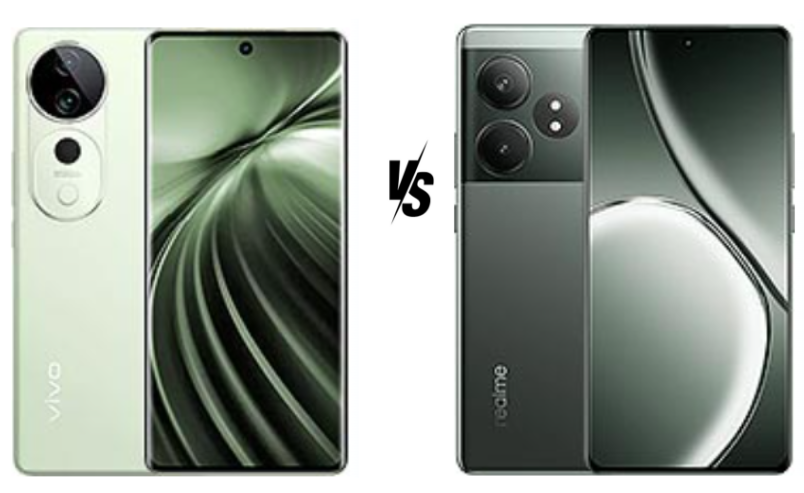
SPECS:
| Feature | Vivo T3 Ultra | Realme GT 6T | Best Specs |
| Design | Glass front and back, IP68 water resistance, 7.6mm thick, 192g | Gorilla Glass Victus 2 front, plastic frame and back, IP65 water resistance, 8.7mm thick, 191g | Vivo T3 Ultra (better durability and premium feel) |
| Display | 6.78” AMOLED, 1260 x 2800 resolution, HDR10+, 120Hz, 4500 nits peak brightness | 6.78” LTPO AMOLED, 1264 x 2780 resolution, HDR, 120Hz, 6000 nits peak brightness | Realme GT 6T (better peak brightness, LTPO) |
| Performance | MediaTek Dimensity 9200+, Octa-core (1×3.35 GHz Cortex-X3) | Snapdragon 7+ Gen 3, Octa-core (1×2.8 GHz Cortex-X4) | Vivo T3 Ultra (stronger performance) |
| Battery | 5500 mAh, 80W wired charging (100% in 56 min), reverse wired | 5500 mAh, 120W wired charging (50% in 10 min) | Realme GT 6T (faster charging) |
| Camera | Rear: 50 MP main + 8 MP ultrawide; Front: 50 MP; 4K@30/60fps (both cameras) | Rear: 50 MP main + 8 MP ultrawide; Front: 32 MP; 4K@30fps front | Vivo T3 Ultra (higher resolution front camera) |
Design & Build Quality
Vivo T3 Ultra: The Vivo T3 Ultra comes with a premium glass front and back, giving it a sleek, modern look. Its dimensions are 164.2 x 74.9 x 7.6 mm, making it slightly thinner than the Realme GT 6T, though marginally heavier at 192 g. Notably, it boasts IP68 water and dust resistance, ensuring that it can survive in up to 1.5 meters of water for 30 minutes, a feature missing in many competitors.
Realme GT 6T: The Realme GT 6T also has a premium design but opts for a plastic frame and back, with a Gorilla Glass Victus 2 front. While the build feels durable, the use of plastic may not feel as premium as the Vivo T3 Ultra’s glass finish. It’s slightly thicker at 8.7 mm but a tad lighter at 191 g. The IP rating is IP65, meaning it can handle light splashes and dust but isn’t as water-resistant as the Vivo model.
Similarities: Both devices are designed with durability in mind and are lightweight, making them portable. They also support dual-SIM functionality.
Differences: The Vivo T3 Ultra has superior water resistance (IP68 vs. IP65), a glass back, and a thinner profile, making it feel more premium.
Verdict: Vivo T3 Ultra wins here due to its premium glass build and better water resistance.
Display
Vivo T3 Ultra: The Vivo T3 Ultra sports a 6.78-inch AMOLED display with HDR10+ support and a 120Hz refresh rate. It’s capable of reaching an astonishing 4500 nits of peak brightness, which makes it an exceptional choice for outdoor viewing. The display resolution is 1260 x 2800 pixels, offering a sharp 453 ppi density for vibrant, detailed images.
Realme GT 6T: The Realme GT 6T has a similarly sized 6.78-inch LTPO AMOLED display, but it uses newer LTPO technology for better power efficiency. With HDR and 120Hz refresh rate, it’s also great for smooth scrolling. Its brightness peaks at 6000 nits, which is even higher than that of the Vivo model, which means it handles bright environments even better. The resolution is 1264 x 2780 pixels with a similar 450 ppi density, giving it nearly the same visual sharpness.
Similarities: Both displays offer 6.78-inch AMOLED panels, 120Hz refresh rates, and similar pixel densities. They are fantastic for media consumption and gaming.
Differences: The Realme GT 6T has slightly better peak brightness (6000 nits vs. 4500 nits) and uses LTPO technology, which could save battery when switching between refresh rates.
Verdict: Realme GT 6T edges out due to its LTPO technology and higher brightness, which enhance the overall display experience.
Performance
Vivo T3 Ultra: Powered by the Mediatek Dimensity 9200+ (4 nm) chipset, the Vivo T3 Ultra is built for heavy tasks and gaming. The octa-core CPU includes a high-performance Cortex-X3 core clocked at 3.35 GHz and a GPU Immortalis-G715 MC11, designed to handle graphically intense games and applications with ease. It comes with up to 12GB of RAM and 256GB of storage.
Realme GT 6T: The Realme GT 6T is equipped with the Qualcomm Snapdragon 7+ Gen 3 (4 nm) chipset, which, while slightly less powerful than the Dimensity 9200+, is still a robust performer. Its octa-core CPU includes a Cortex-X4 core running at 2.8 GHz, making it more energy-efficient but marginally less powerful. The Adreno 732 GPU handles high-end gaming, though not as smoothly as the Vivo’s Immortalis GPU. It also comes with up to 12GB of RAM and 512GB of storage in the higher variant, which is a plus.
Similarities: Both phones offer 4 nm chipsets with octa-core CPUs and up to 12GB of RAM, making them excellent choices for performance-hungry tasks.
Differences: The Vivo T3 Ultra’s Dimensity 9200+ chipset is slightly more powerful than the Snapdragon 7+ Gen 3 in the Realme GT 6T, especially for gaming and multitasking.
Verdict: Vivo T3 Ultra wins for better overall performance, particularly in gaming.
Software & OS
Vivo T3 Ultra: Vivo’s Funtouch OS 14, based on Android 14, offers a clean, customizable interface with various features to enhance user experience. It’s feature-rich but retains some bloatware, which may not appeal to purists.
Realme GT 6T: Realme’s UI 5.0, also based on Android 14, is similarly customizable but is generally considered a little more user-friendly with less bloatware than Vivo’s Funtouch OS. It includes features like enhanced privacy settings and power efficiency improvements.
Similarities: Both phones run on Android 14 with their respective skins offering customization options.
Differences: Realme UI 5.0 has a cleaner experience with fewer unnecessary apps.
Verdict: Realme GT 6T takes the edge with its cleaner, more intuitive software experience.
Camera Systems
Vivo T3 Ultra: The Vivo T3 Ultra features a dual-camera setup with a 50 MP primary camera (with OIS) and an 8 MP ultra-wide camera. The front camera is an impressive 50 MP unit capable of shooting 4K video, which ensures excellent selfies and video calls. Its ring-LED flash enhances low-light shots.
Realme GT 6T: The Realme GT 6T also has a 50 MP primary camera with OIS but uses a 32 MP selfie camera. The ultra-wide camera is similarly 8 MP, and the GT 6T boasts superior video recording options with 1080p@120fps, adding versatility.
Similarities: Both have 50 MP primary and 8 MP ultra-wide cameras with OIS, and both offer 4K video recording on the main and selfie cameras.
Differences: The Realme GT 6T selfie camera is weaker at 32 MP compared to the 50 MP on the Vivo T3 Ultra, but it offers more video recording modes.
Verdict: Vivo T3 Ultra is better for selfie enthusiasts, while Realme GT 6T may appeal to users who need more diverse video options.
Battery Life & Charging
Both phones come equipped with 5500 mAh batteries, but the charging technologies differ.
Vivo T3 Ultra: It supports 80W wired charging, advertised to fully charge the device in 56 minutes, along with reverse wired charging.
Realme GT 6T: This phone takes it a step further with 120W wired charging, allowing it to charge 50% in 10 minutes, making it one of the fastest-charging phones on the market.
Verdict: Realme GT 6T wins with significantly faster charging.
Connectivity
The Vivo T3 Ultra lacks Wi-Fi 6 and NFC, whereas the Realme GT 6T includes both, offering more future-proofing in terms of connectivity.
Verdict: Realme GT 6T wins with more advanced connectivity options.
Speakers & Audio
Both devices feature stereo speakers, but the Realme GT 6T takes the lead with 24-bit/192kHz Hi-Res audio, offering a superior sound experience.
Verdict: Realme GT 6T wins in audio quality.
Security & Biometrics
Both phones have in-display fingerprint sensors and typical accelerometer, gyro, and proximity sensors. The Realme GT 6T adds a color spectrum sensor, enhancing user experience in specific applications.
Verdict: Realme GT 6T takes the lead due to the added color spectrum sensor.
Price & Value
Though the Vivo T3 Ultra is slightly more affordable, the Realme GT 6T offers better connectivity, faster charging, and a more user-friendly software experience, justifying the higher price.
| Preview | Product | |
|---|---|---|

|
realme GT 6T 5G (Fluid Silver,8GB RAM+128GB Storage) | India’s 1st 7+ Gen 3 Flagship Chipset |… | Check Price on Amazon |
Please Note: When you buy something using the links in our articles, we may earn a small commission at no cost to you.
Which is Better?
Both the Vivo T3 Ultra and Realme GT 6T offer compelling packages with strengths in different areas. Vivo T3 Ultra stands out in terms of camera quality, build, and performance, making it ideal for selfie lovers and those seeking a premium design. On the other hand, Realme GT 6T excels with a better display, faster charging, and superior software experience, offering better value for everyday users.
Verdict: The Vivo T3 Ultra is the better choice for performance and photography. For a more balanced, future-proof device with advanced features, the Realme GT 6T is the smarter buy.
Related:




Comments