Add GIZMOCHINA as Preferred Source on Google
As an Amazon Associate, Gizmochina earns from qualifying purchases. Links on this page may earn us a commission at no extra cost to you.
As we step into 2025, smartphone manufacturers have begun unveiling their flagship devices for the year. Among them, Oppo and OnePlus have also introduced their latest flagship models.
For Oppo, it’s the Find X8, while OnePlus has launched the OnePlus 13. It’s no surprise that Oppo and OnePlus operate under the same umbrella, and the similarities between their devices are evident—such as the Hasselblad-tuned cameras featured on both. However, there are some key differences that set them apart.
So, which smartphone is worth your money? Let’s dive into a quick comparison.
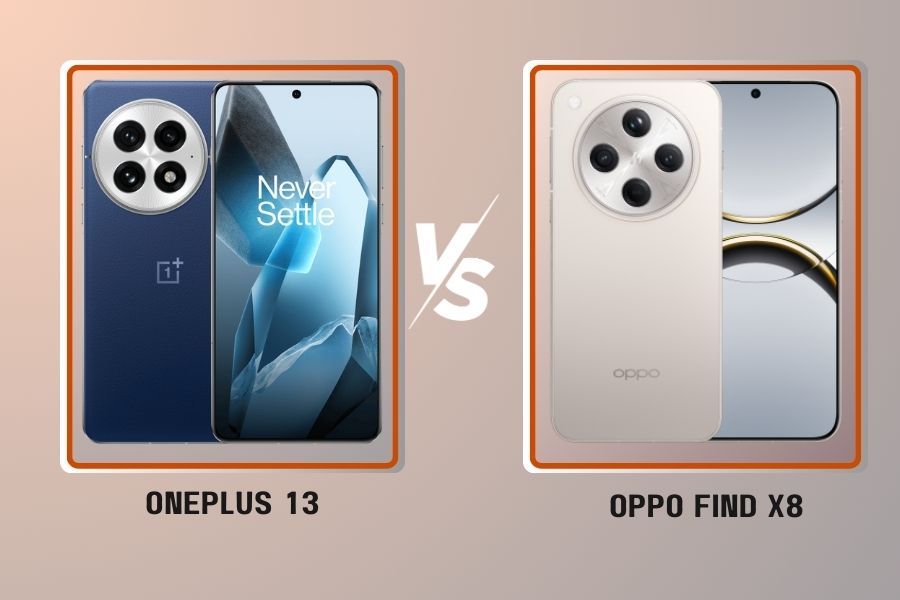
1. Design and Build Quality
Both the Oppo Find X8 and the OnePlus 13 exude premium craftsmanship, but they do so in their own unique ways. The Find X8 is a sleek and lightweight device, measuring 157.4 x 74.3 x 7.9 mm and weighing 193g. Its combination of Gorilla Glass 7i on both the front and back, framed by aluminum, ensures durability while maintaining an elegant feel.
Meanwhile, the OnePlus 13 is slightly larger and heavier, measuring 162.9 x 76.5 x 8.5 mm and weighing up to 213g. It offers a choice between a glass back or eco-leather finish, while its front is protected by Ceramic Guard glass. Both phones boast IP68/IP69 ratings for dust and water resistance.
| Preview | Product | |
|---|---|---|

|
Oppo Find X8 5G (Space Black, 256 GB) (12 GB RAM) | Check Price on Amazon |

|
OnePlus 13| Smarter with OnePlus AI (12GB RAM, 256GB Storage Midnight Ocean) | Check Price on Amazon |
Please Note: When you buy something using the links in our articles, we may earn a small commission at no cost to you.
2. Display
Displays are one of the standout features of flagship smartphones, and these two don’t disappoint. The Oppo Find X8 features a 6.59-inch AMOLED panel with a resolution of 1256 x 2760 pixels, and 460 ppi pixel density. It supports Dolby Vision, and HDR10+, and boasts an incredible peak brightness of 4500 nits.
The OnePlus 13 takes it a notch further with a 6.82-inch LTPO 4.1 AMOLED display at a higher resolution of 1440 x 3168 pixels and a pixel density of 510 ppi.
The phone’s peak brightness matches that of Oppo and they also share the 120Hz refresh rate support. But unlike the OnePlus, the Find X8 uses regular LTPS tech rather than LTPO. As a result, if you prefer a larger screen equipped with the latest tech, the OnePlus 13 is undoubtedly the better choice.
3. Performance
Under the hood, the Oppo Find X8 is powered by MediaTek’s Dimensity 9400 chipset, built on a 3nm process. Its octa-core CPU configuration includes ARM’s latest Cortex-X925 prime core clocked at 3.63 GHz.
The OnePlus 13, on the other hand, features Qualcomm’s Snapdragon 8 Elite processor, also fabricated at 3nm. It boasts innovative Oryon core architecture, with its highest-performing cores running at 4.32 GHz.
Although the Snapdragon 8 Elite’s higher clock speed might suggest greater raw power compared to the Dimensity 9400, note that both are flagship SoCs of 2025. So you can expect a smooth and seamless experience on either device, whether for everyday tasks or intense gaming.
4. Camera Systems
The smartphones have much in common when it comes to cameras. The Oppo Find X8 Pro features a triple 50MP setup, consisting of a wide-angle lens, a periscope telephoto lens with 3x optical zoom, and an ultrawide lens.
The cameras come with the expected Hasselblad Color Calibration and can record up to 4K videos at 60fps, along with Dolby Vision and 10-bit HDR for enhanced video quality.
OnePlus essentially has the same camera setup with a 50MP triple-camera system, also co-engineered with Hasselblad. The OnePlus 13 matches the Find X8 in optical zoom and ultrawide capabilities but adds 8K video recording at 30fps. It also offers higher slow-motion recording at 480fps in 1080p.
On the selfie front, both devices sport 32MP front cameras with gyro-EIS for stable videos. The competition is close here, and the better camera experience ultimately depends on each device’s optimization and post-processing capabilities. We suggest you check detailed comparisons and reviews instead of relying solely on specifications.
5. Software
Both phones ship with Android 15 out of the box. The Find X8 runs on ColorOS 15, while the OnePlus 13 features OxygenOS 15. These Android skins share a common codebase, so they are quite similar in terms of features and functionality.
However, there’s an interesting difference when it comes to software support. Oppo is offering five major Android updates for the Find X8 Pro, while OnePlus, for some reason, guarantees only four updates for the OnePlus 13.
6. Battery and Charging
The Oppo Find X8 packs a 5630mAh battery with support for 80W wired and 50W wireless charging. It also offers reverse wireless charging at 10W.
The OnePlus 13 steps it up with a larger 6000mAh battery. Its 100W wired charging can take the device from 0 to 50% in just 13 minutes, with a full charge in 36 minutes. Both smartphones have 50W wireless charging and OnePlus also supports reverse wired charging at 5W.
7. Connectivity and Extras
Both devices support the latest connectivity standards, including Wi-Fi 7, Bluetooth 5.4, NFC, and GPS with dual-band support. The Find X8 includes USB 3.0 (global), while the OnePlus 13 features the faster USB 3.2 standard. Both also include stereo speakers but lack a headphone jack.
Unique to OnePlus is a barometer sensor, which could be useful for outdoor enthusiasts. Oppo, however, may win over fans of a lighter and more compact device.
8. Pricing and Availability
- Oppo Find X8: ₹62,999
- OnePlus 13: ₹69,999
At these prices, the Find X8 provides excellent value with comparable features, while the OnePlus 13 justifies its higher cost with better performance and a larger battery.
9. Conclusion
The Oppo Find X8 and OnePlus 13 are two of the best flagship smartphones for 2025. If you value sleek design, long-term software support, and a strong camera system, the Find X8 is an excellent choice. However, if you need leading performance, a larger battery, and better video capabilities, the OnePlus 13 could be worth the extra money.
Tech enthusiast? Get the latest news first! Follow our Telegram channel and subscribe to our free newsletter for your daily tech fix!