
Add GIZMOCHINA as Preferred Source on Google
DeepSeek, a Chinese AI company, is making big waves in artificial intelligence. On January 20, 2024, they launched DeepSeek R1, a powerful language model. This model is open-source and affordable, making it a strong competitor to OpenAI’s top models. DeepSeek’s success is challenging the US’s lead in AI development and sending shockwaves through the global tech industry.
What is DeepSeek R1?
DeepSeek R1 is a new kind of AI model built to think and solve problems more like humans. Instead of just using huge amounts of data, it learns in real time, recognizes patterns, and improves on its own. This makes it smarter and more independent, moving AI closer to real human-like reasoning.
Key Features of DeepSeek R1
| Feature | DeepSeek R1 |
| Launch Date | January 20, 2024 |
| Development | Created by DeepSeek, a Chinese AI startup |
| Cost Efficiency | Comparable to OpenAI models but at just 3% of the cost |
| Learning Approach | Large-scale reinforcement learning |
| Accessibility | Fully open-source, allowing unrestricted global development |
| Primary Goal | Supporting the research community in creating smaller, more efficient AI models |
DeepSeek R1’s open-source nature and focus on cost-efficiency offer a stark contrast to Western AI giants, positioning it as a game-changer in the field of artificial intelligence.
The technology behind DeepSeek R1
DeepSeek R1’s architecture combines efficiency and intelligence, setting a new benchmark for AI performance. While traditional AI models require massive computational power, DeepSeek optimizes its neural networks to achieve higher accuracy with fewer resources. This efficiency is crucial for industries like healthcare, finance, cybersecurity, and autonomous systems, where real-time decision-making is essential.
| Feature | Traditional AI Models | DeepSeek R1 |
| Learning Method | Predefined datasets | Adaptive, self-learning |
| Processing Power | High computational cost | Optimized neural efficiency |
| Decision-Making | Rule-based | Contextual & autonomous |
| Transparency | Limited | Explainable AI (XAI) integration |
By utilizing a self-learning framework, DeepSeek reduces reliance on extensive manual programming, making it more adaptable across various industries.
DeepSeek’s Open-Source model gives it an edge over ChatGPT
A key feature of DeepSeek R1 is that it is completely open-source. Unlike OpenAI’s models like ChatGPT, which have restrictions, DeepSeek R1’s code is free for anyone to use and develop. This open approach will help AI grow faster by allowing developers worldwide to improve and build on it.
Open-source AI is also important because it gives everyone access to advanced technology, not just big companies. It helps developers improve and customize AI, making it better for everyone. Being open also builds trust and encourages teamwork, leading to faster progress in AI.
DeepSeek’s disruptive AI development strategy
DeepSeek’s strategy of developing powerful AI models with limited resources sets it apart from its competitors. The R1 model, with only 671 billion parameters, is significantly smaller than those of its rivals.
Only 37 billion parameters are activated during usage, optimizing computational resources. The model was trained with just $5.6 million, far less than the multi-billion-dollar investments made by OpenAI and Google.
How does this impact the AI Market?
The financial impact of DeepSeek’s emergence has been significant. Following the announcement, the Nasdaq Composite Index dropped over 3%, with major U.S. tech firms, including Nvidia, Oracle, and Dell, suffering substantial losses. The world’s 500 richest individuals lost a combined $108 billion, with Nvidia CEO Jensen Huang losing $20.1 billion in a single day.
DeepSeek has gained attention for creating powerful AI models at a much lower cost than big tech companies in Silicon Valley. While Western firms rely on expensive Nvidia GPUs, DeepSeek found a more efficient way to train its AI. Before U.S. export rules tightened, the company collected thousands of Nvidia GPUs, giving it a big advantage in computing power.
Who Created DeepSeek?
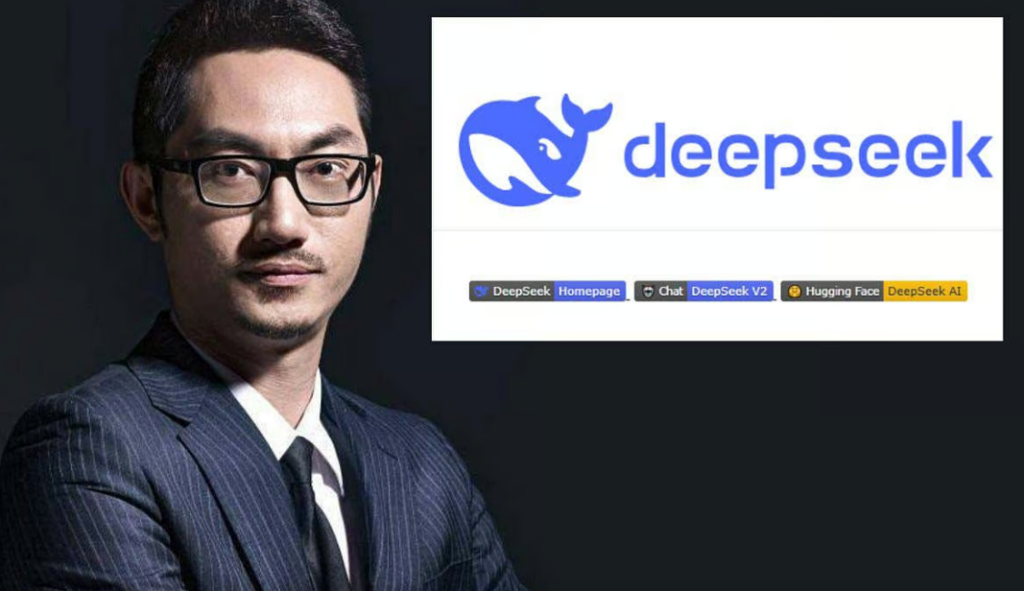
Much of DeepSeek’s success can be attributed to its visionary founder, Liang Wenfeng. Born in 1985, Liang studied information engineering at Zhejiang University before starting DeepSeek in 2023. He has also established High-Flyer Quant, one of China’s largest AI-driven hedge funds. Liang’s emphasis on open AI research and original innovation distinguishes DeepSeek from many other Chinese tech firms, which often focus on adapting existing technologies.
Startup culture is at the heart of this innovation
DeepSeek operates with a start-up mentality. Its team consists of highly skilled graduates from top Chinese universities, including Tsinghua and Peking. The company follows a flat organizational structure, fostering flexibility and rapid innovation. The development of the DeepSeek R1 model involved around 200 researchers, highlighting the company’s collaborative approach to AI development.
AI investments in Silicon Valley are now under huge pressure
DeepSeek’s success challenges the traditional belief that cutting-edge AI development requires massive financial investments. With a reported development cost of just $5.6 million, DeepSeek has shown that efficient AI training methods can rival billion-dollar projects from Western tech giants. This has led to investor skepticism about Silicon Valley’s high-spending AI strategies, raising questions about whether U.S. firms are overinvesting in AI development. Billions of dollars vanished from the market as investors panicked over DeepSeek.
The Global AI Race: U.S. vs. China
As the U.S. and China continue their battle for AI supremacy, DeepSeek’s rise shifts the dynamics of this global competition.
| Factor | United States | China (DeepSeek) |
| AI Investment | Private & government-funded | Chinese Hedge Fund (High Flyer) |
| AI Applications | Research, autonomous tech, ethical AI | Large-scale industrial AI, state monitoring |
| Regulation | Ethical oversight & transparency | Centralized government control |
| AI Chip Access | Advanced GPU technology | U.S. sanctions limiting chip supply |
Despite U.S. sanctions on high-performance AI chips, China is countering by developing its own AI hardware and optimizing models to run on lower-cost chips. This evolving competition is reshaping global AI policies, with both nations striving for dominance in next-generation intelligence systems.
How is the U.S. responding to DeepSeek’s growing influence in AI?
The U.S. government has taken notice of DeepSeek’s disruptive impact. White House press secretary Karoline Leavitt confirmed that U.S. officials are reviewing the national security implications of the Chinese AI model. The National Security Council (NSC) is evaluating potential threats posed by DeepSeek’s AI technology. Concerns have been raised about the potential distillation techniques used by DeepSeek, leading to discussions about stricter measures to prevent unauthorized learning from U.S.-based AI technologies.
US policy shifts and the future of AI regulations
DeepSeek’s rise has forced the U.S. government to reconsider its AI and semiconductor policies. Analysts see DeepSeek’s success as a “Sputnik moment” for the AI race, similar to the Soviet Union’s launch of the first satellite in 1957. U.S. policymakers may shift their focus from hardware bans to regulating AI model behavior and access to training data in the future.
Is this the start of a new age in AI?
DeepSeek’s emergence marks a turning point in the global AI competition. It has demonstrated that China’s private sector can lead in AI innovation, challenging U.S. dominance in the field. As the U.S. reassesses its AI policies and China strengthens its tech ecosystem, DeepSeek is poised to play a pivotal role in shaping the future of artificial intelligence.
Whether this leads to increased competition or collaboration remains to be seen, but one thing is clear, DeepSeek has cemented itself as a game-changer in the AI landscape.
Read More:




Comments