
Add GIZMOCHINA on Google:
As an Amazon Associate, Gizmochina earns from qualifying purchases. Links on this page may earn us a commission at no extra cost to you.
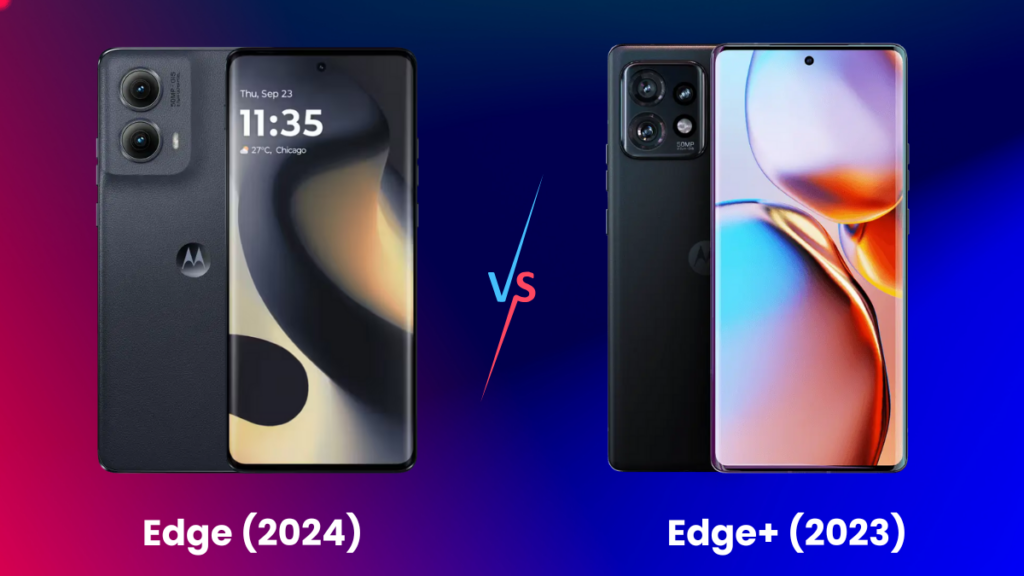
The Motorola Edge (2024) brings a clean and polished design while offering a great display, a capable chipset, and a robust battery that lasts all day. It has gained considerable attention among smartphone seekers. The Edge Plus (2023), on the other hand, is a more premium offering featuring the powerful Snapdragon 8 Gen 2 chipset, a triple-camera setup, and advanced connectivity features.
The two Motorola phones have a pricing difference of $100, but there’s a big difference on the spec sheet. So, which Motorola phone should you choose? Here, we break down the key differences between the Edge (2024) and Edge Plus (2023) to help you make an informed decision.
Motorola Edge (2024) vs Edge Plus (2023): Design and build
Both smartphones sport a premium design with aluminum frames. The Edge (2024) adopts Motorola’s new design language, which extends the camera module into the rear panel for a cleaner look. It features a silicon polymer back that enhances grip and reduces fingerprint smudges.
In contrast, the Edge Plus (2023) has a textured glass back that is nearly immune to fingerprint smudges. It is also more durable, thanks to Corning Gorilla Glass Victus protection on both the front and back, offering better drop and scratch resistance than the Gorilla Glass 3 found on the Edge (2024).
Both models have IP68 rating for the same level of water and dust protection. In terms of size, the Edge Plus (2023) is slightly taller, thicker, and a little heavier than the Edge (2024).
Motorola Edge (2024) vs Edge Plus (2023): Display
Both Motorola phones feature high-quality curved OLED displays with support for over a billion colors and 1,300 nits peak brightness. The Edge (2024) has a 6.6-inch screen, while the Edge Plus (2023) is marginally larger at 6.7 inches. The 2023 model also has a slightly higher refresh rate, though the screen resolution and screen-to-body ratio remain the same.
Additionally, the Edge (2024) includes DC Dimming and PWM for better eye protection.
Motorola Edge (2024) vs Edge Plus (2023): Performance and software
Here’s where the biggest difference lies. The Edge (2024) is powered by a mid-range Snapdragon 7s Gen 2 chipset, while the Edge Plus (2023) packs the flagship Snapdragon 8 Gen 2, offering significantly better performance and battery efficiency.
Here are the benchmark results:
AnTuTu (v10) performance
| Edge (2024) | Edge+ (2023) | |
|---|---|---|
| AnTuTu score | 601,428 | 1,472,745 |
| CPU | 198,727 | 339,588 |
| GPU | 117,371 | 552,853 |
| Memory | 133,253 | 293,250 |
| UX | 152,077 | 287,054 |
Geekbench (v6) performance
| Edge (2024) | Edge+ (2023) | |
| Single core | 1,012 | 1,985 |
| Multi core | 2,843 | 5,276 |
The Edge Plus (2023) outperforms the Edge (2024) by a large margin. It scores more than twice the AnTuTu score of Edge (2024) and achieves nearly 90% better Geekbench scores.
For everyday tasks like browsing and social media, the Edge (2024) feels smooth and responsive. It can also handle casual gaming but may struggle with high-end titles that the Edge Plus (2023) runs effortlessly.
The software promise isn’t impressive, though. The Edge (2024) will only get two Android updates and three years of security patches. The Edge Plus (2023) will get an extra OS update and an additional year of security patches. Since the 2023 model was released with an older version of Android, both phones would receive Android 16 as their last major OS upgrade.
Motorola Edge (2024) vs Edge Plus (2023): Camera
The Edge Plus (2023) has an overall superior camera setup than the Edge (2024). It has a 13MP telephoto sensor, which is lacking on the Edge (2024). The 2023 model also benefits from a higher resolution ultrawide camera for better clarity. Both models share a 50MP primary sensor, though.
There’s also a notable difference in the video recording. The Edge (2024) lets you do up to 4K/30fps recording, while you can do up to 8K/30fps or 4K/60fps on the Edge Plus (2023).
On the other side, you get a 32MP selfie shooter on Edge (2024) and a 60MP on the Edge Plus (2023). The latter lets you do up to 4K/60fps recording, which is limited to 1080p/30fps on the Edge (2024).
In short, the Edge Plus (2023) offers better zoom capabilities, higher-resolution ultrawide shots, and superior video recording options.
Motorola Edge (2024) vs Edge Plus (2023): Battery and charging
The Moto Edge (2024) has a 5,000mAh cell inside that easily lasts for a day on regular usage. And, using the 68W adapter, you can refill it well within an hour.
The Edge Plus (2023) has a slightly larger 5,100mAh battery. While the difference in capacity isn’t huge, Snapdragon 8 Gen 2’s superior efficiency extends battery life by a few extra hours.
The Edge+ (2023) also supports 68W wired and 15W wireless charging, just like the Edge (2024). But the Edge Plus (2023) also includes 5W reverse wired and reverse wireless charging for topping up your earbuds, smartwatches, or other smartphones in emergencies.
Motorola Edge (2024) vs Edge Plus (2023): Connectivity
The Edge Plus (2023) offers Wi-Fi 7 for faster speeds and better performance in congested networks, compared to Wi-Fi 6E on the Edge (2024). It also has newer-generation Bluetooth and USB standards, ensuring more reliable connectivity and faster data transfer speeds.
Overall, the Edge Plus (2023) is more future-proof with its advanced connectivity features.
Motorola Edge (2024) vs Edge Plus (2023): Conclusion
The Edge (2024) is a solid mid-range option with a sleek design, vibrant display, decent battery life, and good overall performance. However, the Edge Plus (2023) is the clear winner in almost every aspect — it has a far more powerful chipset, superior cameras, future-proof connectivity, stronger Gorilla Glass protection, and better battery efficiency.
With only a $100 price difference, the Edge Plus (2023) offers significantly better value for power users and those looking for long-term performance.
Tech enthusiast? Get the latest news first! Follow our Telegram channel and subscribe to our free newsletter for your daily tech fix! ⚡



Comments