
Add GIZMOCHINA as Preferred Source on Google
Huawei and Chery are back with another entry in their joint venture, Luxeed. The two companies, operating under the Harmony Intelligent Mobility Alliance (HIMA), just launched the Luxeed R7 Extended Range Electric Vehicle (EREV) in China.
The EV is available in two trims: Max and Ultra, and is priced at RMB 299,800 (roughly $41,250) and RMB 319,800 (about $43,700), respectively.
Luxeed R7 Overview
The R7 is a five-meter-long SUV with a low drag coefficient of just 0.247 Cd. Its design is sleek and modern with hidden door handles, panoramic roof, and LED light bars on the front and rear. It is available in eight different colors, including the new Tourmaline Blue.

Inside, there’s a 52L frunk and up to 2130L of storage in the rear with the seats folded down. And if you’re after long-haul comfort, Huawei’s clearly trying to check those boxes.
The cabin gets a zero-gravity co-pilot seat with 18-way adjustment, a leg rest, heating, ventilation, and massage, all the comfort features you expect when you’re inching toward $50K. For entertainment, it has a 17-speaker, 1000W Huawei-branded audio system.
Under the hood (or under the floor, more accurately) both trims use a 1.5L four-cylinder range extender paired with a 53.4kWh LFP battery from CATL. It runs on Huawei’s Jujing 400V platform which can go from 20% to 80% in just 15 minutes.

And with a full battery and fuel tank, the Max model (rear-wheel drive) claims a total range of 1,673km. That’s up seven percent from the previous model, and more than enough to challenge the likes of Tesla’s Model Y or NIO’s ES8 in terms of distance.
Performance and Tech
Performance-wise, the SUV can go from 0 to 100km/h in 7.4 seconds. Not the fastest, but if you want more punch, the Ultra trim throws in all-wheel drive with dual motors for a combined 510 horsepower. That version hits 100km/h in 4.9 seconds, but slightly compromises on total range (down to 1,551km).
Huawei is also flexing its tech muscle here. The R7 gets its latest Qiankun ADS 3.0 system with 192-line LiDAR, 3 millimeter-wave radars, 12 ultrasonic sensors, and 11 cameras.
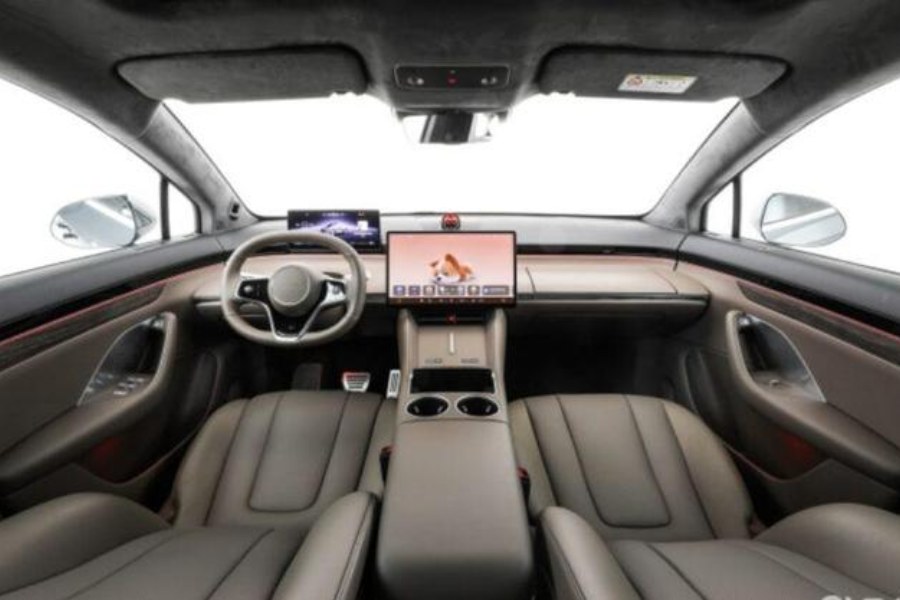
It supports city and highway NOA navigation and can park itself. The dashboard is powered by HarmonyOS 4, which runs on a 15.6-inch central touchscreen and a 12.3-inch digital gauge cluster. OTA updates are supported, as expected.
For driving dynamics, the R7 sits on the Huawei Turing intelligent chassis with a standard double wishbone front and multi-link rear suspension setup. Braking from 100km/h to 0 reportedly takes just 35.6 meters, and Huawei’s iVSE system adjusts for varying road conditions.
Huawei Luxeed R7 Specifications
| Specification | Max (RWD) | Ultra (AWD) |
| Price (CNY/USD) | ¥299,800 (~$41,250) | ¥319,800 (~$43,700) |
| Drive Type | Rear-Wheel Drive | All-Wheel Drive |
| Motor Output | 227 kW (304 hp) | 382 kW (510 hp) (155 kW front + 227 kW rear) |
| Acceleration (0–100 km/h) | 7.4 seconds | 4.9 seconds |
| Curb Weight | 2,308 kg | 2,388 kg |
| Pure Electric Range (CLTC) | 360 km | 331 km |
| Total Range (Comprehensive) | 1,673 km | 1,551 km |
| Powertrain | 1.5T 4-cylinder Range Extender (115 kW, Chery SQRH4J15) + Electric Motor(s) | |
| Battery | 53.4 kWh LFP battery (CATL) | |
| Charging Time (20–80%) | 15 minutes (400V fast charging) | |
| Fuel Tank Capacity | 67 liters | |
| Fuel Consumption (Comprehensive) | 0.46 L/100 km | |
| Suspension | Front Double Wishbone / Rear Multi-link Independent Suspension with Continuously Variable Damping | |
| Optional Suspension | Air Suspension | |
| Braking Distance (100–0 km/h) | 35.6 meters | |
| Moose Test Speed | — | 82.2 km/h |
| Dimensions (L/W/H) | 4956 / 1981 / 1634 mm | |
| Wheelbase | 2950 mm | |
| Drag Coefficient | 0.247 Cd | |
| Frunk Capacity | 52 liters | |
| Rear Trunk Capacity | 837–2130 liters (with foldable rear seats) | |
| Infotainment OS | HarmonyOS 4 | |
| Display Screens | 15.6-inch Central Touchscreen + 12.3-inch Digital Instrument Panel | |
| Audio System | 17-Speaker Huawei Sound System (1000W) | |
| Seating Features | Seat heating, ventilation, massage, zero-gravity co-pilot seat with 18-way adjustment and leg rest | |
| ADAS / Autonomy | Huawei Qiankun ADS 3.0 | |
| Sensors | 192-line LiDAR, 3 mm-wave radars, 12 ultrasonic sensors, 11 cameras | |
| Connectivity / Updates | Multi-screen linkage, OTA updates | |
| Platform | Huawei Jujing 400V platform | |
| Chassis | Huawei Turing Intelligent Chassis + iVSE Intelligent Perception | |
| Noise/Vibration Optimization | “Intelligent Quiet” tech (90% vibration reduction) |




Comments