Add GIZMOCHINA on Google:
Apple recently launched its most affordable iPhone yet, the 16e, and it comes with some notable upgrades. The model lands squarely between the iPhone 15 and the standard iPhone 16, not just in features, but also in price.
But there’s a catch. The iPhone 15 is getting cheaper in many markets as it is a gen-old model now. And with the 16e only a modest step up in price, there’s a common debate among all of us. Should I go for the discounted iPhone 15, or spend a little more for the newer iPhone 16e?
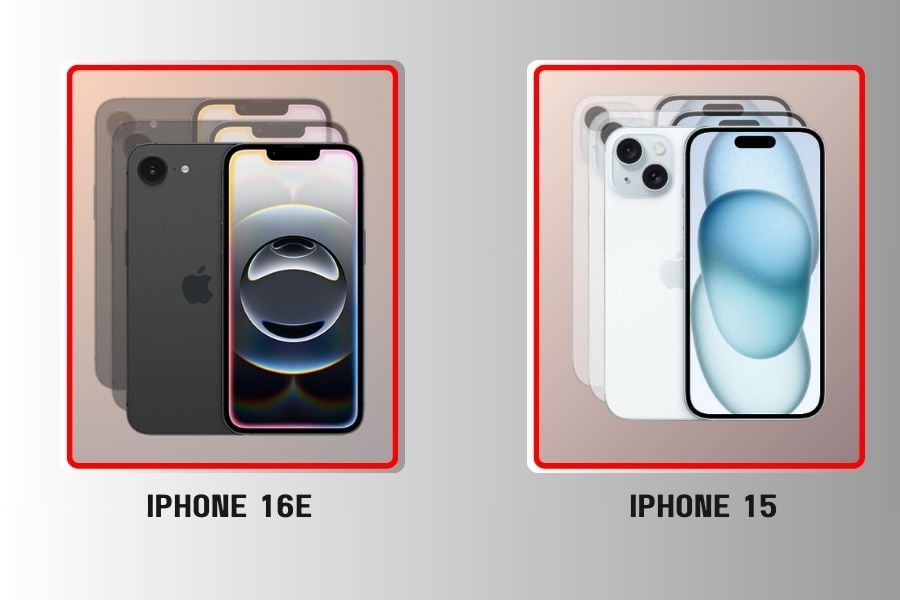
It’s not a simple yes-or-no scenario. On paper, the iPhone 16e brings some newer internals and a slightly larger battery. But there are trade-offs, and the decision depends on how much you value certain hardware features over others.
1. Look That’s… Almost the Same
Apple hasn’t strayed far from its existing design language in either phone. Both phones have flat front and back panels with nearly identical dimensions. The iPhone 15 measures 147.6 x 71.6 x 7.8 mm, while the 16e comes in just slightly shorter and narrower at 146.7 x 71.5 x 7.8 mm.
The weight difference is also barely anything, 171 grams versus 167 grams. Both use an aluminum frame and glass front and back, and both maintain IP68 water and dust resistance.
That said, there are enough visual differences to tell them apart. The iPhone 15 has a Dynamic Island module on the front and a diagonally arranged camera sensor in back. Whereas, the 16e settles for a conventional static display notch and a single camera at the back.
The colors also differ slightly, with the iPhone 15 offering more playful options like pink, green, and yellow, while the iPhone 16e sticks with black and white.
2. Brighter on the 15, Smoother on Neither
Both phones sport a 6.1-inch Super Retina XDR OLED display. They support HDR10 and Dolby Vision, and both are protected by Ceramic Shield glass. The differences lie in brightness.
The iPhone 15 has the upper hand in peak brightness, reaching 2000 nits versus 1200 nits on the iPhone 16e. That makes it easier to use outdoors in direct sunlight.
However, Apple hasn’t given either phone a high refresh rate screen. 60Hz remains the norm for non-Pro iPhones even in 2025. So if you were hoping for smoother scrolling or gaming, you’ll need to look elsewhere in the lineup.
3. Performance is a clean win for the 16e
The biggest internal change is the chip. The iPhone 15 runs on the Apple A16 Bionic, which powers the iPhone 14 Pro series. It’s still a capable processor, built on a 4nm process, with a 6-core CPU and 5-core GPU.
The iPhone 16e, on the other hand, gets the newer Apple A18 chip, built on a more efficient 3nm process. Clock speeds are slightly higher (4.04 GHz on the performance cores vs. 3.46 GHz on the A16). You also get 8GB of RAM versus 6GB on the iPhone 15.
That should theoretically offer better multitasking and longer-term software support. But in day-to-day use, you’re unlikely to notice major differences unless you’re doing something resource-heavy. App launches, camera performance, and general navigation feel nearly identical between the two.
4. Cameras
Here’s where the iPhone 15 arguably pulls ahead, or at least offers more flexibility. It features a dual-camera setup: a 48MP main sensor and a 12MP ultrawide sensor. The iPhone 16e drops the ultrawide entirely and sticks to a single 48MP camera.
That means no ultrawide photography on the 16e. For users who rely on that second lens, this could be a noticeable downgrade.
That said, the 16e does include Apple’s newer 3D spatial audio recording feature for both the main and front cameras, something the iPhone 15 lacks. But unless you’re capturing content for an Apple Vision Pro, that feature feels more niche than essential.
5. Battery and Charging
The iPhone 16e has a 4005 mAh battery, a sizable jump over the iPhone 15’s 3349 mAh. That’s a real difference, on paper, at least. With more efficient 3nm silicon, the 16e might last a bit longer in daily usage, especially under lighter loads.
But there’s a catch in charging. The iPhone 15 supports faster wireless charging: 15W with MagSafe or Qi2, and it can reverse charge up to 4.5W. The iPhone 16e drops MagSafe entirely and maxes out at 7.5W wireless charging on standard Qi pads.
Wired charging remains at 50% in 30 minutes on both models, and both use USB-C, though only at USB 2.0 speeds.
By the time you buy either of these phones, both will run iOS 18. While the iPhone 16e ships with 18.3.1 and the iPhone 15 requires an upgrade, the user experience is fundamentally the same.
The A18 chip in the 16e might get software support a year longer than the A16 in the 15, though Apple hasn’t made that timeline public yet. Historically, iPhones receive around five years of updates, and that likely holds for both.
6. Connectivity and Sensors
The iPhone 16e adds support for NavIC positioning (India’s satellite system), which may improve accuracy in certain regions. Otherwise, both phones offer dual eSIM support, Face ID, satellite emergency services, and Ultra Wideband (Gen 2 for iPhone 15).
Both have stereo speakers and no headphone jack, as expected. Storage options start at 128GB and go up to 512GB on both.
7. Price
The iPhone 15 starts at ₹63,999 in India, with sale prices bringing it down to as low as ₹58,999. Meanwhile, the iPhone 16e starts at ₹60,000. Even at its original price, that’s a minimal difference, for which you get wireless charging support, better cameras, and a more modern design. Considering the sales price, you get even better value.
As is the truth, the 16e is a cut-down version of the iPhone 14. It’s that it comes with a slightly better chip and improved battery life.
8. The Bottom Line
If you’re a casual user looking for the best value, the iPhone 15 is still a practical and well-rounded device, especially at its current price. It offers solid performance, versatile cameras, and faster wireless charging.
The iPhone 16e is newer and has some meaningful improvements. It has a slightly better processor, more RAM, and longer battery life. But those changes are incremental, and the single camera setup limits its appeal for users who want more shooting flexibility.
Unless you need the latest chip or a bit more RAM for future-proofing, the iPhone 15 probably remains the better deal, at least for now.
Don’t miss a thing! Join our Telegram community for instant updates and grab our free daily newsletter for the best tech stories!
For more daily updates, please visit our News Section.