
Add GIZMOCHINA as Preferred Source on Google
Set for a May 22 debut in China, the Xiaomi Pad 7 Ultra has surfaced on Geekbench, showcasing its underclocked XRing O1 chipset. Despite lower clock speeds, it delivers superior performance compared to the Samsung Galaxy Tab S10 Ultra’s MediaTek Dimensity 9300+.
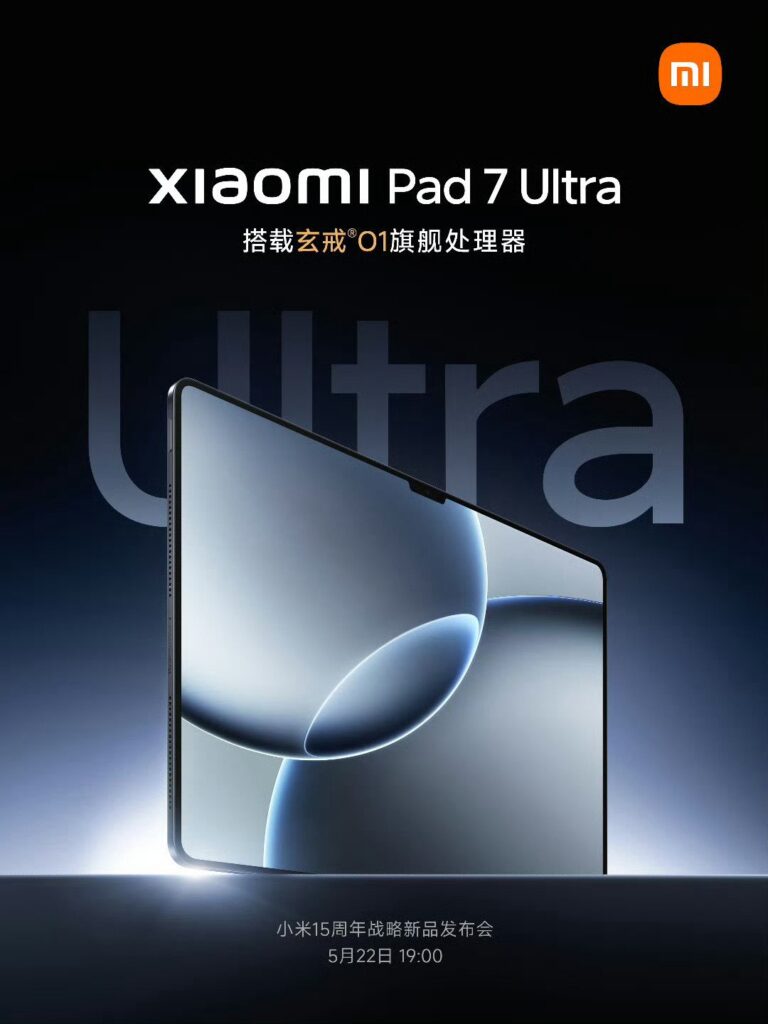
The Xiaomi Pad 7 Ultra, model 25032RP42C, is poised to be Xiaomi’s premium tablet, launching alongside the Xiaomi 15S Pro. Pad 7 Ultra’s Geekbench 6 scores of 2,715 (single-core) and 8,849 (multi-core) highlight the prowess of its in-house XRing O1 SoC, built on TSMC’s 3nm process. However, the chip is underclocked compared to the 15S Pro, with two prime cores at 3.70GHz (vs. 3.90GHz) and four cores at 3.04GHz (vs. 3.40GHz), resulting in a 15% performance dip.
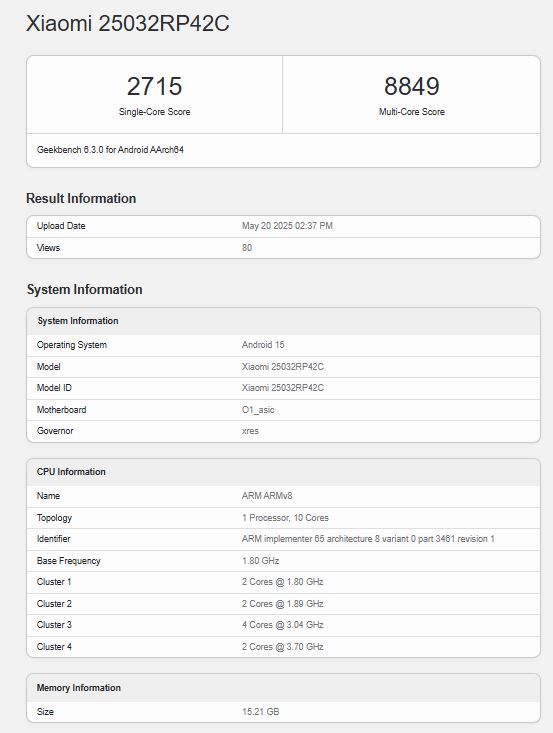
Despite this, the Pad 7 Ultra trounces the Samsung Galaxy Tab S10 Ultra, which scores 2,192 and 7,327 with its MediaTek Dimensity 9300+ (1x Cortex-X4 at 3.4GHz, 3x Cortex-X4 at 2.85GHz, 4x Cortex-A720 at 2.0GHz). The Xiaomi tablet’s 10-core XRing O1, paired with a Mali-G925-Immortalis GPU, offers roughly 20% better performance, making it a formidable rival.
The Pad 7 Ultra also boasts 16GB RAM, a 14-inch 120Hz OLED display with 3.95mm bezels, and a 12,000mAh battery with 120W charging, weighing 609g at 5.1mm thick. For context, the Snapdragon 8+ Gen 1-powered Pad 6 Pro’s 11-inch IPS display has a resolution of 1800 x 2880 pixels and reaches a peak brightness of 550 nits. The more recent Pad 6S Pro 12.4 packs 2032 x 3048 pixels and the Snapdragon 8 Gen 2.
While the Pad 7 Ultra trails Snapdragon 8 Elite tablets, its efficiency and stylus support position it as a premium contender. Will Xiaomi’s first Ultra tablet redefine the market, or will Samsung’s ecosystem hold sway? The launch will tell.
Don’t miss a thing! Join our Telegram community for instant updates and grab our free daily newsletter for the best tech stories!
For more daily updates, please visit our News Section.
(Source)



Comments