Add GIZMOCHINA as Preferred Source on Google
As an Amazon Associate, Gizmochina earns from qualifying purchases. Links on this page may earn us a commission at no extra cost to you.
Realme and iQOO continue their predictable cycle of mid-year smartphone releases, this time with the GT 7T and the Neo 10. Both phones follow a familiar formula of offering big AMOLED displays, fast charging, and performance-centric internals.
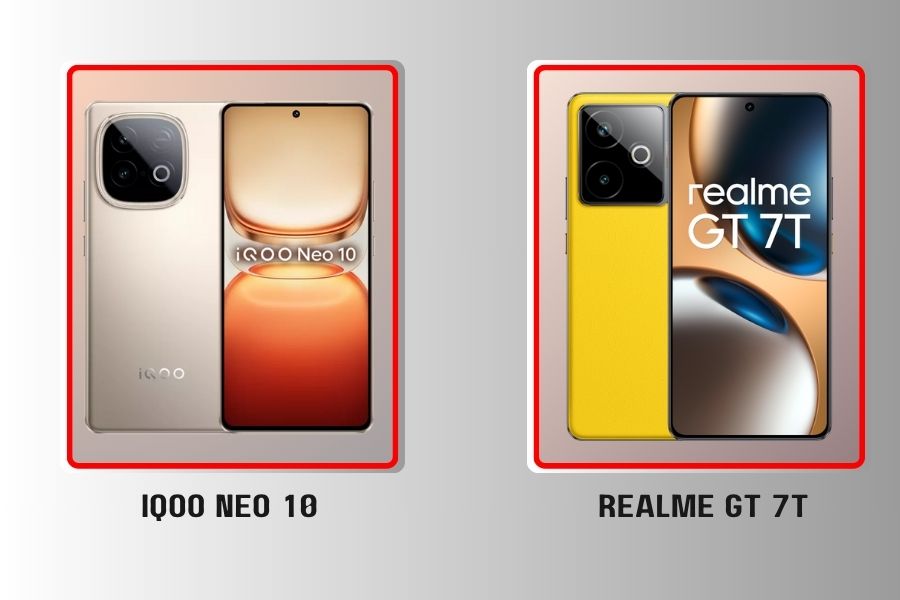
But there are obvious differences between the two. The GT 7T leans heavily into display quality and longer software support. The Neo 10, on the other hand, tries to differentiate through a newer Snapdragon chipset and slightly better thermals and performance tuning, at least on paper. Let’s break it all down.
1. Design and Build
From a distance, both phones look like standard fare. Both feature glass fronts, large panels, and symmetrical bezels. But the two phones differ slightly in terms of build quality.
The GT 7T has an IP68/IP69 rating, which means the device can be submerged and hit with even high-pressure water. iQOO also offers an IP rating for Neo 10, but it’s just resistant to low-pressure water jets with IP65.
For any positives, iQOO does add a MIL-STD-810H tag, but as usual, that means little unless you’re actively trying to stress-test the phone in extreme conditions.
The materials used tell a similar story. The Neo 10 has a plastic back and frame, while the GT 7T has a more polished finish, particularly with its “IceSense” color variants. They use graphene material for thermal conductivity and have a glass fiber finish on the back.


Please Note: When you buy something using the links in our articles, we may earn a small commission at no cost to you.
2. Displays
Realme and iQOO both bring AMOLED panels with over a 6.7-inch footprint. The iQOO Neo 10 touts a 144Hz refresh rate, slightly edging out the GT 7T’s 120Hz, but there’s more to it.
Where Realme really sets itself apart is brightness. The GT 7T has a peak brightness of 6000 nits, which is a notable jump over the Neo 10’s already high 4400 nits. However, these numbers are hardly likely to make a difference in real life. Both should be plenty bright for use outdoors. Realme also includes Dolby Vision and HDR10+, while iQOO’s HDR support isn’t as well defined.
Color depth and resolution are mostly the same. Both displays push 1280 x 2800 resolution at around 453ppi, and both can render 1 billion colors. But the GT 7T also uses ArmorShell glass, which is likely more resistant to scratches and drops than the standard offering on the Neo 10.
3. Software and Updates
The phones come pre-installed with Android 15 out of the box. Realme is further promising 6 years of Android upgrades, meaning the device is good for up to the 2030s.
In contrast, the iQOO Neo 10 tops out at 3 years of major OS updates, which is in line with most midrange Android devices, but still looks dated when stacked next to Realme’s new update policy.
On the UI side, it’s Realme UI 6.0 vs Funtouch 15. Neither is stock Android, and both are packed with extra features and some bloat. The experience will mostly come down to personal preference, though Realme’s UI tends to feel more polished over time.
4. Performance
This is where things get more technical. The iQOO Neo 10 uses the newer Snapdragon 8s Gen 4, while the GT 7T goes with MediaTek’s Dimensity 8400 Max. Both are built on a 4nm process, both are powerful, and neither will struggle with day-to-day performance or gaming.
The Snapdragon 8s Gen 4 includes a Cortex-X4 performance core, which should give it the edge in raw benchmark scores and GPU-heavy workloads. The Adreno 825 GPU on the Neo 10 is expected to outperform the Mali-G720 MC7 inside the Realme device in most gaming scenarios.
That said, Realme has done a decent job optimizing the Dimensity series in the past, so real-world differences may not be dramatic unless you push the phone with long gaming sessions or resource-intensive tasks.
Both phones also include Circle to Search, an AI feature that’s slowly making its way across Android devices. It’s not exclusive anymore, but it’s still notable.
5. Cameras
You’ll find near-identical dual-camera setups on both devices:
- 50MP main sensor with OIS
- 8MP ultrawide sensor
Realme adds a color spectrum sensor, which may help with white balance accuracy. It also seems to use a larger main sensor (1/1.56”) compared to iQOO’s 1/1.95”, which might give it a slight edge in low-light conditions. The GT 7T also supports 4K selfie video, while the Neo 10 caps out at 1080p on the front-facing camera, despite both using a 32MP sensor.
Video capabilities are nearly identical: 4K at 60fps, OIS, and gyro-EIS on the main camera. Don’t expect flagship-level imaging, but both phones should do fine in daylight and controlled lighting.
6. Battery and Charging
Both phones carry a 7000mAh battery, which is more than most devices in this segment and should provide solid two-day battery life for average users.
Charging is also fast on both. They each support 120W wired charging. iQOO also supports Power Delivery and PPS at 100W, plus reverse wired charging. That might matter if you want to charge another device from your phone. Both support bypass charging, which is helpful when gaming while plugged in
7. Connectivity and Extras
Both phones feature stereo speakers, under-display fingerprint scanners, and support for dual SIM, NFC, IR blasters, and high-accuracy GNSS positioning. Neither includes a 3.5mm headphone jack, but both support high-res audio through USB-C.
Where iQOO edges ahead is in Wi-Fi 7 support, offering slightly better future-proofing compared to Realme’s Wi-Fi 6.
8. Final Thoughts
The GT 7T is the more well-rounded device, particularly for users who value display brightness, software updates, and durability. The Neo 10, meanwhile, delivers better value for performance and could appeal more to gamers and those on tighter budgets.
Neither phone changes the midrange game, but they do reflect how far that segment has come. If you’re picking one, the decision likely comes down to priorities: better software and build with Realme, or stronger internals and affordability with iQOO.
For more daily updates, please visit our News Section.
Stay ahead in tech! Join our Telegram community and sign up for our daily newsletter of top stories! 💡