
Add GIZMOCHINA as Preferred Source on Google
Both Qualcomm and MediaTek have been pushing the limits of their mid-range smartphone chipsets, delivering high-end performance that was exclusive to flagship SoCs not too long ago. The Snapdragon 8s Gen 3 and Dimensity 8300 Ultra are two such examples, offering blazing-fast performance, efficient multitasking, and solid efficiency without a flagship price tag.
But how do these two mid-range chipsets stack up against each other? In this detailed comparison, we break down the benchmark scores and key features to help you pick the right one for your next smartphone upgrade.
Note: The Dimensity 8300 Ultra isn’t an entirely new chip. It shares the same hardware foundation as the standard Dimensity 8300 but includes several firmware-level optimizations, often customized for brands like Xiaomi.
Let’s quickly take a look at the spec sheet:
| Snapdragon 8s Gen 3 | Dimensity 8300 Ultra | |
|---|---|---|
| Announced | March 2024 | November 2023 |
| Manufacturing | 4nm (TSMC) | 4nm (TSMC) |
| CPU | 1 x 3GHz — Cortex-X4 4 x 2.8GHz — Cortex-A720 3 x 2GHz — Cortex-A520 | 1 x 3.35GHz — Cortex-A715 3 x 3.2GHz — Cortex-A715 4 x 2.2GHz — Cortex-A510 |
| GPU | Adreno 735 Ray tracing support Snapdragon Elite Gaming features | Mali-G615 MP6 Ray tracing support MediaTek HyperEnging features |
| NPU | Hexagon NPU | MediaTek NPU 780 |
| Memory Storage | LPDDR5x, up to 4.2GHz UFS 4.0 | LPDDR5x, up to 4.2GHz UFS 4.0 + MCQ |
| Camera | Spectra triple ISP (18-bit) Up to 200MP single camera Up to 4K video recording Semantic segmentation support (up to 12 layers) | MediaTek Imagiq 980 ISP (12-bit) Up to 320MP single camera Up to 4K video recording Semantic segmentation support |
| Connectivity | Snapdragon X70 5G modem Download: 6.5Gbps (maximum) Wi-Fi 7 Bluetooth 5.4 | MediaTek 5G modem Download: 5.17Gbps (maximum) Wi-Fi 6E Bluetooth 5.4 |
Snapdragon 8s Gen 3 vs Dimensity 8300 Ultra: Benchmark comparison
Note: The following benchmark tests were conducted on the Poco F6 (powered by Snapdragon 8s Gen 3) and Poco X6 Pro (powered by Dimensity 8300 Ultra).
AnTuTu comparison
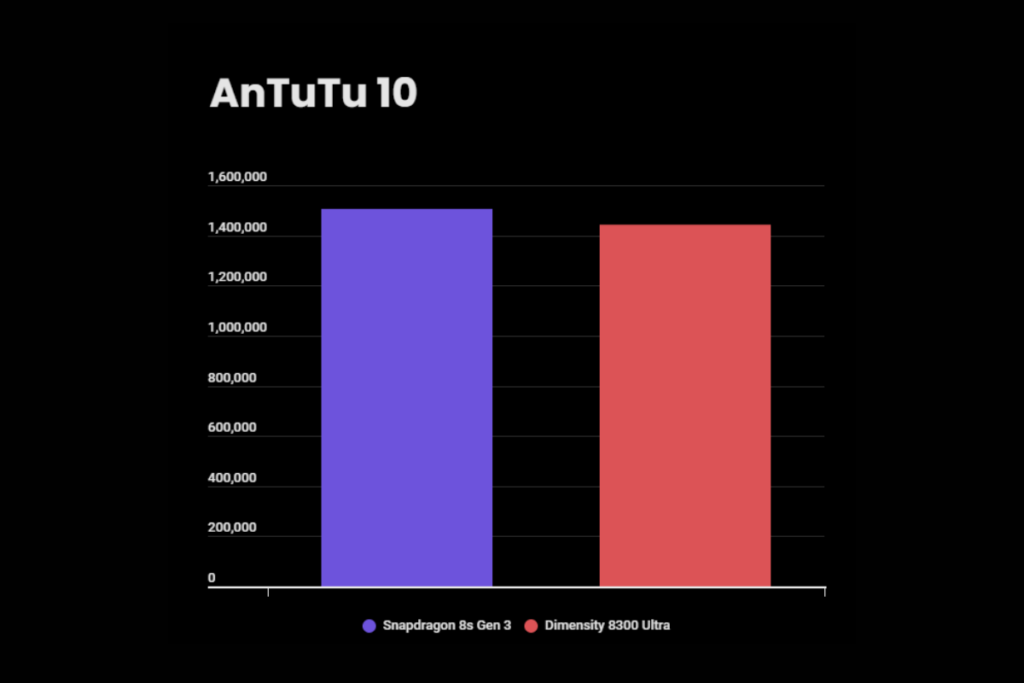
In the AnTuTu benchmark comparison, the Snapdragon 8s Gen 3 edges out the Dimensity 8300 Ultra with an overall score of 1,505,656 — about 4% higher than the 8300 Ultra’s 1,442,661. This lead is primarily driven by its CPU performance, where the 8s Gen 3 posts a 38% higher score (391,859 vs. 283,402), making it more capable in processing-intensive tasks and demanding apps.
While the Snapdragon chip also leads in UX (270,763 vs 264,862), the Dimensity 8300 Ultra holds an advantage in GPU and memory performance. Its GPU score is 531,968 — 3% higher than the Snapdragon’s 517,257 — and its memory score is 11% better (362,429 vs 325,777). Overall, the Snapdragon 8s Gen 3 comes out slightly ahead in raw performance, especially in CPU-heavy scenarios.
| SD 8s Gen 3 | D8300 Ultra | |
|---|---|---|
| AnTuTu score | 1,505,656 | 1,442,661 |
| CPU | 391,859 | 283,402 |
| GPU | 517,257 | 531,968 |
| Memory | 325,777 | 362,429 |
| UX | 270,763 | 264,862 |
Geekbench comparison
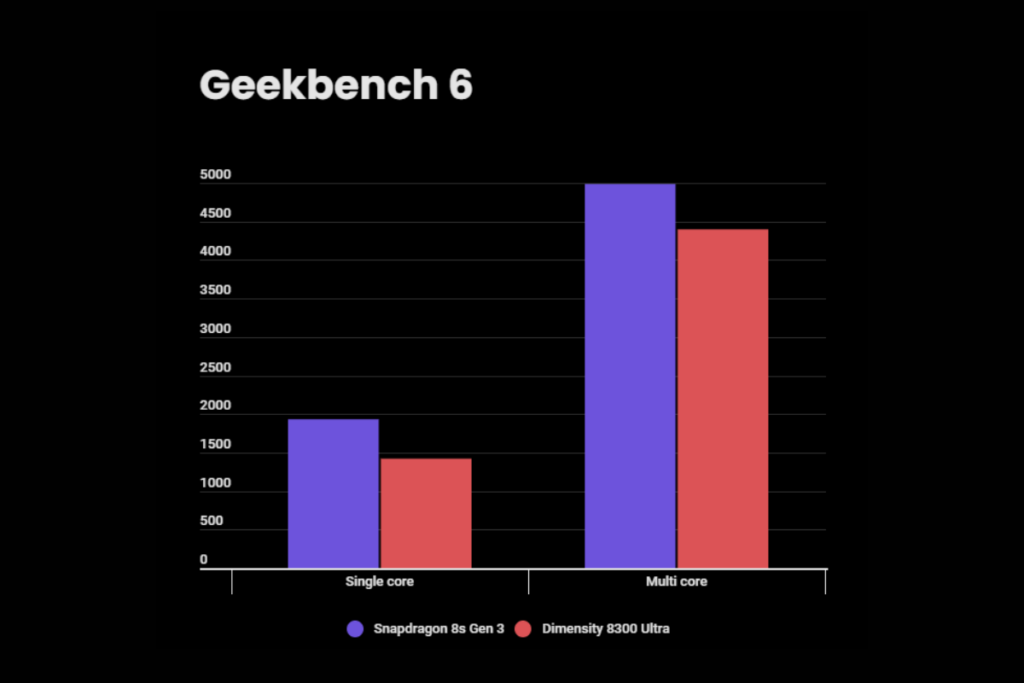
In Geekbench tests, the Snapdragon 8s Gen 3 shows a clear lead over the Dimensity 8300 Ultra in both single-core and multi-core performance. It scores 1,932 in the single-core test — a substantial 36% higher than the 8300 Ultra’s 1,421. This means better responsiveness in everyday tasks.
The multi-core score also favors the Snapdragon chip, with a score of 4,986 compared to the Dimensity 8300 Ultra’s 4,398 — about a 13% performance gain. This makes the Snapdragon 8s Gen 3 a better choice for heavier workloads and multitasking scenarios, offering stronger overall CPU performance.
| SD 8s Gen 3 | D8300 Ultra | |
| Single core | 1,932 | 1,421 |
| Multi core | 4,986 | 4,398 |
Snapdragon 8s Gen 3 vs Dimensity 8300 Ultra — Key differences that matter
Performance
Both the Snapdragon 8s Gen 3 and Dimensity 8300 Ultra are manufactured using TSMC’s 4nm process node, but they use different CPU architecture and instruction sets. The 8s Gen 3’s ARMv9.2-A instruction set offers better performance and security compared to the Dimensity 8300 Ultra’s ARMv9-A.
The 8s Gen 3’s octa-core CPU has 1 x Cortex-X4 large core, 4 x Cortex-A720 performance cores, and 3 x Cortex-A520 efficiency cores. The Dimensity chip, on the other hand, packs four Cortex-A715 performance cores and four Cortex-A510 efficiency cores.
Despite featuring a higher peak CPU frequency (3.35GHz vs 3GHz), the Dimensity 8300 Ultra couldn’t outperform the Snapdragon 8s Gen 3 on benchmarks because the latter has newer cores that are more powerful and power-efficient.
For visual rendering, the Snapdragon 8s Gen 3 features an Adreno 735 GPU, while the Dimensity 8300 Ultra has Mali-G615 MP6. The latter has more pipelines and higher floating-point operations per second (FLOPS). It also runs at a higher frequency than Adreno 735, contributing to better overall performance. Additionally, the chips offer a suite of gaming features from their respective brands, providing smoother and more immersive gameplay.
The chipsets also feature NPUs for on-device AI capabilities — a hexagon NPU for the Snapdragon chip and MediaTek NPU 780 for the other chip, both supporting up to 10 billion parameters.
Connectivity
There are notable changes in the connectivity part as well. The Snapdragon 8s Gen 3 features an X70 5G modem with up to 6.5Gbps download speed and up to 3.5Gbps upload speed. Over a Wi-Fi 7 connection, the maximum speed it allows is 5.8Gbps.
For the Dimensity 8300 Ultra, the maximum download speed is 5.17Gbps, slightly lower than the Snapdragon chip but more than sufficient for most users. This chip, however, lacks Wi-Fi 7 support, which benefits the Snapdragon chip with better connection speed, stability, and latency.
Camera
The Snapdragon chip features an 18-bit Spectra triple ISP, supporting up to 200MP resolution. It allows up to 4K/60fps video recording and 1080p/240fps slow-motion video recording. The 8s Gen 3 supports real-time semantic segmentation up to 12 layers, enabling more granular optimizations in photos and videos. Additionally, it offers a range of camera features, including Snapdragon Low Light Vision (LLV), noise reduction, Video super resolution, Computational HDR, and AI enhancements.
The Dimensity 8300 Ultra’s Imagiq 980 14-bit ISP supports a higher 320MP resolution and also offers up to 4K video recording. It also brings semantic segmentation and many camera features, such as AI Color for Capture, Video Bokeh, Video NR, and AI-based (auto-exposure, auto-focus, auto white balance, and face detection).
Display, memory, and storage
The Snapdragon 8s Gen 3 supports up to 4K Ultra HD screen resolution at 60 frames per second (FPS), while the Dimensity 8300 Ultra peaks at WQHD+ (also known as 2K) at 120Hz.
Regarding memory and storage, both chips feature UFS 4.0 storage and LPDDR5x RAM (up to 4.2GHz frequency).
Snapdragon 8s Gen 3 vs Dimensity 8300 Ultra: Which is better?
Both the Snapdragon 8s Gen 3 and Dimensity 8300 Ultra are powerful mid-range chipsets that bring flagship-tier performance to more affordable smartphones. However, if performance is your top priority, the Snapdragon 8s Gen 3 clearly has the upper hand. It consistently outperforms the Dimensity 8300 Ultra in benchmark tests, thanks to its newer core architecture. It also brings better connectivity support with Wi-Fi 7 and faster 5G speeds.
However, if you prefer better GPU performance and more memory bandwidth — and don’t mind skipping Wi-Fi 7 — the Dimensity 8300 Ultra is still a fantastic and well-rounded chipset for everyday use. The choice ultimately boils down to your preferences.


Comments