
Add GIZMOCHINA as Preferred Source on Google

The Snapdragon 8s Gen 4 is a flagship chipset, featuring an all-big CPU core design, a high-performance graphics unit, and a strong set of connectivity features. It was announced in April 2025, and a month later, MediaTek unveiled its rival, the Dimensity 9400e, with several advancements.
Both chipsets deliver flagship-level performance and efficiency without the usual flagship price tag. But how do they stack up against each other? We’ve tested them on multiple benchmarks and analyzed key differences to get a better picture.
Let’s begin with the spec sheet:
| Snapdragon 8s Gen 4 | Dimensity 9400e | |
|---|---|---|
| Announced | April 2025 | May 2025 |
| Manufacturing | 4nm (TSMC) | 4nm (TSMC) |
| CPU | 1 x 3.21 GHz — Cortex-X3 3 x 3 GHz — Cortex-A720 2 x 2.8 GHz — Cortex-A720 2 x 2.02 GHz — Cortex-A720 | 1 x 3.4 GHz — Cortex-X4 3 x 2.85 GHz — Cortex-X4 4 x 2 GHz — Cortex-A720 |
| GPU | Adreno 825 GPU Ray tracing support Snapdragon Elite Gaming features | Mali-G720 Immortalis MP12 Ray tracing support MediaTek HyperEngine gaming features |
| NPU | Qualcomm Hexagon NPU | MediaTek NPU 790 |
| Storage/Memory | UFS 4.0 LPDDR5x, up to 4.8GHz | UFS 4.0 LPDDR5x, up tp 4.2GHz |
| Camera | Spectra triple 18-bit AI ISP Up to 320MP single camera Semantic segmentation support Up to 4K video recording | 18-bit RAW ISP Up to 320MP single camera Semantic segmentation support Up to 8K video recording |
| Connectivity | Snapdragon 5G modem Download: 4.2Gbps Wi-Fi 7 (peak speed: 5.8Gbps) Bluetooth 6.0 | MediaTek 5G modem Peak speed: 7Gbps Wi-Fi 7 (peak speed: 7.3Gbps) Bluetooth 6.0 |
Snapdragon 8s Gen 4 vs Dimensity 9400e: Benchmark scores
Note: The following benchmark tests were conducted on the POCO F7 (Snapdragon 8s Gen 4) and Realme GT 7 (Dimensity 9400e).
AnTuTu comparison
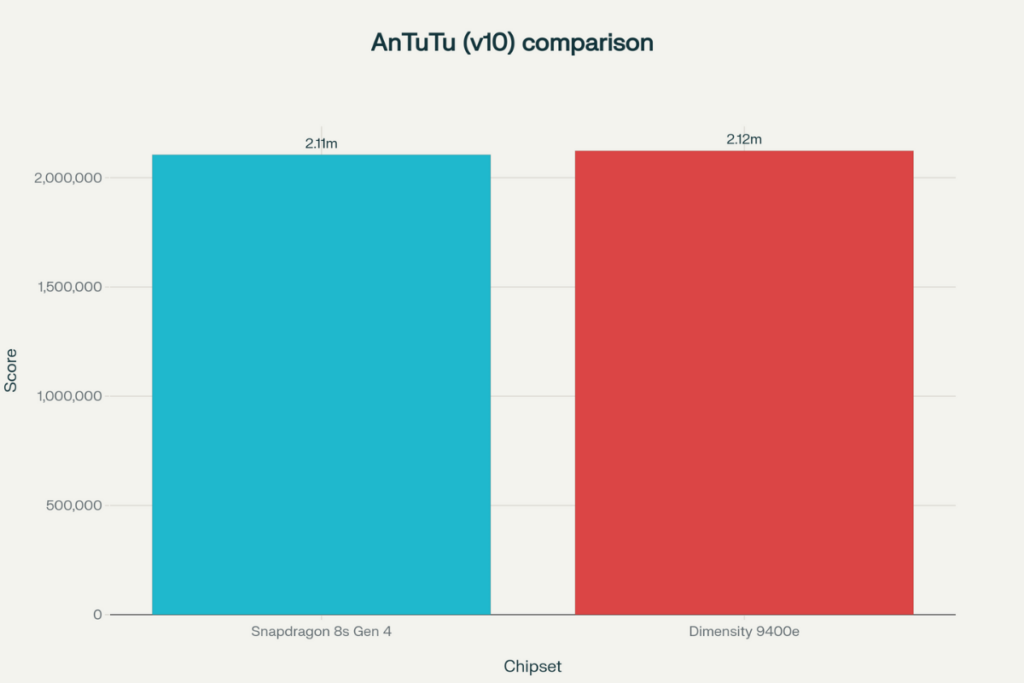
The Dimensity 9400e narrowly outperforms the Snapdragon 8s Gen 4 in overall AnTuTu score — 2,123,428 vs 2,105,193 — but the gap is just 0.8%. However, looking closer reveals important strengths.
CPU performance is where the Dimensity 9400e pulls ahead the most, scoring around 9.5% higher than the Snapdragon chip. This means faster app launches, smoother multitasking, and better sustained performance during intensive workloads.
On the flip side, the Snapdragon 8s Gen 4 leads in GPU, delivering about 3.4% higher graphics performance, which could translate to slightly better frame rates in GPU-heavy games.
| Snapdragon 8s Gen 4 | Dimensity 9400e | |
|---|---|---|
| AnTuTu score | 2,105,193 | 2,123,428 |
| CPU | 459,324 | 502,983 |
| GPU | 884,677 | 855,871 |
| Memory | 432,525 | 402,991 |
| UX | 328,667 | 361,583 |
Geekbench comparison
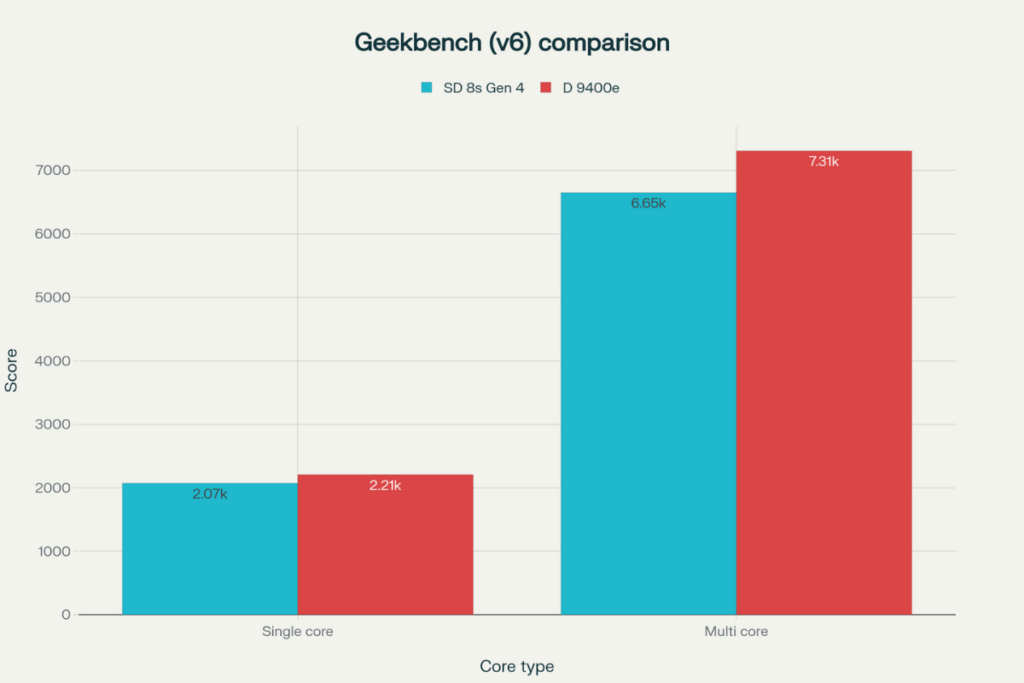
On Geekbench, the Dimensity 9400e outperforms the Snapdragon 8s Gen 4 in both single-core and multi-core tests — scoring 2,208 vs 2,074 in single-core and 7,310 vs 6,651 in multi-core.
That’s roughly a 6.4% gain in single-core and a 9.9% advantage in multi-core performance for the Dimensity chip. These indicate faster performance and better multitasking on Dimensity 9400e devices.
| Snapdragon 8s Gen 4 | Dimensity 9400e | |
| Single core | 2,074 | 2,208 |
| Multi core | 6,651 | 7,310 |
Snapdragon 8s Gen 4 vs Dimensity 9400e: Key differences you should know
CPU, GPU & NPU
Both chipsets are built on TSMC’s 4nm process and use the ARMv9.2 architecture, but their CPU configurations differ. The Snapdragon 8s Gen 4 has one Cortex-X4 core and seven Cortex-A720 cores, while the Dimensity 9400e uses four Cortex-X4 cores and four Cortex-A720 cores.
Since Cortex-X4 is more powerful and efficient than Cortex-A720 and that Dimensity 9400e has more of it, it’s able to outperform the Snapdragon chip’s CPU on multiple benchmarks. However, it’s the other way around for the GPU, as the Snapdragon 8s Gen 4’s Adreno 825 offers a more reliable and consistent gaming performance than the Immortalis-G720 GPU on the Dimensity 9400e.
The chips also feature NPUs for on-device AI capabilities. The Snapdragon chip has a hexagon NPU that’s 44% faster and has 2x larger shared memory than its predecessor. MediaTek’s NPU 790 brings support for generative AI and popular large language models (LLMs).
Camera and Imaging
The Snapdragon 8s Gen 4 features a Qualcomm Spectra 18-bit triple ISP, supporting up to 320MP resolution and 4K video recording. Additionally, it supports real-time semantic segmentation for photos and videos with up to 250 layers for precise optimizations.
The Dimensity 9400e matches 320MP camera support but goes further with 8K video recording. Both chipsets come with a range of camera features for enhanced output.
Connectivity
The Snapdragon 8s Gen 4 chipset is equipped with an X75 5G modem that allows 4.2Gbps of maximum download speed. Over a Wi-Fi 7 connection, it can download stuff at a peak speed of 5.8Gbps. The Dimensity 9400e goes further by offering higher download speeds — 7Gbps on 5G and 7.3Gbps over Wi-Fi 7.
Snapdragon 8s Gen 4 vs Dimensity 9400e: which is a better choice?
Both the Snapdragon 8s Gen 4 and Dimensity 9400e are impressive flagship-tier chipsets, offering excellent performance, AI capabilities, and connectivity features. However, they take different approaches to get there.
The Dimensity 9400e consistently delivers stronger CPU performance across both AnTuTu and Geekbench, thanks to its more aggressive all-big-core setup with four Cortex-X4 cores. That makes it a better pick for power users who rely on raw CPU speed and multitasking. Plus, it also offers higher download speeds over Wi-Fi and 5G connections.
In contrast, Snapdragon 8s Gen 4 shines in GPU performance, which gives it an edge in gaming scenarios. It also features Qualcomm’s excellent camera and AI stack, making it a well-rounded option for creators and gamers alike.
If faster CPU and next-gen 5G speeds are the top priorities, the Dimensity 9400e takes the lead. But if gaming, GPU stability, and Qualcomm’s software optimizations are at the top of your list, the Snapdragon 8s Gen 4 remains a strong contender.



Comments