
Add GIZMOCHINA as Preferred Source on Google
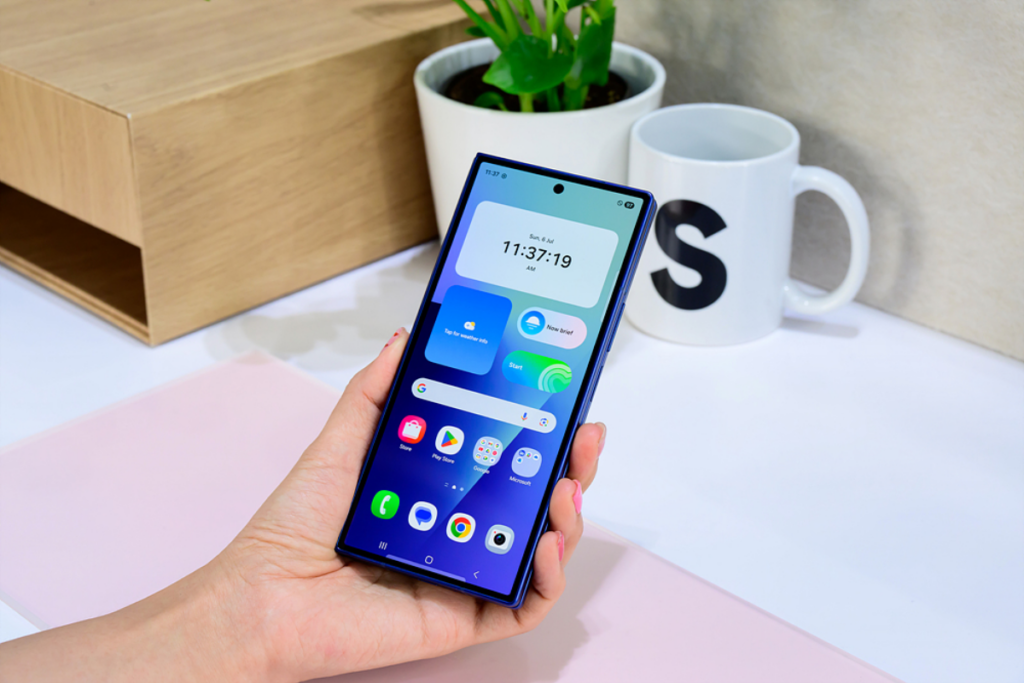
Samsung’s Galaxy Z Fold 7 isn’t just about flashy foldable hardware anymore — it’s a performance beast in disguise. While its sleek design and cutting-edge hinge grabbed most of the attention, the real story lies under the hood. It’s powered by the flagship Snapdragon 8 Elite chipset, which means it won’t only outperform most smartphones in multitasking but also in terms of performance. But how does it perform on benchmarks?
We put the Galaxy Z Fold 7 to the test on popular benchmarking platforms to find out its raw performance. Whether you’re a multitasking pro, a mobile gamer, or just curious about the power packed inside this foldable beast, these benchmark numbers prove to be very useful. So, let’s dive in.
Related:
1. 4 upgrades that make Galaxy Z Fold 7 a solid choice
2. Galaxy Z Fold 7 proves unbreakable in extreme durability tests
3. Who Should Actually Buy Samsung Galaxy Z Fold 7?
Galaxy Z Fold 7 AnTuTu score
| Galaxy Z Fold 7 | Score |
|---|---|
| AnTuTu score | 2,025,744 |
| CPU | 472,258 |
| GPU | 778,749 |
| Memory | 438,501 |
| UX | 336,236 |
The Galaxy Z Fold 7 delivers a stellar performance on AnTuTu with an overall score of 2,025,744, putting it firmly in flagship territory. Digging into the breakdown, the device scores 472,258 in CPU and 778,749 in GPU, showing strong processing power for heavy multitasking and high-end graphics. The memory and UX scores are also excellent at 438,501 and 336,236, respectively.
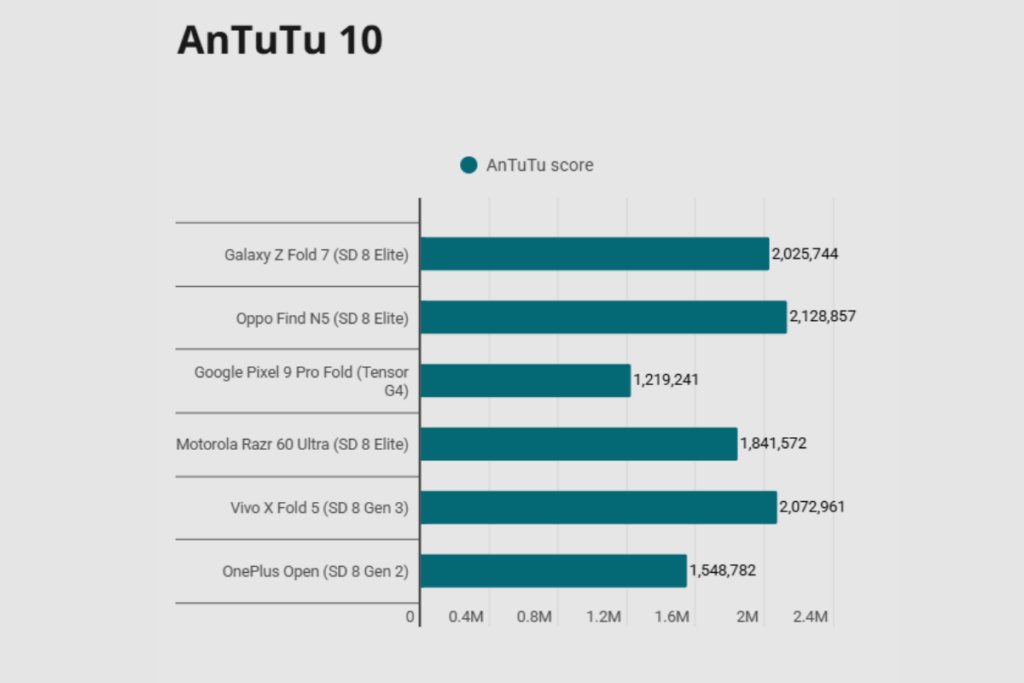
When stacked up against its foldable rivals, the Galaxy Z Fold 7 holds its ground quite well. Devices like the Oppo Find N5 (2,128,857) and Vivo X Fold 5 (2,072,961) slightly edge it out, but the difference is relatively minor and may not be noticeable in real-world use.
The Motorola Razr 60 Ultra, which also runs the Snapdragon 8 Elite, falls a bit behind at 1,841,572. Older-generation foldables like the OnePlus Open (1,548,782) and the Google Pixel 9 Pro Fold (1,219,241) are significantly behind, showing just how far performance has come. Overall, the Z Fold 7 is clearly among the top-performing foldables on the market right now.
| Device | AnTuTu score |
|---|---|
| Galaxy Z Fold 7 (SD 8 Elite) | 2,025,744 |
| Oppo Find N5 (SD 8 Elite) | 2,128,857 |
| Google Pixel 9 Pro Fold (Tensor G4) | 1,219,241 |
| Motorola Razr 60 Ultra (SD 8 Elite) | 1,841,572 |
| Vivo X Fold 5 (SD 8 Gen 3) | 2,072,961 |
| OnePlus Open (SD 8 Gen 2) | 1,548,782 |
Galaxy Z Fold 7 Geekbench score
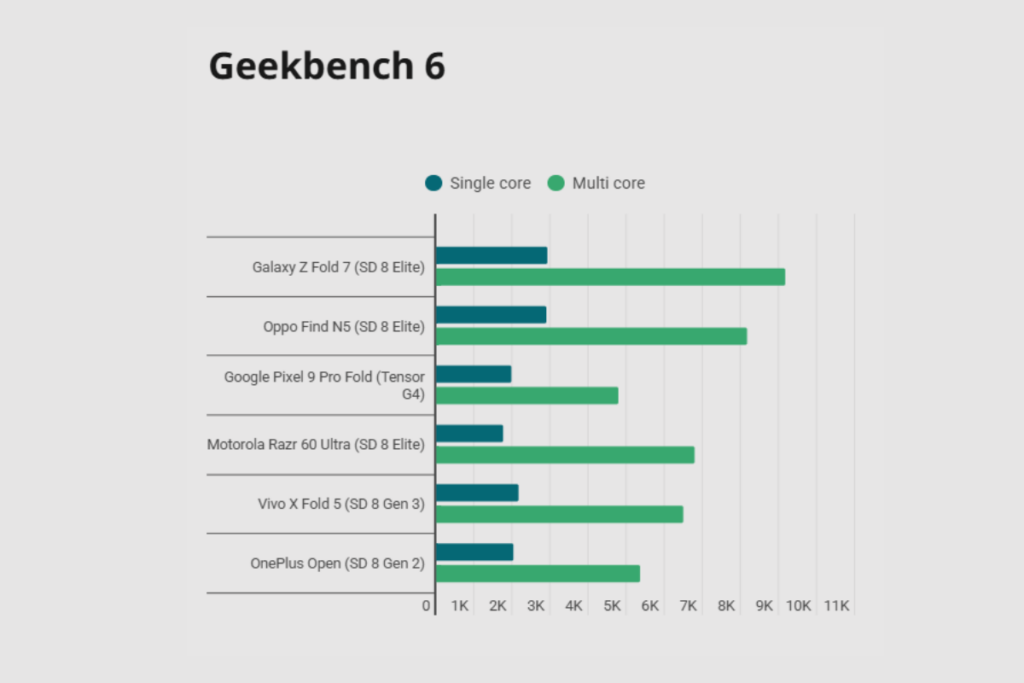
On Geekbench, the Galaxy Z Fold 7 scores 2,910 in single-core and 9,174 in multi-core, showcasing impressive CPU power, especially in multi-threaded tasks like video editing, gaming, and multitasking. It’s one of the best performers among foldables.
Compared to rivals, it edges out the Oppo Find N5 (2,897/8,152) and significantly beats the Motorola Razr 60 Ultra (1,749/6,792). The Vivo X Fold 5 and OnePlus Open, running older chipsets, fall behind as well. Meanwhile, the Pixel 9 Pro Fold lags far behind with just 1,983/4,791, highlighting the performance leap offered by the Snapdragon 8 Elite inside the Z Fold 7.
| Device | Single core/Multi core |
|---|---|
| Galaxy Z Fold 7 (SD 8 Elite) | 2910/9174 |
| Oppo Find N5 (SD 8 Elite) | 2897/8152 |
| Google Pixel 9 Pro Fold (Tensor G4) | 1983/4791 |
| Motorola Razr 60 Ultra (SD 8 Elite) | 1749/6792 |
| Vivo X Fold 5 (SD 8 Gen 3) | 2155/6485 |
| OnePlus Open (SD 8 Gen 2) | 2024/5361 |
Galaxy Z Fold 7 3D Mark Wild Life Extreme Stress Test
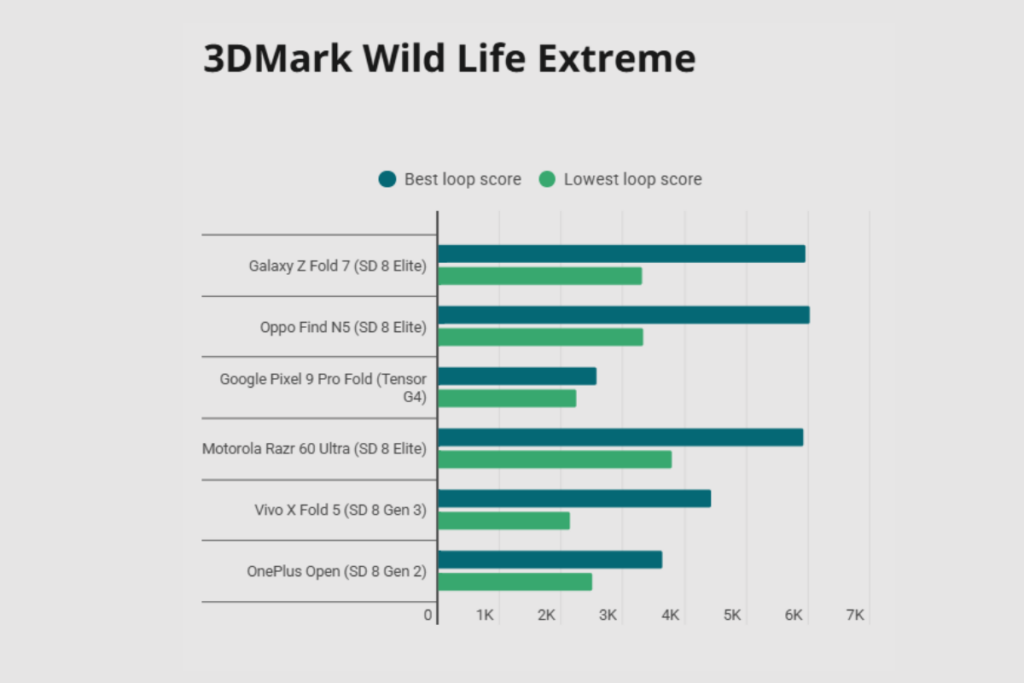
This test pushes the GPU to its limits, simulating intense gaming or heavy graphical tasks. Here, the Galaxy Z Fold 7 scored 5,952 in the best loop and 3,302 in the lowest loop, showing a clear drop due to thermal throttling under sustained load.
When compared to other foldables, the Fold 7 lands right around the Oppo Find N5 (6,012/3,312) and Motorola Razr 60 Ultra (5,910/3,787)—both using the same Snapdragon 8 Elite chip. Devices like the Vivo X Fold 5 and OnePlus Open, which rely on older chipsets, post significantly lower results. The Pixel 9 Pro Fold, with Google’s custom silicon, trails even further behind, highlighting the performance gap in GPU-heavy workloads.
| Device | Best loop/Lowest loop |
|---|---|
| Galaxy Z Fold 7 (SD 8 Elite) | 5952/3302 |
| Oppo Find N5 (SD 8 Elite) | 6012/3312 |
| Google Pixel 9 Pro Fold (Tensor G4) | 2555/2243 |
| Motorola Razr 60 Ultra (SD 8 Elite) | 5910/3787 |
| Vivo X Fold 5 (SD 8 Gen 3) | 4421/2131 |
| OnePlus Open (SD 8 Gen 2) | 3634/2488 |
Samsung Galaxy Z Fold 7 spec sheet
| Body | 158.4 x 143.2 x 4.2 mm (unfolded) 158.4 x 72.8 x 8.9 mm (folded) 215g |
| Main display | 8.0 inches Dynamic LTPO AMOLED 2X 1968 x 2184 pixels resolution 120Hz, 2600 nits (peak) |
| Cover display | 6.5 inches Dynamic LTPO AMOLED 2X 1080 x 2520 pixels resolution 120Hz refresh rate Gorilla Glass Ceramic 2 protection |
| Processor | Qualcomm Snapdragon 8 Elite (3nm) Adreno 830 GPU |
| Software | Android 16, One UI 8 Up to 7 major Android upgrades |
| Rear camera | 200MP (wide) + 10MP (telephoto) + 12MP (ultrawide) Up to 8K/30fps recording |
| Front camera | Inner screen: 10MP, up to 4K/30fps recording Cover screen: 10MP, up to 4K/30fps recording |
| Battery Charging | 4,400mAh 25W (wired), 15W (wireless), 4.5W (reverse wireless) |
| Connectivity | Wi-Fi 7 Bluetooth v5.4 NFC |
Also read:
1. $1,999 Galaxy Z Fold 7 sells out in a price sensitive market
2. How many times you can unfold Z Fold 7 depends on where you live
3. Is the Galaxy Z Fold 7 Worth the Upgrade?


Comments