
Add GIZMOCHINA as Preferred Source on Google
AI and LLMs have been at the forefront of nearly every piece of tech hardware in 2025. While they’ve mostly been helping out inside devices we already know, like phones and laptops, humanoid robots are where AI truly flexes its muscles.
AI and language models are what give a humanoid robot its brain and personality. And believe it or not, the tech has come far enough that we’re about to see it compete on a global stage.
Starting August 15th, China is hosting the world’s first World Humanoid Robot Games in Beijing, which is a three-day athletic and intellectual contest that will bring together 280 teams from 16 countries.
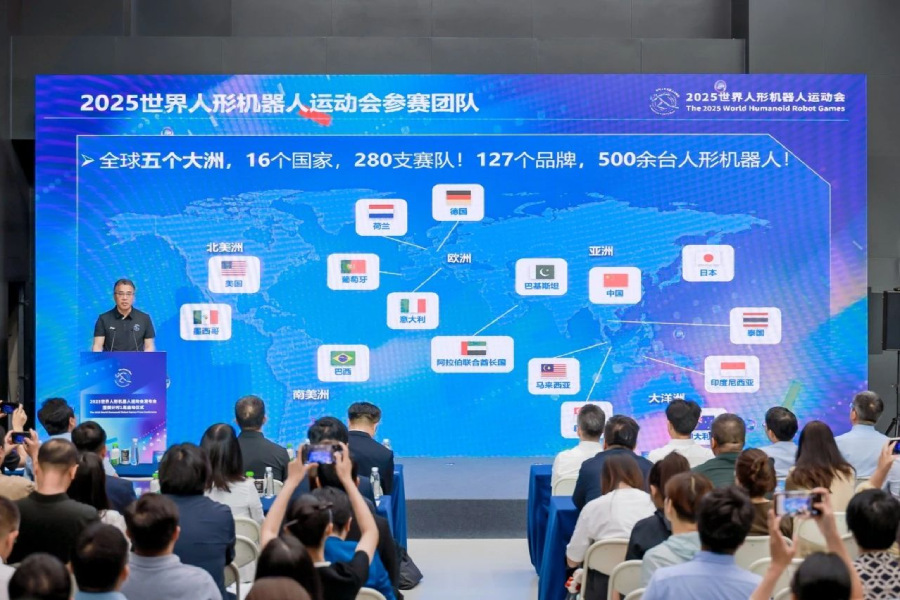
The competition will be held at the National Speed Skating Oval, better known as “The Ice Ribbon.” It is the same venue that hosted speed skating competitions at the 2022 Winter Olympics.
The stadium has now been transformed into a high-tech robot arena with all the facilities required for maintenance and charging of the droids.
The games are co-organized by the Beijing Municipal People’s Government, China Media Group, the World Robot Cooperation Organization, and the Asia-Pacific RoboCup International Council.
The event includes 487 competitions across 26 categories, ranging from traditional athletic events like track and field to scenario-based challenges that mimic real-world jobs.
Also Read:
- DeepSeek-R2 may launch late August as China pushes for AI independence
- Huawei’s AI Innovation May Ease China’s Dependence on Foreign Memory Tech
Games across different genres
Inside the Ice Ribbon stadium, there are now four major competition areas. There’s a widened 2.1-meter running track for sprinting robots, a 5v5 robot soccer field, a boxing ring, and even hotel- and hospital-themed setups for scenario contests. The venue has also been outfitted with a remote control zone along the track, letting human operators guide robots in real time while avoiding collisions.
Outside the arena, organizers have built two dedicated support hubs. Both facilities are equipped with signal support, custom charging cabinets, and even “laboratory-grade” air control for precise competition environments.
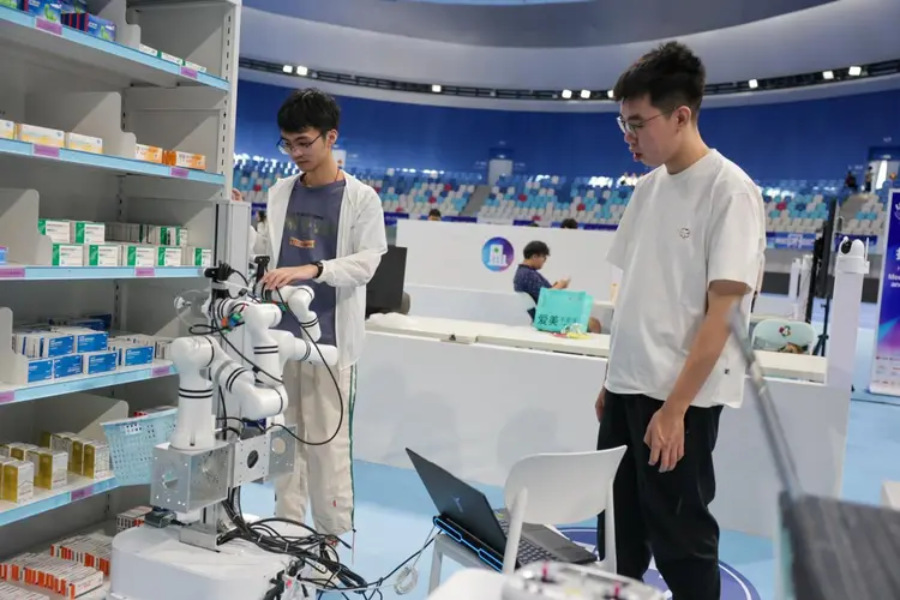
As you might guess from the name, the games are designed to test how helpful or skillful a humanoid can be in real-life scenarios. Like in the hospital challenge, the robots will need to sort medicines and package them according to prescriptions.
In the hotel cleaning event, robots will enter a room, find trash scattered across furniture, and dispose of it properly. Other tasks include warehouse sorting and factory material handling, all situations that could translate directly to commercial use.
Teams can choose between fully autonomous operation and teleoperation (human-controlled). Autonomous robots rely heavily on visual recognition and decision-making algorithms, while teleoperated ones depend on stable, low-latency network links, something the venue’s 5G-A network has been optimized for.
A global mix of players
The lineup includes leading Chinese companies like Yushu Technology, Xinghaitu, Tiangong, and Fourier, alongside top universities such as Tsinghua, Peking, and Shanghai Jiao Tong.
Reportedly, international teams from countries including the US and Germany are also competing in the event. Some companies, like Meituan-backed Xinghaitu, are also supplying robots to multiple teams, including its universal humanoid models R1Pro and R1Lite.
For more daily updates, please visit our News Section or check out our AI section for more AI and robotic news.
Want to stay ahead in what’s happening in tech!
Join our Telegram community and sign up for our daily newsletter of top stories.


Comments