
Add GIZMOCHINA on Google:
As an Amazon Associate, Gizmochina earns from qualifying purchases. Links on this page may earn us a commission at no extra cost to you.
Google finally packs its Pixel devices with a TSMC-made chip, the Tensor G5, and the power efficiency improvements are expected to be one of the biggest jumps in the Pixel lineup. YouTube creator Lover Of Tech put the Pixel 10 Pro through an extreme battery drain test alongside two rivals—the iPhone 16 Pro and the Galaxy S25—to find out just that.
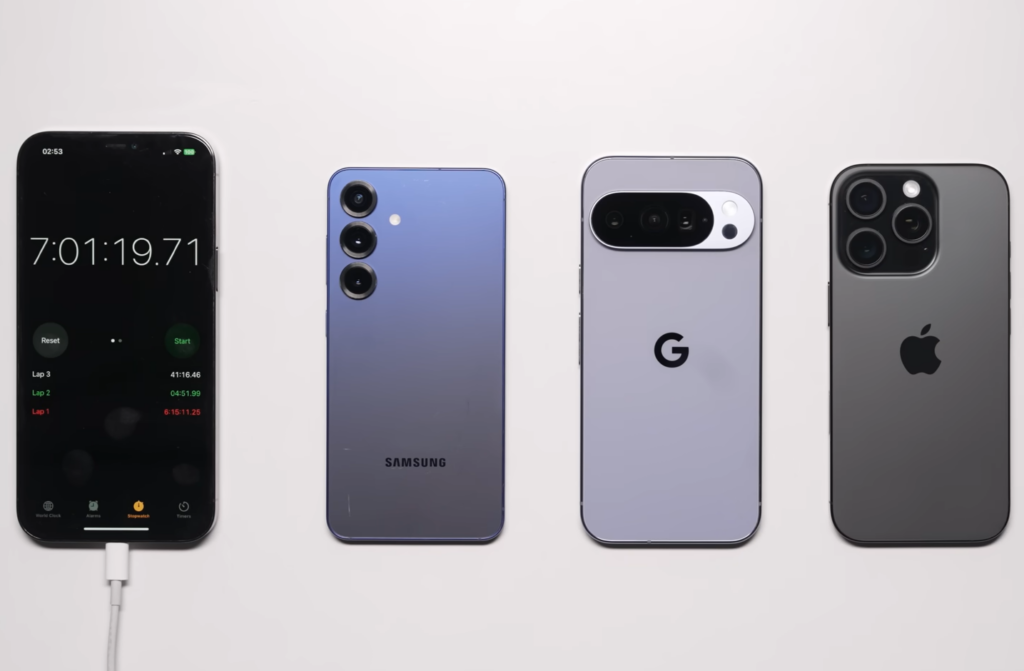
For starters, all three phones pack similarly sized displays calibrated at 200 nits with auto brightness turned off. The Pixel’s resolution was set to 1080p to keep things fair. The Galaxy S25 runs on the Snapdragon 8 Elite, the iPhone 16 Pro on Apple’s A18 Pro, and the Pixel 10 Pro on the Tensor G5—all fabricated on TSMC’s 3nm process. The big difference here lies in the batteries:
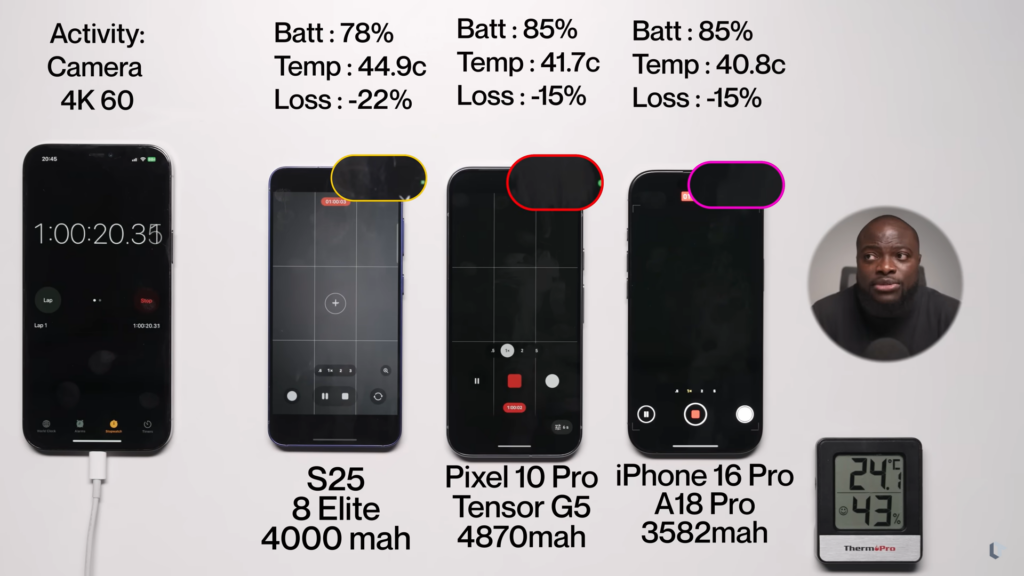
Galaxy S25: 4000 mAh
Pixel 10 Pro: 4870 mAh
iPhone 16 Pro: 3582 mAh
Of course, the total runtime is what matters, and this test gives a good sense of how much this year’s Pixel has improved in terms of endurance.
Starting off with one hour of 4K 60fps recording, the Snapdragon 8 Elite-powered Galaxy S25 surprisingly showed the biggest percentage drop and the highest temperature rise. It lost 22% while both the Pixel and the iPhone lost only 15%. The Galaxy also heated up to 44.9°C, compared to 41.7°C on the Pixel—exactly the improvement many creators had hoped Google would deliver. The iPhone stayed a little cooler still at 40.8°C, thanks to Apple’s efficient chip and tight hardware-software integration.
Although the Pixel performed worse than the others in temperature control during the social media test, it pulled ahead on YouTube playback and eventually took first place overall—defeating a Pro iPhone, which is no small achievement for a Pixel. That said, using the Galaxy S25 Plus instead of the base S25 (4900 mAh vs. 4000 mAh) would likely have swapped the top two spots.
Still, Pixels have always been designed to be among the smartest smartphones rather than the outright best performers—and with the Pixel 10 series, it finally looks like you won’t have to worry about a dead battery or an overheating warning.

Please Note: When you buy something using the links in our articles, we may earn a small commission at no cost to you.
Don’t miss a thing! Join our Telegram community for instant updates and grab our free daily newsletter for the best tech stories!
For more daily updates, please visit our News Section.




Comments