
Add GIZMOCHINA as Preferred Source on Google
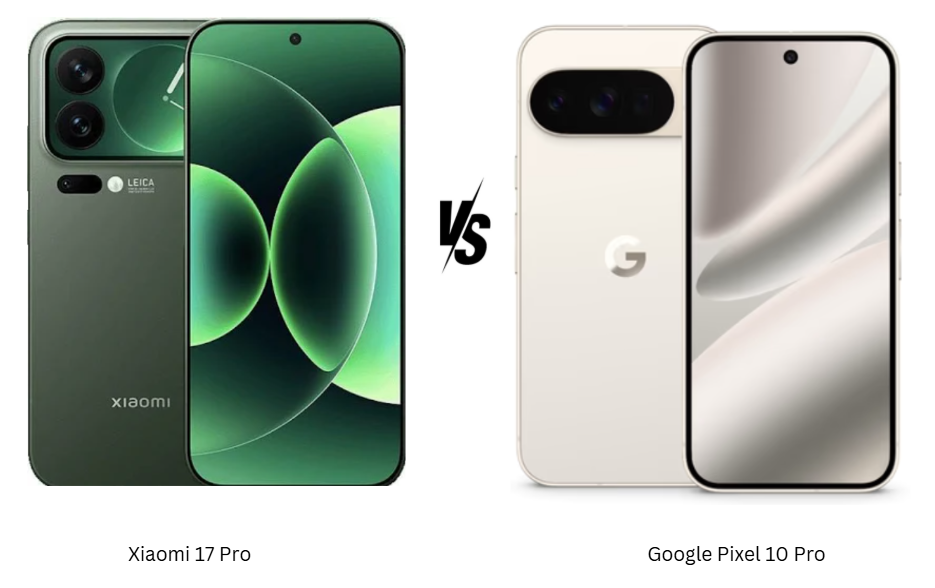
The flagship showdown between Xiaomi 17 Pro and Google Pixel 10 Pro highlights two different visions of premium smartphones. One focuses on cutting-edge hardware and raw power, while the other leans on intelligent software and long-term support. This comparison matters because it pits Xiaomi’s aggressive feature-packed approach against Google’s AI-driven ecosystem, giving buyers a clear look at which flagship better fits their priorities, performance, and innovation or software and experience.
1. Design and display
Build and Feel:
Xiaomi 17 Pro and Google Pixel 10 Pro both offer premium construction with glass and aluminum frames, but their approach differs subtly. Xiaomi uses Dragon Crystal Glass with a sleek aluminum frame and offers IP68 protection with a deeper submersion rating of up to 4 m. Pixel 10 Pro relies on Gorilla Glass Victus 2 on both front and back and also has IP68, but for shallower depths. Xiaomi provides a dual-SIM setup with an IR blaster, while Pixel uses eSIM and nano-SIM, catering more to digital-first users. Xiaomi’s design leans toward luxury and utility with its secondary display on the back, while Pixel focuses on a clean, minimalist finish.
Verdict: Xiaomi has a more versatile build with deeper water resistance and functional extras, making it better for those who value utility.
Display Quality:
Both devices feature 6.3-inch LTPO panels with 120 Hz refresh rates and HDR support, but Xiaomi pushes boundaries with 3500 nits peak brightness and Dolby Vision. Pixel reaches 3300 nits, which is slightly lower but still exceptional. Xiaomi’s secondary AMOLED display gives it an edge in versatility for quick access and camera previews. Pixel’s display, however, has a slightly higher pixel density, providing excellent sharpness and color accuracy. For pure brightness and dynamic range, Xiaomi stands out, while Pixel edges ahead in color precision.
Verdict: Xiaomi leads in brightness and versatility, giving it the upper hand in display impact.
Verdict:
Both are flagship-level in build and display, but Xiaomi’s combination of extreme brightness, secondary panel, and deeper water resistance gives it an edge for those wanting more utility and immersive visuals. Pixel, however, retains a subtle advantage in minimalism and clarity.
2. Specifications
Performance:
Xiaomi runs on the Snapdragon 8 Elite Gen 5, while Pixel is powered by the Tensor G5. Qualcomm’s chip brings superior raw performance, better GPU output with Adreno 840, and more efficient thermal management. Tensor is tuned more for AI and software optimization, excelling in smart features rather than brute force. Xiaomi also benefits from UFS 4.1 storage across variants, whereas Pixel uses UFS 3.1 in the base model. For gaming, heavy multitasking, and sustained performance, Xiaomi holds a performance edge, while Pixel favors intelligent software handling and AI-driven enhancements.
Verdict: Xiaomi leads in raw power and sustained performance.
Battery and Charging:
Xiaomi packs a 6300 mAh battery with 100 W wired and 50 W wireless charging, far ahead of Pixel’s 4870 mAh with 30 W wired and 15 W Qi2 wireless charging. Xiaomi’s reverse wireless at 22.5 W is also more powerful compared to the Pixel’s wired reverse. Pixel does offer bypass charging, which is helpful for temperature control, but Xiaomi’s speed and capacity make it far more versatile for power users.
Verdict: Xiaomi dominates in battery life and charging speed.
Verdict:
While Pixel offers more intelligent software optimization, Xiaomi outshines in performance and charging capabilities, making it better suited for heavy users and gamers.
3. Camera
Main and Secondary Lenses:
Both devices use triple-camera setups with high-resolution primary and telephoto lenses. Xiaomi employs a Leica-tuned triple 50 MP system with 5× optical zoom, offering superior dynamic range and manual control. Pixel uses a 50 MP main sensor with a 48 MP periscope and ultrawide, leveraging Google’s computational photography. Pixel’s Zoom Enhance and Ultra-HDR features give it an edge in consistent clarity, while Xiaomi offers more flexibility with hardware, especially in video—8K@30 fps with Dolby Vision HDR natively, compared to Pixel’s cloud-based 8K.
Verdict: Pixel is stronger in AI-driven image processing, while Xiaomi excels in hardware and pro-grade video.
Selfie Camera:
Xiaomi brings a 50 MP wide selfie camera, delivering sharp and natural results, especially with HDR and 4K recording at 60 fps. Pixel opts for a 42 MP ultrawide lens, allowing wider framing and excellent clarity. Pixel’s edge lies in its consistent skin tone mapping and intelligent processing. Xiaomi, however, offers more raw detail and versatility for creators.
Verdict: Pixel leads in everyday selfie quality, while Xiaomi favors creators needing flexibility.
Verdict:
Both deliver flagship camera experiences but with different strengths. Pixel excels in point-and-shoot accuracy and computational imaging, while Xiaomi provides superior hardware and creative control for advanced users.
4. Pricing
Xiaomi is priced around $800, whereas the Pixel costs around $1000. For $200 less, Xiaomi offers stronger performance, a bigger battery with faster charging, and additional features like a secondary display and IR blaster. Pixel, however, justifies its premium with superior software optimization, AI integration, and extended OS support for 7 major upgrades.
Verdict: Xiaomi delivers more value for performance and hardware, while Pixel justifies its higher price with software longevity and smarter imaging.
Disclaimer:
Prices are approximate and may vary based on country, region, and applicable taxes.
5. Conclusion
Xiaomi stands out with its secondary AMOLED display, extreme charging speeds, larger battery, and Leica camera collaboration. It’s tailored for users who prioritize power, customization, and creative flexibility. Pixel brings AI-centric features like Circle to Search, satellite SOS, and industry-leading software updates, making it ideal for those who value intelligence and reliability. Both support Ultra Wideband and modern connectivity standards, but Xiaomi edges ahead in raw innovation, while Pixel focuses on refinement and ecosystem integration.
Verdict:
Xiaomi delivers superior hardware value and power at a lower cost, making it ideal for enthusiasts and performance seekers. Pixel wins for users who prioritize software intelligence, AI features, and long-term support. The final choice depends on whether hardware muscle or software finesse matters more.
Read More:


Comments