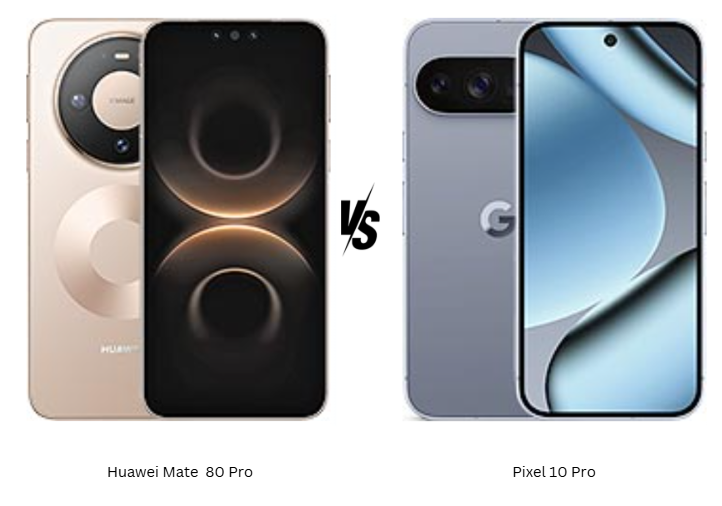
Huawei Mate 80 Pro and Google Pixel 10 Pro take two different routes to deliver a premium smartphone experience. One focuses on powerful hardware and long battery life, while the other leans on smart software and advanced AI. Buyers comparing these two are usually looking for a reliable flagship that fits their daily needs, whether that means stronger performance, better photos, or a longer-lasting device. This comparison helps make that choice clearer by showing what each phone does best.
The Mate 80 Pro delivers a more rugged and durable impression thanks to its tougher water-resistance rating and reinforced materials, making it feel engineered for harsher conditions. Its curved aesthetics and premium finish give it a refined, flagship character. The Pixel 10 Pro opts for a clean, symmetrical glass-and-metal design that feels more minimalist and polished. While the Pixel looks sleeker, the Mate feels more confident in hand, especially for users who value long-term durability and a distinctive flagship identity.
Display Quality
Huawei’s LTPO OLED offers vivid colors, smoother transitions, and strong brightness control backed by high-frequency PWM for comfortable viewing. The larger canvas also provides a more immersive feel for content. Google’s LTPO OLED panel counters with higher peak brightness, richer HDR handling, and sharper density, making it better suited for outdoor visibility and detailed media. Both are premium, but one leans toward eye comfort and immersion while the other emphasizes pure clarity and brightness.
Verdict
Mate 80 Pro wins for durability and immersive visuals, while Pixel 10 Pro edges ahead in brightness and HDR precision.
2. Specifications
Performance
The Mate 80 Pro’s Kirin 9030 series focuses on balanced efficiency, smooth daily use, and reliable thermals. It feels optimized for sustained performance rather than peak bursts. In contrast, the Pixel 10 Pro’s Tensor G5 brings stronger raw power, better AI processing, and superior imaging computation. This gives the Pixel an advantage in multitasking speed and future software expansion. For demanding tasks or AI-driven workflows, the Pixel simply feels more capable.
Battery and Charging
Huawei offers a significantly larger battery with extremely fast wired and wireless charging, delivering quicker turnaround and better endurance across mixed usage. The Pixel’s smaller battery and slower charging mean it lasts a full day, but doesn’t match Huawei’s stamina or convenience. Pixel users gain the benefits of Qi2 magnetic charging and efficient standby, but the Mate’s combination of capacity and charging power feels more practical for heavy users.
Verdict
Pixel 10 Pro wins on raw performance and AI power; Mate 80 Pro dominates battery life and charging speed.
3. Camera
Main and Secondary Lenses
The Mate 80 Pro features a flexible triple-camera system with a variable aperture main lens and strong periscope zoom, delivering natural depth and excellent low-light control. Its color science leans toward rich tones, giving photos a more expressive character. The Pixel 10 Pro relies on computational mastery with consistent results, sharper daytime images, and enhanced telephoto clarity thanks to advanced zoom algorithms. It feels more reliable in tricky dynamic scenes where software makes a difference.
Selfie Camera
Huawei’s ultrawide autofocus selfie system with 3D sensing offers versatility and excellent facial depth mapping, making it ideal for group shots or accurate biometric use. Google’s high-resolution 42MP selfie camera excels in detail and stabilization, producing crisp portraits and smooth video. The Pixel feels stronger for creators who prioritize detail, while Huawei offers a more adaptive selfie experience.
Verdict
Pixel 10 Pro wins for consistent computational results; Mate 80 Pro edges ahead in versatility and depth-driven creativity.
4. Pricing
The Mate 80 Pro comes in at approximately $900, undercutting the Pixel 10 Pro’s $1000 price point while offering stronger battery life, faster charging, and a more rugged build. This makes Huawei’s flagship feel like the better value for users seeking endurance, versatility, and premium hardware at a more accessible cost. The Pixel justifies its higher price with superior AI performance, longer software support, and computational imaging benefits.
Buyers focused on software longevity and intelligent features may find the premium worthwhile, while hardware-first users will see more value in Huawei’s approach.
Disclaimer: Prices are approximate and may vary based on country, region, and applicable taxes.
5. Conclusion
Huawei’s standouts include ultra-fast charging, satellite messaging (region-specific), variable aperture photography, and strong durability. These features cater to users who want independence from power outlets, flexibility in photography, and a device built for demanding environments. Google’s strengths lie in extended software updates, advanced AI tools, cloud-enhanced video, and UWB support, creating a smarter, more connected experience. Each device leans into a different philosophy; Huawei prioritizes hardware dominance, while Google elevates intelligence and computational power.
Verdict
Choose the Mate 80 Pro for superior battery performance, a rugged design, and flexible photography capabilities. Choose the Pixel 10 Pro for stronger AI processing, longer software support, and consistently sharp imaging.
We use cookies on our website to give you the most relevant experience by remembering your preferences and repeat visits. By clicking “Accept”, you consent to the use of ALL the cookies.
This website uses cookies to improve your experience while you navigate through the website. Out of these, the cookies that are categorized as necessary are stored on your browser as they are essential for the working of basic functionalities of the website. We also use third-party cookies that help us analyze and understand how you use this website. These cookies will be stored in your browser only with your consent. You also have the option to opt-out of these cookies. But opting out of some of these cookies may affect your browsing experience.
Necessary cookies are absolutely essential for the website to function properly. This category only includes cookies that ensures basic functionalities and security features of the website. These cookies do not store any personal information.
Any cookies that may not be particularly necessary for the website to function and is used specifically to collect user personal data via analytics, ads, other embedded contents are termed as non-necessary cookies. It is mandatory to procure user consent prior to running these cookies on your website.



Comments