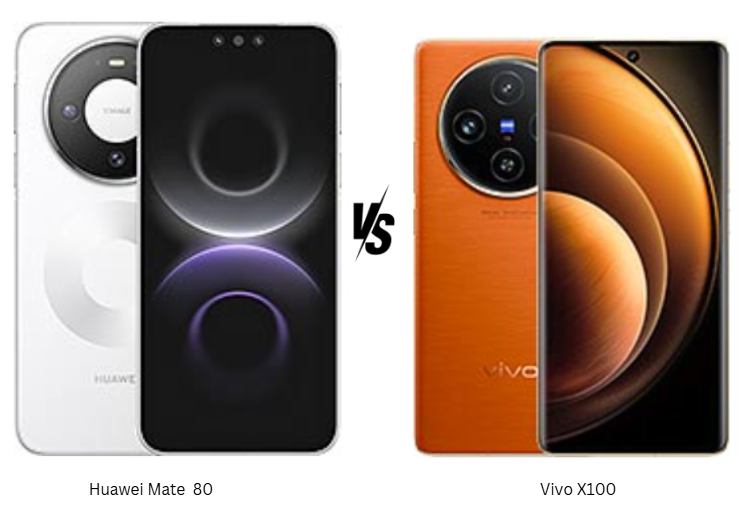
Huawei Mate 80 and Vivo X100 target buyers who want flagship-level performance without crossing premium price brackets. Both appeal to users who value strong cameras, smooth displays, and reliable everyday efficiency, making this comparison important for anyone choosing a balanced high-end smartphone in 2025. With each device excelling in different areas, understanding their strengths helps buyers decide whether they prefer long-term endurance and practicality or cutting-edge performance and imaging refinement.
Huawei Mate 80 goes for a more rugged, utility-driven approach with stronger water resistance and a sturdier frame, giving it a more confidence-inspiring feel for users who value durability. Vivo X100 aims for a sleeker, more polished flagship look, appealing to those who prefer a refined aesthetic. Both phones feel premium, but the Mate 80 leans professional while the X100 feels more modern and stylish.
Display Quality
Both devices offer bright, fluid LTPO panels with 120Hz refresh rates. The Mate 80 focuses on visual comfort with high-frequency PWM and Huawei’s Kunlun protection, making it appealing for long reading or multimedia sessions. The Vivo X100 delivers extremely high peak brightness, giving it an edge for outdoor use and HDR highlights. Its color tuning also feels slightly more vibrant, especially for gaming and video content.
Verdict
Mate 80 is better suited for durability-focused users, while the X100 feels more cinematic and punchy. For everyday multimedia, X100 edges ahead.
2. Specifications
Performance
Vivo X100’s Dimensity 9300 chip provides stronger raw performance with next-gen CPU clusters and faster graphics, offering smoother results in demanding gaming and multitasking. The Mate 80’s Kirin 9020 delivers stable efficiency and optimized HarmonyOS behavior, making daily use smooth and reliable. Those who value sustained high performance will feel the X100 is more future-proof, while the Mate 80 emphasizes consistency over peak numbers.
Battery and Charging
Mate 80 offers a larger battery and balanced power draw, giving it a noticeable advantage in endurance-heavy usage. Wireless charging and reverse wireless add versatility. Vivo X100 counters with extremely fast wired charging that dramatically reduces downtime, ideal for users who prefer quick top-ups rather than overnight charging.
Verdict
Endurance and charging flexibility lean in Mate 80’s favor, while the X100 dominates raw power and fast refuels.
3. Camera
Main and Secondary Lenses
Huawei Mate 80’s variable aperture main camera delivers excellent adaptability, switching effectively between low light and daylight scenes. Its periscope lens offers stronger optical reach, making it more versatile for distance shots. Vivo X100, powered by Zeiss tuning and a higher-resolution telephoto, produces beautifully processed images with excellent color accuracy and contrast. Its overall imaging output feels slightly more polished for casual shooters.
Selfie Camera
Mate 80 includes an ultrawide AF selfie system with TOF depth support, adding better face detection and group-shot flexibility. X100’s 32MP front camera offers crisp detail and stable 4K video, presenting an ideal balance for influencers or video-focused users.
Verdict
Mate 80 excels in versatility and telephoto capability, while the X100 shines in color science and refined processing.
4. Pricing
Both smartphones land around the same price segment (~$700), making the choice heavily dependent on feature priorities. Mate 80 feels like a better value for users who want durability, a larger battery, wireless charging, and adaptable photography. Vivo X100 provides flagship-class performance, ultra-fast charging, and Zeiss-powered optics at the same cost, giving it a stronger appeal for performance enthusiasts and mobile creatives.
For all-around reliability, Mate 80 offers more balanced value. For raw performance and enhanced imaging polish, X100 becomes the more rewarding purchase.
Disclaimer: Prices are approximate and may vary based on country, region, and applicable taxes.
5. Conclusion
Mate 80 stands out with its satellite communication support (regional), stronger water resistance, larger battery, wireless charging, and variable aperture camera system, features that cater to practical users. Vivo X100’s strengths lie in its cutting-edge chipset, Zeiss collaboration, extremely fast charging, and vibrant display tuning, appealing to those who want maximum performance and cinematic visuals.
Verdict
Mate 80 is the better companion for users seeking longevity, versatility, and endurance. Vivo X100 is the more exciting choice for speed-focused buyers and content creators who prioritize performance and refined imaging.
We use cookies on our website to give you the most relevant experience by remembering your preferences and repeat visits. By clicking “Accept”, you consent to the use of ALL the cookies.
This website uses cookies to improve your experience while you navigate through the website. Out of these, the cookies that are categorized as necessary are stored on your browser as they are essential for the working of basic functionalities of the website. We also use third-party cookies that help us analyze and understand how you use this website. These cookies will be stored in your browser only with your consent. You also have the option to opt-out of these cookies. But opting out of some of these cookies may affect your browsing experience.
Necessary cookies are absolutely essential for the website to function properly. This category only includes cookies that ensures basic functionalities and security features of the website. These cookies do not store any personal information.
Any cookies that may not be particularly necessary for the website to function and is used specifically to collect user personal data via analytics, ads, other embedded contents are termed as non-necessary cookies. It is mandatory to procure user consent prior to running these cookies on your website.


Comments