
Add GIZMOCHINA as Preferred Source on Google
The Snapdragon 8 Gen 5 and Snapdragon 8 Elite Gen 5 are both high-end Android chipsets, but due to Qualcomm’s confusing naming scheme for recent 8-series chips, many find it difficult to predict which one delivers superior capabilities, which one is actually faster, and by how much.
For those seeking a quick answer: the Snapdragon 8 Elite Gen 5 offers superior performance and capabilities over the Snapdragon 8 Gen 5. However, things start to become clearer as you dive into the detailed comparison.
Where does Snapdragon 8 Gen 5 fit into the lineup?
It’s important to understand, if you don’t already.
Until the Snapdragon 8 Elite, the naming scheme was sorted, but then Qualcomm announced the Snapdragon 8 Elite Gen 5. It felt like the company skipped multiple generations in between. Qualcomm justified this naming strategy by saying the Snapdragon 8 Elite represents the fourth generation in the Snapdragon 8-series.
Then came the Snapdragon 8 Gen 5 in November 2025. It’s a toned-down version of the Snapdragon 8 Elite Gen 5, but still a very capable chipset. Here’s where it gets interesting: At the launch, Qualcomm didn’t compare the Snapdragon 8 Gen 5 to the Snapdragon 8 Elite, but to the Snapdragon 8 Gen 3 launched in 2023. In other words, the Snapdragon 8 Gen 5 is an upgrade over the Snapdragon 8 Gen 3, but sits below the Snapdragon 8 Elite.
Here’s the correct order of these chips (performance-wise):
- Snapdragon 8 Gen 3
- Snapdragon 8 Gen 5
- Snapdragon 8 Elite
- Snapdragon 8 Elite Gen 5
Snapdragon 8 Gen 5 vs 8 Elite Gen 5: Benchmark score
Note: We’ve performed benchmark tests on OnePlus 15R (Snapdragon 8 Gen 5) and OnePlus 15 (Snapdragon 8 Elite Gen 5). Since both phones have the same software, the final scores will have a negligible difference because of software optimizations.
Geekbench score
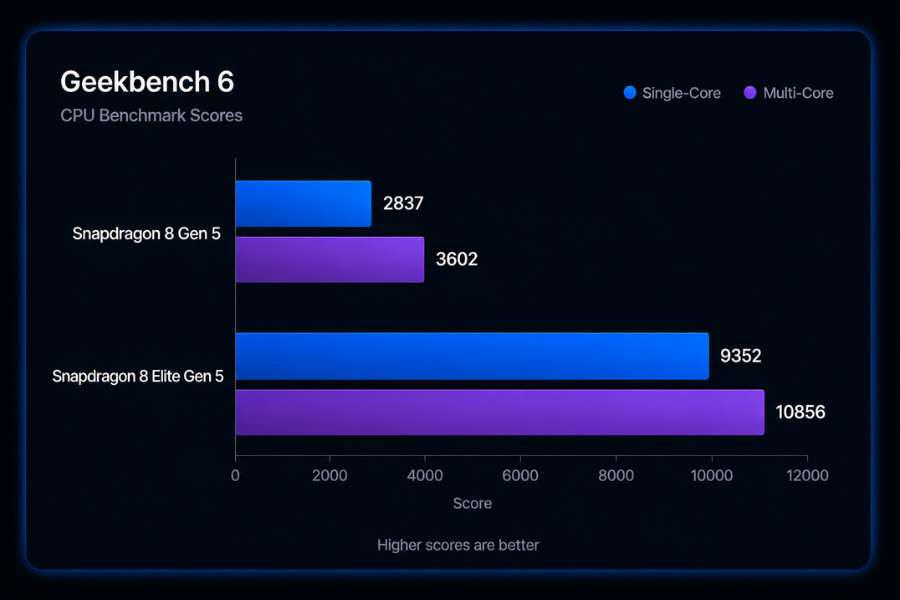
The Snapdragon 8 Gen 5-powered OnePlus 15R achieves 2837 points in the single-core test and 3602 points in the multi-core test. The OnePlus 15, powered by Snapdragon 8 Elite Gen 5, pulls ahead with much higher scores: 3602 single-core points and 10856 multi-core points.
In other words, the Snapdragon 8 Elite Gen 5 scores 26% higher in the single-core test and 16% higher in the multi-core test. This won’t show any difference in low-resource tasks, but things like gaming, video editing, and other resource-intensive tasks will see notable uplift on the 8 Elite Gen 5-powered devices.
| SD 8 Gen 5 | SD 8 Elite Gen 5 | |
|---|---|---|
| Single core | 2837 | 3602 |
| Multi core | 9352 | 10856 |
AnTuTu score
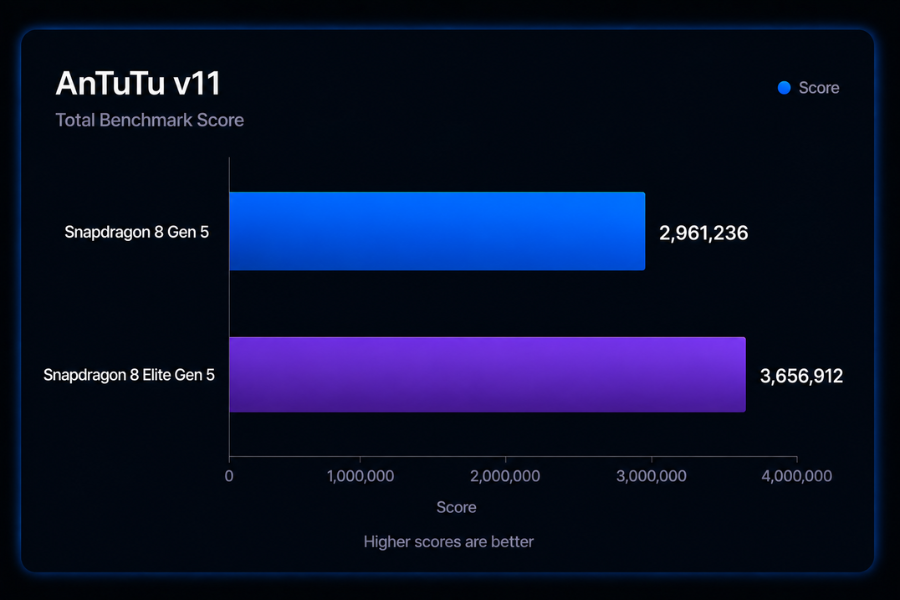
The Snapdragon 8 Gen 5 scores just below the 3 million mark on AnTuTu v11, whereas the Snapdragon 8 Elite Gen 5 pulls off well over 3.5 million points. The breakdown offers much better insights.
The Elite chipset outclasses the standard Snapdragon 8 Gen 5 across every test: the CPU score is 24% higher, the GPU score is 37% higher, the memory score is 15%, and the UX score is 7% higher.
| SD 8 Gen 5 | SD 8 Elite Gen 5 | |
| AnTuTu score | 2,961,236 | 3,656,912 |
| CPU | 914,878 | 1,135,925 |
| GPU | 974,402 | 1,335,274 |
| Memory | 382,729 | 441,695 |
| UX | 689,228 | 744,017 |
3DMark score
Wild Life Extreme Stress Test
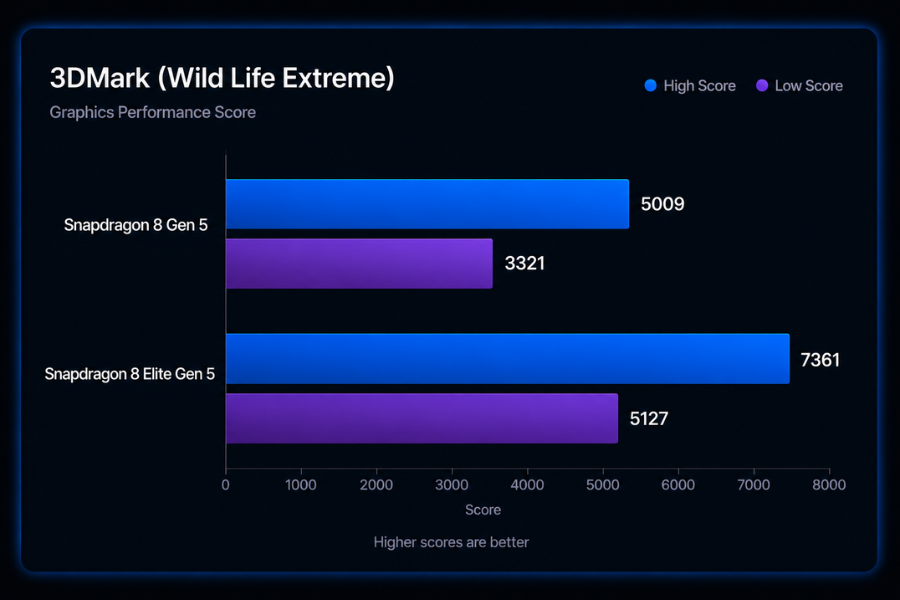
The Wild Life Extreme Stress test is specifically designed to evaluate sustained GPU performance and thermal throttling under heavy graphical loads. In our testing, the Snapdragon 8 Elite Gen 5 achieved 30% higher scores in both the best loop performance and the lowest loop performance tests. Plus, the chip delivers slightly better stability.
In simple words, the Snapdragon 8 Elite Gen 5 delivers much better peak performance than the Snapdragon 8 Gen 5. Also, the chip doesn’t throttle to the Snapdragon 8 Gen 5’s level, which means the Elite chip delivers better sustained performance.
| SD 8 Gen 5 | SD 8 Elite Gen 5 | |
| Best loop score | 5009 | 7361 |
| Lowest loop score | 3321 | 5127 |
| Stability | 66.30% | 69.65% |
Snapdragon 8 Gen 5 vs 8 Elite Gen 5: Major differences
Despite not bearing an “Elite” moniker, the Snapdragon 8 Gen 5 still features an Oryon CPU, and luckily, that’s the same CPU used in the top-tier Snapdragon 8 Elite Gen 5 chip. The CPU configuration also remains unchanged: two prime cores and six performance cores. But the Elite chips offer larger cache memory and higher CPU speeds to maintain a performance edge.
The Snapdragon 8 Gen 5 has two prime cores clocked at 3.8 GHz, while those in the 8 Elite Gen 5 can reach up to 4.61 GHz. The remaining six performance cores in the Elite chip also run at higher clock speeds (3.63 GHz vs 3.32 GHz).
The two Qualcomm chipsets have major differences in their GPUs. The Adreno 829 GPU on the Snapdragon 8 Gen 2 has two GPU slices, while the Adreno 840 on the Elite chip gets an extra GPU slice. This means the Elite chip can process 50% more graphical instructions simultaneously, and that’s why it handles ray tracing so much better.
Furthermore, the Snapdragon 8 Elite Gen 5 features 18 MB of Adreno high-performance memory (HPM) exclusively for the GPU, while the standard 8 Gen 5 chip has just 2MB of Adreno HPM. The Elite chip also benefits from an aggressive 768 MHz peak boost mode for demanding graphics sequences, while the Snapdragon 8 Gen 5 lacks any boost, capping the clock speed much lower at 384 MHz
The Snapdragon 8 Gen 5 features a Snapdragon X85 5G modem, while the Elite chipset uses a newer, more advanced X85 5G modem with higher peak speeds and more seamless multi-carrier network aggregation. The newer modem uses an updated version of Qualcomm’s communication algorithms to deliver marginally faster handover times when moving quickly between cell towers.
| Snapdragon 8 Gen 5 | Snapdragon 8 Elite Gen 5 | |
|---|---|---|
| Announced | November 2025 | September 2025 |
| Process node | TSMC’s 3nm (N3P) | TSMC’s 3nm (N3P) |
| CPU cores | 8-core | 8-core |
| CPU cores | 2 x 3.8 GHz — Oryon (3rd gen) 6 x 3.32 GHz — Oryon (3rd gen) | 2 x 4.61 GHz — Oryon (3rd gen) 6 x 3.63 GHz — Oryon (3rd gen) |
| GPU | Adreno 840 Ray tracing support Snapdragon Elite Gaming features | Adreno 840 Ray tracing support Snapdragon Elite Gaming features |
| NPU | Qualcomm Hexagon NPU Agentic AI support | Qualcomm Hexagon NPU Agentic AI support |
| Memory | LPDDR5X, up to 4.8 GHz | LPDDR5X, up to 5.3 GHz |
| Storage | UFS 4.1 | UFS 4.1 |
| Camera | Qualcomm Spectra Triple ISP (20-bit) Up to 320MP single camera up to 108MP single camera (MFNR, ZSL, 30fps) Up to 48MP triple camera (MFNR, ZSL, 30fps) Up to 8K video recording real-time semantic segmentation (limitless) | Qualcomm Spectra Triple ISP (20-bit) Up to 320MP single camera up to 108MP single camera (MFNR, ZSL, 30fps) Up to 48MP triple camera (MFNR, ZSL, 30fps) Up to 8K video recording real-time semantic segmentation (limitless) Advanced Professional Video (APV) codec |
| Connectivity | Snapdragon X80 5G modem Download speed: 10 Gbps (peak) Upload speed: 3.5 Gbps (peak) Wi-Fi 7 (peak speed: 5.8 Gbps) Bluetooth 6.0 | Snapdragon X85 5G modem Download speed: 12.5 Gbps (peak) Upload speed: 3.7 Gbps (peak) Wi-Fi 7 (peak speed: 5.8 Gbps) Bluetooth 6.0 |
Best Snapdragon 8 Gen 5 phones:
- Vivo X300 FE (review)
- iQOO 15R (review)
- Motorola Signature
- OnePlus 15R (review)
- Motorola Edge 70 Max
Best Snapdragon 8 Elite Gen 5 phones:
- Samsung Galaxy S26 Ultra
- Oppo Find X9 Ultra
- Vivo X300 Ultra
- Samsung Galaxy Z Fold 8
- OnePlus 15


Comments