
Add GIZMOCHINA as Preferred Source on Google
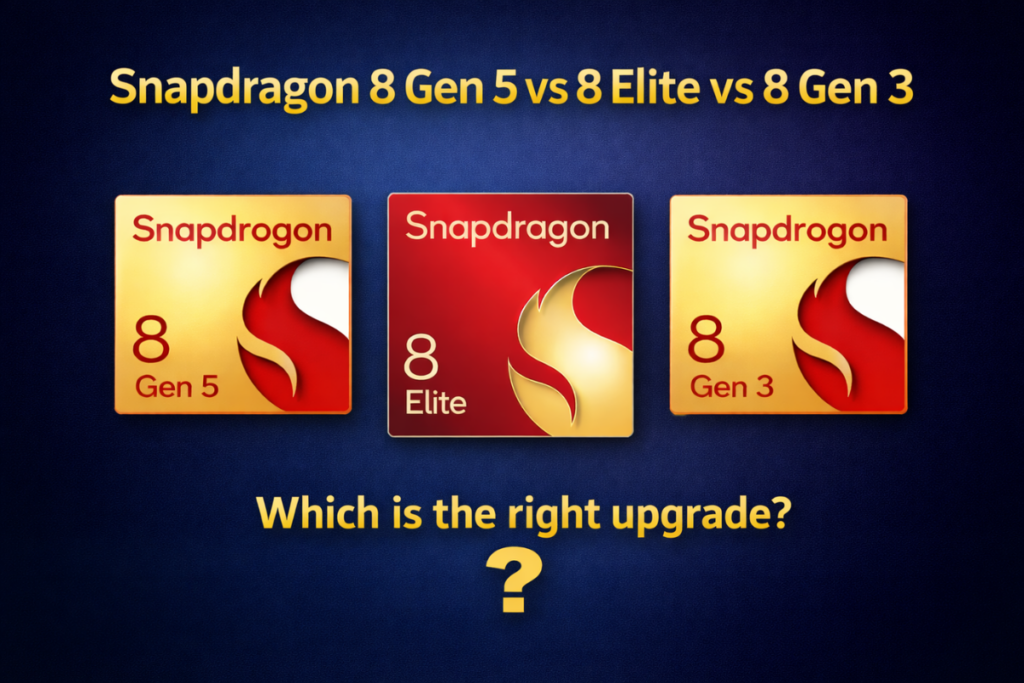
The Snapdragon 8-series naming scheme has become increasingly confusing, and the Snapdragon 8 Gen 5’s arrival has only added to the chaos. Therefore, understanding the correct order of Qualcomm’s flagship chipsets is now more important than ever, as the naming alone can easily lead buyers to the wrong conclusion.
Take the Snapdragon 8 Gen 5, for example: at first glance, it may seem superior to both the original 8 Elite and 8 Gen 3, but that’s not entirely accurate. To make sense of where each 8-series chip truly stands, it’s necessary to understand Qualcomm’s recent naming decisions.
Qualcomm’s naming scheme explained
Until the Snapdragon 8 Gen 3, Qualcomm’s naming scheme for the Snapdragon 8-series was crystal clear. The 8 Gen 1 arrived, followed by the 8 Gen 2, and then the 8 Gen 3. However, the arrival of the Snapdragon 8 Elite in October 2024 created considerable confusion.
The tech community anticipated 8 Elite’s successor to be called “Snapdragon 8 Elite Gen 2,” but instead, Qualcomm labelled it as “Snapdragon 8 Elite Gen 5,” which made it appear as though several generations were skipped. Even folks in the tech industry were surprised by Qualcomm’s naming decisions. Then came the Snapdragon 8 Gen 5 in November, with no 8 Gen 4 already in the lineup.
Qualcomm anticipated the confusion and explained the naming scheme in a detailed blog post before even announcing the 8 Gen 5 chipset. The short takeaway: Snapdragon 8 Elite is actually the fourth generation of the premium 8-series platforms. The Snapdragon 8 Elite Gen 5 is the true fifth-generation chip, and just two months later, the 8 Gen 5 arrived as a slightly toned-down but still very much capable flagship-grade chipset.
With excellent performance and upgraded chip advancements, the 8 Gen 5 is almost a no-brainer upgrade for the 8 Gen 3 users, but pointless for the original Elite users. Let’s take a closer look at the benchmark scores and key differences to see how wide those gaps actually are.
| Snapdragon 8 Gen 5 | Snapdragon 8 Elite | Snapdragon 8 Gen 3 | |
|---|---|---|---|
| Announced | November 2025 | October 2024 | October 2023 |
| Process node | TSMC’s 3nm (N3P) | TSMC’s 3nm (N3E) | TSMC’s 4nm (N4P) |
| CPU | 2 x 3.8 GHz — Oryon (3rd gen) 6 x 3.32 GHz — Oryon (3rd gen) | 2 x 4.32 GHz — Oryon (2rd gen) 6 x 3.53 GHz — Oryon (2rd gen) | 1 x 3.3 GHz — Cortex-X4 3 x 3.15 GHz — Cortex-A720 2 x 2.96 GHz — Cortex-A720 2 x 2.27 GHz — Cortex-A520 |
| GPU | Adreno 829 ray tracing support Snapdragon Elite Gaming features | Adreno 830 ray tracing support Snapdragon Elite Gaming features | Adreno 750 ray tacing support Snapdragon Elite Gaming features |
| NPU | Qualcomm Hexagon NPU agentic AI support | Qualcomm Hexagon NPU | Qualcomm Hexagon NPU |
| Memory | LPDDR5x, up to 4.8 GHz | LPDDR5x, up to 5.3 GHz | LPDDR5x, up to 4.8 GHz |
| Storage | UFS 4.1 | UFS 4.0 | UFS 4.0 |
| Camera | Qualcomm Spectra triple AI ISP (20-bit) up to 320MP single camera up to 108MP single camera with zero shutter lag up to 48MP triple cameras with zero shutter lag real-time semantic segmentation (limitless) 4K/120fps video recording 1080p/480fps slow-mo video recording | Qualcomm Spectra triple AI ISP (18-bit) up to 320MP single camera up to 108MP single camera with zero shutter lag up to 48MP triple cameras with zero shutter lag real-time semantic segmentation (limitless) 8K/30fps video recording 1080p/480fps slow-mo video recording | Quacomm Spectra triple AI ISP (18-bit) up to 200MP single camera up to 108MP single camera with zero shutter lag up to 36MP triple cameras with zero shutter lag real-time semantic segmentation (up to 12 layers) 8K/30fps or 4K/120fps video recording 720p/960fps slow-mo video recording |
| Connectivity | Snapdragon X80 5G modem download speed: 10 Gbps (peak) upload speed: 3.5 Gbps (peak) Wi-Fi 7 (peak speed: 5.8 Gbps) Bluetooth 6.0 | Snapdragon X80 5G modem download speed: 10 Gbps (peak) upload speed: 3.5 Gbps (peak) Wi-Fi 7 (peak speed: 5.8 Gbps) Bluetooth 6.0 | Snapdragon X75 5G modem Download speed: 10 Gbps (peak) Upload speed: 3.5 Gbps (peak) Wi-Fi 7 (peak speed: 5.8 Gbps) Bluetooth 5.4 |
Snapdragon 8 Gen 5 vs 8 Elite vs 8 Gen 3: Benchmark score
Note: The benchmark tests were performed on the OnePlus 15R (Snapdragon 8 Gen 5), OnePlus 13 (Snapdragon 8 Elite), and OnePlus 13R (Snapdragon 8 Gen 3).
Geekbench score

The CPU test on Geekbench 6 yields surprising results for the Snapdragon 8 Elite, surpassing the 8 Gen 5 by a wide margin in single-core performance. The 8 Gen 5 makes a comeback in the multi-core performance, although the gap is very thin.
Unsurprisingly, the Snapdragon 8 Gen 3 sits at the bottom with significantly lower single-core and multi-core scores than the other two chips featuring Oryon CPU.
| SD 8 Gen 5 | SD 8 Elite | SD 8 Gen 3 | |
| Single core | 2,837 | 3,026 | 2,243 |
| Multi core | 9,352 | 9,306 | 6,591 |
AnTuTu score

AnTuTu also favors the Snapdragon 8 Elite over the Snapdragon 8 Gen 5. The breakdown, however, shows a 6% higher CPU score for the 8 Gen 5. However, the 8 Elite comes back strongly in the GPU performance with a 12% higher score.
The Snapdragon 8 Gen 3 sits at the bottom with a total AnTuTu score of 2.27 million, whereas the Snapdragon 8 Elite almost reaches the 3 million mark, and the Snapdragon 8 Gen 5 achieves a total score of 2.96 million.
| SD 8 Gen 5 | SD 8 Elite | SD 8 Gen 3 | |
| AnTuTu score | 2,961,236 | 2,994,563 | 2,274,520 |
| CPU | 914,878 | 862,692 | 607,409 |
| GPU | 974,402 | 1,095,049 | 796,782 |
| Memory | 382,729 | 393,623 | 353,279 |
| UX | 689,228 | 643,199 | 517,050 |
From the benchmarks, it’s clear that the Snapdragon 8 Elite outperforms the Snapdragon 8 Gen 5 in several key aspects, including CPU and graphics performance. This is the reason why Qualcomm chose to compare the Snapdragon 8 Gen 5 against the 8 Gen 3, not the Snapdragon 8 Elite.
Snapdragon 8 Gen 5 vs 8 Elite vs 8 Gen 3: What’s actually different?
Manufacturing:
All three Snapdragon chips have been manufactured by TSMC, but what separates them is the process node. The 8 Gen 5 uses the advanced 3nm (N3P) node, which is slightly improved over the 3nm (N3E) node used for the 8 Elite. Both offer substantially higher performance and power efficiency over the 4nm (N4P) node used for the 8 Gen 3.
CPU:
The 8 Gen 5 and 8 Elite feature the same (2 prime cores + 6 performance cores) CPU configuration, but the 8 Gen 3 uses third-generation Oryon cores, while the 8 Elite uses a generation older CPU cores. Despite that, the 8 Elite offers higher CPU performance, thanks to higher clock speeds across all eight cores.
The Snapdragon 8 Gen 3 features ARM cores (1 x Cortex-X4, 5 x Cortex-A720, and 2 x Cortex-A520), with a peak CPU frequency capped at 3.3GHz.
GPU:
As for the graphics performance, the 8 Gen 5 features Adreno 829, which is effectively a binned version of 8 Elite Gen 5’s Adreno 840. The 8 Elite with Adreno 830 achieves a higher GPU performance with better power efficiency. That’s because of higher processing cores in the sliced architecture and higher frequency. The 8 Elite also benefits from the presence of Adreno high-performance memory (HPM), which is absent on the other two chips.
Camera:
The chips also feature different ISPs, resulting in different capabilities. For instance, the 8 Gen 5 uses a triple 20-bit AI ISP with enhanced color depth and processing capability. The 8 Elite also features an AI-integrated ISP but uses 18-bit processing. The 8 Gen 3 also features an 18-bit ISP but doesn’t bear an AI branding.
Both newer chips feature limitless semantic segmentation at 4K resolution, but not the 8 Gen 3. The latter supports this feature but can’t perform pixel-level semantic segmentation. The 8 Gen 3 also lacks advanced HDR features like the other two chips.
Connectivity:
The Snapdragon 8 Gen 5 and 8 Elite use the same Snapdragon X80 5G modem, whereas the 8 Gen 3 uses a generation older X75 5G modem. However, the maximum download and upload speeds over cellular and Wi-Fi connections remain unchanged.
The newer modems on the 8 Gen 5 and 8 Elite offer better power efficiency and reduced latency. They also get the latest Bluetooth 6.0, Snapdragon Audio Sense technology, satellite connectivity, and High Band Simultaneous (HBS) Multi-Link for simultaneous 5 GHz and 6 GHz connections. The 8 Gen 3, though still very capable, lacks these connectivity features.
Snapdragon 8 Gen 5 vs 8 Elite vs 8 Gen 3: Which is the right upgrade?
The Snapdragon 8 Gen 5 makes the most sense for buyers upgrading from the Snapdragon 8 Gen 3, offering a better ISP, improved connectivity features, and a clear performance uplift without stepping into Elite-tier territory. However, if you already own a Snapdragon 8 Elite device, the 8 Gen 5 doesn’t bring enough to the table to justify an upgrade.



Comments