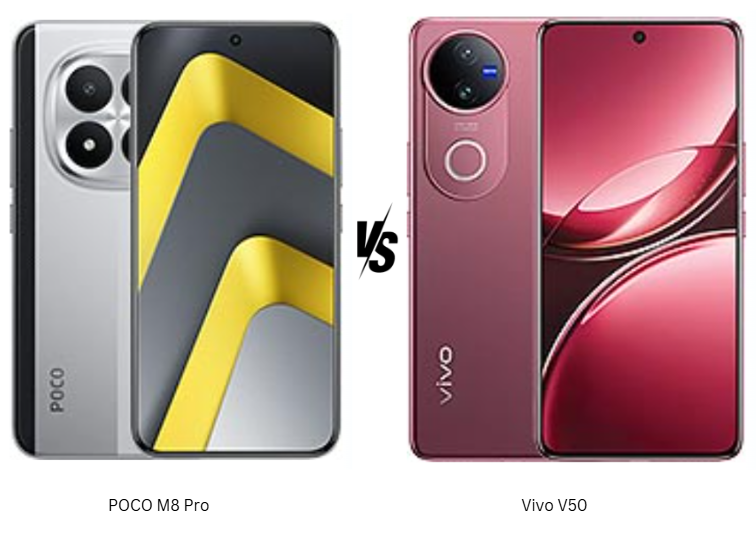
POCO M8 Pro vs Vivo V50 5G highlights how competitive the mid-range segment has become. One focuses on power, durability, and fast charging, while the other emphasizes camera quality and premium design. Both run Android 15 and promise smooth daily performance, but their priorities differ. This comparison matters because choosing between value-driven strength and refined features isn’t as straightforward as it seems.
Major Features:
Feature
POCO M8 Pro
Vivo V50 5G
Winner
Build & Protection
Gorilla Glass Victus 2, IP68/IP69K
Diamond Shield Glass, IP68/IP69
POCO – tougher glass and stronger durability focus
The POCO M8 Pro clearly prioritizes durability, with a tougher construction and stronger protection that feels built for long-term use. It gives off a solid, dependable vibe that suits users who value resilience over aesthetics. The Vivo V50 5G takes a different route, focusing on a cleaner, more refined design that feels modern and stylish. Its finish and material choices make it more visually appealing and comfortable for daily handling. The POCO feels more utilitarian, while the Vivo feels more lifestyle-oriented. Those who prefer a phone that feels reassuringly tough may lean toward POCO, while Vivo better suits users who care about elegance and design finesse.
Display Quality
Both phones feature AMOLED panels with 120Hz refresh rates and high-frequency PWM dimming. POCO adds Dolby Vision support and stronger HDR tuning, making video content feel more cinematic. Vivo counters with extremely high peak brightness and punchy color calibration that stands out in outdoor use. Vivo’s screen looks more vibrant at first glance, while POCO’s feels better tuned for extended media consumption.
Verdict
POCO M8 Pro wins on durability and cinematic display features, while Vivo V50 5G excels in refinement and visual pop.
2. Specifications
Performance
POCO M8 Pro runs on the newer Snapdragon 7s Gen 4 chipset, delivering stronger GPU performance and better stability during demanding tasks. Gaming and multitasking feel more consistent, especially over longer sessions. Vivo V50 5G’s Snapdragon 7 Gen 3 remains smooth for everyday use, social apps, and casual gaming, but it feels slightly less future-proof. Software tuning also shapes the experience. POCO’s HyperOS feels performance-focused, while Vivo’s Funtouch OS emphasizes fluid animations and camera optimizations. Overall, POCO feels more suited for power users, while Vivo prioritizes smoothness over raw output.
Battery and Charging
Battery life is strong on both devices, but POCO’s larger battery and faster charging clearly stand out. It reaches full charge noticeably quicker, making it more convenient for heavy usage days. Vivo still offers solid endurance, but its charging feels more conservative.
Verdict
POCO M8 Pro delivers better long-term performance, confidence, and charging convenience.
3. Camera
Main and Secondary Lenses
Both phones offer stabilized main cameras, but their strengths differ. POCO focuses on consistency, producing reliable images with balanced colors and good dynamic range. Its ultra-wide camera is functional but clearly secondary. Vivo V50 5G takes photography more seriously, featuring Zeiss optics, a higher-quality ultra-wide lens, and more advanced image processing. Photos from Vivo often show better color accuracy, sharper edges, and improved low-light handling. The inclusion of a color spectrum sensor adds to its photographic precision. Vivo’s camera setup feels more refined and purpose-built for photography enthusiasts.
Selfie Camera
The difference is more obvious on the front. Vivo’s high-resolution selfie camera with autofocus delivers sharper photos and cleaner video output. POCO’s selfie camera performs well for casual use but lacks the same level of detail.
Verdict
Vivo V50 5G clearly offers the superior overall camera experience, especially for selfies and content creation.
4. Pricing
The POCO M8 Pro is priced at around $300, making it a strong value-focused option. At this price, it offers excellent durability, fast charging, a large battery, and competitive performance. It feels designed to maximize hardware value, especially for users who prioritize endurance and speed over luxury touches.
The Vivo V50 5G is priced higher at approximately $350, positioning it as a more premium alternative. The extra cost reflects its stronger camera system, refined design, and polished display tuning. Vivo’s pricing makes sense for buyers who care about photography, aesthetics, and a more premium daily experience.
Verdict
POCO M8 Pro offers better raw value at a lower price, while Vivo V50 5G justifies its premium with camera quality and design refinement.
5. Conclusion
POCO M8 Pro stands out with its rugged build, advanced water resistance, large battery, and extremely fast charging. It feels engineered for users who want reliability, long battery life, and strong performance without spending extra.
Vivo V50 5G distinguishes itself with Zeiss-tuned cameras, a high-quality selfie experience, and a more elegant design. Its display brightness and camera consistency give it a strong appeal for photography lovers and style-conscious users.
Verdict
If your priority is overall value, performance longevity, durability, and faster charging, the POCO M8 Pro is the smarter pick, especially at its lower price point. However, if camera quality, design refinement, and a more premium everyday experience matter more, the Vivo V50 5G is worth the extra spend. For most users seeking a balanced all-rounder without compromises, the POCO M8 Pro edges ahead as the better overall choice.
We use cookies on our website to give you the most relevant experience by remembering your preferences and repeat visits. By clicking “Accept”, you consent to the use of ALL the cookies.
This website uses cookies to improve your experience while you navigate through the website. Out of these, the cookies that are categorized as necessary are stored on your browser as they are essential for the working of basic functionalities of the website. We also use third-party cookies that help us analyze and understand how you use this website. These cookies will be stored in your browser only with your consent. You also have the option to opt-out of these cookies. But opting out of some of these cookies may affect your browsing experience.
Necessary cookies are absolutely essential for the website to function properly. This category only includes cookies that ensures basic functionalities and security features of the website. These cookies do not store any personal information.
Any cookies that may not be particularly necessary for the website to function and is used specifically to collect user personal data via analytics, ads, other embedded contents are termed as non-necessary cookies. It is mandatory to procure user consent prior to running these cookies on your website.




Comments