As an Amazon Associate, Gizmochina earns from qualifying purchases. Links on this page may earn us a commission at no extra cost to you.
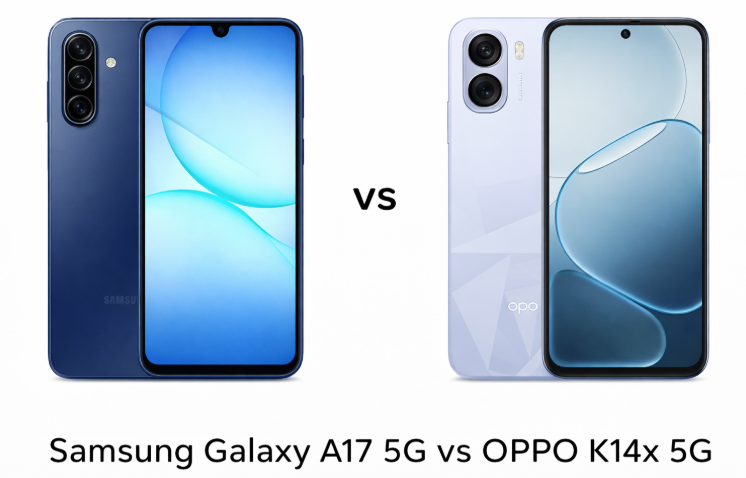
The affordable 5G segment is getting more competitive, and that’s exactly why the Samsung Galaxy A17 5G and OPPO K14x 5G are being compared. Both target buyers in the ₹15,000–₹20,000 range, but they take completely different approaches. Samsung focuses on a refined experience with a Super AMOLED display, OIS-backed camera, and long-term software support. OPPO, on the other hand, pushes aggressive value with a massive battery, faster charging, and a lower expected price.
For buyers trying to choose between display quality and battery endurance, long-term reliability and immediate power, this comparison highlights which phone truly delivers the better overall value in 2026’s crowded budget 5G market.
MajorFeatures:
Feature
Samsung Galaxy A17 5G
OPPO K14x 5G
Winner
Display Quality
6.7″ Super AMOLED, 90Hz, Full HD+ — vibrant colors, deep blacks
The Galaxy A17 5G uses Gorilla Glass Victus on the front with a fiber-reinforced plastic back and IP54 protection. It feels slightly more refined and durable for daily use. The OPPO K14x 5G offers IP64 dust-tight protection, which adds a practical edge against dust exposure. However, its plastic-heavy build makes it feel more utility-focused than premium. Samsung’s cleaner finish gives it a more polished everyday appeal.
Display Quality
Samsung features a 6.7-inch Super AMOLED panel with 90Hz refresh rate, Full HD+ resolution, and 800 nits brightness. Colors are richer, blacks are deeper, and clarity is noticeably sharper. OPPO counters with a 6.75-inch IPS LCD, 120Hz refresh rate, and higher peak brightness, but its HD+ resolution lowers overall sharpness. While OPPO feels smoother, Samsung looks more vibrant and refined.
Verdict
Samsung wins on display quality and overall visual experience, while OPPO offers better dust resistance and smoother scrolling.
2. Specifications
Performance
The Galaxy A17 5G runs on the Exynos 1330 (5nm) with up to 8GB RAM and promises six major Android upgrades. That long-term support adds serious value. The OPPO K14x 5G uses the Dimensity 6300 (6nm) with up to 6GB RAM and UFS 2.2 storage. Both are capable of daily tasks, but Samsung’s extended software support makes it feel like a safer long-term investment.
Battery and Charging
OPPO clearly focuses on endurance with a massive 6500mAh battery and 45W wired charging, plus reverse charging support. It’s built for users who hate frequent charging. Samsung offers a 5000mAh battery with 25W charging, which is reliable but not exciting. OPPO’s charging speeds and larger battery make it more future-ready.
Verdict
OPPO wins in battery and charging. Samsung holds an edge in long-term software reliability.
3. Camera
Main and Secondary Lenses
Samsung provides a 50MP main sensor with OIS, along with 5MP ultrawide and 2MP macro lenses. Optical stabilization gives it an advantage in steadier shots and low-light clarity. OPPO features a 50MP main camera and an auxiliary lens but lacks OIS. While both deliver solid daylight shots, Samsung’s OIS makes photos feel more consistent and dependable.
Selfie Camera
The Galaxy A17 5G includes a 13MP front camera capable of 1080p recording. OPPO offers a 5MP selfie camera. The resolution difference is noticeable in detail and sharpness. Samsung clearly prioritizes better front-camera performance.
Verdict
Samsung wins comfortably in overall camera versatility and selfie performance.
4. Pricing
The Galaxy A17 5G is priced at approximately $200 (₹19,500). The OPPO K14x 5G is expected to cost around $170 (₹15,000), though it has not officially been out for sale yet. OPPO undercuts Samsung in pricing while offering a larger battery and faster charging, which makes it very attractive for budget buyers.
Samsung justifies its higher price with a Super AMOLED display, OIS camera, Gorilla Glass Victus protection, NFC support (region dependent), and extended software updates. Those features make it feel more premium and future-proof.
Verdict
OPPO offers stronger value for budget-focused buyers. Samsung justifies its higher price with better display and camera hardware.
Disclaimer: Prices are approximate and may vary based on country, region, and applicable taxes.
5. Conclusion
Samsung stands out with its Super AMOLED display, OIS-enabled camera, Gorilla Glass Victus protection, NFC support, and long-term Android upgrade promise. These elements make it ideal for users prioritizing display quality and camera stability.
OPPO shines with its 6500mAh battery, 45W charging, reverse wired charging, 120Hz refresh rate, Bluetooth 5.4 with aptX HD, and a lower entry price. It feels built for heavy battery users who want maximum endurance without spending much.
Verdict
Overall, the Samsung Galaxy A17 5G stands out as the better all-around smartphone. While the OPPO K14x 5G impresses with its larger battery, faster charging, and lower expected price, Samsung delivers a more complete experience with its Super AMOLED display, OIS-backed camera system, sharper selfie performance, and long-term software support. For users wanting a balanced phone that feels more refined and future-proof, the Galaxy A17 5G is the stronger overall choice.
We use cookies on our website to give you the most relevant experience by remembering your preferences and repeat visits. By clicking “Accept”, you consent to the use of ALL the cookies.
This website uses cookies to improve your experience while you navigate through the website. Out of these, the cookies that are categorized as necessary are stored on your browser as they are essential for the working of basic functionalities of the website. We also use third-party cookies that help us analyze and understand how you use this website. These cookies will be stored in your browser only with your consent. You also have the option to opt-out of these cookies. But opting out of some of these cookies may affect your browsing experience.
Necessary cookies are absolutely essential for the website to function properly. This category only includes cookies that ensures basic functionalities and security features of the website. These cookies do not store any personal information.
Any cookies that may not be particularly necessary for the website to function and is used specifically to collect user personal data via analytics, ads, other embedded contents are termed as non-necessary cookies. It is mandatory to procure user consent prior to running these cookies on your website.



Comments