
Add GIZMOCHINA as Preferred Source on Google
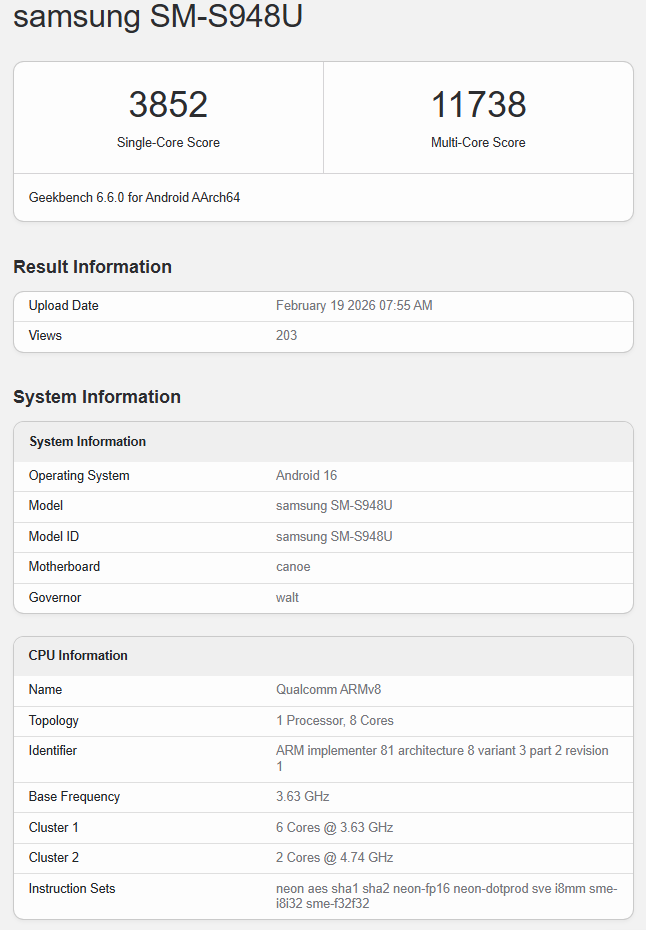
With just days to go before Samsung’s next Unpacked event, a new benchmark result for the Galaxy S26 Ultra has surfaced online, and it’s impressive.
The recent Geekbench 6 listing shows the S26 Ultra posting a single-core score of 3,852 and a multi-core score of 11,738. Samsung typically tunes its custom Snapdragon chips slightly higher than the standard versions found in other Android phones, and that “for Galaxy” tuning appears to be paying off.
A noticeable multi-core jump
The most interesting part of the leak isn’t just the raw number, it’s the gap. If we compare these results to early scores attributed to the Apple iPhone 17 Pro Max, powered by the A19 Pro, the unreleased S26 Ultra appears to have pulled ahead in multi-core performance. The iPhone’s leaked numbers hover around the high 9,000 range in multi-core testing, while the S26 Ultra is approaching 11,700. That’s a sizeable margin — roughly 19–20% in synthetic multi-core tests.
Single-core performance remains much closer, which isn’t surprising. Apple’s chips have traditionally been strong in single-threaded workloads, and the two devices are nearly neck-and-neck there. In theory, those gains should benefit multi-threaded workloads such as rendering, exporting, and intensive gaming.
Big gains over the S25 Ultra?
Compared to the Samsung Galaxy S25 Ultra, the jump is significant. The predecessor typically scored in the low 3,000s for single-core and around 9,700–10,000 in multi-core. That means the S26 Ultra could be delivering over 30% gains in multi-core performance year over year.
Of course, benchmarks only tell part of the story. Real-world performance depends on thermal management, sustained performance, GPU capability, and software optimization. A high peak score doesn’t always mean improved performance in every task.
Samsung is set to unveil the S26 lineup at its February 25 Galaxy Unpacked event, where we’ll likely get confirmation of final specs, regional chipset details, and pricing. The Ultra model is also rumored to include slightly faster wired charging, proper Qi2 support for easier alignment on a wireless charging pad, and new privacy-focused display tech, alongside incremental camera upgrades.
For now, these Geekbench scores add fuel to the pre-launch hype. We won’t have to wait long to see how it holds up outside of synthetic tests.
Stay ahead in tech! Join our Telegram community and sign up for our daily newsletter of top stories!
For more daily updates, please visit our News Section.
(Source: Geekbench)



Comments